Archive for Shortstops

Ottoneu: Jake’s Keep or Cut Decisions at MI

Lucas started off this week with a look at tough keep or cut decisions at 2B and SS. Now it’s my turn with four guys on the keep/cut bubble.

Bo Bichette, SS
Salary: $28, $34
Average Salary: $29
2024 P/G: 3.04
Projected 2025 P/G: 5.31

I’m sure I’m not the only Ottoneu player wondering what the heck to do with Bo Bichette this offseason. His 2024 season was marred by multiple calf injuries and then cut short in the middle of September by a fractured finger. Even when he was on the field, he was horrendous, posting career worsts in WAR, wRC+, batting average, OBP, slugging percentage, wOBA, and xwOBA. It would be easy to chalk up his struggles to those injuries and expect a rebound season for him in 2025, but there were already some yellow flags in his profile before this year.

Bichette’s power output has been steadily declining year-over-year since peaking at a .260 ISO during his rookie year. His 2021 breakout now seems like a distant memory after settling in with a .348 wOBA across the two years afterwards. Despite all his injury issues this year, his hard hit rate stayed relatively stable even if his barrel rate collapsed. That tells me that he had no trouble making solid contact but his batted ball profile was all out of whack. Indeed, when we look at his rate of pulled elevated contact, 2024 represented a career low for him — just 19% of his elevated contact went to his pull side. His 29 home runs in 2021 notwithstanding, Bichette isn’t a traditional slugger but pulling the ball with authority is a surefire way to generate extra-base hits. Without that power, Bichette has produced a lot more empty batting average than you’d like to see, and that type of hitter just isn’t as valuable in Ottoneu than in traditional 5×5 leagues.

Steamer isn’t exactly bought in on a full bounce back either. It’s calling for a .330 wOBA which would have been a career low for him had 2024 not happened. My rankings aren’t sure what to do with him either as they currently show him in the mid-teens at shortstop in a tier with CJ Abrams and Xavier Edwards. That feels too low based on what he’s accomplished in the past but there are just so many question marks about what his product will look like in 2025.

Keep or cut?

I think $34 is too high a price with so much uncertainty surrounding him which makes him an easy cut in that league. $28 feels like it’s right on the cusp of the cut line too, but I think I’m up for gambling at that price. I could probably get him back in the draft somewhere around that price, but I’d rather hold on to him just for the roster clarity.

Brandon Lowe, 1B/2B
Salary: $13
Average Salary: $10
2024 P/G: 4.97
Projected 2025 P/G: 5.12

Oh look, another guy who feels tricky to evaluate due to injuries. Brandon Lowe’s injury history is much more extensive than Bichette’s, but to Lowe’s credit, he’s performed decently well when on the field. This year, he actually posted his best wRC+ since his monster season in 2021, and he only had one trip to the IL for an oblique strain towards the beginning of the season. Once he returned from that injury, he posted a scorching hot 152 wRC+ over the next three months, from May 20 through August 18. Afterwards, he fell into a bit of a slump and finished the season with an overall wRC+ of 123.

His batted ball peripherals all looked good; his hard hit and barrel rates all fell within his established norms and his power production was the best it’s been since 2021. There were some yellow flags in his plate discipline, however. His walk rate had sat at 11% over the last four years but fell to just 7.8% this year. His strikeout rate fell by about a point, which is good news, but the missing free passes are a lot more concerning. It all stems from an approach that was a lot more aggressive; his overall swing rate was a career high and was largely fueled by a five point jump in his zone swing rate. Swinging at more strikes is better than swinging at pitches outside the zone, but unless it comes with a corresponding jump in contact rate, it’s going to negatively affect his walk rate. That’s exactly what happened. He swung more often, didn’t make any more contact, and wound up walking and striking out less.

Of course, the real question for Lowe is how much he’ll end up playing in 2025. Between the injuries and the Rays careful handling of him against left-handed pitching, he’s accumulated more than 450 plate appearances in exactly one season during his career. On a per-plate-appearance basis, he’s one of the most productive second basemen out there, but rostering him means you’ll need to have a backup plan ready to go for 300 or so plate appearances.

Keep or cut?

His injuries and lack of playing time have depressed Lowe’s value these past few seasons, but he can really hit when he’s healthy. Still, $13 feels like it’s a bit too high to bet on a full season from Lowe. His average salary of $10 seems like a much better ceiling.

Tyler Fitzgerald, SS/OF
Salary: $4, $7
Average Salary: $8
2024 P/G: 5.06
Projected 2025 P/G: 4.46

An absolutely ridiculous month of July fueled Tyler Fitzgerald’s surprise breakout this year. Seriously, he hit .321/.390/.849 across 15 games that month and quickly took over the starting shortstop gig for a Giants team that was going nowhere. He continued to hit well through the end of the season and is slated to begin next season as the Giants starting second baseman after they signed Willy Adames.

He was ranked 26th on the Giants preseason prospect list as a 35+ FV prospect so his ascent and subsequent breakout were genuine surprises. Looking at all of his batted ball peripherals explains why no one really believes he’ll be able to replicate his success in 2025. He had below average exit velocity, hard hit rate, whiff rate, and xwOBA and his barrel rate was only slightly above average. His sweet spot rate was very high and his sprint speed was among the highest in baseball which could explain how he sustained such a high BABIP.

Fitzgerald’s entire approach is based on pulling the ball with authority; it’s the same kind of approach that Isaac Paredes uses with such great success. Indeed, look at how correlated Fizgerald’s pull rate is with his wOBA.
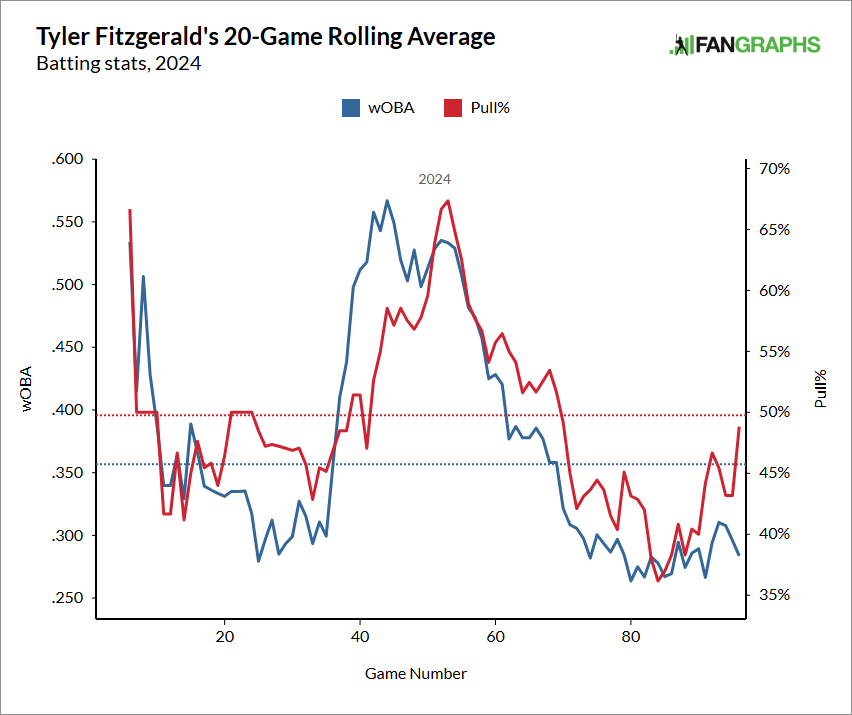
When he was crushing pitches to left field in July and August, he was a legitimate threat in San Francisco’s lineup. The issue is that this kind of approach is easily exploitable unless the batter has a good eye and can wait for the right pitch, like Paredes does. Unfortunately for Fitzgerald, he simply has too much swing-and-miss in his profile and isn’t patient enough to make his pull-happy ways work in the big leagues. My guess is that he’ll be a pretty streaky hitter in 2025, with some peaks like we saw this year, but an overall below average hitter.

Keep or cut?

Despite all the red flags laid out above, I’m not necessarily out on Fitzgerald at $4. He’ll add 2B back to his positional eligibility fairly quickly and a MI with his kind of potential for a hot streak is useful at that price. $7 feels like you’re paying for his July and August with the expectation that that hot streak is closer to his true talent and that’s just not going to be the reality.

Michael Massey, 2B
Salary: $3, $5
Average Salary: $4
2024 P/G: 3.98
Projected 2025 P/G: 4.51

I’m going to make this quick. Let’s play Chad’s favorite game: how many points did Michael Massey earn in games that he started? 4.64 points per game started! That’s a useful bench MI, and because he’s on the strong side of a platoon, it’s pretty easy to know when to lock him into your lineup or leave him on the bench. What’s funny is that even though the Royals protected him against left-handed pitching, Massey’s platoon split was just 4 points of wOBA.

Keep or cut?

I’m keeping at $3. At $5 things get a little dicey but it sounds like the Royals might be open to using Massey in the outfield now that they’ve acquired Jonathan India. Adding that positional flexibility might make him worth the extra couple of dollars.

Shortstop 2024 Fantasy Rankings

Brad Penner-USA TODAY Sports

Shortstop is shaping up nicely this winter. Even cutting the guys who are added with the 5-game eligibility threshold we’re using, there are still a lot of interesting multi-eligible studs with major upside. The next wave is already making noise with some young risers carrying massive price tags despite some clear risk while a lot of the veterans come with stable floors. There is still some uncertainty at the position that I will address with updates throughout the rest of the winter.


Changelog

  • 3/6/2024 – José Caballero & Gavin Lux added, multiple ranking updates
  • 2/22/2024 – Xander Bogaerts, Matt McLain, Tim Anderson, Gio Urshela profile and ranking updates
  • 2/15/2024 – No ranking changes, but wanted to update the ADP info
  • 1/30/2024 – Vaughn Grissom boost & write-up, Corey Seager sports hernia surgery news
  • 1/9/2024 – First Release

Ranking Methodology

  • ADP is based on 30-day rolling NFBC Draft Champions Leagues.
  • $ Values are based on standard 5×5 12-team league using the FanGraphs Depth Charts and these Auction Calculator settings. They default to a player’s most valuable position, so if the first base list includes a catcher, it will show that player’s value at catcher.
  • ADP and $ Values are updated as of the last update date on this post.
  • 5-game eligibility was used for these lists to cast the widest net.

Read the rest of this entry »


Beat the Shift Podcast – Middle Infield Preview Episode w/ Sara Sanchez

The Middle Infield Preview episode of the Beat the Shift Podcast – a baseball podcast for fantasy baseball players.

Guest: Sara Sanchez

Strategy Section

  • Risk
    • Should you minimize risk early on in drafts?
    • Should you increase risk late?
    • At what point in the draft do you worry less about risk?
    • How does league size / depth affect your risk propensity?
  • The value of player consistency
    • Head to Head formats
  • Pitchers with injury issues
    • Why do projections seem to overstate innings for risky starters?
    • Should you avoid injury risk pitchers all together?
    • Should you worry about your team’s aggregation of risky pitching?

Middle Infield

  • General player pool observations
  • Positing scarcity no longer exists
  • Which price points to play at in 2024?
  • What statistics should you get from the MI?
  • Injury Guru’s Trivia of the Week

ATC Undervalued Players

Read the rest of this entry »


Chad’s 2024 Tiered Ottoneu Rankings: Middle Infield

As we move into draft season, I will be updating these rankings occasionally, when there is news to justify changes. The original rankings will stay at the bottom of the article to maintain my player notes. The original middle infield rankings were posted 1/25 and the most recent update is 2/27.

Read the rest of this entry »


Ottoneu: Jake’s Keep or Cut Decisions at MI

Earlier this week, Lucas Kelly and Chad Young ran though their tough keep or cut decisions at middle infield for their Ottoneu teams. Now I’ll join in on the party and run through three players on my bubble and where I think the keep line could be for each of them. All P/G projections are from the 2024 Steamer projections.

Ryan McMahon 2B/3B
Salary: $6 and $10
Average Salary: $11.4
2023 P/G: 4.71
Projected 2024 P/G: 4.95

Ryan McMahon’s career trajectory has been anything but a straight line. A breakout season in 2019 was followed by an extremely disappointing pandemic-shortened season. A second breakout in 2021 made it seem like he had gotten things back on track but he took some significant steps back the next year and followed that up with another step back this year.

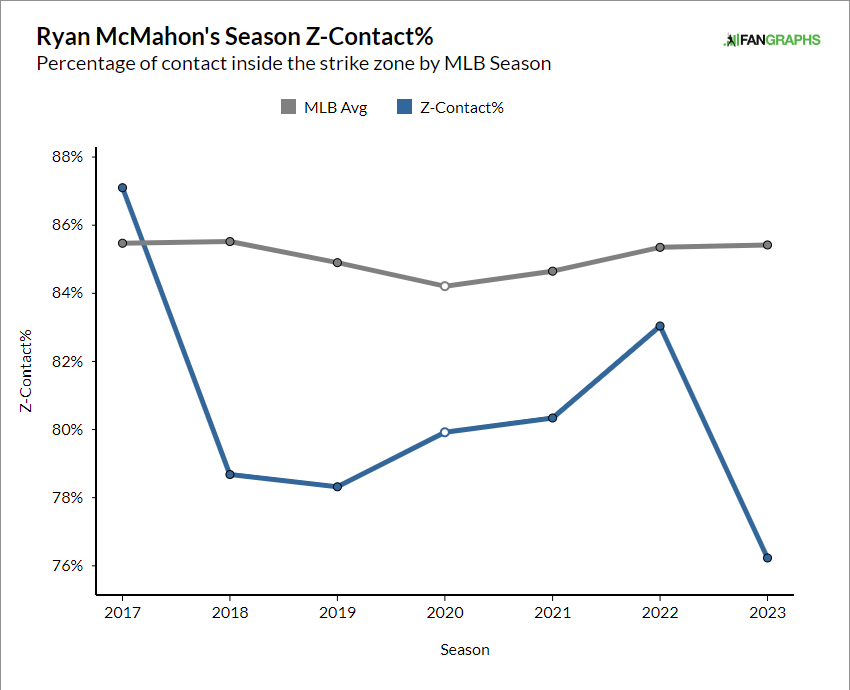
It all comes down to his strikeout rate. In 2021, he struck out a career-low 24.7% of the time while continuing to hit for power and draw a decent amount of walks. The strikeout rate stayed low last year but his power dried up a bit despite similar looking underlying batted ball peripherals. His quality of contact stayed mostly the same in 2023 — a good thing — but his strikeout rate suddenly shot back up above 30%. It’s pretty easy to see why.

His ability to make contact on pitches in the zone absolutely cratered last year. His walk rate was actually a career-high 10.8% which indicates he still had a decent idea of which pitches to swing at. Unfortunately, his ability to consistently make contact with those right pitches eluded him. For a player with his offensive profile, making the most of every single ball he puts in play is paramount, but when those below-average bat-to-ball skills take a turn for the worse, the whole house of cards collapses.

Keep or Cut?
The good news is that his quality of contact is still present. He posted career bests in barrel rate and expected wOBA this year and will continue to play in the most hitter friendly environment in baseball. His profile will always be a little risky thanks to his below average contact skills even if his power and discipline give him a solid floor in this format. Steamer projects a bit of a bounce back in his strikeout rate at the cost of some power leading to an overall wOBA right in line with what he’s done the last two years. That puts his value somewhere between $8 and $11 based on the Auction Calculator. I’m rostering him in two leagues and I’m definitely keeping him at $6. In the other league, he’s still on my bubble since that team desperately needs cap space and I’m not sure keeping McMahon at essentially market value is the best use of resources there.

Jeff McNeil 2B/OF
Salary: $8 and $13
Average Salary: $10.9
2023 P/G: 4.35
Projected 2024 P/G: 5.14

A year ago, Jeff McNeil was coming off a phenomenal season in which he won the NL batting crown, was an All-Star, and received down-ballot MVP votes. Fast forward a year and McNeil’s star looks a lot less bright. It’s not hard to figure out the issue that sank his season this year: it’s all about the BABIP. In many ways, his offensive struggles this year look a lot like the mediocre season he put together in 2021. Unfortunately, there are a lot more red flags this year than there were two years ago.

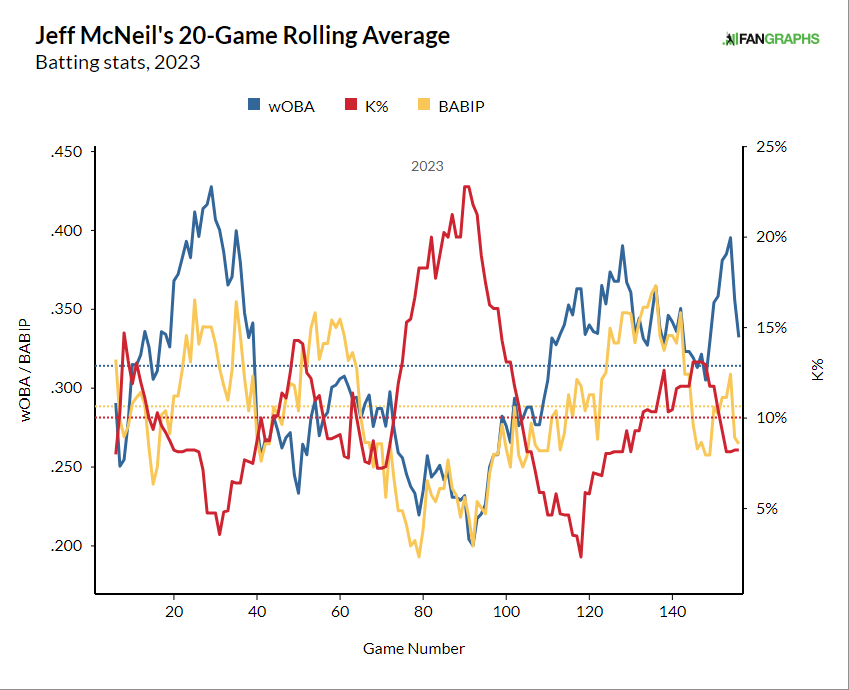
It’s important to note that McNeil’s full season stats hide the ebbs and flows of his season. He actually started off fairly strong, posting a 139 wRC+ through the first month of the season, but a prolonged summer slump dragged his production into a crater that even a late season surge couldn’t salvage.

For the most part, his wOBA followed his BABIP, which makes sense for a player so dependent on his high-contact approach. The weird thing was the gigantic spike in strikeout rate that occurred in the middle of the season. It’s almost as if he tried to swing his way out of his slump which only exacerbated his issues. Despite that huge mountain of strikeouts during the summer, his overall strikeout rate ended up at nearly a career-low by the end of the season. His ability to make contact isn’t in question.

I am a little more worried about his quality of contact. McNeil has never really hit the ball all that hard, relying instead on an ability to spray his contact from line to line while never really producing all that much weak contact. Unfortunately, his hard hit rate fell three points to 27% and his sweet spot rate dropped seven points to 32.1%. It all culminated in a ghastly .281 expected wOBA on contact, easily a career-worst for him and one of the worst marks in baseball among qualified batters. For a batter who relies so heavily on putting the ball in play, to have such a dramatic drop in contact quality is a serious red flag.

Keep or Cut?
McNeil now has almost 2700 career plate appearances with a .346 wOBA and Steamer projected a nice bounce back from him in 2024. Still, the drop in contact quality is a big concern which clouds his future a bit. During his down year in 2021, his hard hit and sweet spot rates were right in line with his career norms indicating that much of his struggles were simply rooted in bad batted ball luck; that’s not the case this year. Despite his up-and-down year, he was still worth $8 according to the Auction Calculator in 2023. Like McMahon, I’m rostering McNeil in two leagues and one is priced as an easy keep ($8) and the other puts him on the bubble ($13). There is certainly a universe where McNeil returns that higher value or even more but it now feels a little more risky than it did a year ago.

Carlos Correa SS
Salary: $27
Average Salary: $27.4
2023 P/G: 4.45
Projected 2024 P/G: 5.40

A year ago, if you told me I had the option of keeping a $27 Carlos Correa, it would have been a no-brainer decision. One season long bout with Plantar Fasciitis has completely changed his fortunes. Health has always been an issue with Correa; he’s topped 150 games played in a season just once back in 2016 and has had major IL stints for a variety of ailments in nearly every other season. The production is obviously elite when he’s on the field, but you have to bake in some risk that he’ll miss significant time each season into your evaluation calculus.

While his foot injury sapped a lot of his power, he also underperformed many of his underlying metrics based on his batted ball quality. His hard hit and barrel rates were right in line with his career norms, but all of his expected stats outpaced what he actually produced at the plate this year and his BABIP fell from .339 to .272. That one-two punch of bad luck combined with bad health meant that he was a shell of his normal self in 2023.

The amount you value Correa in 2024 seems entirely dependent on how much you think he’ll play. If you believe he’ll be healthy and ready to play a full season, a $27 salary could be close to market value with the potential of becoming a steal if Correa is truly firing on all cylinders. As it is, $27 feels like too much of a risk for a player who had yet to prove he can stay on the field for an entire season.

Keep or Cut?
The team that has to make a decision about Correa also has Gunnar Henderson to cover shortstop if I end up cutting the former. Steamer projects a pretty significant bounce back campaign for Correa next year and the projection even accounts for around 20 games missed next year. Because I have Henderson to step into the full-time shortstop role and they’re priced around the same, I’ll be cutting Correa in favor of the younger option.


Ottoneu: Chad’s Keep or Cut Decisions at MI

Yesterday, Lucas Kelly went through some tough keep or cut decisions at for his Ottoneu teams. Today, I’ll do the same. Before diving in, I’ll note that Lucas and I have slightly different values on middle infield.

Read the rest of this entry »


Ottoneu: Lucas’s Keep or Cut Decisions at MI

Last week I tried to create benchmarks for what should be considered a replacement-level player in a few of my FanGraphs points leagues. Here’s what I came up with for middle-infield players:

2B Replacement Level: 3.71 P/G
SS Replacement Level: 3.51 P/G

The actual MI position is a tricky one to nail down, so I’ll just separate the two positions out for now. This replacement level mark is not an exact science. Maybe your league mates have been stock-piling shortstops for some reason and that would change the way you calculate a replacement-level player. Regardless, if you have a sense of what kind of player you can typically find on the waiver wire throughout the season, you can make decisions on whether a player is worth keeping in 2024 or not. With that in mind, let’s take a look at a few of my middle-infielders and analyze their keepworthiness for 2024.

Tommy Edman, 2B/SS/OF
Salary: $11.00
Average Salary: $11.98
2023 P/G: 4.17
Proj 2024 P/G: 4.50

Edman’s projected 4.50 P/G according to Steamer places him in Tier 5 among all players who played in over 75 games last season. Steamer expects Edman to take a step forward in 2024, increasing his P/G mark by over 0.30 P/G. What’s the reason for that? Well, his BABIP was at a career-low .248 in 2023 and Steamer took notice, bumping it up to .264 in 2024, which is aiding increases in his slash line:

2023: .248/.307/.399
2024: .264/.321/.407 (PROJ)

Though Edman did lose some time to injury in 2023, he still reached 528 plate appearances. Steamer has bumped that up to 536 in 2024 and FanGraphs Depth Charts is even higher at 581. No one seems too concerned that Richie Palacios will be taking over either 2B or SS playing time from Edman in 2024. Unless something unexpected happens this offseason, Edman seems like a very good lock at everyday SS. Edman’s speed is still an asset and though FanGraphs points leagues reward power and slugging percentage more, speed still plays and I’m banking on a positive hitting regression for Edman.

Keep or Cut?
I am keeping for 2024. If I were rostering him for $12, I would cut him and take my chances trying to get him back for less at the auction. Cuts have not been made in this league yet, and when I look at the players who are not rostered at the 2B/SS positions who played more than 75 games in 2023, the best I can find is 4.35 P/G (Jeff McNeil). That makes me feel pretty good about where I’ve set the replacement level considering McNeil ended the year on the IL.

Andrés Giménez, 2B
Average Salary: $9.11
Salary: $6.00
2023 P/G: 4.39
Proj 2024 P/G: 5.15

Giménez’s slash line took a hit in 2023 compared to 2022:

2022: .297/.371/.466
2023: .251/.314/.399
2024: .265/.328/.427 (PROJ)

If that’s not an example of a projection system regressing to the mean then I don’t know what is. It would be easy to say that he was BABIP’d in 2023 (.289) and move on. But Giménez is still only 25 years old and I do think there is another gear in his game. His power skills took a hit in 2023, but he played in a career-high 153 games. Could there be an aspect of fatigue involved? Take a look at some of his power skills between 2022 and 2023:

Barrel% 2022: 6.2 -> 2023: 5.5
HardHit% (Statcast) 2022: 37.6 -> 2023: 27.0
xwOBA 2022: .326 -> 2023: .300
EV: 2022: 87.8 -> 2023: 84.8
MaxEV 2022: 109.9 -> 2023: 108.8

He also started to pull the ball more with less power:

Andres Giminez (HH%, FB%, Pull%)

There is a disagreement between his statcast HardHit% and his SportsInfo measurements. Regardless of which you believe in more, the bump in 1% in the graph would need to be a whole lot higher in order for the pull-the-ball-in-the-air approach to help Giménez’s power. Though the table below is not adjusted for batted ball events, it does indicate that Giménez is generating the most power from line drives:

Andrés Giménez .wOBA by Batted Ball Type
Pull Center Oppo
GB .190 .190 .332
LD .920 .642 .549
FB .784 .168 .097

He seems to find himself in this place where he needs to add a little more power to his pull-the-ball-in-the-air approach, or he needs to simply focus on making hard contact and plate discipline to increase his BB%. His 30 stolen base potential is at risk and declines further from the .314 OBP he showed in 2023.

Keep or Cut?
Last season’s 4.39 P/G was well above what I’ve marked as replacement level (3.71 P/G) and Steamer likes a positive regression in 2024. The upside is there, stolen base potential and perhaps he finds a way to add power to his new approach. If not, and he reverts back to a harder-hit ball, not in the air, then I still like what he did in 2022. Most second basemen with over 75 games in 2023 at 5.00 P/G were rostered, on average, between $5-$12. I’m keeping anywhere below $8 and might even go a few dollars higher.

Brice Turang, 2B/SS
Average Salary: $4.30
Salary: $3.00
2023 P/G: 2.51
Proj 2024 P/G: 3.87

Turang’s projection places him above the replacement level at 2B in 2024, but just barely. He came very close to a full season in 2023, playing 126 games and recording 546 plate appearances. Steamer projects a step forward when looking at his slash line:

2023: .218/.285/.300

2024: .246/.319/.370 (PROJ)

Steamer also thinks his six home runs and 26 stolen bases will turn into 10 home runs and 20 stolen bases next season. Turang is not being rostered in Ottoneu leagues due to his ability to provide a P/G mark above that of any replacement-level player. Managers are rostering for his future value and upside potential. The question is, will it come? For now, he seems good enough defensively to stay in the 2B position, and depending on what happens to shortstop Willy Adames in 2025 when he hits free agency, it could be a few more seasons before we really get a sense of what Turang will become. His contact rates from 2023 looked a little troublesome and he really struggled to hit the fastball. While rookies walked 8.1% and struck out 25.8% of the time in 2023, Turang did better, walking 8.5% of the time and striking out 21.0% of the time. However, he did not hit the ball hard very often, only barreling the ball 2.9% of the time. The league average among rookies is 7.6%.

Keep or Cut?
This is my last season holding Turang for upside and it might not last long. He hasn’t shown the skills necessary to be a rosterable hitter, yet. That is in a points format, however. Any player who can hit 10 home runs and steal 20 bases at a very low price should probably be rostered in roto formats. In points formats, anything over $3 is a cut for me.

Jonathan India, 2B
Average Salary: $12.13
Salary: $16.00
2023 P/G: 5.20
Proj 2024 P/G: 5.23

India found himself in Jeff Zimmerman’s “Hitters Who Played Through a 2023 Injury” report at the end of the season, but the difference between his projected OPS and final OPS was a tiny .003. Regardless, Zimmerman’s research has determined a decline in performance while players play through injury, and with an injury like plantar fasciitis, the one India suffered through in 2023, you can hope that India will improve with health in 2024. Even with the injury, he was above replacement. Players who earned around the 5.0 P/G mark in 2023 with over 75 games have an average salary between $5-$14.

In 2023, India’s BB% increased, his K% decreased, but his overall slash line declined, except for SLG. His wOBA was also up over his 2022 mark. His BABIP was at a career low, .281. His power metrics and batted ball profile have roughly stayed the same, but he’s hitting the ball in the air more. The problem is that his fly ball increases did not correspond with his power increases throughout the season:

Jonathan India Rolling Chart

His swing percentages tell a story, I’m just not sure what the story is. It looks as if his swing decisions have improved. He has swung outside of the zone less often, swung inside the zone more often, and become more selective overall. None of that really helped against left-handed pitchers, though, he hit .207 against them. That’s the second-worst mark in front of Alan Trejo among second basemen with at least 100 plate appearances against lefties. That’s worrisome when you look at the Reds RosterResource page and see India lined up in the DH spot. He feels dangerously close to finding himself platooned.

Keep or Cut?
I think the $10 or $11 dollar mark is appropriate. Anything over $12 feels like a cut.


3 Breakout Shortstops for 2023

Joe Camporeale-USA TODAY Sports

As I did in the 1B piece, I’ll ask that we not get too hung up on the actual phrasing of “breakout” as at least one of these selections has undoubtedly broken out before so it’s almost a re-breakout that I have them doing in 2023. These are guys I like above their market price and have them easily outperforming their draft cost. I understand that a “breakout” is more a first time thing, but they aren’t necessarily “sleepers” (although there is usually at least one guy in each of these pieces that is more deep league-friendly), either, so I chose the better of the two words.

Read the rest of this entry »


Jake Mailhot’s 2023 Ottoneu Shortstop Rankings

After running through the second base rankings, we turn our attention to the other up-the-middle position: shortstop.

Jake Mailhot’s Ottoneu Position Rankings: C | 1B | 2B | SS | 3B | OF | SP | RP
Chad Young’s Ottoneu Position Rankings: C | 1B | 2B | SS | 3B | OF | SP | RP

I really like the format of Chad’s ranking so I’ll try and emulate them a bit here. Here are few more notes about my process:

  1. Tiers > Ranks. While these players will all be technically ranked ordinally, the tier they’re placed in really matters. The order within the tiers doesn’t matter as much, though that isn’t to imply that the players within each tier are interchangeable either.
  2. Projected points. I’ve been building my own homebrewed projections for the past decade plus, ever since I started playing Ottoneu, and they form the basis for the rankings below. They’re nothing overly complicated; essentially just a MARCEL-esque projection using three years of historical data filtered through a rough aging curve and adjusted for the current run environment. I also include a collection of three public projection systems (ZiPS, Steamer, and PECOTA) to provide some additional context. That gives each player six data sources that form their projection.
  3. P/G vs P/PA. Points per game played is the gold standard by which you should be evaluating players in Ottoneu. I won’t argue with that. That measure does have some drawbacks, particularly for players who pinch hit, pinch run, or are used as defensive substitutions often. Those limited appearances can skew a player’s P/G lower than what they’re producing when they’re getting full-time playing time. To provide a little more context for these kinds of players, I’ve also included points per plate appearance below. That measure should give us a better idea of how a player produces no matter how he’s used by his team.
  4. Dollar amounts are pre-inflation. The dollar amounts assigned to each tier are pre-inflation but are easily adjusted for your league context.

Rather than give notes on every player like Chad, I’ll give my general thoughts on the position below and discuss a handful of players I like more or less than his rankings. Let’s get into it.

Ottoneu FanGraphs Points Shortstop Rankings
Tier Rank Player Eligibility Projected P/G Projected P/PA
$35-$40 1 Trea Turner SS 6.38 1.45
$25-$34 2 Corey Seager SS 5.93 1.36
$25-$34 3 Carlos Correa SS 5.71 1.33
$25-$34 4 Bo Bichette SS 5.69 1.33
$25-$34 5 Xander Bogaerts SS 5.57 1.33
$20-$24 6 Marcus Semien 2B/SS 5.55 1.25
$20-$24 7 Francisco Lindor SS 5.23 1.2
$20-$24 8 Gunnar Henderson SS/3B 5.45 1.28
$20-$24 9 Wander Franco SS 5.43 1.26
$15-$19 10 Andrés Giménez 2B/SS 4.83 1.26
$15-$19 11 Willy Adames SS 5.18 1.23
$15-$19 12 Tim Anderson SS 5.51 1.22
$15-$19 13 Bobby Witt Jr. SS/3B 5.18 1.21
$15-$19 14 Dansby Swanson SS 5.06 1.19
$10-$14 15 Oneil Cruz SS 5.26 1.23
$10-$14 16 Ezequiel Tovar SS 4.78 1.22
$10-$14 17 Jake Cronenworth 1B/2B/SS 4.87 1.17
$7-$9 18 Luis Urías 2B/SS/3B 4.43 1.15
$7-$9 19 Vaughn Grissom 2B/SS 4.63 1.14
$7-$9 20 Nico Hoerner SS 4.39 1.11
$4-$6 21 Jeremy Peña SS 4.36 1.07
$4-$6 22 Thairo Estrada 2B/SS/OF 4.37 1.12
$4-$6 23 Brendan Donovan 1B/2B/SS/3B/OF 4.37 1.12
$4-$6 24 Spencer Steer 1B/2B/SS/3B 4.67 1.12
$4-$6 25 Luis Rengifo 2B/SS/3B 3.97 1.02
$4-$6 26 Tommy Edman 2B/SS 4.56 1.08
$1-$3 27 Christopher Morel 2B/SS/3B/OF 4.19 1.08
$1-$3 28 Nick Gordon 2B/SS/OF 3.62 1.08
$1-$3 29 Amed Rosario SS/OF 4.48 1.07
$1-$3 30 Javier Báez SS 4.32 1.04
$1-$3 31 Oswald Peraza SS 4.35 1.04
$1-$3 32 Adalberto Mondesi SS 4.54 1.03
$1-$3 33 Ha-Seong Kim 김하성 SS/3B 3.79 1.02
$1-$3 34 Bryson Stott 2B/SS 3.78 0.99
$1-$3 35 Luis García 2B/SS 4.05 1.03
$1-$3 36 CJ Abrams 2B/SS 3.71 0.94
$1-$3 37 Rodolfo Castro 2B/SS/3B 4 1.01
$1-$3 38 Brandon Crawford SS 4.51 1.15
$1-$3 39 Dylan Moore 2B/SS/OF 3.28 1.07
$1-$3 40 Enrique Hernández 2B/SS/OF 4.43 1.06
$1-$3 41 Christian Arroyo 1B/2B/SS/3B/OF 3.91 1.11
$1-$3 42 Aledmys Díaz 1B/2B/SS/3B/OF 3.76 1
$1-$3 43 J.P. Crawford SS 4.08 0.98
$1-$3 44 Brice Turang SS 3.82 0.93
$1-$3 45 Ezequiel Duran 2B/SS/3B 4.05 0.98
$0 46 Ji Hwan Bae 2B/SS/OF 4.31 1.04
$0 47 Gabriel Arias SS/3B 3.98 0.96
$0 48 Tyler Freeman 2B/SS/3B 4.26 0.95
$0 49 Joey Wendle 2B/SS/3B 3.92 1.03
$0 50 Zach McKinstry 2B/SS/3B 3.58 1.02
$0 51 Jon Berti 2B/SS/3B/OF 3.93 1.02
$0 52 Santiago Espinal 2B/SS/3B 3.59 1
$0 53 Kyle Farmer SS/3B 3.6 0.99
$0 54 Luis Guillorme 2B/SS/3B 3.11 0.99
$0 55 David Hensley 2B/SS/3B 4.06 0.99
$0 56 Jordan Groshans SS/3B 3.69 0.91
$0 57 Vidal Bruján 2B/SS/OF 3.45 0.86
$0 58 Geraldo Perdomo SS/3B 2.44 0.72
$0 59 Edmundo Sosa SS/3B 2.86 0.99
$0 60 Harold Castro 1B/2B/SS/3B 3.34 0.98
$0 61 Eguy Rosario 2B/SS/3B 4.15 0.96
$0 62 Josh Smith SS/3B/OF 3.7 0.95
$0 63 Nick Maton 2B/SS/OF 3.61 0.95
$0 64 Miguel Rojas 1B/SS 3.57 0.94
$0 65 Elvis Andrus SS 3.55 0.94
$0 66 Willi Castro 2B/SS/OF 3.33 0.94
$0 67 Jorge Mateo SS 3.28 0.94
$0 68 José Iglesias SS 3.97 1.04
$0 69 Isiah Kiner-Falefa SS 3.69 0.92
$0 70 Mauricio Dubón 2B/SS/OF 3.02 0.92
$0 71 Nick Ahmed SS 3.58 0.91
$0 72 Paul DeJong SS 3.36 0.91
$0 73 Garrett Hampson 2B/SS/3B/OF 2.92 0.89
$0 74 Diego Castillo 2B/SS/OF 3.05 0.89
$0 75 David Fletcher 2B/SS 3.76 0.88
$0 76 Romy Gonzalez 2B/SS 3.4 0.87
$0 77 Nicky Lopez 2B/SS/3B 3.07 0.86
$0 78 Leury Garcia 2B/SS/3B/OF 2.84 0.82
$0 79 Taylor Walls 2B/SS/3B 2.57 0.75
$0 80 Nick Allen 2B/SS 2.7 0.73
$0 81 Jose Barrero SS 2.74 0.69

The talent level at shortstop feels deeper than it has in a long time. The top of the rankings are filled with established superstars and you’d do well to pick any one of those seven. Some of that depth is due to the group of young prospects who are on the verge of really establishing themselves in the big leagues. Betting on a big breakout from Gunnar Henderson, Wander Franco, Oneil Cruz, or Ezequiel Tovar presents some risk, but the rewards could be astronomical.

Once you get past the top 20 or so options, there’s a steep cliff down to the lower tiers. Like second base, these lower tiers are filled with youngsters with potential upside and flexible options eligible at multiple positions. The depth at shortstop likely means you’re filling your middle infield position with a second shortstop, unless you really want to pay for another top second baseman. However you choose to fill these three positions, you’ll want plenty of bench depth to ensure you’re hitting your games played cap for all three spots.

Two Guys I Like More than Chad
Xander Bogaerts – I have Bogaerts a tier higher than Chad and I think it all comes down to consistency. Over the last five seasons, he’s posted a 134 wRC+ with no individual season that’s diverged more than a handful of points from that five-year average. Combine that with an exemplary health history, and he’s as sure a bet to post a solid offensive season again in his new home in San Diego. He did post the lowest power output in this five-year stretch last year; his fly ball rate fell by more than five points and his barrel and hard hit rates both dropped a bit too. Despite blasting just 15 home runs, his wOBA fell by just five points from what he had posted over the last two seasons.

Dansby Swanson – There are plenty of reasons to doubt Swanson’s ability to repeat his career-year. On the surface, it looks like his success at the plate is tied to his BABIP with all the ups-and-downs that come with batted ball luck. To a certain extent, that’s true; he strikes out a bit too much making him more reliant on good outcomes when he puts the ball in play. He was able to improve his contact quality last year, posting a career-high hard hit rate while maintaining his elite barrel rate. That gives me a bit more hope that he can maintain his high BABIP while continuing to hit for power.

For the most part, Chad and I agreed on the general contours of the position so I could only find two guys who I liked enough to merit a blurb.

Three Guys I Don’t Like as Much as Chad
Oneil Cruz – I’m fully aware that I could regret putting Cruz here by the end of the season if everything works out for him. The tools are there and they’re loud. The problem for him is generating enough contact to do enough damage to buoy his high ceiling. And when he is putting the ball in play, it’s on the ground far too often for someone with his kind of power. He’s a few adjustments away from really breaking through which means there’s a ton of risk in paying up to make him your primary shortstop.

Vaughn Grissom – The Braves are set to give Grissom a long look at shortstop this year, hoping he’s the future at that position. He impressed in his initial callup to the majors last year, posting a 121 wRC+ in just over 150 plate appearances. The problem is that a lot of his success was BABIP driven with some serious red flags in his contact quality metrics. His average exit velocity and hard hit rate were both well below league average and nearly half of his batted balls were put on the ground. That’s not a great combination and indicates he could struggle to find as many hits in his first full season in the big leagues. His plate discipline looks to be in good shape — critically important for a player who skipped Triple-A altogether — so there’s a solid foundation to build from, just don’t expect a repeat of his rookie success.

Jeremy Peña – Peña had an up-and-down rookie season that ended on one hell of a high note, earning MVP honors in the ALCS and the World Series. The problem for him is his plate discipline; he has an extremely aggressive approach at the plate. When he’s making contact regularly, he’s able to put together hot streaks like he had in the playoffs, but if he’s not seeing the ball as well, he’s racking up too many strikeouts to really be all that effective. It’s a profile reminiscent of peak Javier Báez. But where Báez had enough power to offset all those strikeouts, Peña hasn’t consistently shown that level of power yet.


Shortstop ADP Market Report: 2/6/2022

As we hit the beginning of draft season, it is important to monitor where players are being drafted on a regular basis. Throughout draft season, I will be doing that work for you with regular updates on the Average Draft Position on NFBC up until Opening Day. You can read all the Market Reports here.

Read the rest of this entry »