Archive for Hitters

Batter Injuries and Future Performance

Predicting hitter injuries has been a fool’s errand for me. Besides players with chronic injuries (e.g. Albert Pujols and Ryan Braun), others and myself have made little headway in the field. With few guidelines, many fantasy analysts and owners handle hitter injuries differently. Previously, I focused on a hitter’s recent injury history. This time I attempted a different approach and used the hitter’s career IL days. In the end, I found a useful and easy to remember injury threshold.

For the study, I examined hitters from the 2010 to 2018 seasons. I have IL data going back to 2002, so I hoped the preceding eight years of data would get most of the hitter’s 2010 career total. Additionally, I needed the next season (e.g. 2019) to compare results. Additionally, I set a minimum hitting threshold (100 PA) to include at least some semi-regulars. I know I may miss a hitter who is out the whole season, but the two-week callups were diluting the results. In all, I ended up with a sample of 2365 player seasons.
Read the rest of this entry »

League-wide Batted Ball Changes

About every month, podcast mate Rob Silver pours out his undying love and affection for the Rockies Charlie Blackmon. I’m not as much of Blackmon fan but this comment got me thinking.

Blackmon definitely hit the ball harder last year but so did everyone else with MLB’s juiced ball. Even with noisy data, Rob was right and Blackmon exceeded expectations.
Read the rest of this entry »


Intentional Walk Decline: Let MLB Teams Do the Scouting

Fiddle Farts. I’ve been diving deep into my to-do list hoping for a study to verify nothing. This study was not a quick-and-easy one. I’m surprised how much can be gleaned from a small drop in a hitter’s intentional base-on-balls (IBB).

When examining intentional walks, it’s not like canoeing across a calm flat lake with no dangers. Instead, it’s more of a white water rafting with no rest or the end in sight.

Two types of hitters normally see a drop in intentional walks, great hitters on the decline and the eighth hitter in National League parks. Of the 776 intentional walks last season, 410 came from the third (104), fourth (123), and eighth (183) spots in the lineup. It’s a player pool of just the once best and now worst hitters in the league.
Read the rest of this entry »


Batted Ball Analysis: Goldy, Shaw, Moncada, & Santana

Earlier this week, I examined the batted data on four hitters and I’m diving into four more today. My goal is to see if their breakout or struggles stemmed from normal aging or swing or approach change. Sometimes the change is obvious and other times, it’s murky.

Currently, I’m using five StatCast data points per month:

  • Average Launch Angle
  • Average Exit Velocity
  • Max Exit Velocity
  • Hard Hit Launch Angle: The average launch angle for all batted balls hit over 98 mph.
  • Average Hard Hit Difference: The difference between the HHLA and the angle for the sub-98 mph hits. From yesterday’s research, hitters start to see a production decline at a 0 AHHD and it accelerates around -4.4 AHHD. Basically, the batter is trying to get too much loft and his batted balls are going for weak flyouts.

I’m plotting the best-fit curves using the LOWESS (LOcally WEighted Scatter-plot Smoother) method. The curves use the nearest data points to create a best-fit line. Additionally, I’ve weighted the curve by the monthly batted balls. These values are represented by the dot size in each graph.
Read the rest of this entry »


Batted Ball Analysis: Marte, Bell, Davis, & Ramirez

Yesterday, I introduced Hard Hit Launch Angle (HHLA) and Average Hard Hit Difference (AHHD) after reading a report from Driveline Baseball. After working my way through much of the boring but necessary background information, I’m now going to dive into some players to help explain some of their changes in production. In several cases, nothing was obvious with previous stats, but the two new measures helped a ton to explain some changes. Here is an examination of four hitters who broke out or busted last season.

For the analysis, I’m debuting new comparison graphs. They are monthly StatCast data is plotted against:

  • Average Launch Angle
  • Average Exit Velocity
  • Max Exit Velocity
  • Hard Hit Launch Angle: The average launch angle for all batted balls hit over 98 mph.
  • Average Hard Hit Difference: The difference between the HHLA and the angle for the sub-98 mph hits. From yesterday’s research, hitters start to see a production decline at a 0 AHHD and it accelerates around -4.4 AHHD. Basically, the batter is trying to get too much loft and his batted balls are going for weak flyouts.

I’m plotting the best-fit curves using the LOWESS (LOcally WEighted Scatter-plot Smoother) method. The curves use the nearest data points to create a best-fit line. Additionally, I’ve weighted the curve by the monthly batted balls. These values are represented by the dot size in each graph.

Read the rest of this entry »


A Batter’s Hard Hit Angle: Introduction

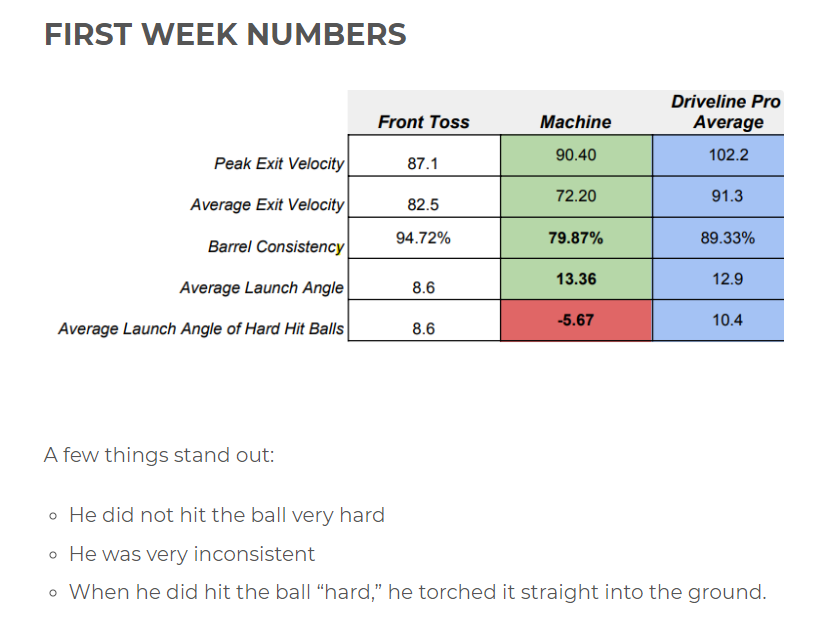
I had no idea who Dylan Moser was. In all respects to Dylan and his family, I still don’t. When I saw an article about him come through my feed, I was interested in how Tanner Stokey described Driveline Baseball’s evaluation of Moser. While Driveline has its own advocates and critics, it pushes the research bounds so I wanted to see what they considered important about Mr. Moser. Immediately, I saw this little nugget.

The “Average Hit Angle of Hard Hit Balls” caught my eye and I’ve been investigating its implications ever since.

Determining and finding the effectiveness of a hitter’s launch angle spread has been investigated several times in the past. Andrew Perpetua pointed out the importance of High Line Drives (a close cousin to Barrels) and how too much of an uppercut can hurt a player’s production. Alex Chamberlain and Brock Hammit both found a link between the standard deviation in launch angle and increased production.
Read the rest of this entry »


Potential National League DHs

With all the potential setups we’re seeing for 2020 baseball, it seems like most would benefit from having a designated hitter included for the National League. If that does come to fruition, a group of hitters will see value upticks just by virtue of getting extra playing time, but they will also benefit from not having to play defense. Let’s go west to east with our NL DH candidates for each team:

ARIZONA DIAMONDBACKS

Kevin Cron, Jake Lamb | Cron and Lamb are a righty-lefty combo that could straight up platoon as Arizona’s DH in this scenario. Cron didn’t do much in a tiny sample last year, but he did pop 6 HR and boast a .310 ISO in the 78 PA of work. Lamb is now three years removed from his 30 HR/105 RBI season, but I still think the 29-year old has big power when healthy (he just hasn’t been close to healthy since ’17). Seth Beer is the prototypical DH, but he’s not on the 40-man so I went with Cron & Lamb instead.

Read the rest of this entry »


Comparing Pitcher-Hitter Split For Various ADPs

After working my way through the first eight rounds of the website ADP draft,  some sites leaned heavy pitcher while others were drafting just hitters. Before continuing the draft, I wanted to determine the split difference for each website. The difference wasn’t as big as I thought considering the results seen to this point in the draft.

Just for reference, I used the ADP data collected at FantasyPros from ESPN, Yahoo, NFBC, CBS, FanTrax, and Real Time Sports (RTS). Next, I assumed people were drafting a 12-team league with 23 players (14 hitters, 9 pitchers) which works out to 276 players. Then, I gave each player an auction dollar amount based on their ADP. Finally, I divided them into two groups and added up their auction dollars. Here are the results
Read the rest of this entry »


Prospect Scouting & Stats — Hitter Spd – Present

As continue our look at scouting grades and stats, let’s now move along to hitter speed, represented by the Spd grade. Although there is also a Future grade, we’re not going to bother with it, as only four of 420 prospects earned a higher Future grade than Present. So all our analysis will be based on the Spd – Present (SP) grades. We’ll start by looking at correlations and grade distribution.

Read the rest of this entry »


Prospect Scouting & Stats — Hitter Hit Tool – Future

Yesterday, I listed and discussed the top 12 prospects in the Hit – Present (HP) grade. Today, let’s look toward the future, as we’ll take a gander at the top 14 in the Hit – Future (HF) grade. Since there are a whopping 42 prospects slapped with a 60 grade HF, I’m going to only include those with an FV of at least 55 in that HF tier. If the prospect also appeared on yesterday’s board, I won’t discuss him again.

Read the rest of this entry »