Archive for Featured

Intentional Walk Decline: Let MLB Teams Do the Scouting

Fiddle Farts. I’ve been diving deep into my to-do list hoping for a study to verify nothing. This study was not a quick-and-easy one. I’m surprised how much can be gleaned from a small drop in a hitter’s intentional base-on-balls (IBB).

When examining intentional walks, it’s not like canoeing across a calm flat lake with no dangers. Instead, it’s more of a white water rafting with no rest or the end in sight.

Two types of hitters normally see a drop in intentional walks, great hitters on the decline and the eighth hitter in National League parks. Of the 776 intentional walks last season, 410 came from the third (104), fourth (123), and eighth (183) spots in the lineup. It’s a player pool of just the once best and now worst hitters in the league.
Read the rest of this entry »


Reviewing My OOTP Perfect Team Set

If you’ve been reading my Texas Red Bulls OOTP series, then you’re familiar with the Perfect Team mode. Every Thursday they release new content cards available in their packs and this week they let me curate the set! Kris Jardine is the content manager for Perfect Team so I sent him an insanely extensive list of players I’d be interested in and he pared it down to these 12.

Here are the 12 players and some insight into why I chose them:

Jose Ramirez 2016 – His breakout has been really fun to follow, and this season was the taste of it with a .312/.363/.462 line, 11 HR, 22 SB, and infield/outfield eligibility having played 3B and LF. This generated a really solid silver card that will be popular in tournaments and be a staple for teams in Rookie and Stone leagues. Strong contact, gap power, and ability to avoid strikeouts should play very well.

Read the rest of this entry »


Batted Ball Analysis: Goldy, Shaw, Moncada, & Santana

Earlier this week, I examined the batted data on four hitters and I’m diving into four more today. My goal is to see if their breakout or struggles stemmed from normal aging or swing or approach change. Sometimes the change is obvious and other times, it’s murky.

Currently, I’m using five StatCast data points per month:

  • Average Launch Angle
  • Average Exit Velocity
  • Max Exit Velocity
  • Hard Hit Launch Angle: The average launch angle for all batted balls hit over 98 mph.
  • Average Hard Hit Difference: The difference between the HHLA and the angle for the sub-98 mph hits. From yesterday’s research, hitters start to see a production decline at a 0 AHHD and it accelerates around -4.4 AHHD. Basically, the batter is trying to get too much loft and his batted balls are going for weak flyouts.

I’m plotting the best-fit curves using the LOWESS (LOcally WEighted Scatter-plot Smoother) method. The curves use the nearest data points to create a best-fit line. Additionally, I’ve weighted the curve by the monthly batted balls. These values are represented by the dot size in each graph.
Read the rest of this entry »


The Sleeper and the Bust Episode: 811 – A 1999 ReDraft

05/14/20

The latest episode of “The Sleeper and the Bust” is live. Support the show by subscribing to Fangraphs! With a standard $20 membership, you help maintain and improve our database of stats and graphs as well as our staff of 8 full-time employees and over 50 contributors. The premium ad-free membership at $50 year supports site growth and also includes faster load speeds and better site performance. You can also support monthly for just $3.

Follow us on Twitter

TOPICS

  • No WBC in 2021
  • 1999 Re-Draft

Read the rest of this entry »


The Sleeper and the Bust Episode: 810 – A New Proposal and ADP Risers

05/12/20

The latest episode of “The Sleeper and the Bust” is live. Support the show by subscribing to Fangraphs! With a standard $20 membership, you help maintain and improve our database of stats and graphs as well as our staff of 8 full-time employees and over 50 contributors. The premium ad-free membership at $50 year supports site growth and also includes faster load speeds and better site performance. You can also support monthly for just $3.

Follow us on Twitter

NOTABLE TRANSACTIONS/INJURIES/RUMORS

  • Latest Season Proposal
  • 5-Round Amateur Draft

Read the rest of this entry »


Batted Ball Analysis: Marte, Bell, Davis, & Ramirez

Yesterday, I introduced Hard Hit Launch Angle (HHLA) and Average Hard Hit Difference (AHHD) after reading a report from Driveline Baseball. After working my way through much of the boring but necessary background information, I’m now going to dive into some players to help explain some of their changes in production. In several cases, nothing was obvious with previous stats, but the two new measures helped a ton to explain some changes. Here is an examination of four hitters who broke out or busted last season.

For the analysis, I’m debuting new comparison graphs. They are monthly StatCast data is plotted against:

  • Average Launch Angle
  • Average Exit Velocity
  • Max Exit Velocity
  • Hard Hit Launch Angle: The average launch angle for all batted balls hit over 98 mph.
  • Average Hard Hit Difference: The difference between the HHLA and the angle for the sub-98 mph hits. From yesterday’s research, hitters start to see a production decline at a 0 AHHD and it accelerates around -4.4 AHHD. Basically, the batter is trying to get too much loft and his batted balls are going for weak flyouts.

I’m plotting the best-fit curves using the LOWESS (LOcally WEighted Scatter-plot Smoother) method. The curves use the nearest data points to create a best-fit line. Additionally, I’ve weighted the curve by the monthly batted balls. These values are represented by the dot size in each graph.

Read the rest of this entry »


Jeff Zimmerman Fantasy Baseball Chat

3:01
Snuds: How would you attack starting pitching in a redraft AL only roto league for the short 2020 season?    Starters always go quickly

3:02
Jeff Zimmerman: Go with the high IP/S guys to get Wins and/or QS.

3:02
Jeff Zimmerman: Greinke would be a good target.

3:02
Chris: In a points league who do you like best and how would you rank Dahl, Willy Calhoun or Upton?

3:03
Jeff Zimmerman: Calhoun, Upton, Dahl

3:03
Jeff Zimmerman: I’m not a fan of Dahl because he unstartable on the road and against lefties.

Read the rest of this entry »


Texas Red Bulls: Sinking Like a Stone

In the hours after the last update, the team started to turn things around. There was a 10-2 run over a 12-game stretch, but the surge was short lived. We finished 74-88, 5th in the division and actually got demoted back to Stone Level. We had a positive run differential in that update when we were 43-53, but it evaporated as we scored 749 and allowed 780.

2026 REVIEW

The offense wasn’t too bad with the bulk of the lineup toting a wRC+ north of 100, with Joe Sewell (126) leading the club in a part-time role (352 PA). Three of the four players who logged at least 600 PA were above average: Jackie Jensen (110 in 622 PA), Jerry Mumphrey (106 in 616) and Ray Durham (109 in 611). Derrek Lee just missed with a 93 wRC+, but he led the team with 686 PA.

Read the rest of this entry »


A Batter’s Hard Hit Angle: Introduction

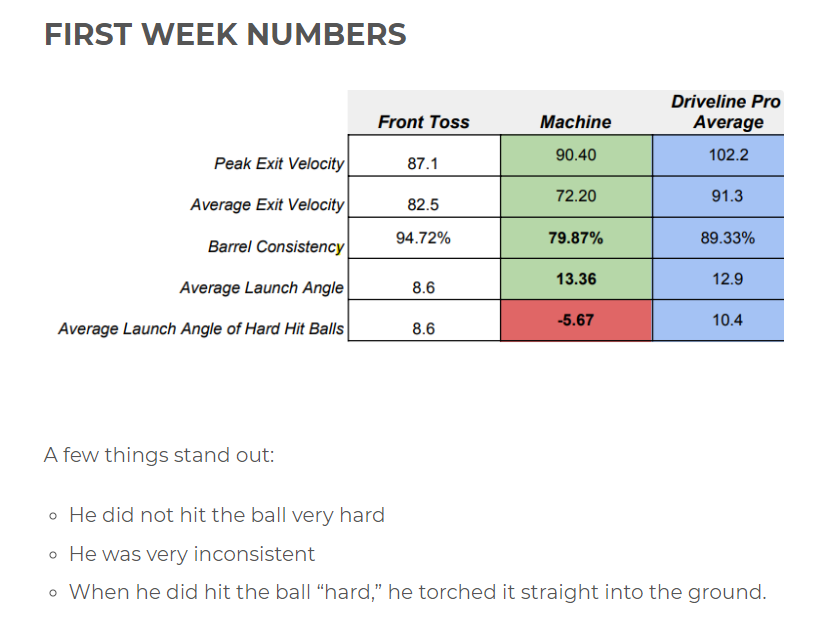
I had no idea who Dylan Moser was. In all respects to Dylan and his family, I still don’t. When I saw an article about him come through my feed, I was interested in how Tanner Stokey described Driveline Baseball’s evaluation of Moser. While Driveline has its own advocates and critics, it pushes the research bounds so I wanted to see what they considered important about Mr. Moser. Immediately, I saw this little nugget.

The “Average Hit Angle of Hard Hit Balls” caught my eye and I’ve been investigating its implications ever since.

Determining and finding the effectiveness of a hitter’s launch angle spread has been investigated several times in the past. Andrew Perpetua pointed out the importance of High Line Drives (a close cousin to Barrels) and how too much of an uppercut can hurt a player’s production. Alex Chamberlain and Brock Hammit both found a link between the standard deviation in launch angle and increased production.
Read the rest of this entry »


Innings Per Start Analysis: Fool’s Gold

For my last few articles, I’ve been focusing on how some pitcher value changes based on the innings thrown per start. Today I’m going to examine the pitchers who go long into starts but could be landmines for their owners.

Just for reminder, I’m highlighting the pitchers who go longer into games because I expect the second Spring Training to be shorter than normal. Pitchers won’t be stretched out to start the season. Also, the games will be condensed with some starters in piggy-back situations as managers need to pull out all the stops to win games. While most of the pitchers who go long into games will be helpful, I found a few starters who I can’t recommend.

The following starters are in the top-300 in NFBC ADP and the stats are combined from the past three seasons.

Length of Starts
Name G GS IP IP/G Threw 90 Pitches 100 Pitches Reached 5 IP 5 IP/G 5 IP/GS 6 IP/GS Reached 6 IP ADP
Gerrit Cole 98 98 616 6.3 93 63 95 97% 97% 79% 77 6
Jacob deGrom 95 95 622 6.6 86 70 88 93% 93% 83% 79 7
Walker Buehler 62 53 329 5.3 41 16 48 77% 91% 60% 32 12
Max Scherzer 91 91 594 6.5 84 68 86 95% 95% 85% 77 16
Justin Verlander 101 101 643 6.4 95 72 96 95% 95% 81% 82 20
Jack Flaherty 67 66 369 5.5 41 23 53 79% 80% 48% 32 22
Shane Bieber 54 52 329 6.1 40 28 48 89% 92% 71% 37 26
Mike Clevinger 80 74 448 5.6 62 41 64 80% 86% 66% 49 27
Stephen Strasburg 83 83 514 6.2 75 52 75 90% 90% 76% 63 28
Chris Sale 84 84 520 6.2 73 54 73 87% 87% 70% 59 35
Clayton Kershaw 82 81 515 6.3 59 25 75 91% 93% 86% 70 37
Luis Castillo 78 78 450 5.8 54 35 68 87% 87% 56% 44 40
Blake Snell 78 78 417 5.3 50 34 60 77% 77% 50% 39 44
Patrick Corbin 99 98 592 6.0 81 41 88 89% 90% 70% 69 45
Chris Paddack 26 26 141 5.4 11 0 20 77% 77% 38% 10 49
Lucas Giolito 68 68 395 5.8 54 35 58 85% 85% 65% 44 50
Yu Darvish 70 70 405 5.8 49 24 57 81% 81% 59% 41 53
Charlie Morton 88 88 508 5.8 63 33 78 89% 89% 60% 53 54
Aaron Nola 94 94 583 6.2 78 47 87 93% 93% 71% 67 57
Zack Greinke 98 98 619 6.3 83 39 91 93% 93% 78% 76 61
Tyler Glasnow 72 36 234 3.3 13 4 23 32% 64% 36% 13 61
Jose Berrios 90 89 538 6.0 71 36 75 83% 84% 63% 56 75
Brandon Woodruff 49 34 207 4.2 24 6 24 49% 71% 44% 15 78
Trevor Bauer 94 92 565 6.0 82 75 78 83% 85% 68% 63 80
Sonny Gray 88 81 468 5.3 51 29 64 73% 79% 56% 45 95
Frankie Montas 52 27 193 3.7 16 4 23 44% 85% 67% 18 100
Corey Kluber 69 69 454 6.6 55 36 62 90% 90% 80% 55 101
Mike Soroka 34 34 200 5.9 16 5 28 82% 82% 65% 22 104
James Paxton 81 81 447 5.5 59 39 61 75% 75% 54% 44 119
Zack Wheeler 77 77 464 6.0 64 41 67 87% 87% 69% 53 120
Lance Lynn 97 95 551 5.7 80 58 83 86% 87% 58% 55 121
Dinelson Lamet 35 35 187 5.4 17 6 29 83% 83% 40% 14 122
Zac Gallen 15 15 80 5.3 12 5 13 87% 87% 33% 5 123
Julio Urias 45 13 107 2.4 3 0 6 13% 46% 15% 2 126
Madison Bumgarner 72 72 448 6.2 59 34 69 96% 96% 79% 57 130
Max Fried 56 39 225 4.0 16 4 31 55% 79% 38% 15 135
Eduardo Rodriguez 86 81 470 5.5 69 49 71 83% 88% 53% 43 137
Carlos Carrasco 87 74 472 5.4 55 33 63 72% 85% 66% 49 139
David Price 68 63 358 5.3 45 21 52 76% 83% 59% 37 139
Hyun-Jin Ryu 69 68 392 5.7 36 14 52 75% 76% 57% 39 146
Kyle Hendricks 87 87 516 5.9 56 22 75 86% 86% 57% 50 153
Robbie Ray 85 85 460 5.4 71 41 69 81% 81% 46% 39 158
Matthew Boyd 89 88 491 5.5 67 30 69 78% 78% 59% 52 158
Kenta Maeda 105 71 413 3.9 26 9 51 49% 72% 32% 23 162
Carlos Martinez 113 50 372 3.3 41 20 44 39% 88% 64% 32 167
Lance McCullers Jr. 47 44 247 5.3 34 10 32 68% 73% 50% 22 172
German Marquez 90 90 532 5.9 65 26 76 84% 84% 64% 58 176
Mike Minor 125 60 443 3.5 50 28 54 43% 90% 62% 37 177
Ian Kennedy 115 52 337 2.9 35 17 38 33% 73% 46% 24 182
Sean Manaea 61 61 349 5.7 34 13 52 85% 85% 57% 35 183
Jake Odorizzi 90 90 467 5.2 70 36 66 73% 73% 37% 33 185
Luis Severino 66 66 397 6.0 52 34 58 88% 88% 61% 40 194
Jose Urquidy 9 7 41 4.6 1 0 4 44% 57% 43% 3 195
Luke Weaver 55 47 261 4.7 30 10 33 60% 70% 38% 18 197
Andrew Heaney 53 53 297 5.6 35 14 43 81% 81% 51% 27 202
Mike Foltynewicz 81 80 454 5.6 57 36 64 79% 80% 51% 41 204
Marcus Stroman 84 84 488 5.8 64 29 66 79% 79% 57% 48 207
Masahiro Tanaka 89 88 516 5.8 47 23 71 80% 81% 63% 55 207
Dylan Bundy 89 89 503 5.7 70 30 73 82% 82% 54% 48 213
Joe Musgrove 89 65 395 4.4 28 9 51 57% 78% 55% 36 216
Joshua James 55 4 84 1.5 1 0 3 5% 75% 0% 0 221
Mitch Keller 11 11 48 4.4 8 0 6 55% 55% 9% 1 228
Adrian Houser 42 18 125 3.0 4 0 9 21% 50% 17% 3 229
Ryan Yarbrough 66 20 289 4.4 18 4 30 45% 80% 55% 16 234
Caleb Smith 53 46 249 4.7 27 17 34 64% 74% 39% 18 234
Anthony DeSclafani 52 52 282 5.4 19 5 39 75% 75% 38% 20 247
Joey Lucchesi 56 56 294 5.2 22 7 43 77% 77% 32% 18 248
Jon Gray 77 76 433 5.6 52 21 61 79% 80% 55% 42 248
Garrett Richards 25 25 113 4.5 8 4 14 56% 56% 20% 5 248
Chris Archer 84 84 469 5.6 67 40 70 83% 83% 58% 49 251
Aaron Civale 10 10 58 5.8 4 0 9 90% 90% 60% 6 252
Alex Wood 67 59 340 5.1 27 5 49 73% 83% 56% 33 252
Sandy Alcantara 46 38 240 5.2 32 10 34 74% 89% 58% 22 266
Michael Kopech 4 4 14 3.6 0 0 1 25% 25% 25% 1 270
Yonny Chirinos 44 25 223 5.1 12 5 30 68% 80% 44% 14 274
Rich Hill 63 62 327 5.2 33 7 49 78% 79% 45% 28 277
Dylan Cease 14 14 73 5.2 12 7 12 86% 86% 43% 6 278
Steven Matz 75 73 381 5.1 45 25 54 72% 74% 47% 34 283
Dallas Keuchel 76 76 463 6.1 62 33 70 92% 92% 70% 53 286
Miles Mikolas 64 64 385 6.0 44 13 58 91% 91% 66% 42 287
Dustin May 14 4 35 2.5 2 0 4 29% 100% 0% 0 295
Jordan Montgomery 37 36 187 5.0 17 5 25 68% 69% 39% 14 296
Cole Hamels 83 83 480 5.8 66 29 69 83% 83% 60% 50 297

Here are some pitchers whose innings per start won’t be enough to help their value.

Marcus Stroman and Masahiro Tanaka: I believe both pitchers are perfectly fine to roster, but Dallas Keuchel and Miles Mikolas are going about 100 picks later and have similar projections.

Veteran Starters Comparison
Name K/9 ERA WHIP ADP
Mikolas 7.2 4.12 1.24 287
Keuchel 7.2 4.30 1.37 286
Stroman 7.3 3.80 1.31 207
Tanaka 8.0 4.45 1.26 207
SOURCE: Depth Chart Projections

If an owner needs a steady boring vet, don’t pay up and grab the last available of these four.

Sandy Alcantara: The 24-year-old righty was 17th in innings pitched last season. Even with all those innings, he had barely any value. He won just six games. He did have 151 strikeouts which were good for 57th overall. He didn’t get hit around too bad keeping his ERA under 4.00. His projections have him taking a major step backward (4.60 ERA, 1.44 WHIP) and 190 innings of his projected ratios could be devastating. I’ll let someone else handle that time bomb.

Sean Manaea: I’m a little surprised to see Manaea so high. I’ll continue to doubt him until he finds some way to stay healthy. His five September starts provided some helium, but career stats (7.3 K/9, 1.20 WHIP, and 3.77 ERA) are in line with the four aging vets profiled earlier.

Carlos Martinez: Whenever Martinez has started over the past few seasons, he’s gone long into games. The problem is that he’s just started 50 games with more games as a reliever. I have no faith he can stay healthy through a shortened 2020 season and will head to the bullpen … again. Since his role will change, it’s tough for me to invest an 11th round pick on an unknown role. At that point in the draft, I need to know if I’m adding a starter or reliever.

Corey Kluber: I just think he may be done. His Spring Training velocities have him at or under his 2019 fastball speeds. I could not find any other information from Spring Training so I decided to compare his NFBC ADP to see his draft position jumped. Maybe others knew more than I did. In February’s online championships, he averaging pick 102. It jumped to 90 in March. Owners seem to believe in as Spring Training progressed. I’m not one of them but there will be a second chance to evaluate him to see who’s right.

David Price: Part of the allure around Price is that he goes long into games to accumulate bulk strikeouts. Since he’s now on the Dodgers, I’m not sure. The Dodgers have curtailed Kershaw’s innings so they’ll do the same with Price.