Archive for STUFFF

Five Starting Pitchers Adjusting Their Pitch Mix in July and August

Kansas City Royals pitcher Noah Cameron (65) pitches during the first inning against the Detroit Tigers  at Kauffman Stadium.
Credit: William Purnell-Imagn Images

One way to identify potential pitch mix changes is to compare monthly fastball (four-seamer and sinker) usage splits to season-long averages. That helps identify which pitchers have been increasing or decreasing their fastball usage, typically in favor of other offerings.

The chart below shows the pitchers who averaged a lower fastball usage in July and August compared to their season-long average by 5 or more percentage points.

Read the rest of this entry »


Stuff and Location: Ceiling and Floor?

Credit: John E. Sokolowski-Imagn Images

Stuff and location have become key parts of pitcher analysis in recent years. It is something I have used a lot in my writing, and I believe it can be a great indicator of success when applied correctly. This can be particularly useful in fantasy when looking to identify pick-ups or diagnose regression.

The relationship between stuff and location is symbiotic, but not exactly equal. To understand this correlation, we can look at how 2026 starting pitchers have performed across metrics and what we can learn through a macro lens when building our pitching staffs across formats. In this chart, we have Stuff+ on the y-axis and Location+ on the x-axis. The higher the pitcher, the more ‘Stuff’ they have, and the further to the right of the chart they are, the better they are at locating their pitches. If you hover over or tap a dot, you can also see how many innings they pitched and their xERA for 2026.

Read the rest of this entry »


Starting Pitchers Who Lost Stuff and Command in May and June

Mandatory Credit: Steven Bisig-Imagn Images

Last week, we examined a few starting pitchers who gained stuff and command in May and June. This time, we’re looking at starting pitchers who lost stuff and command since May 1. Pitchers can go through stretches of gaining and losing stuff and command, with these metrics fluctuating over time. The visual below shows the pitchers who lost two points in their Stuff+ and Location+ since May 1.

Read the rest of this entry »


Starting Pitchers That Gained Stuff and Command in May/June

Mandatory Credit: Eric Hartline-Imagn Images

In a previous article, we looked at starting pitchers who improved or lost their stuff and command over the past two seasons. This time, we’re examining starting pitchers that gained stuff and command in May and June compared to April to identify small sample changes. Sometimes a pitcher’s stuff and command improve closer toward the career averages. However, there can notable changes in a pitcher’s location and movement profiles that impact their stuff and command grades. This may be small sample noise, but it can also represent a change. Fantasy leagues can be won by being an early mover on a player who is breaking out. We’ll examine a few starting pitchers who made improvements in their stuff and command since May 1.

Read the rest of this entry »


Three Starting Pitchers Who Lost Stuff and Command

Mandatory Credit: Nathan Ray Seebeck-Imagn Images

I’ll often wonder and speculate on what’s happening and why, without researching the idea. Somehow, most of my interesting ideas tend to happen when I’m driving or doing something where I can’t stop and research the data. One of those ideas was to examine which starting pitchers have lost stuff and command in 2026. compared to 2025. That said, here’s a look at the starting pitchers who threw 20 innings with a three-point decline (we rounded, so you’ll see a difference of 2.5 or more) in their Stuff+ and Location+ in 2026.

Though these pitchers have lower Stuff+ and Location+ grades, they might not remain that way for the rest of the season. Several of these pitchers make sense since they often relied upon command. We can toss out Cole Ragans and Garrett Crochet (injuries). Meanwhile, Freddy Peralta, Parker Messick, and Ranger Suarez have been showing above-average command numbers in both seasons.

Whenever a starting pitcher is struggling or succeeding, we want to understand the why and try to determine whether the results have been sustainable. This is a beefy one, with a deep look into three starting pitchers who lost significant stuff and command in 2026. 

Read the rest of this entry »


Stuff Wins: Revisiting the Multi-Fastball Profile

Credit: Gary A. Vasquez-Imagn Images

Beyond the Obvious Multi-Fastball Breakouts

Building on the chart we used last week to identify multi-fastball starters, some interesting names did not receive the analysis they perhaps deserved. This second piece seeks to address that, diving deeper into the names that did not fit the profiles identified in the initial piece but deserve coverage nonetheless, both from a pure baseball and fantasy perspective. Of the 38 qualified starters using a multi-fastball approach, 24 utilize a true multi-variant arsenal. The majority of these pitchers are already well known. Deep dives on Bryan Woo or Max Fried are not necessary at this point, but having covered some of the more obvious fantasy adds in part one, there was still plenty more to explore. The updated chart below reflects the latest qualified starter data, including some new names worth keeping an eye on.

Read the rest of this entry »


Do Pitchers Struggle as Their Stuff Declines?


Nathan Ray Seebeck-Imagn Images

Earlier this week on the CBS Fantasy Baseball Today podcast, Chris Towers noted that Shane McClanahan was struggling more than he would have expected, even with his STUPH model grades down. Chris wondered if a pitcher’s STUPH drops to a new level, does the pitcher perform worse than those who were already at that level? Pitchers need time to adjust to their new talent level. Well, I decided to give the question a quick look.

When McClanahan last threw back in 2023, he had a Pitching+ of 115, and now has a Pitching+ of 90. While he has the same number of strikeouts (9 K/9), the rest of his results have been horrible (5.00 ERA, 1.33 WHIP) as his walks have ballooned (5.5 BB/9). The biggest issue with analyzing this change is that it is extreme, with a two-year gap between throwing. I needed to simplify the search.

Finding a large enough sample set was a pain. The set needs to include starting pitchers (I stayed away from combining starters and relievers) with a STUPH decline into a range with a large enough sample of other pitchers already pitching in that range. And all this occurs in the few seasons that STUPH models have existed. In the end, I went with Pitching+ as my metric because I wanted the pitcher’s overall talent. Also, I wanted a quick snapshot, not a full-blown study. Future studies could use several factors.

For the sample, I took all starters with at least 40 IP in back-to-back seasons. I subdivided that group into pitchers who saw their Pitching+ drop between five and 10 points into the 95 to 105 Pitching+ range (n=26). Then I created another group of pitchers with a 97.5 to 102.5 Pitching+ range in subsequent seasons (n=37).

Here are the average values from the two samples.

Results when Pitching+ Drops and Remains Constant.
STUPH Model Previous Pitching + Pitching+ Stuff+ Location+ IP ERA FIP xFIP SIERA K/9 BB/9 WHIP
Pitching+ Decline to Range 106.8 100.2 96.7 102.8 108 4.50 4.51 4.26 4.34 8.70 3.39 1.35
Pitching + Stable in Range 100.0 100.1 97.5 102.1 125 3.86 3.97 4.07 4.15 8.45 2.84 1.24

Even though Pitching+ was the factor controlled for, both sets’ Stuff+ and Location+ values ended up similar. And that’s about it for any similarities. The declining pitchers threw fewer innings (possible injury?) with an ERA that’s 0.64 higher and a WHIP that’s 0.11 higher. These pitchers seemed to struggle at the new talent level compared to pitchers who had time to adjust to it.

The effects seen by this one small subset mean someone should dive in to verify the results. The different ways to cut up the data could be endless. Different change sizes? Include TheBot Values? Do changes in Stuff values lead to changes in Location values? After a season with worse STUPH, do the pitchers’ results improve? As long as the sample sizes remain reasonable, the combinations are endless. I’m afraid Chris opened a can of worms.



Overpaying for a Bird and a Song

Robert Edwards-Imagn Images

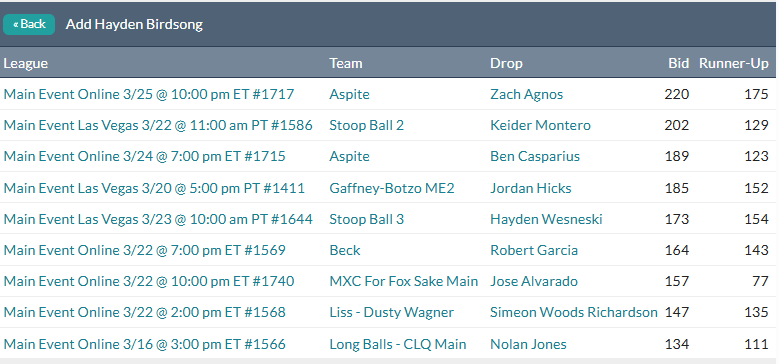
Last week, the Giants decided to move Jordan Hicks to the bullpen and Hayden Birdsong to the rotation. While some fantasy managers had already stashed Birdsong, he was available in many leagues like these nine NFBC Main Event leagues.

These teams spent 15% to 20% of their yearly budget on a starter projected to be below replacement-level. Unless a manager wore blinders or took some analyst’s hype without any doing their own basic analysis of Birdsong. No line of reasoning points to Birdsong making a difference, and the most likely scenario is that he’s on the waiver wire in a couple of weeks. Read the rest of this entry »


Linking STUFFF Changes to Fantasy Relevant Stats

I have a major love-hate relationship with the STUFFF metrics. After just a few pitches, useful information becomes available to determine if a pitcher has improved or not. On the other hand, the issue I have against STUFFF is the lack of transparency and values change as the dataset increases. With all the STUFFF talk, all I want to know is how changes in it will affect a pitcher’s fantasy-relevant stats. In my first article, I set some ERA baselines for the STUFFF values. The next step is to understand what a change in a STUFFF value has on a pitcher. For example, if I hear their Stuff+ jumps from 90 to 110, why should I care? Is the pitcher’s ERA going to drop by 1.00 or by 0.10 or not at all? I decided to just make a major data dump to have a reference when a STUFFF value does move.

Caution: The following values may or may not be predictive. They could just be descriptive. There is just not enough information (2 years of information) to run any ideal predictive test at this point, especially with STUFFF’s vagueness and everchanging nature.

Read the rest of this entry »