Author Archive

Monday Night Fantasy Baseball Chat

8:02
Jeff Zimmerman: It’s time to get started.

8:03
Isaac C: Any recommendations for first time players in the NFBC. Asking more about what’s a good level to start playing at?

8:04
Jeff Zimmerman: An online championship. The FAAB process and bi-weekly lineup setting can be learned with one.

8:04
Dragoon: 14 team dynasty points. I have an excess of 1B. Should I trade A) 5 years of Pete Alonso for 2 years of Story, 2 years of Conforto, 6 years of Tony Gonsolin B) 5 years of Pete Alonso for 1 year of Mookie, rookie roster Ian Anderson, Trevor Larnach, Astudillo or C) Hold

8:05
Jeff Zimmerman: I like A a lot.

8:05
Ned: How many plate appearances for Miguel Andujar this year?

Read the rest of this entry »


Mining the News (1/17/20)

I’m finally able to mine a few useful bits of information with players, coaches, and owners talking at Fan Fests and caravans.

• Maikel Franco played through a hand bruise last season. When I collected information on players who played through an injury, he didn’t come up. The injury happened in early August and initially, his production suffered (.572 OPS). It bounced back in September (.703 OPS) hopefully meaning it’s not major.

• Brandon Nimmo is another hitter I missed who played through an injury.

Dragging down the above numbers is Nimmo’s performance last April and May, when he played through a bulging disk in his neck.

• Also, while investigating all the hitters who played through an injury, I found this nugget on Matt Carpenter from 2017.

Carpenter sat out the Cardinals’ final three games and underwent a follow-up MRI to the one he had a month ago. The exam showed the same thing now that the doctors knew then, which is that Carpenter is dealing with inflammation and not a structural issue.

Since then, he has missed a considerable amount of time with back injuries. I just can’t pay for any kind of rebound with what seems to be a chronic injury.

Read the rest of this entry »


Should I Care About Sprint Speed?

Sprint Speed values have been publicly available for a few seasons. While I see it mentioned for this or that, I don’t know how predictive it is or if should I care about it at all. After analyzing the data, Sprint Speed might need to be ignored in favor of Time-to-First. The stopwatch still rules.

The key, in my opinion, is if the ability to run fast can be predictive in any way. No one that I know of is playing in a Sprint Score league, so the speed with have a secondary effect. If a player is running slower, do their stolen bases drop? How about how many infield hits they can leg out? Generally, how will the players change in speed affect their stolen bases and batting average.

One factor to keep in mind is that the aging curve for stolen bases is just a drop with all humans reaching their peak sprinting speed in their early 20’s.  There are going to be a lot of negative speed values coming up but that’s just aging pulling players down.

A second factor to remember is that teams are not allowing hitters to run as much. In 2015, there were over 2500 stolen bases league-wide. Last season, the value was under 2300 for a 9% decline. Again, more negative numbers.

Sprint Speed was first introduced in 2015 at Baseball Savant (links to Time-to-First values) and it is widely cited. Sprint Speed is not the only measured speed metric available. For one fewer season, Baseball Savant has each hitter’s run times to first base which have been the traditional measure of a player’s speed and it’s still used in scouting players. With the two metrics, it’s table time to what conclusions can be drawn.

Read the rest of this entry »


Should Projections for Astros Hitters be Tempered?

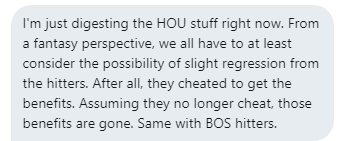
Yesterday, I noticed someone slid into my DM’s and I got my hopes up but instead I got this:

Maybe. Many of the Astros players didn’t think it helped.

Some Astros players told my investigators that they did not believe the sign-stealing scheme was effective, and it was more distracting than useful to hitters.

We just don’t know for sure of the effects of cheating so I guess I better take a stab and find out.

To start with, I went to the projection sources to find out how the projections weigh each year’s results. The weighted averages, along with some aging adjustments and regression, create the final projections. ZiPS is up first.

Dan Szymborski uses individual weightings for each component (strikeouts, doubles, etc) but at the end, the weighting is close to 8-5-4-2 where ‘8’ is the last season. According to the commissioner’s report, the Astros “only” cheated at home in 2017 so only 2 units (half of four, the third value) of the weighting will be boosted. The percentage of the projection’s input from the cheating is 10.5% (2/[8+5+4+2] or 2/19).

Read the rest of this entry »


Are Catchers a More Volatile Than Other Position Players?

How to correctly value catchers has always been up for debate. As a position, they are by far the worst hitters in the league. Last season, catchers posted a .713 OPS while second basemen were next with a .745 OPS. Most player calculations give catchers a valuation boost to attempt to even them out with the other hitters. This theoretical boost always exceeds the actual cost paid by draft picks or auction dollars. I assumed some experts knew more than me (safe bet) and the catcher projections have a wider range of outcomes. Owners don’t want to pay for these gambles. By examining historical values, I found the complete opposite. Catcher projections are the least volatile.

I’m not going to rehash why catchers need a positional adjustment. I’ve written a whole section on it in The Process. For anyone new to the subject or just wants a refresher, Ariel Cohen wrote an in-depth article on the subject.
Read the rest of this entry »


Playing Through an Injury Hurts Future Performance

I was wrong. About seven years ago, I wrote on how hitters may overperform their projections since they played through an injury. The injury hampered their production in the season in question, lowered the future projection, and created a buying opportunity. For years, I believed this steadily until last season when I re-ran the numbers and found “jack squat”.

Earlier this week, I examined some of this past season’s hitters who fought through the pain and felt a deeper analysis was needed. I dove in and the results were backwards. I found no bounceback should be expected from hitters who played through injuries, but there is more. For those hitters who play through the discomfort, their future production will take a major hit.

The key to uncovering the following results was getting a usable dataset which is easier said than done. Many of the injuries I’m using for the analysis aren’t well documented, if at all. Real men play baseball and they play hurt because that is what real men do and most importantly, they don’t complain about. Besides the machismo, a player has every right to keep his medical data to himself so vagueness thrives. Simply, there is no good available data. Even with the hurdles, I dug into each of the hitters who were reported to have played through an injury the past three seasons (2017, 2018, 2019).

Read the rest of this entry »


Projection Altering Hitter Injuries

I’ve had a semi-fixation on hitters playing through injuries and how the diminished production could hamper the next season’s projection. At first, I found some correlation. Then, I didn’t. One possible answer to there being no bounceback is that the injury becomes chronic and the hitter never improves. Or the dataset could be too small.

I want to dive further into the subject, but the information around injuries is sketchy at best. Most of the time, there are no usable details. The lack of an answer means that I should stop coming back to the subject but I’m stubborn.

Very.

I’m going to go through this past season’s hitters. The dive has a couple of goals. One is to create a better dataset for future reference. The second is to understand why some hitters may have struggled when creating a profile. And just maybe, I’ll find out if I can put to rest the notion that hitters who played through injuries are under projected.
Read the rest of this entry »


Mining the News (1/2/20)

It’s time to empty my notes and start clean for the new year. A “Mining the News” almost came out before the holiday break, so some notes are dated but still applicable.

• Nomar Mazara owners shouldn’t be counting on fulltime at-bats from him next season since he’ll likely be on the strong side of a platoon.

In 574 plate appearances against southpaws, Mazara features a below pedestrian line of .231/.272/.361 to go with 15 homers, 19 double and 68 RBIs. Manager Rick Renteria expressed hope in getting Mazara going against left-handers, but as it stands now, Mazara could get the bulk of playing time vs. righties with someone such as switching-hitting Leury García facing lefties.

Read the rest of this entry »


Keuchel & Ryu Look to Disappoint

I going to examine how both Hyun-Jin Ryu‘s and Dallas Keuchel’s fantasy value changed since both signed over the last few days.

Hyun-Jin Ryu signs with the Toronto Blue Jays

Ryu finally pieced together a great season by staying healthy and throwing more innings (182) than any time since 2013 (192). While his strikeout rate was acceptable (23%), he dominated (2.32 ERA) by walking almost no one (3%) and in the juiced ball era, he limited home runs (0.8 HR/9) with a surge in groundball rate (50%).

I hate this move for Ryu’s value with every aspect being a downgrade from the Dodgers. He moves to the AL where he’ll face a DH more often. He goes to the hyper-competitive AL East. He transitions from a pitcher’s park to one that is neutral overall but gives up more home runs than average. Finally, he goes from a nearly average defense to one in the bottom third.

Read the rest of this entry »


Gonzalez and Teheran: BABIP Masters

Most times it’s easier to get an idea of how a veteran pitcher will perform because of years of examinable data. With Gio Gonzalez and Julio Teheran, they have tons of data and each has beat their ERA estimators for years with no obvious reason why. They’ve beaten luck for years. Both are free with Teheran going with an average draft pick of 352 and Gonzalez with pick 632, so cost isn’t an issue. So is either one worth a roster spot at no cost?

Gio Gonzalez signed by Chicago White Sox

Gonzalez posted a reasonable 3.50 ERA with a 1.29 WHIP in 87 innings of work with the Brewers. He’s been able to walk the fine line walking too many hitters (3.8 BB/9 in 2019 and his career) yet limiting hard contact (0.9 HR/9 and .277 BABIP for 2019, 0.8 and .293 BABIP for his career). While he used to generate a decent number of groundballs (54% in 2015), he’s no longer on either end of the batted ball spectrum. His pitches have some batted ball split with the change and curve over 50% GB% and four-seamer at 26% GB%. The combination is nothing special to explain the difference.
Read the rest of this entry »