Archive for Starting Pitchers

Meta-Trends for 2018 Fantasy Season

This past weekend, I was in Phoenix for Baseball HQ’s First Pitch forum. It’s an intensive few days of catching up with old friends and focusing on the upcoming fantasy baseball season. There was an underlying theme of the weekend, the fantasy baseball game is being forced to change. Some game facets have experienced some massive adjustments. The following are some of the meta-trends which have quickly popped up over the past few seasons.

Home runs are way up

A few days ago I wrote the following incorrect statement about Carlos Martinez for a 2018 player preview.

His 1.19 HR/9 will likely drop back below the league average.

It was pointed out to me, his home run rate was below league average. I was for sure it was not near 1.20 but I was wrong. Here are the recent league-wide HR/9 values.

2014: 0.86
2015: 1.02
2016: 1.17
2017: 1.27

I remember when the HR/9 hovered around 1.0. Not anymore. Some other pitching stats are feeling the effects of the jump like ERA, but the root cause is more home runs.

Read the rest of this entry »


2018 Top 100 Fantasy Prospects: First Look

Happy Game 7 Day!

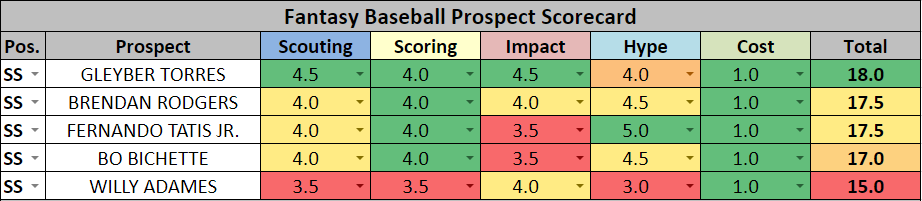
About a year ago I released my (2017) Top 50 Fantasy Prospect rankings using the Prospect Scorecard to weight a variety of important variables in the context of fantasy baseball.  Today I’m publishing an (early) expanded list of the Top 100 Fantasy Prospects for 2018 for both Ottoneu’s FanGraphs Points leagues (where wOBA is a key measure on offense) and Roto leagues (5 x 5).

A few quick notes before we begin:

  • Since “Cost” is league-dependent (auction salary, keeper round, etc.), I’ve ignored it here for simplicity by keeping it constant for every prospect listed. Feel free to use the Scorecard to make changes that reflect true player costs for your league, which will impact these rankings.
  • These rankings below are intended to represent the 100 most valuable prospects for fantasy leagues (depending on scoring format).
  • It’s quite possible I’m missing an obvious player that should be ranked, so let me know in the comments.  We can discuss the specific rationale for player rankings in the comments, too.  Player ages are current ages.
  • For a lot more prospect resources, check out the Ottoneu community.

Here are the (early) 2018 Top 100 prospects for the linear-weights-based FanGraphs Points scoring format (a good proxy for those in OBP leagues):

Read the rest of this entry »


Brewers Show Faith in Chase Anderson… And You Should, Too

Chase Anderson had shown glimpses of upside over his first three seasons as a major leaguer, during which he netted a 4.26 ERA, 1.35 WHIP, and 12% K-BB in 418.7 IP. He even caught the eye of our very own Eno Sarris, who heralded him as a solid deep league option for those first two seasons.  Unfortunately, he (Anderson, not Sarris… though Sarris has given up some bombs) had a home run issue as well (1.3 HR/9) only exacerbated by playing first in Arizona then Milwaukee.

Read the rest of this entry »


Reviewing The 2017 Starting Pitcher Walk Rate Regressers

Yesterday, I reviewed the 2017 starting pitcher walk rate improvers using my updated xBB% equation. Today, I’ll recap my walk rate regressers, which includes those starting pitchers whose actual walk rates were significantly better than their xBB% marks.

Read the rest of this entry »


Reviewing The 2017 Starting Pitcher Walk Rate Improvers

In late January, I updated my pitcher xBB% was include and additional variable, 3-0%, which is the percentage of a pitcher’s plate appearances in which a 3-0 count is seen. Since Alex Chamberlain had already published such a formula, which built upon my original equation, I simply updated the variables of his. I then used the new formula to highlight a group of starting pitchers with an xBB% significantly lower their actual 2016 marks. This group was then discussed as potential walk rate improvers in 2017. Let’s see how they did.

Read the rest of this entry »


Late-Round SP Targets – Glasnow, Gohara and Gibson

I often struggle to come up with players and topics to write about this time of year. Thankfully, colleague Justin Mason has provided me with something to piggyback off of. He’s done an awesome job rounding up participants and conducting industry mock drafts, and you can check out the ADP from those here. The ADPs will change as players change teams and roles change for individuals, but this is a great starting point. Using that data, three pitchers stood out as enticing dice rolls in the 300-plus range. Read the rest of this entry »


Early Mock Thoughts: Starting Pitcher ADP

Yesterday, the Justin Mason posted the ADP from four of the slowest drafts containing industry experts and myself. One thought I had after a handful of rounds was the lack pitching available and how the good were the available hitters. I decided to go back and examine draft results from last year and these draft to see if pitching was being taken early. While it wasn’t, some other information could be extracted.

Read the rest of this entry »


Andrew Cashner’s Strange Path to Fantasy Relevance

Andrew Cashner did not get much respect from fantasy owners this season. Given that he finished with the highest contact rate and lowest swinging strike rate for any qualified starting pitcher, it may look like he was undeserving of widespread ownership. Cashner’s 12.2 percent strikeout rate was lower than all qualifiers, except for Ty Blach, and that paucity of Ks usually doesn’t bode well for one’s fantasy value. Not only does it put an owner behind in the strikeout category, but K-rates inversely correlate with ERA.

Run prevention was not a problem for Cashner, as he ranked 15th among qualifiers with a 3.40 ERA. On the basis of that, along with 11 wins, a 1.32 WHIP and just 86 strikeouts, Cashner was a top-70 starter, both in Roto value (per ESPN’s Player Rater) and in CBS fantasy points. That may not sound like a big deal — okay, it’s not a big deal — but it does mean that Cashner was more valuable than several more popular starters. For example, the 31-year-old outearned Tanner Roark, John Lackey and Sean Manaea in Roto value and amassed more CBS fantasy points than Taijuan Walker.
Read the rest of this entry »


World Series Game 1 SP Matchup Notes

Here is a look at some of the performance data for each team based on tonight’s matchup: Dallas Keuchel v. Clayton Kershaw. Links to the data where available.

The Dodgers v. Dallas Keuchel

  • After a disastrous year vs. lefties in 2016 where they finished dead last in wOBA (.275) with a 22.4% K rate (13th-highest), they’ve soared to 5th in wOBA (.337) while standing pat in K rate at 22.3% (10th-highest).
  • They’re 12th in wOBA (.281) against lefty sliders, Keuchel’s most-used secondary pitch (19%).
  • They’re 6th in wOBA (.334) against lefty changeups, Keuchel’s best secondary by pitch value (6) which he used 13% of the time.

Read the rest of this entry »


2017 pERA Update With Exit Velocity Grades

Last offseason, I created an individual pitch metric, pERA, which gives each pitch an ERA and prospect grade based on its ground ball nature and swing-and-miss capability. With the 2017 season over, I’ve compiled the final 2017 values. This year, I’ve added in exit velocity (EV) grades for each pitch.

The process I used for creating pERA is in the article linked above but here is a quick rundown.

  • The key change is to give each pitch an ERA value (pERA) based on the pitch’s swinging strike and groundball rate. All the values are based on the average values for starting pitchers. Closers will have higher grades because their stuff plays better coming out of the bullpen.
  • The pitcher’s control is determined from their walk rate which is separate from the pitch grades.
  • I’ve put each pitch on the 20-80 scale with 50 being average, 80 great, and 20 horrible. For starters, target pitchers with three average or better pitches. For relievers, they just need two pitches.

Read the rest of this entry »