Archive for Projections

2019 Fantasy Baseball Profitability By Team

Introduction

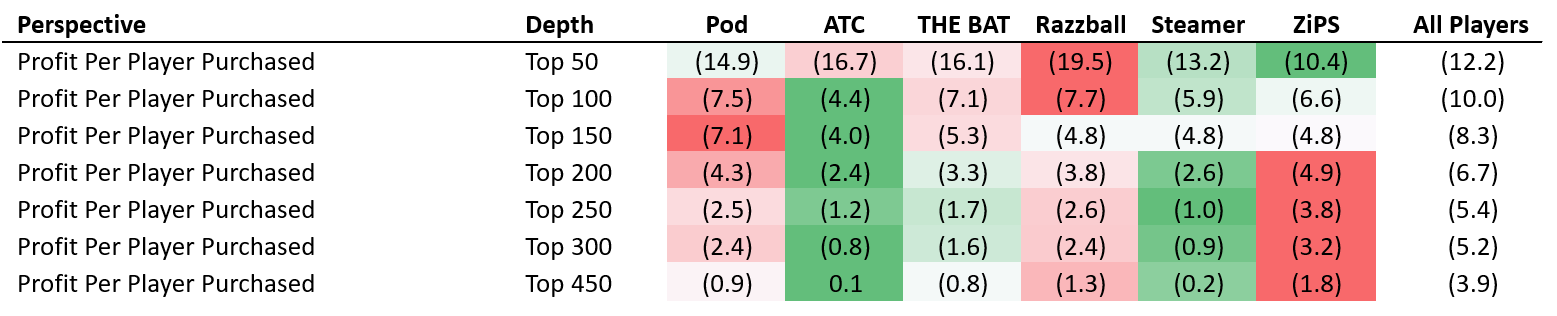
I thought it would be an interesting exercise today to look at fantasy baseball in a different way – profitability at the major league team level. Certainly, the better real-life clubs consist of not only more fantasy relevant players, but also of the higher quality ones.

But what else can be said about the profitability of the fantasy player pool at the team level? Does a higher spend translate to more value for fantasy owners? Does winning ball games correlate with higher levels of fantasy profitably? What can we learn from looking at player investments from this unique ball club perspective?

Let’s dive in and see …

Definitions & Methodology

For today’s analysis, I have used the same pre-season pricing and full-season valuations as in my game theory projections comparison. There are three specific quantities that are relevant here:

  • $Value – This is the 2019 full season rotisserie value that each player provided this season. I use my own auction calculator which employs a Z-score methodology to generate the $Values. Standard NFBC 15-team settings are assumed (Mixed AL/NL, $260 budget, standard NFBC positions). I assume that players are only eligible at their original 2019 positions + any positions that they were expected to gain in the first 2 weeks of the season.
  • $AAV – Average Auction Value – This is the average of what NFBC owners paid to acquire players during the heart of the 2019 draft season. These values come from all NFBC auctions between March 15, 2019 and March 25, 2019.
  • $Profit – The difference between the $Value and the $AAV per player.
Read the rest of this entry »


Can Strasburg Repeat 200+ Innings?

… probably not, but anyone probably already guessed that considering Stephen Strasburg’s injury history. The answer isn’t that far off after digging through some historic comps. Only once in his 10-year career has he topped 200 innings (215 in 2014) and only over 180 one other time. He’s thrown under 160 innings six times in ten seasons. Another issue besides the limited innings is that he’s going to be on the wrong side of 30 where pitcher breakdown faster. It’s time to look a little deeper and see what innings total should be expected.

I need to start with some guidelines. First, I’m only going to examine pitchers who throw the 200 innings between their ages 28 and 32 seasons. Also, the pitcher needs to be considered a starter with at least half of their games as a starter (GS/G >= 0.5). Finally, I rode the fine line of using recent data and having enough samples. With pitchers recently throwing fewer innings, I only used pitchers from the past 10 seasons.
Read the rest of this entry »


Injured Hitters: Projection Adjustments

Historically, I’ve “corrected” hitter projections to my own liking and every time I’ve backtested them to the actual results, my adjustments have failed miserably. So why create more work when the end results make my final product worse? Am I a glutton for punishment? In all fairness, I’m sure a heavy dose of Dunning-Kruger is going on but I also believe there may be a sweet spot where personal scouting can come into play. Today, I’m going back to the well one more time to see if some injured hitters should have more encouraging projections because they may have played hurt.

First, I’ve always thought playing through an injury meant that the team and the player were accepting suboptimal production. Then the player could come back healthy and full productive the next season.
Read the rest of this entry »


2019 Projection Systems Comparison – Hitting vs. Pitching

In my previous article, I compared a number of baseball projection systems for the 2019 season using a game theory approach. We looked at the profitability of each projection system in the context of simulating what would transpire at a fantasy baseball auction. We measured each projection’s successes and failures.

Several readers had approached me to further split out the resulting analysis into the hitter and pitcher components. By popular demand, I have decided to do exactly that. Today’s article will detail the analysis by its offensive and defensive elements.

For a refresher on the process and methodology, or for reference, please refer to the original post which can be found here.

Overall Results:

First, let’s quickly remind ourselves of the results of overall total profitability by projection system in 2019.

As we previously saw, ATC and Steamer were the two best overall systems according to this analysis in 2019.

Read the rest of this entry »


The 2020 Edition of The Process is Now Available in Paperback

A few weeks back, I posted that the 2020 edition of The Process was available in e-book form for downloading. All the loops have been jumped and now all it is available in paperback form at Amazon.

Here are some of the additions:

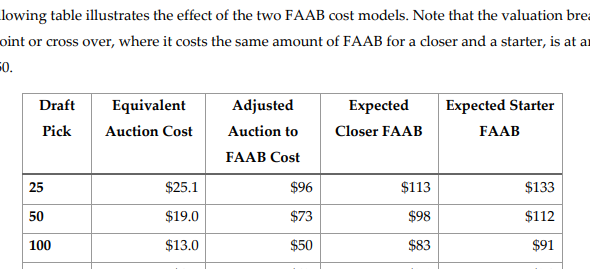
• A comparison to see if it’s more efficient to buy closers versus starters in the draft or wait for free agency for each one.

Read the rest of this entry »


At What Age is a Hitter’s Projection No Longer Reliable?

I blame my podcat mate Rob Silver for today’s study. First, he stated this:

And then he said this:

Of course, players age. Some quickly. Some not as fast. While few hitters remain productive into and past their mid-30’s, I needed a simple rule on how to deal with these vets. I found one and since I need to provide content to be paid, so does the world.
Read the rest of this entry »


Mining the News (11/20/19)

Today’s “news” is a combination of recent and old. Some of the information was reported over a month ago, but with little to nothing happening in the game, it still relevant.

• Trea Turner had surgery on his index finger and should be 100% by the start of spring training.

Read the rest of this entry »


2019 Projection Systems Comparison – A Game Theory Approach

Introduction

Last year, I introduced a game theory approach for comparing baseball projection systems. Today, I have once again applied the same methodology in order to evaluate which set of baseball projections excelled in 2019.

Most others who venture in such a comparative exercise make use of some type of statistical analysis. They calculate least square errors, perform a chi-squared test, or perhaps do hypothesis testing. I won’t be engaging in any of these capable methods.

Instead, I will look to determine the profitability potential of each projection system by simulating what would have happened in a fantasy auction draft. Instead, I’ll play a game.

What do I mean by this?

First, think about what happens in a fantasy baseball draft auction.

Suppose that Rudy Gamble of Razzball (or anyone who exclusively uses the Razzball projections) walks into a rotisserie auction league prior to the 2019 baseball season. Let’s say that Rudy decides to participate in an NFBC auction league. Mr. Gamble would take his projections and run them through a valuation method to obtain auction prices. He would generate a list that looked something like this …

Razzball Projected Values: Chris Sale 49, Mike Trout 45, Jacob deGrom 44, Max Scherzer 44. Mookie Betts 42, J.D. Martinez 37, Giancarlo Stanton 36, Justin Verlander 35, … , Brandon Lowe 1, Josh Reddick 1, Mark Melancon 1, etc.

In addition to the raw projected values generated by the Razzball system, Rudy would then establish a price point that he is willing to pay for each player. There might be a premium that he will pay for the top ones, and a discount that he expects to save on lower cost players. He may be willing to bid up to $46 on Jacob deGrom (valued at $44), but would only pay $1 for a $4 Jason Kipnis, etc. Read the rest of this entry »


The Sleeper and the Bust Episode: 754 – Steamer Pitching Projections

11/13/19

The latest episode of “The Sleeper and the Bust” is live. Support the show by subscribing to Fangraphs! With a standard $20 membership, you help maintain and improve our database of stats and graphs as well as our staff of 8 full-time employees and over 50 contributors. The premium ad-free membership at $50 year supports site growth and also includes faster load speeds and better site performance. You can also support monthly for just $3.

Follow us on Twitter

NOTABLE TRANSACTIONS/INJURIES/RUMORS

Read the rest of this entry »

01:37:09

Fantasy Baseball Process E-Book Available

This year’s edition of the Fantasy Baseball Process by Tanner Bell and myself is finally completed and the e-book is now available for sale (the paper version will be available at Amazon in a few weeks). We added over 50 pages of new material (link to list), cut out some info we felt was not needed, and included the historic standings and Standing Gains Points formulas to help with planning the 2020 season.

Before I move along to some of the highlights, I’d like to thank Dylan Higgins for the editing, Jared Cross for the Steamer projections, Clay Link for the introduction, Rob Silver for giving it a read over, and especially Tanner for hours and hours spent grinding through all the new changes.
Read the rest of this entry »