Archive for Projections

Keuchel & Ryu Look to Disappoint

I going to examine how both Hyun-Jin Ryu‘s and Dallas Keuchel’s fantasy value changed since both signed over the last few days.

Hyun-Jin Ryu signs with the Toronto Blue Jays

Ryu finally pieced together a great season by staying healthy and throwing more innings (182) than any time since 2013 (192). While his strikeout rate was acceptable (23%), he dominated (2.32 ERA) by walking almost no one (3%) and in the juiced ball era, he limited home runs (0.8 HR/9) with a surge in groundball rate (50%).

I hate this move for Ryu’s value with every aspect being a downgrade from the Dodgers. He moves to the AL where he’ll face a DH more often. He goes to the hyper-competitive AL East. He transitions from a pitcher’s park to one that is neutral overall but gives up more home runs than average. Finally, he goes from a nearly average defense to one in the bottom third.

Read the rest of this entry »


Projection Busting Research Updated

Over the years, I’ve been working on how to fine-tune my player evaluation process. The following are six datasets that I’ve found useful I’ll not go into detail on any of them since I provide a link to the original article. The following is basically a referenceable data dump.

Note: I know there is a lot of content and when questions arise, make sure the area in question is obvious in the comment. Also, I’ll only answer questions here and not in the original articles.

Voit/Muncy All-Stars (link)

These are older AAA hitters who have shown signs of a breakout.

Voit/Muncy All-Stars
Name Position Age Team PA BB% K% GB% ISO
Adam Engel OF 27 White Sox 277 8% 22% 43% .194
Addison Russell SS 25 Cubs 119 12% 21% 38% .281
Andy Ibanez 2B/3B 26 Rangers 529 10% 17% 37% .197
Austin Dean OF 25 Marlins 282 10% 18% 39% .298
Billy McKinney OF 24 Blue Jays 154 14% 16% 35% .217
Breyvic Valera 2B 27 Yankees 348 10% 10% 34% .200
Bryan Reynolds OF 24 Pirates 57 12% 19% 38% .367
Cavan Biggio 2B 24 Blue Jays 174 20% 16% 30% .203
Chance Sisco C 24 Orioles 196 10% 22% 42% .238
Chas McCormick OF 24 Astros 225 12% 15% 37% .204
Cheslor Cuthbert 3B 26 Royals 219 8% 21% 39% .218
Connor Joe 1B/3B 26 Dodgers 446 16% 18% 42% .203
Cristhian Adames SS 27 Giants 165 12% 19% 42% .234
Daniel Pinero 3B/SS 25 Tigers 110 16% 23% 32% .220
DJ Stewart OF 25 Orioles 277 14% 18% 41% .257
Donnie Dewees OF 25 Cubs 419 10% 15% 41% .207
Esteban Quiroz 2B/SS 27 Padres 366 14% 22% 38% .268
Harrison Bader OF 25 Cardinals 75 11% 21% 26% .381
Jason Vosler 3B 25 Padres 426 11% 24% 37% .232
Jaylin Davis OF 24 Giants 117 12% 24% 40% .353
Jeimer Candelario 3B 25 Tigers 178 12% 20% 42% .268
Johan Camargo SS 25 Braves 64 8% 19% 35% .207
Jonah Heim C 24 Athletics 119 9% 15% 34% .198
Jose Rojas 3B 26 Angels 578 10% 23% 31% .283
Josh VanMeter 2B/3B 24 Reds 211 11% 18% 38% .320
Kevin Cron 1B 26 Diamondbacks 377 16% 20% 26% .446
Mark Payton OF 27 Athletics 447 10% 17% 35% .319
Matt Thaiss 1B 24 Angels 372 16% 17% 42% .203
Michael Brosseau 3B 25 Rays 315 11% 18% 40% .263
Michael Perez C 26 Rays 216 13% 24% 36% .250
Mike Ford 1B 26 Yankees 349 13% 16% 40% .303
Nick Dini C 25 Royals 213 10% 14% 33% .269
Nick Tanielu 2B/3B 26 Astros 503 9% 17% 36% .225
Oscar Mercado SS/OF 24 Indians 140 11% 23% 40% .202
P.J. Higgins C 26 Cubs 140 12% 21% 40% .231
Phillip Ervin OF 26 Reds 172 11% 20% 31% .193
Roberto Pena C 27 Angels 155 11% 19% 32% .196
Ronald Guzman 1B 24 Rangers 135 13% 23% 39% .197
Rowdy Tellez 1B 24 Blue Jays 109 13% 23% 34% .323
Ryan McBroom 1B 27 Yankees 482 12% 21% 38% .259
Ryan O’Hearn 1B 25 Royals 149 11% 21% 39% .302
Taylor Jones 1B 25 Astros 531 13% 21% 37% .210
Taylor Ward C/3B 25 Angels 512 16% 20% 38% .278
Ty France 1B/3B 24 Padres 348 9% 15% 31% .372
Will Smith C 24 Dodgers 270 15% 18% 28% .335
Willie Calhoun 2B/OF 24 Rangers 172 19% 14% 33% .232
Yermin Mercedes C 26 White Sox 220 11% 19% 28% .337

Read the rest of this entry »


2019 Fantasy Baseball Profitability By Team

Introduction

I thought it would be an interesting exercise today to look at fantasy baseball in a different way – profitability at the major league team level. Certainly, the better real-life clubs consist of not only more fantasy relevant players, but also of the higher quality ones.

But what else can be said about the profitability of the fantasy player pool at the team level? Does a higher spend translate to more value for fantasy owners? Does winning ball games correlate with higher levels of fantasy profitably? What can we learn from looking at player investments from this unique ball club perspective?

Let’s dive in and see …

Definitions & Methodology

For today’s analysis, I have used the same pre-season pricing and full-season valuations as in my game theory projections comparison. There are three specific quantities that are relevant here:

  • $Value – This is the 2019 full season rotisserie value that each player provided this season. I use my own auction calculator which employs a Z-score methodology to generate the $Values. Standard NFBC 15-team settings are assumed (Mixed AL/NL, $260 budget, standard NFBC positions). I assume that players are only eligible at their original 2019 positions + any positions that they were expected to gain in the first 2 weeks of the season.
  • $AAV – Average Auction Value – This is the average of what NFBC owners paid to acquire players during the heart of the 2019 draft season. These values come from all NFBC auctions between March 15, 2019 and March 25, 2019.
  • $Profit – The difference between the $Value and the $AAV per player.

Read the rest of this entry »


Can Strasburg Repeat 200+ Innings?

… probably not, but anyone probably already guessed that considering Stephen Strasburg’s injury history. The answer isn’t that far off after digging through some historic comps. Only once in his 10-year career has he topped 200 innings (215 in 2014) and only over 180 one other time. He’s thrown under 160 innings six times in ten seasons. Another issue besides the limited innings is that he’s going to be on the wrong side of 30 where pitcher breakdown faster. It’s time to look a little deeper and see what innings total should be expected.

I need to start with some guidelines. First, I’m only going to examine pitchers who throw the 200 innings between their ages 28 and 32 seasons. Also, the pitcher needs to be considered a starter with at least half of their games as a starter (GS/G >= 0.5). Finally, I rode the fine line of using recent data and having enough samples. With pitchers recently throwing fewer innings, I only used pitchers from the past 10 seasons.
Read the rest of this entry »


Injured Hitters: Projection Adjustments

Historically, I’ve “corrected” hitter projections to my own liking and every time I’ve backtested them to the actual results, my adjustments have failed miserably. So why create more work when the end results make my final product worse? Am I a glutton for punishment? In all fairness, I’m sure a heavy dose of Dunning-Kruger is going on but I also believe there may be a sweet spot where personal scouting can come into play. Today, I’m going back to the well one more time to see if some injured hitters should have more encouraging projections because they may have played hurt.

First, I’ve always thought playing through an injury meant that the team and the player were accepting suboptimal production. Then the player could come back healthy and full productive the next season.
Read the rest of this entry »


2019 Projection Systems Comparison – Hitting vs. Pitching

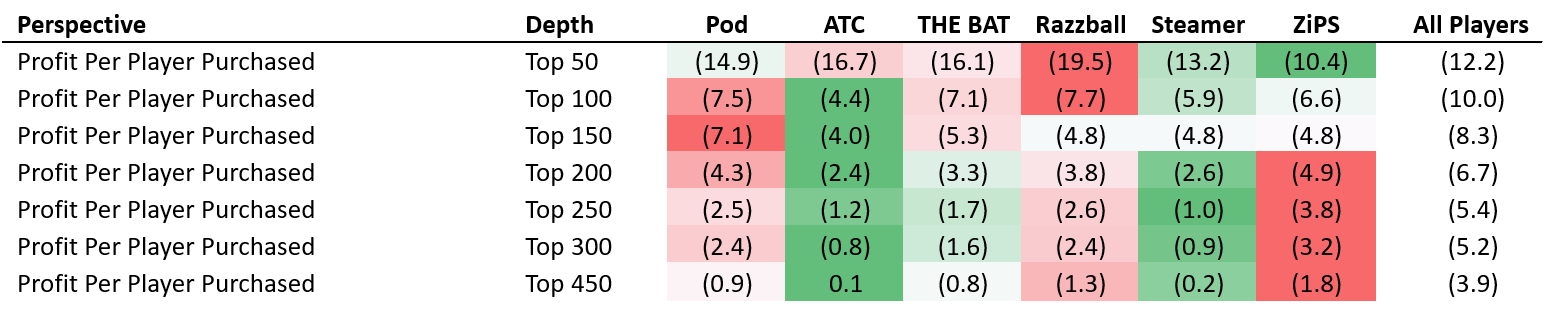
In my previous article, I compared a number of baseball projection systems for the 2019 season using a game theory approach. We looked at the profitability of each projection system in the context of simulating what would transpire at a fantasy baseball auction. We measured each projection’s successes and failures.

Several readers had approached me to further split out the resulting analysis into the hitter and pitcher components. By popular demand, I have decided to do exactly that. Today’s article will detail the analysis by its offensive and defensive elements.

For a refresher on the process and methodology, or for reference, please refer to the original post which can be found here.

Overall Results:

First, let’s quickly remind ourselves of the results of overall total profitability by projection system in 2019.

As we previously saw, ATC and Steamer were the two best overall systems according to this analysis in 2019.

Read the rest of this entry »


The 2020 Edition of The Process is Now Available in Paperback

A few weeks back, I posted that the 2020 edition of The Process was available in e-book form for downloading. All the loops have been jumped and now all it is available in paperback form at Amazon.

Here are some of the additions:

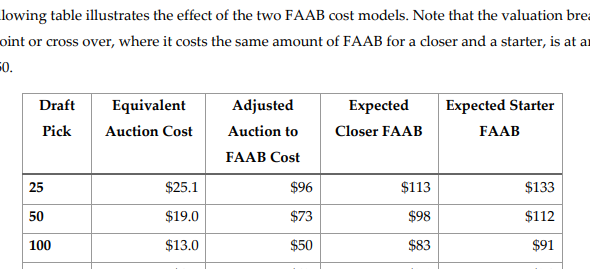
• A comparison to see if it’s more efficient to buy closers versus starters in the draft or wait for free agency for each one.

Read the rest of this entry »


At What Age is a Hitter’s Projection No Longer Reliable?

I blame my podcat mate Rob Silver for today’s study. First, he stated this:

And then he said this:

Of course, players age. Some quickly. Some not as fast. While few hitters remain productive into and past their mid-30’s, I needed a simple rule on how to deal with these vets. I found one and since I need to provide content to be paid, so does the world.
Read the rest of this entry »


Mining the News (11/20/19)

Today’s “news” is a combination of recent and old. Some of the information was reported over a month ago, but with little to nothing happening in the game, it still relevant.

Trea Turner had surgery on his index finger and should be 100% by the start of spring training.

Read the rest of this entry »


2019 Projection Systems Comparison – A Game Theory Approach

Introduction

Last year, I introduced a game theory approach for comparing baseball projection systems. Today, I have once again applied the same methodology in order to evaluate which set of baseball projections excelled in 2019.

Most others who venture in such a comparative exercise make use of some type of statistical analysis. They calculate least square errors, perform a chi-squared test, or perhaps do hypothesis testing. I won’t be engaging in any of these capable methods.

Instead, I will look to determine the profitability potential of each projection system by simulating what would have happened in a fantasy auction draft. Instead, I’ll play a game.

What do I mean by this?

First, think about what happens in a fantasy baseball draft auction.

Suppose that Rudy Gamble of Razzball (or anyone who exclusively uses the Razzball projections) walks into a rotisserie auction league prior to the 2019 baseball season. Let’s say that Rudy decides to participate in an NFBC auction league. Mr. Gamble would take his projections and run them through a valuation method to obtain auction prices. He would generate a list that looked something like this …

Razzball Projected Values: Chris Sale 49, Mike Trout 45, Jacob deGrom 44, Max Scherzer 44. Mookie Betts 42, J.D. Martinez 37, Giancarlo Stanton 36, Justin Verlander 35, … , Brandon Lowe 1, Josh Reddick 1, Mark Melancon 1, etc.

In addition to the raw projected values generated by the Razzball system, Rudy would then establish a price point that he is willing to pay for each player. There might be a premium that he will pay for the top ones, and a discount that he expects to save on lower cost players. He may be willing to bid up to $46 on Jacob deGrom (valued at $44), but would only pay $1 for a $4 Jason Kipnis, etc. Read the rest of this entry »