Archive for Hitters

2019 Review — Surprising Average Fly Ball Distance Leaders

A couple of weeks ago, I listed and discussed the average fly ball distance (AFBD) surgers and decliners. As a reminder, AFBD is one of the main components of my xHR/FB rate equation. Today, let’s review some of the surprising AFBD leaders. We’ll define surprise as hitters we didn’t predict to appear anywhere near the top tier in the rankings. I’ll only call out fantasy relevant names.

Read the rest of this entry »


Josh Donaldson Heads to Twinkie Town

Though we’ve known about it for a week now, Josh Donaldson has officially signed with the Twins, which pushes Miguel Sano to first base. Donaldson now joins his fourth team in three years, which is surprising given how good he has been, outside a down, injury-marred 2018. Speaking of 2018, he rebounded off that disappointing performance admirably, proving it was health, not age, that was the issue. He now returns to the American League after a year in Atlanta. What might the change in home park do to his results? Let’s consult the (2018) park factors.

Read the rest of this entry »


Marcell Ozuna Heads to the Braves

Wow, in a surprise twist, free agent Marcell Ozuna settled for a one-year deal with the Braves. He now joins the third team of his career as he enters his age 29 season. So how might his offense be affected by the move from Busch Stadium (Cardinals) to Truist Park (Braves)? Well first, he has to tell his friends and family that he’ll be playing his home games at a stadium called Truist Park without laughing. That has to be the worst stadium name in all of sports right now. Outside of that challenge, let’s see what the park factors say (well, at least the 2018 ones!).

Read the rest of this entry »


Should I Care About Sprint Speed?

Sprint Speed values have been publicly available for a few seasons. While I see it mentioned for this or that, I don’t know how predictive it is or if should I care about it at all. After analyzing the data, Sprint Speed might need to be ignored in favor of Time-to-First. The stopwatch still rules.

The key, in my opinion, is if the ability to run fast can be predictive in any way. No one that I know of is playing in a Sprint Score league, so the speed with have a secondary effect. If a player is running slower, do their stolen bases drop? How about how many infield hits they can leg out? Generally, how will the players change in speed affect their stolen bases and batting average.

One factor to keep in mind is that the aging curve for stolen bases is just a drop with all humans reaching their peak sprinting speed in their early 20’s.  There are going to be a lot of negative speed values coming up but that’s just aging pulling players down.

A second factor to remember is that teams are not allowing hitters to run as much. In 2015, there were over 2500 stolen bases league-wide. Last season, the value was under 2300 for a 9% decline. Again, more negative numbers.

Sprint Speed was first introduced in 2015 at Baseball Savant (links to Time-to-First values) and it is widely cited. Sprint Speed is not the only measured speed metric available. For one fewer season, Baseball Savant has each hitter’s run times to first base which have been the traditional measure of a player’s speed and it’s still used in scouting players. With the two metrics, it’s table time to what conclusions can be drawn.

Read the rest of this entry »


2019 Review — Surprising Barrels Per True Fly Balls Laggards

Yesterday, I identified and discussed a smattering of hitters who made surprising appearances near the top of the barrels per true fly ball (Brls/TFB) leaderboard. Today, we flip to the opposite end of the list, moving to the laggards. These are going to be fantasy relevant guys you never expected to appear closer to the bottom of the leaderboard than the top.

Read the rest of this entry »


Steamer vs NFBC 2020 – Batting Average Bargains

In my last two columns, I uncovered potential undervalued speedsters and power bats by comparing the Steamer projections to the current NFBC ADP. The exercise now continues this week for batting average.

In 2019, there were 55 qualified players with least a .280 batting average. There were 36 players above the .290 mark, and 19 above .300. Tim Anderson led all of baseball with a .335 BA, followed by National Leaguers Christian Yelich and Ketel Marte who each hit .329.

Though 2019 had almost two dozen players who hit at least .300, you won’t find a projection set that will have that many BA studs. Projections are typically more conservative. Steamer only projects 17 regular players to bat over .290 in 2020, and only 5 players to eclipse the .300 mark.

For this year’s potential batting average bargains, we will focus on all players with a Steamer projection of a .278 BA or more. This will give us a number of players who can greatly help your fantasy team’s batting average in in 2020.

For these draft value comparisons, I look at:

  • The player ranks as computed by the FanGraphs Auction Calculator with Steamer projections (standard NFBC 15 team roto league settings).
  • The current NFBC ADP (of Draft Championship leagues from December 4, 2019 to present).

Read the rest of this entry »


2019 Review — Surprising Barrels Per True Fly Balls Leaders

Last week, I listed and discussed the barrels per true fly ball (Brls/TFB) surgers and decliners. As a reminder, Brls/TFB is one of the main components of my xHR/FB rate equation. Today, let’s review some of the surprising Brls/TFB leaders. We’ll define surprise as hitters we didn’t predict to appear anywhere near the top tier in the rankings. I’ll only call out fantasy relevant names.

Read the rest of this entry »


Should Projections for Astros Hitters be Tempered?

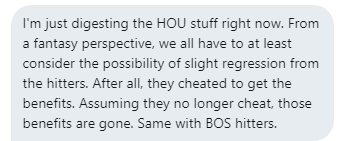
Yesterday, I noticed someone slid into my DM’s and I got my hopes up but instead I got this:

Maybe. Many of the Astros players didn’t think it helped.

Some Astros players told my investigators that they did not believe the sign-stealing scheme was effective, and it was more distracting than useful to hitters.

We just don’t know for sure of the effects of cheating so I guess I better take a stab and find out.

To start with, I went to the projection sources to find out how the projections weigh each year’s results. The weighted averages, along with some aging adjustments and regression, create the final projections. ZiPS is up first.

Dan Szymborski uses individual weightings for each component (strikeouts, doubles, etc) but at the end, the weighting is close to 8-5-4-2 where ‘8’ is the last season. According to the commissioner’s report, the Astros “only” cheated at home in 2017 so only 2 units (half of four, the third value) of the weighting will be boosted. The percentage of the projection’s input from the cheating is 10.5% (2/[8+5+4+2] or 2/19).

Read the rest of this entry »


Upgrading a Deserved Barrel%

New year, new deserved barrels metric. In October, I took a crack at devising a “deserved barrels” metric in which I took the basic components of a barrel — a hitter’s exit velocity (EV) and launch angle (LA) — and determined the capacity in which the components relate to Statcast’s barrel rate metric (barrels per batted ball event, or “Brls/BBE %” on Baseball Savant). I included squared terms (EV2, LA2) assuming the relationship is not linear. (A launch angle that’s too steep is detrimental, for example.)

Further offseason research led me to additional insights:

There exist many measures of contact quality; barrel rate captures how often a hitter produces high-quality contact. (Hard-hit rate functions similarly but ignores launch angle, to my knowledge, making barrel rate arguably superior.) It only made sense, then, that the latter finding above — that launch angle tightness matters to batted ball quality — should be incorporated into my deserved barrels work somehow.

Read the rest of this entry »


2019 Review — FB Pull% Decliners

Yesterday, I discussed surgers in the final important component of my xHR/FB rate equation, FB Pull%. Today, I’ll move on to the decliners. What follows is a list of the hitters whose FB Pull% declined by at least 10 percentage points from 2018.

Read the rest of this entry »