Archive for Roto

Leave Them In? A Look at 2021’s Pinch Hitters

You’ve seen it before. In ESPN leagues it’s that little red exclamation point. In Ottoneu, it’s a red X. It means your guy isn’t in the starting lineup tonight and you have a decision to make. Do you sub him out for your replacement level bench guy? Or, do you roll the dice, leave your “not in the starting lineup today” player in, and hope he comes in with a big at-bat off the bench?

Read the rest of this entry »


Targets and Avoids for Streaming LHP

As we come down the fantasy stretch, every matchup you choose starts to matter that much more. Whether it’s knowing who to stream or which stalwart in your rotation should maybe sit one out, it’s best to bring as much recent information to your process as possible.

We already looked at team performances vs RHP, so let’s crossover and look at how teams are faring versus lefthanders, looking at the numbers heading into last night’s action. But first, a quick caveat. Read the rest of this entry »


How Are Your Counting Stats? Strikeout Edition

This season I’ve been checking to make sure all my counting stats are on pace using my league’s historical first-place totals. This is just a shallow ESPN league, but we’ve been at it for a few years now. So, I can get a good idea of what totals I’ll need to accumulate to come out on top. Using historical data in combination with Steamer rest of season projections, I can get a good sense of where I’ll be at the season’s end. Here’s a nice, simple graph that you can easily replicate using Excel:
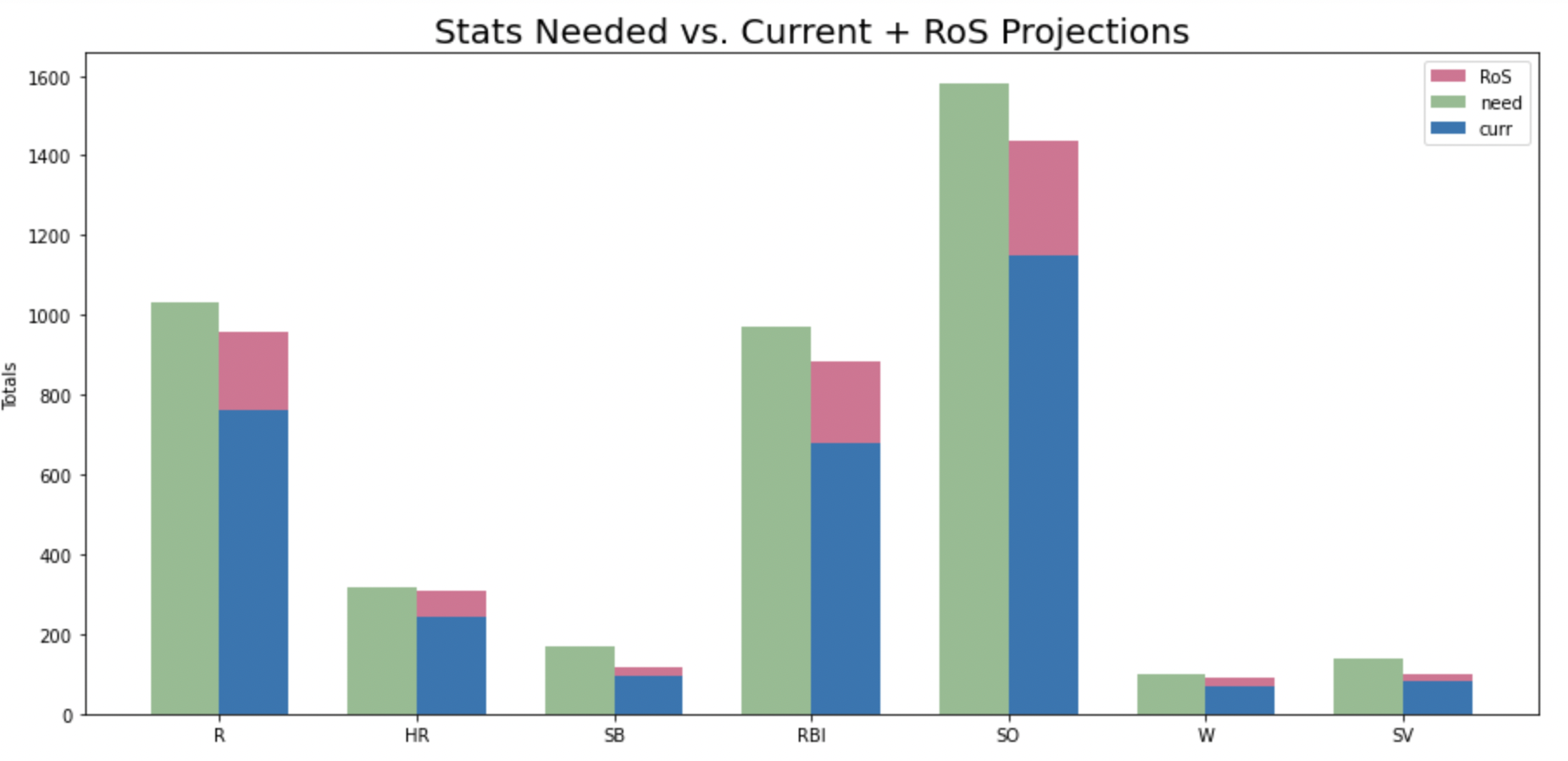


I won’t show my ratios, you don’t want to see them. My WHIP and ERA are practically gone and never coming back. But, that allows me to go all-in on strikeouts and as you can see, I’ll need a big boost if I want to finish with first-place totals. Here are three pitchers who are likely available on waiver wires and have high rest of season strikeout totals. 


Patrick Corbin, 43.9% rostered ESPN, ROS SO: 44

Corbin has hurt a lot of fantasy managers this season and his 5.82 ERA is the evidence. But, an extra 44 strikeouts would certainly be welcome. With the Nationals projected to win another 16 games, you may just get one or two more wins. His ROS ERA is 4.02, but this is really a move for strikeouts and not ratios. If you’re holding onto a small number there, don’t claim Corbin. 


Josiah Gray, 33.9% rostered ESPN, ROS SO: 41

In Gray’s second start for the Nationals he recorded 10 strikeouts and in his two most recent starts he’s gone six innings. His ROS K/9 is a healthy 9.48 and it really seems like the Nationals are trying to see what their new rotation piece has to offer. 


JT Brubaker, 12.4% rostered ESPN, ROS SO: 36

I know, I know. He’s on the IL, he’s had a rough go in his last few starts and his ROS ERA is a 4.18. But, his injury is supposedly only going to keep him on for the minimum stay, two of his last three starts resulted in an xFIP that was at least 4 points lower than his FIP and he only gave up four hits, and no runs in his most recent start.


The big disclaimer here is that you need to be willing to ditch WHIP and ERA. These three pitchers are not projected to keep the numbers off the scoreboard, but they could be cheap and easy ways of accumulating more strikeouts. As long as you have the starts remaining to spare, these three pitchers’ rest of season projections could get you what you need.


Targets and Avoids For Streaming RHP

Back in June, we took a look at which teams to attack with streaming options, as well as who to avoid, according to pitcher handedness. With a scant five weeks remaining in the season (and playoffs starting soon for H2H leagues), knowing which teams to exploit (and which beartraps to step around) becomes even more paramount.

But not just for streaming options, as fantasy players in tight races might need to make some tough decisions on who to start down the stretch. Because when time is running out, every start counts, and pitchers who were “start no matter what” prior, might slide into a more nebulous zone as you try to bring home gold.

You may have spent the previous five months cruising but no one wants to be this guy in September:

With that in mind, let’s take a fresh look at the teams you should be going out of your way to face, as well as those teams who’ve improved enough in the second half to make you take a pause.

Damn the torpedoes, full stream ahead. Read the rest of this entry »


Defying the Aging Curve

A few days ago, I saw this post from Eno Sarris:

Zaidi’s mention of the “old aging curves” led me down an aging curves rabbit hole, where I read excellent posts from Mitchel Lichtman on creating aging curves (part 1 and part 2) and a few more recent studies by Jeff Zimmerman. I created my own aging curve using wRC+ as the metric and I looked to see where the Giant’s players fell on the line. Using the same techniques as described by Lichtman and Zimmerman, I used the delta method on all players who recorded at least 10 plate appearances in each season between 2008 and today. Here is the league-wide aging curve including the current year:

Read the rest of this entry »


Abraham Toro Makes You Believe

There are a number of players who have seen a change in playing time post-trade deadline. Abraham Toro moved into a near everyday role upon Alex Bregman’s injury and was consistently hitting towards the bottom of the order. But, since being traded to Seattle, Toro has found himself hitting in the 5 spot, keeping his everyday role intact, only at second base rather than third. It is likely that Toro would have found himself back on the bench, or worse, as Bregman nears a return from injury. Since moving to Seattle, Toro still does not have the most crystal clear path towards an everyday role, but it’s getting clearer. The Mariners Depth Chart shows a lot of interchangeable pieces and it’s not clear whether or not Toro will continue to fill the 2B spot if his bat begins to go quiet. Regardless, Toro has made an impact with his new club, has begun appearing on many analysts’ waiver wire feeds, and has hit from the leadoff spot in his two most recent appearances. Let’s take a dive down the rabbit hole and see what Toro’s game is all about. 

Read the rest of this entry »


A Roster Platoon Case Study

There are many strategies to employ during a fantasy baseball season and this year I’ve been trying a few new ones. The one strategy that has worked out tremendously well for me so far has been based on Jeff Zimmerman’s early-season analysis of xwOBA’s in-season predictive power. I detailed a practical way to apply his findings to waiver claims in shallow leagues. I’ve also decided, though the decision was sort of decided for me, to punt one category. Some of my own early-season research showed that punting one category can be fine as long as you have a few maxed-out category scores. However, one strategy that I’ve never employed is the usage of platoon splits. Two players, acting like one, and being placed in your lineup as if you were a real manager sounds pretty cool. But, I play in a shallow, 10-team, ESPN roto-league and I wanted to see if this strategy can work in such conditions. Here’s a little case study to see how this strategy would have played out for me in 2021 if I had started at the very beginning of the year and stuck with it until now. 

Read the rest of this entry »


Second Half Batting Average Fades

We’re over halfway through the season and have entered the prime trading season, with many deadlines coming at the end of July. This means teams that are contending but not cruising, will likely need to make some moves to address their deficiencies by (hopefully) moving their surpluses.

Last time out, we took a look at some starting pitchers who’ve gotten a majority of their value from ERAs that might not be sustainable. Now let’s switch over to the hitters and look at some players whose value could take a hit if they see their batting average swoon in the second half.

Just like with the pitchers, this isn’t about saying that Player X will be worse at baseball in the second half. This is about identifying who has put most of their eggs in one basket and whether you need to bake in some regression for the rest of the way. Whether it’s to make a trade or just adjust your categorical expectations, the more you know, the better you can prepare. Read the rest of this entry »


Second Half ERA Value Fades

We’re over halfway through the season and have entered the prime trading season, with many deadlines coming at the end of July. Which means teams that are contending but not cruising, will likely need to make some moves to address their deficiencies by (hopefully) moving their surpluses.

Whether you’re one of the lucky ones who are stacked on pitching and need to trade for an impact bat, or someone running the opposite, you need to know who to trade, who to fade, and who to trade for. Because is there really anything worse than trading away someone who blows up, or trading for someone who blows up your team? It’s really just the worst.

With that in mind, let’s look at starting pitchers who have significant differences between their ERA and their ERA evaluators. This way we can see who could be the most vulnerable to a rising ERA and whether their overall value could take the hit. This isn’t necessarily about saying that Player X is going to be worse at baseball in the second half, it’s about baking in regression to your expectations for the rest of the year. Read the rest of this entry »


Trade Deadline Decline or Second Half Surge?

Every year I start looking for ways to take advantage of trade rumors as a fantasy manager. But, is there actually any reason to? Maybe if a slugger goes from a pitcher-friendly home park to a hitter-friendly home park. Perhaps if a base stealer, who has had his restrictor plates put on while playing for a team that doesn’t steal bases, gets traded to a run happy team. These are the situations that seem easy to identify and are most likely smaller transactions that savvy managers can take advantage of. But what about the big dogs?

Read the rest of this entry »

