Archive for Andrew McCutchen

Week Seven Trade Possibilities

Here are seven players for your consideration to either acquire or send packing.

BUY

Scott Baker – Right now his ERA is a poor 4.93 and his WHIP checks in at 1.36, not what owners were expecting when they drafted him in the middle rounds of their fantasy draft. But Baker has a 3.91 K/BB ratio and both his FIP and xFIP show a pitcher who should have an ERA in the 3.65 range. It has been feast or famine for Baker this year, with four Quality Starts and three outings where he gave up 5 ER or more. But this is the same guy who went 26-13 over the two previous seasons with a 3.94 ERA and a 1.184 WHIP. Baker has a .342 BABIP, so there is reason to hope the beatings will taper off once regression kicks in.

Edwin Jackson – Most fantasy owners did not expect a repeat of Jackson’s 2009, when he posted 13 Wins and a 3.62 ERA. But few expected him to be 2-5 with a 6.33 ERA in the third week of May, either. Jackson’s xFIP actually shows him as a better pitcher this year (4.08) than a season ago (4.39). Right now he is being hurt by the gopher ball, having allowed 8 HR in 54 IP. Six of those homers have come in home starts, as Jackson is adjusting to pitching in Chase Field. But Jackson has dramatically increased his GB/FB rate from 0.92 to 1.47 this year. His K/9 rate is up to 7.33 from 6.77 a year ago. If his HR/FB rate moves away from its current 15.1 percent, Jackson could see a huge boost in his fantasy value.

Magglio Ordonez – In 2007 Ordonez combined for 256 R + RBIs thanks in part to a .595 SLG. The following year he was down to 175 R + RBIs and a .494 SLG and last year those marks were 104 and .428, respectively. Ordonez is off to a fast start, one that has him on pace to better 2008’s numbers. There will be owners out there looking to sell high on Ordonez, but neither his BABIP (.323 vs. 318 lifetime) nor HR/FB (12.5 vs. 13.5) are unsustainable. His 1.35 BB/K is the best mark of his career as is his 90.2 Contact%. Since contact rate is one of the quickest stats to stabilize (150 PA), Ordonez’ is likely to maintain his improvement in this area for the remainder of the season.

SELL

Andrew McCutchen – A fast start has McCutchen on pace to shatter pre-season expectations. But if a .376 BABIP raises eyebrows for an unsustainable rate, the Dutton-Carty xBABIP model has McCutchen’s line so far this year producing a .323 BABIP. McCutchen’s power in 2009 in the majors caught a lot of people by surprise but he has matched that production so far this year, too. But it is unlikely that he will maintain an AVG 40-50 points higher than all of the projection systems forecasted for him. McCutchen should not be traded at all costs, but now is an excellent time to cash in on his great start.

Justin Morneau – He currently leads the league in AVG and is third in home runs. Morneau is achieving that with a .404 BABIP and career-high marks in both FB% (52.4) and HR/FB (20.0). A high BABIP usually does not accompany a high FB%. Of the eight batters with a 50 percent or better FB%, only three have a BABIP over .300, so it is very likely that at least one of these marks is going to have to give. Traditionally, Morneau has been an excellent RBI man. But even with his great start in AVG and HR, he is on pace to deliver fewer RBIs than either 2006 or 2008. Like McCutchen, Morneau is another guy who will produce good numbers throughout the 2010 season. But his trade value will never be higher.

David Price – Over-hyped in 2009, Price fell off the radar for a lot of fantasy owners heading into drafts this year. He has rewarded fantasy owners who did not give up on him with a fantastic start, as he is 6-1 with a 1.81 ERA. However, by xFIP, Price is not substantially better in 2010 than he was a season ago, when he finished 10-7 with a 4.42 ERA. This year’s xFIP is 3.98 while it was 4.49 in 2009. I would be a shade more aggressive shopping Price at this point than either of the hitters mentioned above.

HUNCH

Jeff Francis – After missing all of the 2009 season recovering from labrum surgery, Francis is back in the majors with the Rockies. The history of pitchers with this surgery is not encouraging but I like Francis’ chance to buck those odds and beat his RoS ZiPS projection of 4 W, 4.55 ERA, 60 Ks and a 1.41 WHIP.


Updating the Rankings: Outfielders (OF2)

Since outfielders are so bountiful, it makes sense to create some tiers. We’ll start these rankings at 17, which means that the first outfielder may be an OF1 in most leagues, but we’ll still be able to delve a little deeper than we have to date. Once again, to-date wOBA plus ZiPS RoS wOBA is listed.

Worst of the Best?
1. Andrew McCutchen, Pittsburgh (.390 wOBA, .360 ZiPs RoS wOBA)
2. B.J. Upton, Tampa Bay (.328 wOBA, .339 ZiPs Ros wOBA)
3. Manny Ramirez, Los Angeles (.484 wOBA, .414 ZiPs RoS wOBA)
4. Adam Lind, Toronto (.323 wOBA, .356 ZiPs RoS wOBA)
5. Carlos Gonzalez, Colorado (.345 wOBA, .351 ZiPs RoS wOBA)
6. Bobby Abreu, Los Angeles (.343 wOBA, .361 ZiPs RoS wOBA)

Jayson Werth and Andre Ethier moved up into the OF1 rankings with their strong play in the early goings. Adam Lind and Manny Ramirez moved down because of mediocre play and old age, though Lind could still get it going – he just needs to find his power and stop striking out so much. Neither of those things becomes significant in a short sample. That fact should temper our enthusiasm for McCutchen a tiny bit, though, since there is still no guarantee that he will retain all the power gains he’s made in the past year-plus. As an aside, it’s a little silly to hear about how few times Manny Ramirez has gone on the DL. We all know he’s old and injury-prone at this point. 2008 aside, he’s the kind of guy that misses time here and there but has “somehow” avoided the DL.

Still Strong
7. Adam Dunn, Chicago (.387 wOBA, .393 ZiPs RoS wOBA)
8. Alfonso Soriano, Chicago (.435 wOBA, .370 ZiPs RoS wOBA)
9. Torii Hunter, Los Angeles (.358 wOBA, .366 ZiPs RoS wOBA)
10. Michael Bourn, Houston (.363 wOBA, .324 ZiPs RoS wOBA)
11. Denard Span, Minnesota (.354 wOBA, .342 ZiPs RoS wOBA)
12. Carlos Quentin, Chicago (.294 wOBA, .351 ZiPs RoS wOBA)

This is the boring-as-vanilla tier for the most part (but to be fair, it does seem that Haagen-Dazs Vanilla with strawberries is the nectar of the gods). Carlos Quentin is making it harder to believe in him every day, but he’s having some BABIP problems and we can hope that power comes back still. Not too late for him to turn it around and have a decent year. Soriano’s resurgence takes him from afterthought to solid OF2, which is actually sort of an amazing thing with how bad he’s looked in the recent past.

What’s Going On?
14. Jason Heyward, Atlanta (.439 wOBA, .356 ZiPs RoS wOBA)
15. Alex Rios, Chicago (.384 wOBA, .346 ZiPs RoS wOBA)
15. Chase Headley, San Diego (.378 wOBA, .327 ZiPs RoS wOBA)
12. Adam Jones, Baltimore (.255 wOBA, .342 ZiPs RoS wOBA)
13. Carlos Lee, Houston (.230 wOBA, .357 ZiPs RoS wOBA)

Yup, as boring as the tier above was, this tier is full of rock-em-sock-em peaks and valleys. Is Jason Heyward really an OF2 already? Will he be a top tier OF1 by the end of the year? He’s really surpassing even the most precocious of young stars with his performance to date. The best news is that he’s making adjustments on breaking balls. Alex Rios, Chase Headley? Finally? And Adam Jones and Carlos Lee may not be remotely close in terms of career arc, but they are looking in the same closet for their lost games. Hopefully for their owners they will find what they are looking for.

For Reals? Really Reals?
Colby Rasmus, St. Louis (.419 wOBA, .342 ZiPs RoS wOBA)
Austin Jackson, Detroit (.414 wOBA, .307 ZiPs RoS wOBA)
Brett Gardner, New York (.415 wOBA, .330 ZiPs RoS wOBA)
Marlon Byrd, Chicago (.422 wOBA, .363 ZiPs RoS wOBA)
Vernon Wells, Toronto (.440 wOBA, .346 ZiPs RoS wOBA)

Marlon Byrd has to count as the most surprising player in this tier full of surprises. There aren’t enough words for this space to unpack all that’s going on here, but you’ll see analysis on these guys here at FanGraphs and RotoGraphs. I promise.


Rankings Update: Outfielders

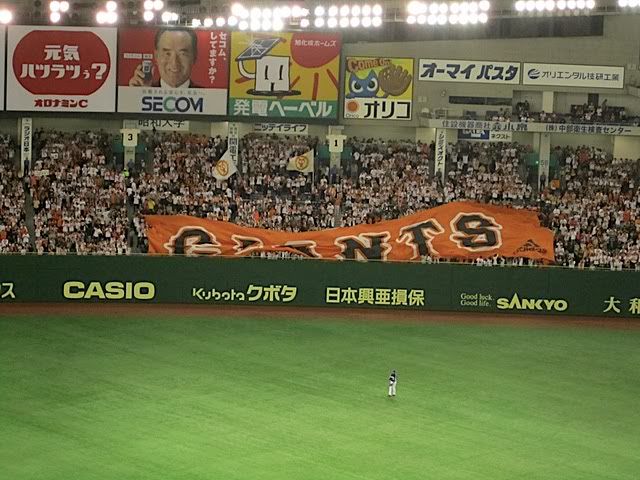
I’m back from Japan and have Basu-Baru pictures for your pleasure. Baseball in Japan has many of the trappings of the American version, but also includes cheerleaders and choreographed songs. Interestingly enough, the game I saw featured two Westerners at cleanup – Tony Blanco for the Chunichi Dragons and Alex Ramirez for the Yomiuri Giants. The pitchers had decent stuff, and the crowd was louder than many (most?) regular season MLB games, but overall the package was something like a AAAA game.

I digress. Time to take ownership of these outfielder rankings and change them up a bit. I will be doing them all season, as a sort of power ranking at the position. We’ll go with the FANS’ projected wOBAs (aka their upside projections) for another week.

The Top Three:
Ryan Braun, Milwaukee (.405 wOBA)
Matt Kemp, Los Angeles NL (.367 wOBA)
Justin Upton, Arizona (.388 wOBA)

Nothing much to say here except it looks like Upton’s ankle isn’t bothering him. These guys are studs and by the end of the year, could easily all be top-five fantasy players despite playing in the outfield.

There’s Nothing Wrong With…
Grady Sizemore, Cleveland (.343 wOBA)
Matt Holliday, St. Louis (.390 wOBA)
Carl Crawford, Tampa Bay (.367 wOBA)
Jacoby Ellsbury, Boston (.354 wOBA)
Curtis Granderson, New York AL (.340 wOBA)
Nelson Cruz, Texas (.368 wOBA)
Ichiro Suzuki, Seattle (.369 wOBA)
Shin-Soo Choo, Cleveland (.389 wOBA)

After the spirited Choo vs Granderson vs Sizemore comments conversation from the last time we updated these rankings, it’s only natural that we find a way to put them all in the same tier where they belong. Nelson Cruz is absolutely on fire, but his BABIP (.357) and K rate (24.1%) together suggest that the batting average should regress to his career norm. Granderson is still having trouble with lefties, but if he continues to bash righties to this extend, he’ll stay out of the next tier.

Not Quite Five-Category Performers
Josh Hamilton, Texas (.321 wOBA)
Jason Bay, New York NL (.397 wOBA)
Adam Lind, Toronto (.394 wOBA)
Nick Markakis, Baltimore (.349 wOBA)
Manny Ramirez, Los Angeles NL (.396 wOBA)

Manny is actually showing that he’s still got something left and with another tater or two could even join the next tier. That said, his missed games will keep the old(er) man back a little. Those same missed games should come into play with Hamilton eventually too. Lind’s power has taken a slight step back, but it’s early going and all it looks like he needs to do is loft the ball a little more (33.3% FB this year, 36.8% last year).

Missing Something?
Jayson Werth, Philadelphia (.382 wOBA)
B.J. Upton, Tampa Bay (.310 wOBA)
Andre Ethier, Los Angeles NL (.370 wOBA)

Werth reminded us that he has some injury issues by missing time with hip soreness, but has otherwise played well. The older Upton is actually playing about as well as can be expected, and in leagues that don’t use batting average, he may yet prove to be an elite option. Ethier will have his supporters, but his fly ball rate already fell, and his power pace should fall with it. The batting average should be strong this year, though, and he’s still a solid option.

Upside to Join the Top
Andrew McCutchen, Pittsburgh (.360 wOBA)
Carlos Quentin (.375 wOBA)
Michael Bourn (.326 wOBA)
Jason Kubel (.370 wOBA)

Outfielders are a tough position to handicap because of the sheer numbers, which also won’t allow me to go too deep. By highlighting some guys that could join the elite with the right years, we can delve a little deeper. So, while Shane Victorino is a fine option in the outfield, McCutchen is stealing bases at a pace (five so far) that would outpace the Flyin’ Hawaiian should it keep up. Bourn has shown the same plus plus speed. Should Quentin stay healthy, and Kubel prove that he can keep his slugging percentage over .500 year-in and year-out, they would join the power elite. So far, so good.


ADP Values in Center Field (Part 2)

Though our tools may not always be at their sharpest, we can still use them in concert to find truth in the fog. Yes, the 2010 projections are not up yet at BaseballMonster, but we have a sweet set here and can use their standard-deviation weighted-category-based rankings to help compare players with different skill sets. Yes, the ADP values on MockDraftCentral are flawed and skewed by their proprietary pre-ranks, but until we have more sources, they’ll have to do (Yahoo ADPs go live February 18).

The flaws of our tools were revealed when we looked at the first couple of center field tiers on Thursday, but the middle tier awaits and we will not be deterred from our goal of finding the strongest values at each position (and yes, we’ll do a post to gather all of these values into one place eventually).

Melvin Bossman Jr Upton is being taken the earliest (59.88), but after reading Dan Budreika’s breakdown of the difficulty of projecting his season (especially his power, in my opinion), I have to think that’s a little early for him. Adam Jones (89.04) comes next, but with most projections having him around 18 and 10 with an okay batting average, that seems a little high for a guy that won’t be a major plus in any category. Andrew McCutchen (91.08) may yet grow into his power, but as Paul Bourdett pointed out here, our perception of the current level of his power might have been skewed by a burst late last year. The fact remains that his minor league ISO was in the .130s, not the .180s like last year. Without plus power, he looks like a Shane Victorino (74.25) who I also believe is going too high (unless he finally steals 40+).

I hate to be so obvious about my man-crushes, but Carlos Gonzalez (124.70) has all the tools to fly past all the center fielders in his tier. We’ve talked extensively about him on the site, but I’ll just add a couple more points. CarGo is in a crowded outfield, yes, but the team hasn’t shown the willingness to make Seth Smith an every-day player, so it really looks like Smith and Dexter Fowler are the ones battling for playing time. CarGo played almost every day down the stretch down last year and I expect that to continue. Second, it makes me drool when a toolsy former top prospect makes good on his tools by improving his walk rate, strikeout rate, reach rates and contact rates across the board, while also returning his ISO to his minor league days of promise. The stars are aligned for CarGo to Go CarGo.

The speed-only tier creates a trio of players that are seemingly projected (by CHONE) to be virtually the same players next year:

Player A: .268, 4 home runs, 37 steals
Player B: .281, 3 home runs, 29 steals
Player C: .270, 4 home runs, 31 steals

What if I added that Player B actually stole 42 bases last year with a 71% success rate? Well, then you’d probably want him, wouldn’t you? Congratulations, you just bought Nyjer Morgan at bargain-basement prices (130.21 ADP). He would almsot certainly make a better value than Michael Bourn (72.45 ADP), and should sport a better batting average (and more guaranteed playing time) than Rajai Davis (171.44 ADP) in that crowded house that is the Oakland outfield.

We may have to go to a part three here to discuss the fantasy fault line (thanks to reader Johnny Tuttle for that wording, which may become a feature here shortly) between Shane Victorino and Denard Span.


Mailbag: Keepers Minus Two

Reader Jonathan G. asks:

I’ve got an upcoming decision for my keepers to make which I can use some FanGraphs expertise on. The keeper rules are that you forfeit a draft pick of the round your keeper is in minus 2. So if you keep a guy you drafted in the 5th round, you forfeit your 3rd round pick. My best keeper options (with rounds I would forfeit) are as follows:

–Chase Utley (forfeit 1st round)
–Adam Lind (forfeit 19th round)
–Adam Jones (forfeit 15th round)
–Gordon Beckham (forfeit 25th round)
–Andrew McCutchen (forfeit 25th round)
–Ubaldo Jimenez (forfeit 17th round)
–Jon Lester (forfeit 6th round)

My league is standard 5×5. My thoughts right now are to keep Utley, Lind, and Jones though I’ve given a lot of thought to keeping Beckham instead of Lind/Jones/Utley because of the value I’d get from keeping him in the 25th round.

I’d appreciate any time + thought that you can give to helping me out.

You didn’t explicitly say, but I am going to answer this with the assumption that you are limited to three keepers. Generally, you want to maximize value with your keepers. We can use the ADP numbers from MockDraftCentral.com as a proxy for value. Here are the numbers for your guys:

Utley – 4 – first round
Lind – 46 – fourth round
Jones – 87 – eighth round
Beckham – 93 – eighth round
McCutchen – 90 – eighth round
Jimenez – 105 – ninth round
Lester – 57 – fifth round

Here, Utley and Lester give you the least amount of value, relative to what you have to give up to keep them. I would also eliminate Jones, because of concerns around both his GB% (55.4) and Contact% (74.6).

Of the remaining four players, I think you can make a good case for keeping any of them.
Lind’s HR/FB rate is a bit worrisome, but he has a better batted ball profile and BB/K rates than Jones. His BABIP was slightly elevated but nothing too concerning. If you keep Lind, you do have to be a tiny bit concerned about his lack of SB.

Beckham begins the year as a 3B and should pick up 2B eligibility by the end of the month, assuming your league allows mid-year qualifications. He held his own as a 22-year old and had his best power month in September (6 HR). He did most of his damage on the road last year and given the hitter-friendly tendencies of his home park, it is not too hard to see him developing into a 25-HR guy as he matures. Ideally, he would have a higher LD% and a lower IFFB%.

McCutchen hit more HR than was expected last year. None of the preseason projections has him maintaining last year’s pace. Still, a 15 HR and 30 SB year is within reach and it is not impossible to see him topping those marks. One thing to keep in mind is that McCutchen did very well last year against FB but was below average against both CB and SL and will probably see more breaking balls in his sophomore season.

Jimenez is a ground ball pitcher that piles up strikeouts. He has three quality pitches and is clearly an ace-type pitcher. The Razzball Player Rater had him as the 57th best fantasy player in 2009. Jimenez did have a low HR/FB rate (7.8%) which gave him an xFIP higher than his ERA. But in 506.1 IP in the majors, Jimenez has an 8.3 percent HR/FB mark.

I would go Jimenez, Beckham and Lind.

The possibility of losing Utley is no doubt painful. But if everyone else has a first-round keeper, you get to re-draft him and keep him regardless. And if other owners opt to keep value picks, you should have other first-round talents to choose from when it is your pick.


Check the Position: Centerfield

Over the offseason we’ll take a look at each position on the diamond and see how the past season affected the positional rankings and where there might be some potential bounceback value picks going into next year’s drafts. (See shortstops, catchers, second basemen, first basemen, third basemen, right fielders and left fielders.)

These rankings are for 5×5 rotisserie fantasy baseball. Eligibility was determined by where the player had the most at-bats last year.

CenterFielders

There might be some grumblings about putting Matt Kemp into a tier of his own. The fact is, he’s the closest to .300 30/30 out there and that means something. Even with the eventual bounce back that both Grady Sizemore (.276 BABIP in 09, .308 xBABIP in 09, .317 career BABIP) and Curtis Granderson (.276 BABIP in 09, .301 xBABIP in 09, .323 career BABIP) will be getting in the average department, they both should fall short of those hallowed numbers. Kemp just needs a few more fly balls to leave the yard, and with his increasing fly ball totals and HR/FB ratios, it doesn’t take much squinting to get him there.

Carlos Beltran doesn’t quite have the speed to join the top tier, but injury concerns aside, he’s pretty much the definition of the second tier. Before last year, he’d cleared 600 plate appearances for eight straight years, so he’s a decent bet as a value pick once the first two rounds are complete. Jacoby Ellsbury is in the news a lot these days, has more speed than anyone on the list, but also has very little power and may be destined for a new position. You could pick him if you are getting plus power from a position on the infield, though, and not miss a beat.

Josh Hamilton’s position in the tier may be the most tenuous. The injury concerns are real (469 average PAs over the last three years), and speed is probably not part of the package any more (20 stolen bases and 7 caught stealings career). I would definitely be tempted to wait on him and pick the surging Carlos Gonzalez instead. CarGo rode a .320/.384/.608 second half (with 12 home runs and 11 stolen bases) into our collective consciousness. One of the main reasons for his effectiveness was that he cut down his strikeouts (23.2% in second half, 26% career), and we know he has the tools to continue producing should the refined approach continue. Bucs wunderkind Andrew McCutchen and O’s rising star Adam Jones help fill the Upside Tier, a trough that many knowledgeable readers will be dipping into next year. With Jones’ tiny walk rate (5.6% career) I just see a little more risk there. We’ve written extensively on B.J. Upton, who may yet have books written about him. Suffice it to say that his oscillating power (ISOs ranging from .046 to .209) and BABIPs (.312 to .399) make him risky.

The next tier we might as well call the “No-Power-All-Speed” tier. With his terrible 2008, of course there’s a reason to doubt Michael Bourn, but his walk rate, BABIP and line drive percentage all finally approached his minor league rates. He might have just found himself on the major league level finally, and he looks to have the best speed of this bunch. Otherwise, there’s not really much difference between Bourn, Nyjer Morgan and Rajai Davis. Take your pick.

The last tier is looking for redemption in some cases. Shane Victorino is being grounded slightly by his splits (.749 career OPS vs righties) but also by rumors that Placido Polanco will take his position in the lineup for reasons unclear. He still could provide tremendous value if he gets drafted at this tier position. It’s unclear why he stole fewer bases as his success rate (79.6%) and speed score (7.5) are still elite. Torii Hunter will get some love in the comments, perhaps, but his BABIP was at a nine-year high last year, and if his average drops, his 20/20 prowess looks a little less sexy. If batting average is not a concern, he’s a decent pickup late in the game. Vernon Wells just needs more space than we have here.

This position was deeper than I expected. Young players like Colby Rasmus, Dexter Fowler, and Franklin Gutierrez could all join the big boys with some steps forward in their games. All of them already make decent bench picks even in mixed leagues.


Fantasy Links — 9/3/2009

Three day games have already gotten underway and there are seven more contests on deck. Let’s get to some fantasy links as the season marches on…

Dustin Hockensmith of Imaginary Diamond lists 10 young players who could prove to be fantasy sleepers in 2010. As Hockensmith notes, “Some of these guys — Andrew McCutchen, Tommy Hanson, Neftali Feliz and Rick Porcello — are making an impact right now.”

The boys over at Fake Teams work through a discussion-inducing question: “Who would you rather have, Justin Upton or Matt Kemp?” Both have shot up in fantasy value this season and will be taken among the top tier of outfielders in drafts next season.

Not ready to begin thinking about 2010? Fantasy Baseball Junkie has you covered with a look at “vulture win opportunities” for the month of September. The blog post suggests adding guys like Jamie Moyer and Alfredo Aceves, who leach off starters like Pedro Martinez and Joba Chamberlain, respectively, for wins. The strategy may come off as odd, but it does make some sense.

With Chad Qualls, Mariano Rivera and Huston Street hitting the bench recently with injuries, there are an awful lot of saves up for grabs. Knox Bardeen of AOL Fanhouse runs us around some of those situations.

Troy Patterson of Roto Savants previews Buster Posey’s September fantasy value. For those who didn’t catch the news, the elite prospect was called up to the majors on Wednesday to aid the Giants in their push toward the playoffs. Bengie Molina is hurting and reportedly disgruntled, so there may be some playing time available.

Rotoworld’s Matt Stroup spins us around the league with a group of recommended waiver adds. Brian Joura handles that duty wonderfully for RotoGraphs, but it’s always nice to have multiple perspectives.

Have a link, comment, question or fantasy blog you think I should be reading? Send me an e-mail and tell me about it. Or find me on Twitter.


Stock Watch: 8/30

Stock Up

Andrew McCutchen, Pirates

Ever hear the old adage that even a blind squirrel finds the occasional nut? Well, McCutchen is the legume uncovered during the otherwise comedic/tragic tenure of former Pirates GM Dave Littlefield. The 11th overall selection in a stunningly deep 2005 draft class, McCutchen has hit the ground running in the majors. He’s batting .293/.362/.500 in 337 PA, showing power (.207 ISO, 10 HR) that belies his 5-11, 170 pound frame and well surpasses his minor league dossier.

The 22 year-old is working the count rather well (9.6 BB%, 18 K%), chasing 21.6% of pitches out of the strike zone (25.1% MLB avg). McCutchen has also been a smart, efficient base thief, with 15 swipes in 18 attempts (83.3% success rate). Couple the quality bat and high-percentage running with ample range in center field (+10.4 UZR/150), and you have a franchise pillar who has racked up 3.2 WAR since his early June call-up.

Ervin Santana, Angels

Is Santana turning his season around? There’s reason to believe so. Not that Ervin has been his dominant 2008 self this month, but he has allowed 12 runs in 33 August frames, holding opponents to a .250/.338/.408 line. Santana’s ’09 campaign has been plagued by injuries (a partially torn UCL and a forearm strain) and a consequent loss in velocity (after firing 94.4 MPH bullets and 84 MPH sliders in ’08, Santana’s overall fastball velocity sits at 91.8 MPH in ’09, with an 82 MPH slider).

However, his stuff does seem to be trending up as of late. His average fastball velocity is up to 92.3 MPH in August, and the pitch has been moderately effective after a disastrous showing earlier:

Santana’s Runs/100 pitches value with his fastball, by month:

May: -4.49
June: +1.12
July: -2.59
August: -0.13

(note: these linear run values are dependent on things like BABIP and HR/FB rate. In the case of a guy like Santana, his BABIP was in excess of .350 during the first three months, meaning those numbers shouldn’t like quite as bad as they do).

John Smoltz, Cardinals

Smoltz’s good processes and awful results with the Red Sox spurred countless discussions on just how we can more properly evaluate pitching performance.

The easy, lazy narrative on Smoltz following his run of drubbings with Boston was, “he’s old, injured and washed up.” But his underlying numbers suggested that he was still capable of performing at the highest level.

Latching on with St. Louis, Smoltz has made two excellent starts to begin his Red Bird career (a combined 11 IP, 15 K, 1 BB and 1 R vs. San Diego and Washington). While clearly promising, Smoltz’s two dominant outings don’t declare “he’s back” any more than his brutal Boston stint announced “he’s done.”

I’m obviously in the more optimistic camp when it comes to Smoltz’s future, but declaring “I told you so” after two starts would be even more foolish than coming to the conclusion that he was washed up following his Boston tenure. In other words, it’s just best to avoid knee-jerk reactions based on a small smattering of playing time.

Barry Zito, Giants

By this point, saying that the immense financial commitment that the Giants made to Barry Zito through at least 2013 was unwise is like beating a dead horse. Frankly, it’s more like beating glue. But, the calls for the club to outright release the left-hander are hyperbolic to the highest degree. That Reign of Terror-like bloodlust (“off with his head!”) might make for headline-generating copy, but it would also be a terrible financial decision.

Zito isn’t worth nearly $20M per season; we get it. But that doesn’t mean he’s worthless, either. In 2009, Barry has posted his lowest FIP (4.20) since 2003, with his highest K rate (6.93) since ’02 and his lowest walk rate (3.49) since ’04. His vaunted curveball (+2.49 runs/100 pitches thrown) is in the black run-wise for the first time since 2005, and Zito’s slider (+2.24 runs/100) is also getting the job done.

Overall, Zito has been worth 2.2 WAR, which equates to about $9.8M worth of value. Yes, that falls well short of how the Giants are compensating him. But severing ties for the mere sake of satiating the scribes would be like cutting off your nose to spite your face.

Rajai Davis, Athletics

A 28 year-old speedster originally drafted by the Pirates, Davis has gone from DFA’d Giant during the spring to everyday center fielder for the A’s. A plus defender and an adept base stealer (29 for 37 in ’09), Rajai could be a viable starter if he can avoid stinking up the joint at the plate.

While Davis’ gifts afield and on the bases are apparent, we don’t exactly know what to expect from an offensive standpoint. He was relatively patient in a productive 2007 season (10 BB%, 19.4 O-Swing%), an unabashed hacker in a letdown 2008 campaign (3.6 BB%, 36.2 O-Swing%), and he has essentially split the difference in 2009 (7.8 BB%, 30.9 O-Swing%). If Davis can work the count and get on base at a reasonable clip, he’s a perfectly acceptable regular and a person of interest in fantasy circles. If he reverts to chasing off the plate and in the dirt, he’s Willy Taveras.

Stock Down

Johan Santana, Mets

At this pace, Mr. Met will be inserted into the New York lineup by mid-September. Santana is just the latest in a staggeringly long line of Mets casualties, as he’s done for the season following arthroscopic surgery to remove bone spurs from his left elbow.

Something was clearly amiss with the ace southpaw, as his K rate plummeted after a dominant April and May and his fastball velocity dipped into the 80’s (89.5 MPH in August). What’s Nelson Figueroa’s WAMM (Wins Above Mr. Met)?

Hank Blalock, Rangers

The 28 year-old Blalock once looked like a building-block player for the Rangers (he posted 5.3 WAR in 2003 and 4.4 WAR in 2004). Since then, not-so-hammerin’ Hank has compiled 2.5 WAR. Combined. Injuries have assuredly played a part, but Blalock’s plate patience has progressively eroded:

2007: 9.2 BB%
2008: 6.9 BB%
2009: 4.7 BB%

Hank’s wOBA has dipped from .383 in ’07 to .317 this year. And now, he’ll grab some pine as Chris Davis gets another chance to, well, stop hitting like Blalock.

Bobby Parnell, Mets

Forced into the depleted Queens rotation, Parnell has been hammered for 24 runs in 21 innings as a starter. The 6-4, 200 pound righty (a 9th-round selection out of Charleston Southern in 2005) boasts a low-to-mid-90’s heater with good movement out of the ‘pen, but middling control and questionable secondary offerings call into question his viability as a starter. There’s certainly no harm in trying to figure out if the soon-to-be 25 year-old can handle lineups multiple times (all but two of his appearances in the minors came as a starter), but he appears to be Mike Pelfrey, with worse control.

B.J. Upton, Rays

Let me preface this by saying that I remain a big believer in Upton. The 2nd overall pick in the ’02 draft just turned 25. And at one point or another, B.J. has shown every skill required of a superstar player. He has popped extra base hits (.209 ISO in ’07), has generally worked the count very well (11.7 BB% career), can swipe plenty of bags (he’s on pace for over 40 this year) and has acclimated himself to center field after his nomadic “shortstop, no second baseman, no third baseman” experience.

With strong D, Upton has still been a valuable contributor this season (2.1 WAR). But from a fantasy standpoint, he has been a disappointment. B.J.’s walk rate is down to 9.5% after a career-best 15.4% in ’08. Upton’s relative power outage in 2008 (.128 ISO) was largely attributed to a shoulder injury that required off-season surgery and sidelined him early in ’09, but his ISO this year (.129) hasn’t climbed. His first-pitch strike%, just 55.2% in 2008, is up to 62.1% in 2009 (58.2% MLB average).

The overall package of tools remains tantalizing, and Upton’s down 2009 could actually present an opportunity to buy low in 2010. But, owners who invested a high draft pick back in March are surely bummed out.

Aaron Harang, Reds

Harang’s 2009 season is over, following an emergency appendectomy. And with that, three-fifths of Cincy’s rotation (Cueto, Volquez and Harang) has hit the shelf during the summer.

The popular narrative for Harang cites the massive change in his won-loss record from 2007 (16-6) to 2009 (6-14). Oh, how the mighty have fallen. But how much has Harang really declined? Not that much, when viewed through the scope of Expected Fielding Independent ERA:

2006: 3.89 XFIP
2007: 3.81 XFIP
2008: 4.39 XFIP
2009: 4.00 XFIP

As a fly ball-centric pitcher in a ballpark that inflates home run production considerably, Harang and Great American Ballpark go together like peanut butter and tooth paste. But he’s still largely the same guy who performed so admirably from 2005-2007.


Stock Watch: 8/3

Stock Up

Rich Harden, Cubs

Fantasy owners pretty much know what to expect from Harden by this point: transient brilliance, followed by a stint or two on the disabled list. 2009 has been little different (10.56 K/9, 3.77 BB/9), though an inflated homer rate (1.74 HR/9, 16.7 HR/FB%) has put a dent in his ERA, which sits at 4.50. The 27 year-old Canadian has been considerably better than that: his Expected Fielding Independent ERA (XFIP), based on K’s, walks and a normalized HR/FB rate, is 3.64. That’s exactly the same as his 2008 figure (when his ERA was slightly over two).

Rich has been on a tear lately, with 32 K’s, 5 walks and 5 runs allowed in 24 innings over his past four starts. Harden is one of those great “what if” pitchers. He crushes hitters with a fastball/changeup combo (he scrapped a plus slider because it caused him discomfort), and just about no one makes contact against him (his 67.9% contact rate is the lowest among starters tossing 90+ frames). If only we knew that he would make his next start…

Andrew McCutchen, Pirates

Some in the Pittsburgh media choose to ignore age, durability, service time and baseball economics, howling at every trade the Pirates make. To hear some tell it, it’s as if Pirates management is Kurtz-like, putting veteran Bucco heads on poles and keeping all the money and ivory for themselves- “The horror! they traded someone I know for someone I don’t!”.

Meanwhile, McCutchen is showing that these purportedly worthless, alien beings received for those beloved vets (sometimes referred to as “prospects”) can actually turn into studs. One of the very few successful remnants of the Dave Littlefield era, McCutchen is a 22 year-old with a shed full of tools. In his rookie campaign, the ’05 first-rounder is more than holding his own (.292/.347/.484, .365 wOBA in 239 PA).

McCutchen’s three-homer outburst on Saturday versus the Nationals is not something that should be expected on a regular basis (he slugged .423 in the minors), but he has some thump in his bat and a decent eye at the plate. Owners will also take note of his outstanding raw speed- McCutchen has swiped 10 bags in 12 tries in the majors, though his work at AAA Indianapolis last season (64.1% success rate) suggests he still needs some work on reading pitchers.

Jeff Niemann, Rays

A 2004 first-round pick out of Rice, Niemann punched out 9.1 batters per nine innings in the minor leagues. However, he whiffed just slightly above five per nine in the majors from April-June. The 6-9 right-hander has picked up the pace since then, with 20 K’s in 26.2 July frames (6.8 K/9) and 7 K’s in 8 IP during his first start of August. Niemann also limited the free passes, with 4 walks in July and none in his first outing this month. In fact, the 26 year-old is pounding the zone more and more as the year goes on:

Niemann’s Zone%, by month (the MLB average is 49.3%)

April: 46.2
May: 51.2
June: 53.2
July: 59.6

Kendry Morales, Angels

Heading into the 2009 season, the Cuban switch-hitter figured to be something of a drag on Los Angeles’ offense. First base is a position where if a player doesn’t mash, they’re a liability. And Morales’ preseason projections looked bleak:

CHONE: .327 wOBA
Oliver: .333
ZiPS: .325

Instead, the 26 year-old has popped 23 home runs, slugged .581 and posted a .383 wOBA. That’s pretty impressive, but believe it or not, that ranks 12th among first baseman. Morales is handling fastballs well (+0.98 runs/100 pitches), but throwing him a curveball has pretty much been the worst idea, ever (+5.13 runs/100).

Ubaldo Jimenez, Rockies

Jimenez entered the 2009 campaign with plenty going his way. After all, the 25 year-old sat in the mid-90’s with his fastball (and it’s not straight as an arrow), with a pair of nasty breaking pitches and a nice changeup as well. The big question was: could he hit the strike zone more often?

The answer appears to be a resounding “yes.” Jimenez has lowered his walk rate from 4.67 per nine innings in 2008 to 3.38 in ’09, while missing more bats (8.02 K/9, up from 7.79). That’s awfully impressive, when you consider that Ubaldo putting fewer runners on first means fewer chances to K hitters (his percentage of batters punched out is up from 19.8 to 21.1).

Obscene stuff, improved control, and groundball tendencies (52.6 GB%)? What’s not to like?

Stock Down

Jarrod Washburn, Tigers

The newest Tiger has turned in a pretty nice season, as his 2.39 K/BB ratio is the highest mark of his career. But a 2.64 ERA pitcher he is not: Washburn (a flyball, pitch-to-contact lefty residing in friendly Safeco) has benefitted from a .249 BABIP (second-lowest among starters) and his 79.5% strand rate is over five percent above his career figure.

Heading to Detroit, Washburn will still pitch in front of a quality defense (the Tigers place 5th in team UZR), but it would be prudent to expect that shiny ERA to rise at least somewhat. Washburn’s rest-of-season ZiPS ERA comes in at 4.73, which is probably a little on the harsh side. But if you can barter the soon-to-be- 35 year-old southpaw for something substantial, this would be the time to do it. Washburn isn’t bad by any means, but he’s more of a low-four ERA pitcher than the ace that his ERA would indicate.

Brandon Wood, Angels

Wood needs a hug, an off-season trade, or both. The long-time prospect was optioned back to AAA on deadline day, after another big league call-up in which he mostly sipped Gatorade and waited to be sent back to Salt Lake.

In three years and 220 PA of scattershot major league playing time, Wood has posted a 2.8% walk rate, while punching out 31.1% of the time. The righty batter has plenty of pop (he’s hitting .313/.366/.587 at AAA, though Salt Lake is a hitter-friendly venue), but L.A.’s surprisingly adept offense leaves Wood toiling in AAA. His questionable control of the zone leads to some less-than-stellar Major League Equivalencies: according to Minor League Splits, Wood’s 2009 season translates to .253/.294/.462 at the highest level.

Nick Blackburn, Twins

As a pitcher who puts the ball in play as often as anyone (only John Lannan has a lower K rate among starters), Blackburn is subject to the caprices of his defense. That worked out pretty well during the first three months of the season…

BABIP by month

April: .307
May: .273
June: .271

…but July was most unkind to the to the sinker/cutter righty. Blackburn suffered from a .347 BABIP, surrendering 23 runs in 31.1 IP. If you’re expecting ace-like production from Nick, he’ll sorely disappoint you. Blackburn is basically a right-handed Zach Duke, as a strike-tossing starter who will occasionally have a month where more of those squibbers find holes. Unfortunately, the Twins haven’t been particularly adept with the leather (ranking 27th in team UZR).

Emilio Bonifacio, Marlins

If Bonifacio is still in your starting lineup, then you’re likely a masochist, in last place, or both. The switch-hitting infielder, formerly of the D-Backs and Nationals, has shown a dizzying propensity to make outs this season. His .275 wOBA “bests” only Jason Kendall and Willy Taveras among qualified batters, but he’ll now have a reduced role in Florida with the club’s acquisition of OBP fiend Nick Johnson.

Jorge Cantu will slide over to third base, with Bonifacio apparently platooning with Chris Coghlan in left field. Cantu has been statuesque at third (-14.5 UZR/150 career), but even with a lead glove, the move improves Florida’s chances. Some quick, back-of-the-napkin math comparing a Cantu 1B/Bonifacio 3B infield to a Johnson 1B/Cantu 3B alignment has the Fish coming out with a 1-1.5 win upgrade over the rest of the season.

Jack Cust, Athletics

Oakland’s DH/”outfielder” has experienced a goofy 2009 season. Long a Three True Outcomes hero, Cust has gradually put the ball in play more often:

2007: 21 BB%, 41.5 K%, 31.7 HR/FB%
2008: 18.8 BB%, 41 K%, 29.7 HR/FB%
2009: 14.5 BB%, 33 K%, 15.2 HR/FB%

Has Jack consciously changed his approach at the plate in order to put the bat on the ball more often? It seems like it. Cust’s Outside-Swing% is up to 19.8%, from 2008’s 15.3% rate. He’s swinging at more pitches within the zone as well (69.4%, compared to 62.8% in ’08), while making contact with 80.6% of those pitches within the zone (71.1% in 2008). Overall, Cust has offered at 43% of pitches seen, well above his 38.3% clip in 2008.

If Jack is trying to shorten his swing and make more contact, he might want to stop. Cust posted a .245 Isolated Power in ’08, but that figure is down to .172 this year. A less-powerful, less TTO-ish Cust has been a league average hitter (.335 wOBA).


Daily Linkage — 6/15/2009

Happy Monday, everybody. It’s a slow day in the baseball world with just two games on tap. On to the links…

MVN’s Fantasy Outsider reviews Andrew McCutchen’s fantasy value. The 22-year-old is batting .327/.377/.429 with a double, two triples and seven RBI in 53 plate appearance. He’s also nabbed two bases in two opportunities.

Sergio Gonzalez of CBSSports.com has this week’s team-by-team “Fantasy Hitting Planner.”

Fantasy Baseball Junkie takes note of several non-closing relievers worth grabbing for fantasy purposes. Among the names: Kiko Calero, Mark DiFelice and Matt Thornton.

Tommy Rancel of DRaysBay examines Ben Zobrist’s electrifying start to the season. The 28-year-old utilityman is batting .309/.424/.667 with 13 home runs, 38 RBI and eight stolen bases. He’ll have to maintain quite a pace, but there’s a chance he could become the first player in franchise history to join the 30/30 club.

Rotoworld’s Matthew Pouliot comes through with his weekly American League and National League notes columns.

Andy Behrens of Yahoo! Sports examines Tampa Bay’s bullpen situation. J.P. Howell picked up his third save of the season on Sunday. He and Randy Choate are likely to share ninth-inning duties moving forward.

Tim Dierkes of RotoAuthority thinks fantasy owners should keep an eye on Sean Rodriguez, who slugged .644 at Triple-A Salt Lake before the Angels called him up on Friday.

Knox Bardeen of AOL Fanhouse suggests a few starting pitchers worth picking up for fantasy owners low on strikeouts.

Have a question, suggestion, or link you think others should see? Shoot me an e-mail or hit me up on Twitter.