Archive for Uncategorized

Kang’s Ups and Downs in 2016

It might be hard to imagine now after his 36 big league homers, but just two short years ago everyone questioned how well Jung Ho Kang’s power would translate from the Korean Baseball Organization to Major League Baseball.  Many assumed the power would be substantially reduced, and Kang’s leg kick, and his timing mechanisms along with it, would suffer at the hands of superior pitching.  Well, his rookie campaign last season put those fears to rest pretty quickly, when he hit .287/.355/.461, including 15 HR, over 467 plate appearances. Unfortunately, the season ended prematurely when he suffered a terrible knee injury while attempting to turn a double play.

Kang returned to play on May 6th and immediately returned to the same standards of production for Pirates. He lost a few miles per hour off his average exit velocity, but his average launch angle increased, netting lower BABIP, lower batting average, more fly balls and more home runs. Overall, this turned into a 10 point increase in wOBA. This may have been influenced by luck to some degree, because his xOBA in both seasons are effectively identical, at .347 in 2015 and .345 in 2016.  No matter how you look at it, though, Kang had two months in 2016 that really stand out on the scoresheet: July and August- but before we get to that we’re going to have to talk about what happened in June.

Read the rest of this entry »


Learning Ottoneu

Last Wednesday, I took some time to discuss why you should play Ottoneu. I think Ottoneu is a great fantasy format for anyone who has a sabermetric leaning. Those who play are hyper-involved sports fans who crave a deeper fantasy experience than a casual work league. However, I can totally understand why there are times where the rules/gameplay could seem daunting to a newcomer. This does not need to be the case. I want to help bridge that gap. Today, I wanted to take some time to build off of this and discuss how you learn to play the format. Since the scope of Ottoneu is vast, this will likely divulge into several posts which I will try to group similarly, but today I wanted to start with what drives Ottoneu, it’s communities of owners. I wanted to know what their opinion was on adjusting to the format. Since the scope of Ottoneu is vast, I have tried to group responses similarly – and thanks to everyone who helped me with this. You’re responses are valuable.

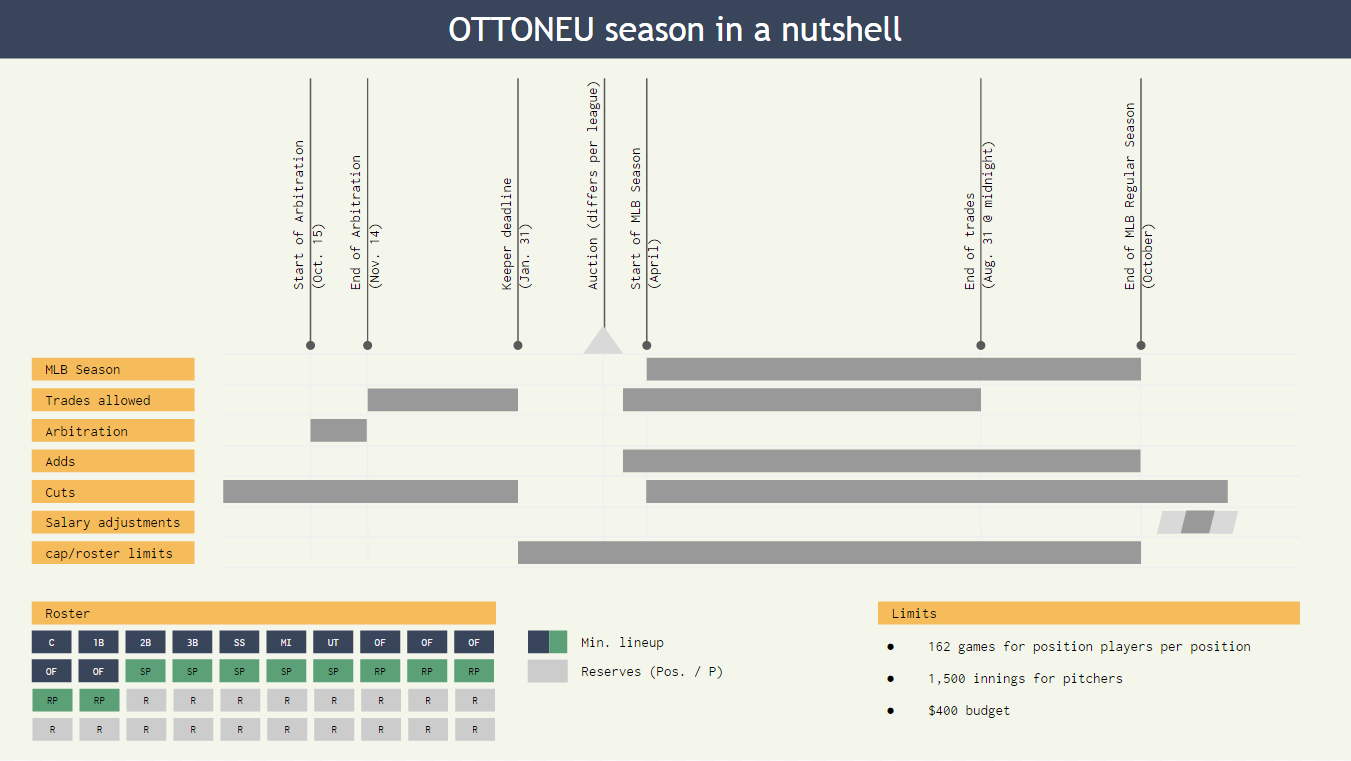
First, a snapshot of the Ottoneu Season (courtesy of ottoneu owner RJ Weise).

pasted-image-at-2016_11_09-09_24 Read the rest of this entry »


The Difficulty in Valuing Jose Abreu and Wil Myers

The beauty of our updated auction calculator is that it turns us all into masters of hindsight. Personally, I like to abuse this power by offering grating “I told you so” proclamations with little or no written accountability for the things I got wrong. But I also use the calculator to identify players who might be tough to evaluate going forward. Usually these players have greatly under-performed or outperformed their average draft prices and the sustainability of those performances is not always clear. Just because a player provided a certain end-of-season value doesn’t necessarily mean he’ll provide that value the next season. Obviously. Or if he does, that he’ll provide it by the same means. With that in mind, I’d like to look at a couple first basemen whose 2016 performances leave us with a muddled picture of how to value them going into next season.


Read the rest of this entry »


Let’s Get Real…muto


Sorry for the title. Let’s move on. At the start of this season, I recommended J.T. Realmuto as someone deep-league managers should target for his speed and his price. At the time, Realmuto was coming off a season in which he led his position in stolen bases during a year in which steals were at a 20 year low. He was also going 17th overall at catcher in public leagues, despite being picked 10th in NFBC drafts. Given that Realmuto popped 10 homers while lacking the typical red flags of a regression candidate, he seemed criminally overlooked during drafts and possibly primed for a breakout. So how’d he do?

Read the rest of this entry »


The Change: Catchers, Who Needs Them?

Well, it wouldn’t be much fun if the ball just rolled to the wall every time the pitcher threw it, so obviously the game needs a catcher, even if robot umps take over. But my impression of trying to draft stud catchers from year to year is that it’s folly.

Maybe because the position is so demanding defensively, my impression of their ability to hit is somewhere between ‘American League pitcher’ and ‘Defensive Replacement’. The numbers say that catchers debut later, but even that finding is muddied by late-career backup catcher debuts. Aging for catchers seems about the same, and finding value in a catcher is easy even if they hit 13% worse than league average as a group this year, worse than any other position players — you still need to fill the position, so even an okay batter should be valuable.

Still… am I crazy? It seems that catchers are more volatile, year to year, and I just want to shop in the bargain bin for the most part. Let’s jump in and see if I am loony tunes.

Read the rest of this entry »


Reviewing ottoneu Trades – Part I?

“Part I with a question mark?” you ask.

“Yes,” I answer. Today, I am going through every trade I made in one ottoneu league. I have no idea how this will play out, if it will lead to interesting conversation, or if you will all hate it. If you enjoy it, I will do the same for other leagues and there will be subsequent parts. If not, I won’t, and there won’t.
Read the rest of this entry »


The Chacon Zone and a Closer Look at Relief Pitchers in 2016

This season I had an idea for a recurring column called The Chacon Zone that never materialized (tip of the hat to @sporer for the name). The column would have been aimed at avoiding a common pitfall that I’ve succumbed to many times myself, improperly valuing saves and subsequently chasing them at my own peril. At what point does a closer’s poor performance negate the value of an occasional save?

I hoped to identify relief pitchers whose contributions in non-save categories would outweigh the Tony Cingranis and Brad Zieglers of the world. For a variety of reasons, most notably a lack of time and unusually low bullpen volatility early in the season, I never followed through. I’m hoping to rectify that with this end-of-season yet inaugural (?) edition of The Chacon Zone.

Read the rest of this entry »


The Sleeper and the Bust Episode: 397 – AL Playoff Talk

10/16/16

The latest episode of “The Sleeper and the Bust” is live!

Follow us on Twitter

Notable Transactions/Rumors/Articles/Game Play

Read the rest of this entry »

01:01:14

Reviewing Eno Sarris’ Bold Predictions

I usually get three or four of these Bold Predictions right every year, and I’ve grown comfortable with that level of success. Any more and they aren’t bold enough, any less, and they’re useless. That said, wait till you see number one. It’s a doozy. It’s *so* wrong that it should probably invalidate all my hits. It’s *so* wrong that I’m questioning why any of you are here right now. It’s *so* wrong I want to throw crap.

Read the rest of this entry »


Last Call: Predicting the Playoffs

As our regular readers, assuming optimistically that we have any, probably know, it was a disappointing Fantasy season for us. But are we discouraged? Not we! Rising on stepping stones of our dead selves to higher things, we have embraced the challenge (despite the punishing vig) of the NFBC Post-Season Contest.

Contest rules, predictions, and entries in a moment. But first, allow us to note that we’re a bit better at predicting outcomes at the team level than at the individual level. Thus, aside from the virtually-infallible Brett Talley, we alone among 55 Fangraphs writers predicted that Seattle would make it to the wildcard game. That’s right, spoilsport; they didn’t. But they came close. And, in the spirit of scientific inquiry, we now know the exact difference between having Lloyd McClendon as your manager and having someone else as your manager. (10 games.) We also envisioned that new manager Dave Roberts would assemble a bullpen that would enable the Dodgers to get from the fifth or sixth inning to Kenley Jansen, and we were right, although (except for Joe Blanton) we were wrong about the guys he’d assemble it with. And finally, our proudest accomplishment: we were four-for-four in our preseason over-under predictions, and the spiritual succor we derive almost offsets the fact that it did us no financial good whatever.

Back to the contest. It entails picking a lineup for the first round of the playoffs, resetting for the second round, and resetting again for the World Series. Rosters consist of ten hitters and six pitchers, with at least one guy and no more than three from each of the playoff teams in the first round. The big gimmick of the contest is the “Scoring Multiplier”: a player’s points total in a given week doubles if he’s on your roster the next week; his point total for the first round triples if he’s still around for the World Series. Since there’s a premium on picking players who make it to the succeeding rounds, you want to be right about which teams win. It also appears to us that the rules favor home runs unduly, and tilt slightly in the direction of starting pitchers and against closers (forget about non-closer relievers). And of course, to the extent it comports with what you actually think might happen, you want to be contrarian.

So here’s how we see the playoffs: Read the rest of this entry »