Archive for Starting Pitchers

Ottoneu: Jake’s 2026 Keep or Cut Decisions at SP

Credit: David Richard-Imagn Images

The Ottoneu keeper deadline is quickly approaching. There’s less than a month left to make your roster decisions before the January 31 cut deadline. I’m going through a handful of difficult keep or cut decisions at every position group to give you a transparent look at my decision making process and hopefully help you with theses specific cases for these specific players. I’ve already covered hitters in three separate articles — corner infielders, middle infielders, and outfielders — now I’m wrapping everything by covering three starting pitchers.

–

Kodai Senga, SP
Salary: $16, $17
Average Salary: $18
2025 P/G: 4.33
Projected 2026 P/G: 4.16

I’m not sure the Mets know what to do with Kodai Senga so I wouldn’t blame you if you didn’t know what to do with him on your fantasy squad. Injuries cost him nearly all of 2024 and a hamstring injury in June derailed his season a year later. Before that injury, he had put up a 1.47 ERA and a 3.24 FIP in 13 starts. During the rehab from his injury, his mechanics were thrown out of whack, and after he returned to the majors, he produced a 5.90 ERA and 5.76 FIP across nine starts. Ultimately, he was demoted to Triple-A in September to work on those mechanical inconsistencies.

Even if Senga is completely healthy in 2026, there were enough yellow flags in his first-half performance that a rebound back to the level of his excellent 2023 debut isn’t necessarily guaranteed. During those first 13 starts of the season, his strikeout-minus-walk rate was 13.3%, just a hair below league average and well short of the 18.0% K-BB% he posted during his first season in the US. Most of that was driven by a significant drop in strikeout rate.

You could point to his signature pitch, the ghost fork, as the reason why he wasn’t seeing as many swings and misses in 2025. And while that pitch was a little less effective last year, it was his cutter that saw the most dramatic drop in effectiveness. In 2023, his cutter was the fourth most valuable pitch in baseball by Run Value with a 2.9 RV/100, far outpacing his forkball (1.0 RV/100). In 2025, his cutter was exactly neutral with a 0.0 RV/100. Unlike his diving forkball, Senga’s cutter was a contact suppression machine during its peak, but batters made much higher quality contact against that pitch last year. That combination — a forkball that wasn’t getting as many swings and misses and a cutter that wasn’t generating as much weak contact — has me worried that Senga’s ceiling is far lower than we might think.

The projections are picking up on those concerns and see Senga taking a pretty significant step back in 2026. Health concerns aside, there are enough flags in his pitch arsenal that present enough risk to steer clear. And when you add his mechanical issues and injury history back into the picture, it’s a pretty easy call to avoid paying too high a price for Senga in 2026.

Keep or cut?

I’m cutting Senga in both of my leagues where I’m rostering him and I doubt I’ll be looking to redraft him in the spring.

–

Gavin Williams, SP
Salary: $11, $9, $8
Average Salary: $9
2025 P/G: 4.22
Projected 2026 P/G: 4.03

Through his first 11 starts of the year, Gavin Williams put up a rough 4.27 ERA and 4.65 FIP. It wasn’t terrible, but it was a concerning start to the season after an up-and-down year in 2024. From the beginning of June through the end of the season, his ERA fell by nearly two full runs down to 2.50 but his FIP only dropped to 4.27. His strikeout-to-walk ratio improved slightly during those final four months of the season but the biggest reason his ERA improved was thanks to a .221 BABIP and a 87.5% strand rate. Most of his underlying peripherals pointed to the same pitcher on the mound, but a ton of good batted ball luck helped him flip his season.

For Ottoneu players, an improved ERA shouldn’t necessarily help Williams’s fantasy production and a FIP above four is usually a bad sign. But here’s where understanding the ins and outs of your given format becomes extremely important.

Gavin Williams, Ottoneu Points Performance
Time Period FIP BABIP FGpts/IP SABRpts/IP
Prior to June 4.65 0.323 3.43 3.47
June Onward 4.27 0.221 4.57 3.86

In Ottoneu leagues using the FanGraphs points system — which critically takes hits allowed into account — Williams dramatically improved his production during the later half of the season. In leagues using the SABR points system — using only the inputs for FIP — Williams’s season was frustrating from start to finish.

As for Williams’s pitch arsenal, he was able to develop a very effective sweeper last year that returned a 44.0% whiff rate. That’s an excellent pitch to add to his repertoire, though his lack of command holds him back from really raising his ceiling. That’s sort of the big issue with his profile. He has a good, hard fastball, two excellent breaking balls, but he needed some incredible batted ball luck to turn into an effective pitcher for fantasy. His command was still an issue throughout the season, leading to some pretty inconsistent outings. Still, his Location+ improved from 91 during the first two months to 96 through the end of the year. That’s something to build off of, but until he’s able to make some significant improvements in that area, I fear his excellent stuff will be held back from reaching its maximum potential.

Keep or cut?

Thankfully, all three leagues where I’m rostering Williams use FanGraphs points, so I was able to partially enjoy his second half improvements in 2025. I’m probably keeping him at $8 and $9 but I think I’ll be cutting him at $11. His inconsistencies and command issues make him a risk to roster at a double-digit salary.

–

Yusei Kikuchi, SP
Salary: $5
Average Salary: $8
2025 P/G: 3.78
Projected 2026 P/G: 4.09

Coming off what seemed to be a mini-breakout during his short 10 start stint with the Astros during the second half of 2024, Yusei Kikuchi latched on with the Angels last year. Even though he was leaving the pitching development powerhouse in Houston, I expected the changes he implemented while he was there to stick in Los Angeles. Unfortunately, they didn’t. Some mechanical issues led to a drop in velocity and a lower arm slot affected the shapes of all his pitches. He spent most of the season working out the kinks in his delivery, slowly raising his arm slot and regaining some of his velocity.

I think the thing that worries me the most is the effectiveness of Kikuchi’s fastball. He’s one of the hardest throwing left-handers in baseball, but he’s entering his age-35 season in 2026. His velocity dropped early last year, and even though he regained it in the middle of the season, it dropped again in August and September and his results tanked along with it.
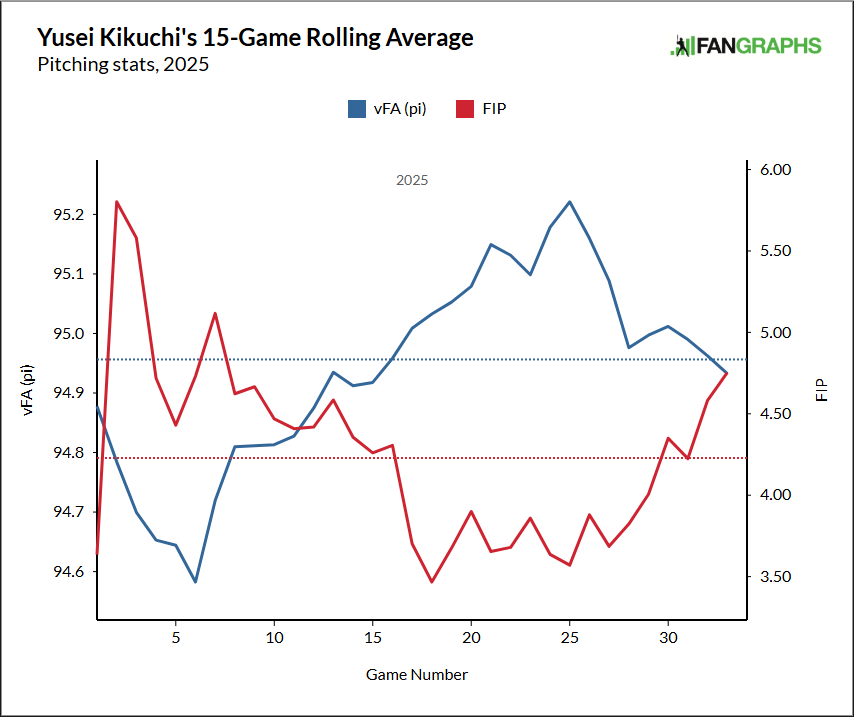
Last year, he generated the lowest whiff rate on his fastball since his debut season in 2019. Both his slider and changeup were a little less effective at getting swings and misses too. It all added up to a 5.5 point drop in strikeout rate and a much higher walk rate that was more in line with what he was posting during his time in Seattle.

Kikuchi has never been a model of consistency during his career. He’ll have dominant stretches from time to time, but his command issues have often held him back from reaching his ceiling. It looked like he had turned a corner in Toronto and Houston in 2023 and ‘24, but he came crashing back down last year thanks to his mechanical troubles. Steamer projects a small bounce back but he’s getting to the point in his career where the velocity of his fastball is sitting on a knife’s edge; dip just a little and the whole repertoire comes crashing down.

Keep or cut?

$5 is probably the highest I’d want to roster Kikuchi for heading into next season. There’s always the possibility he’ll figure out his mechanics over the offseason and post another strong season like he did in 2024, but there are too many flags to risk anything higher than that. I’ll probably keep him at $5, but he’s a quick cut if his fastball isn’t looking good in the spring.
Starting Pitcher ADP Market Report: 12/27/2025

As we hit the beginning of draft season, it is important to monitor where players are being drafted on a regular basis. Throughout draft season, I will be doing that work for you with regular updates on the Average Draft Position on NFBC up until Opening Day. You can read all the Market Reports here.

Read the rest of this entry »


Dylan Cease Returns to AL, Heads to Blue Jays

Mandatory Credit: David Frerker-Imagn Images

Just before Thanksgiving, the Blue Jays signed Dylan Cease to a seven-year, $210 million contract. He now returns to the American League, where he spent five seasons with the White Sox before joining the Padres for two seasons. Coming off the second worst ERA over a full season in his career, how might his new park affect his results? Let’s consult the park factors to find out.

Read the rest of this entry »


Sonny Gray Returns to AL, Heads to Beantown

Mandatory Credit: Jeff Curry-Imagn Images

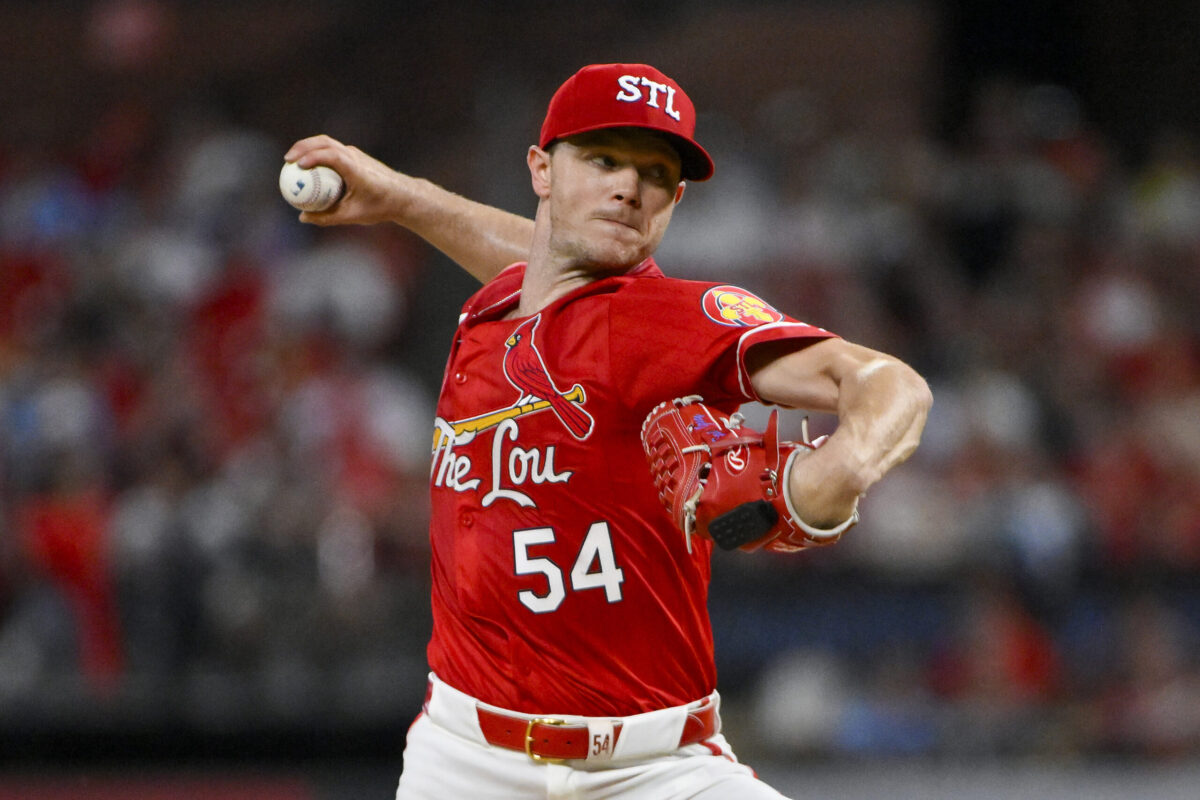
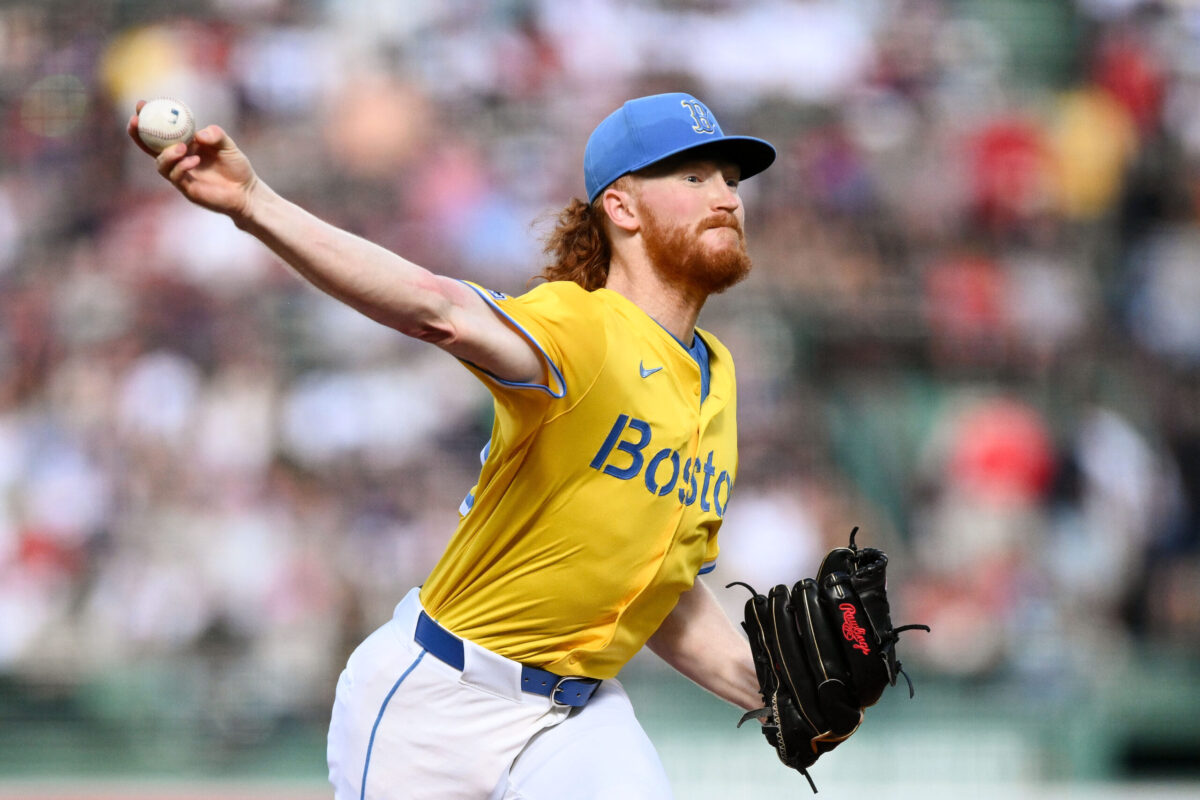
Last Tuesday, the Red Sox acquired Sonny Gray from the Cardinals, allowing him to don his sixth uniform in 10 seasons. It’s pretty surprising to see a guy with a career ERA- of 87 to be constantly packing his bags to join a new team, but perhaps the positive spin is that so many organizations want him! After spending two seasons calling Busch Stadium home, let’s dive into the park factors to find out how the move to Fenway Park might impacts his results.

Read the rest of this entry »


Early Starting Pitcher Stuff+, Injury Returnees & Rookies — A Review

Mandatory Credit: Brian Fluharty-Imagn Images

A couple of weeks ago, I reviewed the early starting pitcher Stuff+ risers and fallers. Unfortunately, comparing 2025 Stuff+ to 2024 Stuff+ meant that I was missing a whole group of potentially interesting pitchers to evaluate — both injury returnees and rookies. So I dedicated a post to reviewing these two groups’ Stuff+, but without any comparisons to the previous season. Let’s find out how they finished the season.

Read the rest of this entry »


Starting Pitcher Stuff+ Risers & Fallers – Apr 28 2025, A Review

Mandatory Credit: Jayne Kamin-Oncea-Imagn Images

In late April, after about a month of the season was in the books, I compared starting pitcher Stuff+ grades to their marks from the 2024 season, identifying the risers and fallers. Just like with any other metric, could pitcher go on a stuff hot streak or suffer through a slump? Or does such changes early on tend to stick? Let’s review the names to see how they finished the season in both Stuff+ and strikeout rate, which correlates strongly with the former.

Read the rest of this entry »


Early 2025 Starting Pitcher Velocity Changes — A Review

Mandatory Credit: Bill Streicher-Imagn Images

The preseason and early season reviews continue! Today, I’m going to review the early starting pitcher velocity changes to find out if the gainers held onto their gains and if the decliners suffered their losses all year. Since we know that fastball velocity positively correlates with strikeout rate, I’ve included the change from 2024 to 2025 as well to see if both moved in the same direction.

Read the rest of this entry »


Jake’s Ottoneu Drip in Review

Credit: Daniel Kucin Jr.-Imagn Images

The theme of this offseason for the Ottoneu wing of RotoGraphs is self-reflection and accountability. I’ve already gone through some of the lessons I learned from the big mistakes I made this year and reviewed my bold predictions. Last week, Chad Young reviewed his weekly Hot/Cold Right Now column to see if the advice he was giving throughout the season was useful and actionable.

Following in Chad’s footsteps, I’d like to review my semi-regular Ottoneu Drip articles. The goal of this column is to identify under-rostered pitchers who might be able to help your team in both the short- and long-term. By its very nature — limiting analysis to pitchers owned less than 60% across all Ottoneu leagues — the hit rate on my advice is pretty low. These pitchers aren’t rostered for good reasons. Still, I was able to uncover a handful of very valuable pitchers who produced excellently over the long-term and there were a few more short-term wins that could have helped throughout the season.

I wrote eight Ottoneu Drip articles during the season with a bonus article written for the final weekend of the season that I opted not to include in my analysis. I identified 64 pitchers in these articles — 54 of them unique — and I graded my advice along the same 1–5 scale that Chad used in his Hot/Cold review:

  1. Bad advice, this pitcher was bad over the short- and long-term.
  2. Didn’t work out, but there might have been some short-term value there.
  3. Neutral, there might have been some short-term value or the possibility of long-term value if you squint.
  4. Good advice that had some strong long-term value or extended short-term value.
  5. Solidly good advice that had excellent long-term value.

Here’s what I found:

  • My average score was 2.53. If you ignore the article posted after the first weekend of the regular season on April 1, the average is slightly boosted to 2.70.
  • That April 1 article was a disaster. All eight of the pitchers were busts; the average rest-of-season FIP in that group was 4.85 and the average rest-of-season P/IP was a ghastly 2.91. Two of pitchers identified in that article — JP Sears and Mitchell Parker — returned some slight short-term value over the next few weeks but they eventually turned into pumpkins. I guess the lesson there is to not jump to any conclusions based on a single start and wait for a bit of a bigger sample before making any recommendations.
  • It shouldn’t surprise, then, to see that my average score from June through August was 2.74, half a point higher than it was in April and May. Making recommendations with a larger body of work to reference is a lot easier than taking a shot in the dark.
  • There was one outlier article in April posted on the 16th. In that piece, I identified Tyler Mahle, Matthew Liberatore, Randy Rodríguez, Phil Maton, and Gabe Speier as pitchers with plenty of short- and long-term value. Mahle and Liberatore eventually succumbed to injury and fatigue, respectively, but they were solid pitchers for most of the spring and early summer. Rodríguez was one of the best relief pitchers in baseball this year but Tommy John surgery will keep him from providing any value next year unfortunately.
  • I had a lot more success identifying relief pitchers (3.0 average score) than starting pitchers (2.3). Along with the trio above, I also called out Will Vest, Brendon Little, Garrett Whitlock, Louis Varland, Reid Detmers, and Seranthony Domínguez as helpful relievers before they were snatched off the waiver wire. My most successful starting pitcher recommendations included Trevor Rogers, Ryne Nelson, Ian Seymour, Chad Patrick, Quinn Priester, Mike Burrows, Mahle, and Liberatore.
  • If you had somehow managed to follow every single one of my recommendations, you would have added 3.28 P/IP over the following 30 days after the article was published. And you would have added 3.46 P/IP over the rest of the season.

I have no idea what any of these results mean in context. That amount of analysis will have to come next year with this year as a baseline. I do think I need to be a bit more careful about recommending players so early in the season. It’s easy to take one strong start with some interesting velocity readings and assume the pitcher is about to breakout — I’m looking at you Jordan Hicks. I also think I need to follow Chad’s lead and evaluate fewer players more deeply. A deeper dive into some of these early season picks would have likely revealed that nothing under the hood had really changed.

What’s your feedback? Is this column useful? Is my 60% rostered threshold too low (or too high)? Any changes you’d like to see?


Building a 2025 $9 NFBC Pitching Staff — A Review

Mandatory Credit: Jerome Miron-Imagn Images

Yesterday, I reviewed my $14 NFBC offense, filled with 14 hitters with an average auction value of $1 in late February when I published my imaginary roster. Today, let’s now flip over to reviewing my fake $9 pitching staff. I would imagine it’s easier to hit on some big wins from the crop of $1 pitchers than $1 hitters, so let’s see if that was the case this year. As a reminder, I rostered three true hits on the hitting side, composing just over 21% of my team. Did I do better on the pitching side?

Read the rest of this entry »


Reviewing 2024’s Biggest IP Risers A Year Later

Lexi Thompson-Imagn Images

The ever-shrinking share of innings going to starting pitchers in today’s game has us focusing on volume more than ever. “Bankable” these days is someone with back-to-back 150+ IP seasons, a total that doesn’t even qualify for the ERA title (requires at least 162). A blind spot in my analysis has been that I don’t follow up the year after their surge. I’ll read or even create content in the spring of a given year highlighting the big IP gainers from the previous year just so people are knowledgeable about the big spikes, but I don’t circle back to see what those guys did for an encore.

We will look at the biggest IP gainers from 2023 to 2024 and see how their 2025 fared. There were 21 pitchers who added at least 75 innings in 2024 and they’ll serve as our focus group here broken down into a few clusters. Later in the offseason, I’ll take a closer look at the 2025 IP gainers with some thoughts on their 2026 outlook.

100+ IP HEROES

100+ Inning Heroes
Name Team 2025 IP 2024 IP 2023 IP 23-24 Inn. Chg. 23-24 FIP Chg. 24-25 Inn. Chg. 24-25 FIP Chg.
Frankie Montas NYM 39 151 1 149 0.70 -112 0.63
Garrett Crochet BOS 205 146 13 133 -3.02 59 0.20
Simeon W.Richardson MIN 111 134 5 129 -1.71 -22 0.40
Ryan Feltner COL 30 162 43 119 -0.02 -132 0.23
Ronel Blanco HOU 48 167 52 115 -1.84 -119 0.13
Tarik Skubal DET 195 192 80 112 0.50 3 -0.05
Nestor Cortes 3TMS 34 174 63 111 -0.65 -140 4.45
Carlos Rodón NYY 195 175 64 111 -1.40 20 -0.61
Trevor Rogers BAL 110 124 18 106 0.43 -15 -1.70

Nine pitchers added at least 100 innings in 2024, averaging just 38 innings per season in 2023 before surging to 158 per in 2024. Meanwhile, the group’s average FIP dropped as well, down 78 points to 3.89.

Frankie Montas essentially missed all of 2023 with just 1.3 IP so virtually all of his 2024 was surplus. Unfortunately, the results weren’t anywhere near his 2021-22 output (3.55 FIP). An early-spring lat injury kept anyone from investing so his flop season with the Mets (39 IP of 6.28 ERA and TJ surgery) wasn’t really felt on the fantasy landscape.

Garrett Crochet, Tarik Skubal, and Carlos Rodón are the major outliers on the list, all adding volume to their 2025 total with elite production. Crochet’s FIP went up, but only 20 pts to 2.89 in 205.3 IP, most in the AL. Skubal, of course, is headed toward a second straight Cy Young win. Rodón did have a 1.40 improvement on his FIP in 2024 but that only got him to 4.39, though 16 Ws and 195s Ks helped him still finish SP42. He was back to stud Rodón this year with an SP10 finish.

Simeon Woods Richardson couldn’t maintain his 2024 volume, but he did still lower his ERA and WHIP despite the 40-point jump in FIP. He delivered occasional streamer value en route to a 4.04 ERA/1.28 WHIP in 111 IP.

Ronel Blanco was felled by TJ (internal brace version) which is a bummer because I would’ve liked to see how he followed up his breakout season. His skills remained intact with a 14% K-BB and he was still extremely difficult to square up with a .207 AVG against. Now he’ll miss most of 2026 and have to climb back up the hill at age-33 in 2027.

Nestor Cortes had a disastrous Opening Day in Yankee Stadium (8 ER), was traded to San Diego during a 4-month injury absence and looked decent again in his August return before a torn biceps injury cut him down and will now keep him out for half of 2026. He is completely off the fantasy radar at this point.

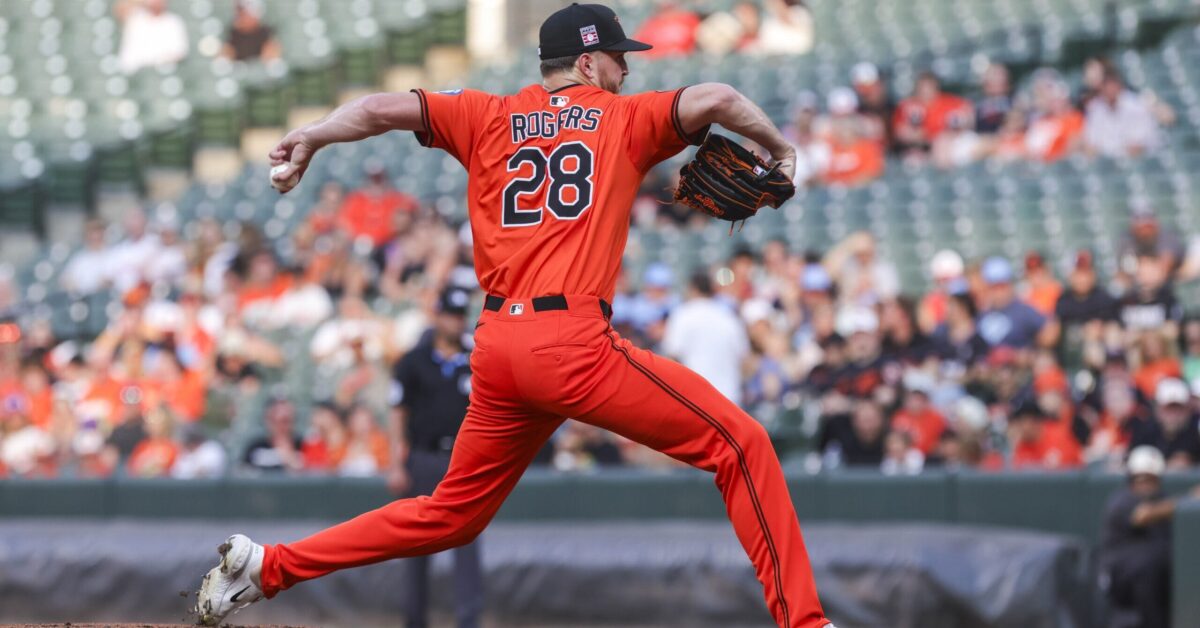
Trevor Rogers is the most unique case on the board. He ramped back up to 153 innings if you count his MiLB work but struggled so much that he became an fantasy afterthought. He was also going to miss upwards of two months to start the 2025 season leaving no reason to draft him anywhere outside of maaaaybe a last 2-3 round Hail Mary in Draft Champions. Instead, he became arguably the fantasy pickup of the season (at least pitcher pickup; Nick Kurtz is really tough to beat for the overall best pickup). He had an elite season debut on the backend of a doubleheader against Boston in late-May but was sent back down for over three more weeks before settling in for the stretch run. Now he’s the de facto ace of the O’s and positioned to be a mid-rotation fantasy arm in 2026. The return of his velocity (+1.2 to 93.1 mph) and razor-sharp skills (18% K-BB) have me ready to buy back in at the draft table.

Looking at 2025, the group’s average output dropped to 107 IP but the collective FIP improved as only Cortes and Montas were bad — both for fewer than 40 innings, though, so not a lot of damage came from them.

85-99 IP SURGES

85-99 IP Surges
Name Team 2025 IP 2024 IP 2023 IP 23-24 Inn. Chg. 23-24 FIP Chg. 24-25 Inn. Chg. 24-25 FIP Chg.
Max Fried NYY 195 174 78 97 0.19 21 -0.26
Jose Quintana MIL 132 170 76 95 1.04 -39 0.25
Luis Severino ATH 163 182 89 93 -1.93 -19 -0.10
Cole Ragans KCR 62 186 96 90 -0.20 -125 -0.49
Kyle Harrison SFG/BOS 36 124 35 90 -1.20 -89 -0.61
Ryan Pepiot TBR 168 130 42 88 -0.23 38 0.41
Brandon Pfaadt ARI 177 182 96 86 -1.58 -5 0.61

The seven pitchers featured here came with a lot of hype for 2025 thanks to a couple fantasy aces and several young arms on the rise. Their 164 IP average actually tops the first group, but they are coming from higher 2023 totals so only an average of +91 IP. They also clipped the first group in 2024 FIP with a 3.89 mark.

Max Fried was either your 2/3 if you were pitching-forward or the ace for a team waiting on starters and he delivered with an SP11 finish. His 195 innings mitigate the strikeout rate issues as his 189 total tied for 14th-most. The 19 Ws play a big role in that finish as well, but it’s not like his 2.86 ERA/1.10 WHIP combo is anything shy of fantastic meaning even if win volatility gets the best of him next year, there is still a firm skills floor here. He also now has at least 165 IP in 4 of the last five seasons. I’m still getting used to that being workhorse adjacent (18th in IP since 2021), but that’s where we are today.

Cole Ragans laid such strong groundwork in 12 starts with the Royals in 2023 that his breakout 2024 wasn’t a huge shock. In fact, paired together he had 258 IP of a 3.00 ERA/1.12 WHIP and ascended into a top 50 overall ADP for 2015. He showed flashes of greatness, including a 3-start, 31-strikeout run right out of the gate, but he sputtered in May and injuries limited his ability to ever recover leaving him with a 4.67 ERA/1.18 WHIP in 62 IP. He did finish strong in three abbreviated September starts (2.77 ERA/0.77 WHIP/22 Ks in 13 IP) and posted 38% K rate on the year, both of which have buying back in even at a continued high price. Nothing about his season has me less confident in his ability. He might not stay healthy in 2026, either, but I’ll bet on the talent.

Ryan Pepiot and Brandon Pfaadt were both big breakout picks with similar ADPs and a lot of crossover amongst their ardent supporters. Both were building on sharp small samples from the year before and played on teams capable of supporting a quality young arm (at least we thought so coming into the season, both clubs wound up sub-.500 and short of expectations). Results aside, it is encouraging that both managed big IP totals again this year. Pepiot added 38 IP up to a career-high 168 while Pfaadt’s 5 IP dip was more because of performance as he actually managed 1 more start than 2024 with 33 (Logan Webb stood alone with 34).

The “results aside” caveat was really just for Pfaadt as his excellent 5% BB rate (3rd in MLB) was essentially wasted by the 1.3 HR9 and .316 BABIP. There’s a case he’s just in the zone too much as neither problem is new (career 1.4, .315). Pepiot didn’t reach the lofty heights I had for him in my Bold Predictions, but he gave you what you paid for: SP46 ADP, SP45 season finish.

I’ve been using FIP as the easy catchall here but it does obscure the success of someone like Jose Quintana who posted a 3.96 ERA, nearly a run lower than his 4.81 FIP. And he was likely curated to an even better ERA by many of his fantasy managers as a streamer. He ended the season with a 7.40 ERA in his final four starts, but most managers likely avoided the bulk if not all of those starts given the matchups (ARI, PHI, TEX, STL). In short, a quality streamer who even found shallow league viability early on as he posted a sub-3.00 ERA through his first 10 starts.

The market was keen to what Sacramento’s park could do to Luis Severino after his rebirth with the Mets in 2024. His early-300s ADP was even too high for his SP161 finish, but his buyers went in eyes wide open to the potential trouble at that stadium. Sometimes playing a home/road split with a pitcher is dangerous, but Sevvy proved incredibly bankable depending on venue. He was completely unusable in Sacramento with a 6.01 ERA/1.53 WHIP and wasn’t shy about how he felt pitching there. Meanwhile, he was a ratios stud on the road with a 3.02 ERA/1.07 WHIP. If he is traded out and lands in the right spot, he could be a worthy bounce back bet for next season, but if he remains with Sacramento then he’ll stay a venue-focused streamer which is a scary player class to bet on.

Kyle Harrison had a whirlwind first half with the Giants. He started in the minors and then spent time in the bullpen after a promotion back to SF, capped off by a brief stint in the Giants rotation before his inclusion in the huge Rafael Devers trade that put him on the Red Sox. They sent him back to the minors until September when they gave him a relief appearance and two starts. He was a bit different with the Red Sox, but not really in obvious standout ways. His velo was down nearly 2 mph to 93.4 but he threw a lot fewer fastballs (-13 pts to 52% usage), funneling most of that into his 87 mph cutter (11% usage) while also amplifying his curve usage 7 pts to 32%. For more on his changes with Boston, check out this David Laurila piece. He did enough to get back on my radar. A former big time prospect who will be just 24 years old in an organization that has done some intriguing things with starting pitchers is a winning formula for a quality late-round pick.

75-84 IP JUMPS

75-84 IP Jumps
Name Team 2025 IP 2024 IP 2023 IP 23-24 Inn. Chg. 23-24 FIP Chg. 24-25 Inn. Chg. 24-25 FIP Chg.
Chris Paddack MIN/DET 158 88 5 83 0.93 70 0.84
Cristopher Sánchez PHI 202 182 99 82 -0.99 20 -0.44
Nick Lodolo CIN 157 115 34 81 -1.84 41 -0.14
Carson Fulmer LAA 29 87 10 77 -0.35 -57 0.20
Chris Sale ATL 126 178 103 75 -1.71 -52 0.59

Our final group features three studs (Sánchez, Lodolo, Sale) and two duds (Paddack, Fulmer). It was the only group who saw their 2025 output go up as the gains of Paddack, Sánchez, and Lodolo cancelled out the 50+ inning dips of Sale and Fulmer. Paddack keeps them from improving their FIP as a whole, but no one felt bad about investing in the three studs even with Sale dropping his IP count so much.

Cristopher Sánchez showed that 2024 was just the beginning for him, pitching quite a bit better in 2025 with a 2.50 ERA/1.06 WHIP combo in a career-high 202 innings, up 20 from his 2024 total. His SP6 finish might perfectly portend his 2026 ADP. He could even secure the 5-spot after Skubal, Yamamoto, Skenes, and Crochet.

At age-36 and litany of injuries on his ledger, it was hard to expect another 170+ innings from Chris Sale but I was confident that the innings we did get would be good. And that’s how it all played out: he pitched 126 innings with a sparkling 2.58 ERA/1.07 WHIP combo with a near-identical 26% K-BB rate (-0.4 from 2024). Where do we go from here, though? He can be a top 25-30 SP with even just 100 innings if they’re good enough, but what price are you willing to pay for the 37-year-old southpaw? I know he’s not coming off a Cy Young win again, but I’m not sure he drops all that far off his 36 ADP from 2025.

Nick Lodolo missed most of August and some of September, but otherwise had a great season. He took the compelling skills we saw in 2024 and turned ‘em into results in 2025. Like teammate Hunter Greene, his HR rate jumped back up in 2025 but his control improvements mitigated any damage from the added homers. He will likely be a big fantasy target for his believers next season and even drum up some longshot Cy Young chatter.

Chris Paddack was a passable backend innings eater for the Twins but a gigantic surge in homers (+1.3 to 2.7 HR9) tanked his time with the Tigers and snuffed out the last remnants of fantasy value that might’ve been lurking.

—

The ultimate takeaway here is that I don’t think an innings surge alone should change how you feel about a pitcher. You should probably expect fewer innings (-31 on average among the 21 pitchers studied here), but outside of Cortes’s 35 IP meltdown the performance of the collective group didn’t really fall off. There will be some tricky cases to investigate such Matthew Boyd and Drew Rasmussen and again, I’ll take a deeper look at the 2025 gainers later into the offseason.