Archive for Projections

Ottoneu Top 100 Starting Pitchers for 2020

Using a format similar to the one Justin Mason recently posted for 2020 Roto player rankings, below is the 2020 ranking of the Top 100 Starting Pitchers for Ottoneu fantasy baseball.  Ottoneu leagues are auction style, but with no salaries listed (league dependent), think of these lists as simplified “snake draft” rankings (“which player would I take before the next”), or a value ranking of players above replacement level for 2020. Players with multi-position eligibility may receive a slight bump in value (2020 positions listed).  You can reference average Ottoneu player salaries here, but keep in mind these salaries fluctuate throughout the winter as rosters shape up towards today’s keeper deadline for all leagues.

Previous 2020 Ottoneu rankings:

First Base

Third Base

Middle Infielders

Shortstop

Second Base

Outfield

Since a majority of Ottoneu leagues are points leagues (pitching based on linear weights), WHIP and Wins are less of a factor here than in traditional rotisserie rankings.  Even if you don’t play Ottoneu, this list might be a good proxy for sabermetric leagues, so keep that context in mind as you review. “P/IP” represents the projected points per innings pitched from Steamer projections and their estimated innings total.

If I’ve missed an important player, or you believe I’ve wildly over or under-valued someone, please let me know in the comments and I’ll be sure to update.

Read the rest of this entry »


Foreign Player Evaluations & Projections

Since I’m starting drafts, I decided I needed projections for seven of the players signing from Asia, either new to the MLB or returning. I could just pull a ranking out of my ass, but I figured I should at least start with a projection before inserting my own biases. For the following projections, I averaged the ZiPS and Clay Davenport projections and then add my own playing time adjustment.

Pitchers

Pierce Johnson
From the NRB
Signed with the Padres

2020 Projections for Pierce Johnson
Projection IP G GS W K SV ERA WHIP
ZiPS 57.3 60 0 3 64 0 3.77 1.26
Davenport 59.7 54 0 3 76 2 3.32 1.18
Average 60.0 59 0 3 72 1 3.55 1.22
My Playing Time Adjustment 50.0 49 0 3 60 1 3.55 1.22

Read the rest of this entry »


The 2020 ATC Projections

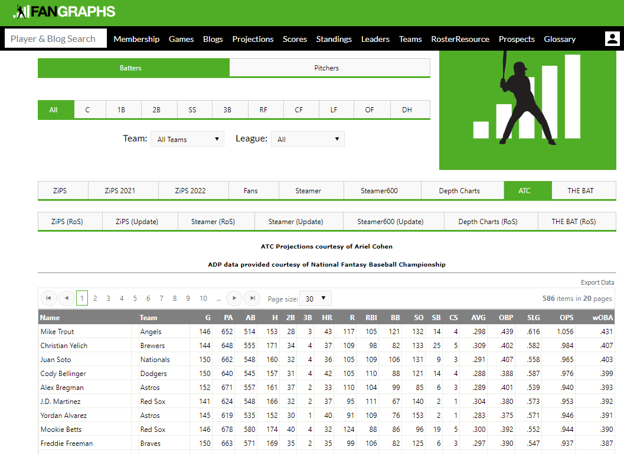
The first cut of the 2020 ATC Projections have arrived! Fantasy baseball draft prep season is now officially ready to be thrusted into high gear!

There are three ways to view and utilize the ATC projections on this site.

  • Full Projections
  • Individual Player Pages
  • Auction Calculator

Full Projections

The full ATC projections can be found by heading to the “Projections” drop-down tab on the menu bar by clicking on “ATC.”

Read the rest of this entry »


Should I Care About Sprint Speed?

Sprint Speed values have been publicly available for a few seasons. While I see it mentioned for this or that, I don’t know how predictive it is or if should I care about it at all. After analyzing the data, Sprint Speed might need to be ignored in favor of Time-to-First. The stopwatch still rules.

The key, in my opinion, is if the ability to run fast can be predictive in any way. No one that I know of is playing in a Sprint Score league, so the speed with have a secondary effect. If a player is running slower, do their stolen bases drop? How about how many infield hits they can leg out? Generally, how will the players change in speed affect their stolen bases and batting average.

One factor to keep in mind is that the aging curve for stolen bases is just a drop with all humans reaching their peak sprinting speed in their early 20’s.  There are going to be a lot of negative speed values coming up but that’s just aging pulling players down.

A second factor to remember is that teams are not allowing hitters to run as much. In 2015, there were over 2500 stolen bases league-wide. Last season, the value was under 2300 for a 9% decline. Again, more negative numbers.

Sprint Speed was first introduced in 2015 at Baseball Savant (links to Time-to-First values) and it is widely cited. Sprint Speed is not the only measured speed metric available. For one fewer season, Baseball Savant has each hitter’s run times to first base which have been the traditional measure of a player’s speed and it’s still used in scouting players. With the two metrics, it’s table time to what conclusions can be drawn.

Read the rest of this entry »


Steamer vs NFBC 2020 – Batting Average Bargains

In my last two columns, I uncovered potential undervalued speedsters and power bats by comparing the Steamer projections to the current NFBC ADP. The exercise now continues this week for batting average.

In 2019, there were 55 qualified players with least a .280 batting average. There were 36 players above the .290 mark, and 19 above .300. Tim Anderson led all of baseball with a .335 BA, followed by National Leaguers Christian Yelich and Ketel Marte who each hit .329.

Though 2019 had almost two dozen players who hit at least .300, you won’t find a projection set that will have that many BA studs. Projections are typically more conservative. Steamer only projects 17 regular players to bat over .290 in 2020, and only 5 players to eclipse the .300 mark.

For this year’s potential batting average bargains, we will focus on all players with a Steamer projection of a .278 BA or more. This will give us a number of players who can greatly help your fantasy team’s batting average in in 2020.

For these draft value comparisons, I look at:

  • The player ranks as computed by the FanGraphs Auction Calculator with Steamer projections (standard NFBC 15 team roto league settings).
  • The current NFBC ADP (of Draft Championship leagues from December 4, 2019 to present).

Read the rest of this entry »


Are Catchers a More Volatile Than Other Position Players?

How to correctly value catchers has always been up for debate. As a position, they are by far the worst hitters in the league. Last season, catchers posted a .713 OPS while second basemen were next with a .745 OPS. Most player calculations give catchers a valuation boost to attempt to even them out with the other hitters. This theoretical boost always exceeds the actual cost paid by draft picks or auction dollars. I assumed some experts knew more than me (safe bet) and the catcher projections have a wider range of outcomes. Owners don’t want to pay for these gambles. By examining historical values, I found the complete opposite. Catcher projections are the least volatile.

I’m not going to rehash why catchers need a positional adjustment. I’ve written a whole section on it in The Process. For anyone new to the subject or just wants a refresher, Ariel Cohen wrote an in-depth article on the subject.
Read the rest of this entry »


Playing Through an Injury Hurts Future Performance

I was wrong. About seven years ago, I wrote on how hitters may overperform their projections since they played through an injury. The injury hampered their production in the season in question, lowered the future projection, and created a buying opportunity. For years, I believed this steadily until last season when I re-ran the numbers and found “jack squat”.

Earlier this week, I examined some of this past season’s hitters who fought through the pain and felt a deeper analysis was needed. I dove in and the results were backwards. I found no bounceback should be expected from hitters who played through injuries, but there is more. For those hitters who play through the discomfort, their future production will take a major hit.

The key to uncovering the following results was getting a usable dataset which is easier said than done. Many of the injuries I’m using for the analysis aren’t well documented, if at all. Real men play baseball and they play hurt because that is what real men do and most importantly, they don’t complain about. Besides the machismo, a player has every right to keep his medical data to himself so vagueness thrives. Simply, there is no good available data. Even with the hurdles, I dug into each of the hitters who were reported to have played through an injury the past three seasons (2017, 2018, 2019).

Read the rest of this entry »


Steamer vs NFBC 2020 – Home Run Bargains

In last week’s edition of this series, we uncovered several undervalued speedsters for 2020 drafts. We did so by comparing the Steamer projections to current NFBC Average Draft Position reports. Today, we will go through a similar exercise for potential power bargains.

For this article’s draft value comparisons, I look at:

  • The player ranks as computed by the FanGraphs Auction Calculator with Steamer projections (standard NFBC 15 team roto league settings).
  • The current NFBC ADP (of Draft Championship leagues from November 27, 2019 to present).

Read the rest of this entry »


Projection Altering Hitter Injuries

I’ve had a semi-fixation on hitters playing through injuries and how the diminished production could hamper the next season’s projection. At first, I found some correlation. Then, I didn’t. One possible answer to there being no bounceback is that the injury becomes chronic and the hitter never improves. Or the dataset could be too small.

I want to dive further into the subject, but the information around injuries is sketchy at best. Most of the time, there are no usable details. The lack of an answer means that I should stop coming back to the subject but I’m stubborn.

Very.

I’m going to go through this past season’s hitters. The dive has a couple of goals. One is to create a better dataset for future reference. The second is to understand why some hitters may have struggled when creating a profile. And just maybe, I’ll find out if I can put to rest the notion that hitters who played through injuries are under projected.
Read the rest of this entry »


Steamer vs NFBC 2020 – Stolen Base Bargains

A new year and in turn, a new decade is now upon us! We have begun the Roaring Twenties once again. More importantly, fantasy baseball draft season is now upon us.

I am not one for paying large amounts of attention to positional rankings. Knowing who is valued as the 7th best shortstop, or who the 11th ranked second baseman is – is helpful no doubt, but that alone will not win you your fantasy leagues. We can spend time debating whether Rhys Hoskins is better than Trey Mancini, but since the duo have similar profiles, the discussion isn’t all that helpful on its own.

To me, the task that needs the higher priority – is the comparison of market prices to player valuations. The greater assignment is to determine the players which the market undervalues. One of the first exercises that I engage in – is to find the players which projections foretell a superior year as compared to where they are currently being priced.

The two needed components to complete this analysis are very generally:

  • Projections
  • Market

Read the rest of this entry »