Archive for Hitters

Kyle Schwarber Heads to Nation’s Capital

On Saturday, it was reported that Kyle Schwarber had agreed to a one-year contract with the Nationals. After spending six seasons with the Cubs, Schwarber now finds himself with a new home park for the first time. Let’s consult the park factors to see how the change might impact his performance.

Read the rest of this entry »


Francisco Lindor Heads to Broadway

It’s another blockbuster! Last Thursday, the Indians traded Francisco Lindor and Carlos Carrasco to the Mets. Today, I’ll focus on just Lindor and consult the park factors to determine how the team switch might affect his performance.

Read the rest of this entry »


2020 Forecast — Hitter BABIP Surgers, A Review

Let’s move along to reviewing my 2020 BABIP surgers list. I used my xBABIP equation and identified the fantasy relevant names who most underperformed that mark. While merely underperforming your xBABIP doesn’t automatically mean a BABIP spike is forthcoming, I’d say the odds are pretty high for the biggest underperformers. Also important is the hitter maintains the underlying skills driving that xBABIP. If his skills falter, then of course his BABIP isn’t going to rise to meet the previous year xBABIP. Since BABIP is heavily influenced by luck, a shortened season means even more randomness than usual. Remembering that, let’s see how they ended up performing.

Read the rest of this entry »


2020 Forecast — HR/FB Rate Decliners, A Review

Yesterday I continued my review of 2020 preseason articles by recapping my HR/FB rate surgers list. Today, I’ll review the flip side, the hitters that appeared on my HR/FB rate decliners list. The list was compiled using my xHR/FB rate, and then I identified the fantasy relevant hitters with the most significant overperformance. Let’s see how they ended up doing over the shortened season.

Read the rest of this entry »


2020 Forecast — HR/FB Rate Surgers, A Review

With hot stove transactions summarized and still no updates on when the season will begin, I’m going to continue to review my 2020 preseason articles. Obviously, it’s pretty silly to review my calls based on a 60 game season, but it’s still fun to look back on and hey, maybe we can learn something. Today’s review is my HR/FB rate surgers. The list was compiled using my xHR/FB rate, and then I identified the fantasy relevant hitters with the most significant underperformance. Let’s see how they ended up doing over the shortened season.

Read the rest of this entry »


Blasts: A Subset of Barrels (Not the Same as Statcast Blasts)

Edit (5/13/24): Hi! Alex here, writing to you from the future. MLBAM just published swing data (it’ll be exciting, I promise you), and one of the marquee metrics for swings on Statcast is called a “Blast.” It has nothing to do with the Blasts herein. As far as I’m concerned, Statcast is the ledger of record, so I will brainstorm new terminology for this so it doesn’t create confusion… although changing the name of my metric might create confusion for the four people or whatever who use it. Anyway, just a PSA for y’all. These are not the same blasts!

I’ve heard (read) a lot of hullabaloo about “not all barrels are equal.” Hullabaloo or not, it’s true; although barrels capture exit velocity (EV) and launch angle (LA) combinations that produce optimal wOBAcon (weighted on-base average on contact) results, the Statcast metric is defined broadly enough to include absolute blasts alongside somewhat-pedestrian hard hits within the same grouping.

The algorithm used to classify barrels is not publicly available (edit: an anonymous tipster alerted me that it, indeed, is available! I think I reverse-engineered it correctly just by sight…), but one can reverse-engineer it easily enough. Here’s a plot of all barrels since the start of the 2017 season.
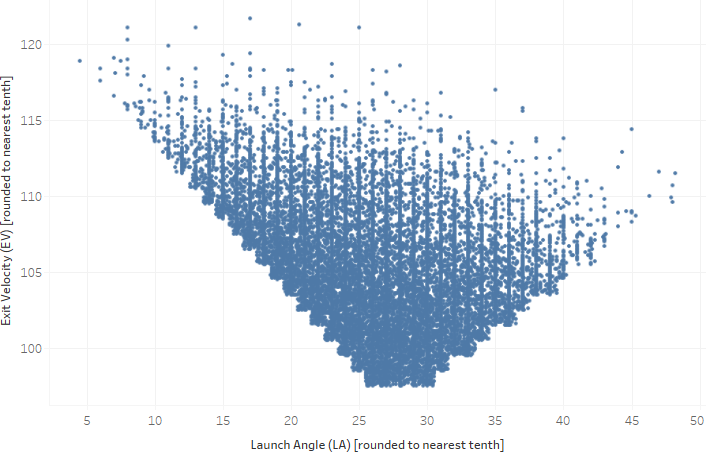
Given the scatterplot, the formula is most likely as follows:

if EV < 97.5 mph, then barrel = no
if LA > 25.5° and LA < 30.5°, then barrel = yes
if LA < 25.5° and (25.5 – LA) < (EV – 97.5), then barrel = yes
if LA > 30.5° and ((LA – 30.5) * 2) < ((EV – 97.5) * 3), then barrel = yes
if EV > 97.5 mph but none of these apply, then barrel = no

“Not all barrels are equal” takes on its meaning once you convert the above scatterplot to a heatmap. I set the low end of the color legend artificially high to show the contrast between barrels that are relatively productive versus those that are massively productive:

Read the rest of this entry »


2021 Pod Projections: Ha-seong Kim

Although the year just flipped to 2021, it’s already Pod Projections time! The 2021 forecasts are not available yet, and it’s looking likely that I’ll have more time to finish them once again, just like last year. So consider this an early preview to whet your appetite, for a hopefully longer season than in 2020, even if we don’t return to a 162 game schedule. As usual, I’ll dive into my projection methodology (detailed in Projecting X 2.0) by sharing my process on several hitters and pitchers.

Read the rest of this entry »


Are 2019’s Busts This Season’s Rebounds? A Review

Two weeks ago, I reviewed my pre-season article discussing six 2019 breakouts and my verdict for their 2020 performance and earnings. Today, let’s now flip to 2019’s busts. In late March, I discussed six 2019 busts and determined whether they would rebound enough in 2020 to earn within $7 of their 2018 dollar value. If I did think they would earn within $7 of their pre-bust season value, I labeled the player “REBOUND”, and if not, “STILL A BUST”. Though a 60 game season is hardly the sample size needed to evaluate my methodology on calling these 2019 busts, it’s all we have. So let’s see how the players and I did.

Read the rest of this entry »


Josh Bell Heads to Nation’s Capital

In 2019, former Pirates first baseman Josh Bell enjoyed a breakout season. His wOBA spiked from the high .330 range to .378, while his ISO settled just below .300, thanks to a HR/FB rate that surged above 20% for the first time. Unfortunately, he failed to effectively follow up that performance during this year’s shortened season, as his overall power plummeted (even though his HR/FB rate held onto the majority of its 2019 gains), while his strikeout rate skyrocketed well above 20% for the first time. Given his poor defense, all it took was a poor 223 plate appearances at the plate for the Pirates to jettison him, as he now lands in Washington to take over first base duties for the Nationals. Let’s check the park factors to see how the park switch might affect his results.

Read the rest of this entry »


Are 2019’s Breakouts This Season’s Busts? A Review

Back in late March, I discussed six of 2019’s biggest breakouts, as defined by gain in end of season dollar value as calculated here. Obviously, reviewing how these six players ended up performing in 2020 is pretty silly considering we only played 60 games, amounting to just 37% of a regular full season. I’m going to do it anyway, because it’s still fun for me to look back to see how I did on the many calls I made. So let’s find out how the six 2019 breakouts performed in terms of generating fantasy value and whether I was right or wrong in calling them REAL (2020 EOS $$ was within $10 of 2019 EOS $$) or a BUST ((2020 EOS $$ was $10 or more below 2019 EOS $$).

Read the rest of this entry »
