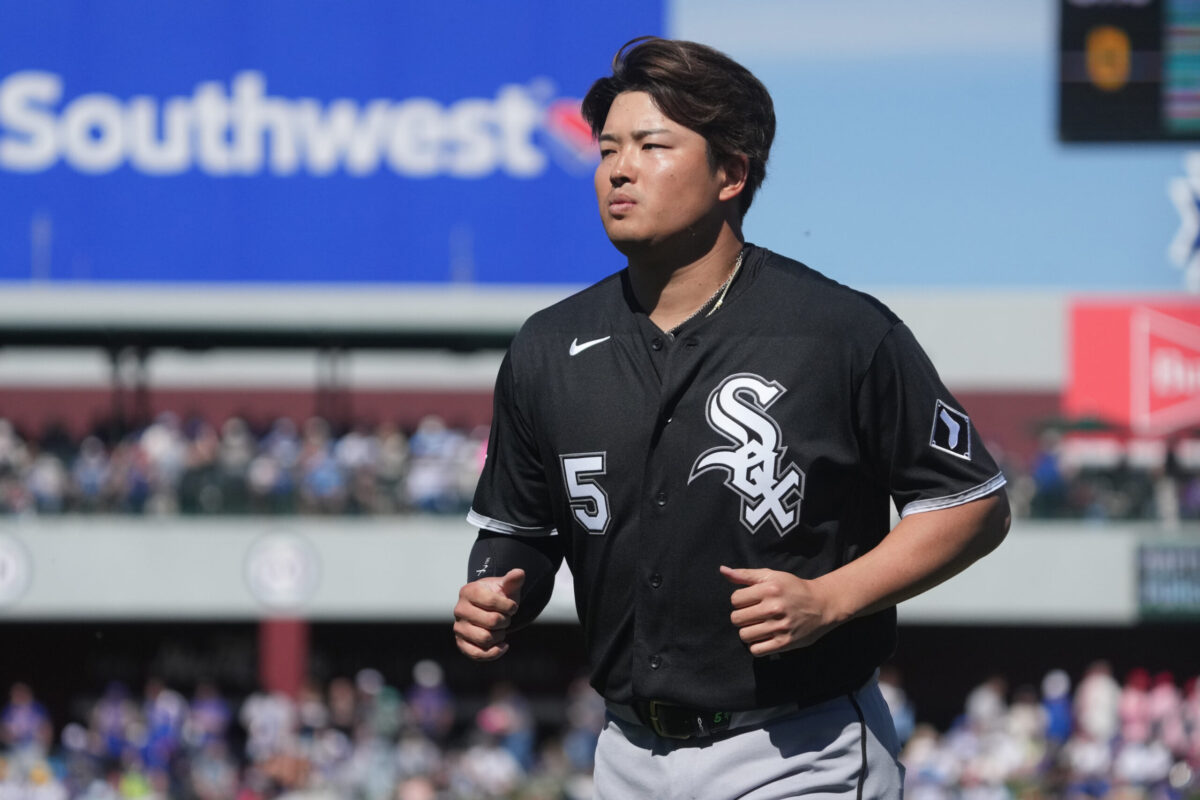
• While this blurb is directly about Seiya Suzuki, it points out that players can cut their IL stint from 10 to seven days if they don’t play in the last three Spring Training games. If a guy is not playing in a regular Spring Training game this upcoming weekend (back fields appearances don’t count), they may be headed to the IL, with a chance to be back in seven rather than 10 games.
The big question for the Cubs right now, in relation to both the WBC and the regular season, is whether Seiya Suzuki’s PCL sprain will prevent him from being available on Opening Day. The Cubs will see how Suzuki feels by the end of this weekend, and then make a decision on whether it’s an Injured List situation or not. The timing there matters, as an IL stint can be backdated by up to three days. In other words, the Cubs will want to know by this weekend whether they want to put Suzuki into the final few Cactus League games to ramp him up, or whether they need to hold him out so that they can backdate the maximum three days (and thus turn his 10-day minimum IL stint, effectively, into a 7-day minimum IL stint). Read the rest of this entry »
Paul Sporer: Hey y’all!! Thanks for coming out. Last big draft weekend coming up, I’ll have a sizable SP rankings update coming. Likely tomorrow, no later than Friday AM.
1:03
Bria: Do you have any long term health concerns about Crochet?
1:06
Paul Sporer: Not any more than every SP which is to say yes, I do, it’s just not actionable. Knowing that literally every pitcher can and at some point almost certainly WILL break leaves me focused way more on skills over health. Obviously, guys currently dealing with injuries, freshly back them, or with an extensive history of them carry extra risk, but there is no such thing as a safe pitcher, so gimme the best skills. (This doesn’t mean stacking Rodon, Snell, Cole on a team, but rather not eschewing a more talented but higher injury risk guy for a lesser talented guy and the myth of safety)
1:06
Matt: Joined a league with a FAB this year for the first time – I’m usually in Ottoneu/dynasty world. How do you recommend approaching FA? I’m usually VERY active on the wire, so will try as many $0 bids as possible, but how should I think about allocating my dollars? Is it mostly impact call-ups?
1:07
Paul Sporer: Yeah impact call-ups and injury replacements. Spamming the mid and lower tier bids is usually the better option v. the big budget players. Rarely do the triple-digits really deliver. Doesn’t mean you NEVER go for ’em, but be very smart about when to take that shot.
1:07
Chuck: How high would you go on Palencia in a 6×6 format with saves and holds separate cats?
Every year many of the best minds in the fantasy industry are invited to leagues that draft in New York City in the middle of March for Tout Wars. I was also invited.
This year I participated in the Tout Wars Mixed Auction. This is a 5×5 roto league using OBP instead of average. The other wrinkle in Tout Wars is unlimited IL slots, which definitely changes auction strategy compared to NFBC or other formats.
After pulling a Labadini in my LABR auction, I wanted to go back to my traditional balanced approach to try and take advantage of what is often an over aggressive room. At least a few people expected for me to do something crazy or just go for the Labadini again, so by sticking with my normal strategy, I was hoping it would still throw some people.
As usual, don’t hesitate to tweet us or comment below with fantasy questions.
You can show your support to Fangraphs by becoming a member! With a standard $10 ad-free membership or yearlong $60 ad-free membership, you help maintain and improve our database of stats and graphs as well as our staff of 8 full-time employees and over 50 contributors while gaining access to dark & classic theme modes, RosterResource Excel exports, and the optional removal of photos on the homepage.
You can subscribe to the podcast on iTunes or via the feed. Please rate & review the show in iTunes letting us know what you think!
This past weekend, I participated in the Tout Wars mixed auction. I’ve been in the league for about a decade and have won the league a couple of times. Previously, when I won the league, I used a value approach, but over the last few years, the league winners have leaned stars and scrubs. After some middling performances, I needed to find a way to get back to the top. I decided to lean into the league’s tendencies and rules to get ahead.
“Don’t it always seem to go, you don’t know what you got ‘til it’s gone.”
Joni Mitchell may not be a roto savant, but even she might agree that the best part of the fantasy baseball season is research-and-draft season. Every day, from February until Opening Day, is so incredibly thrilling – nonstop spring training news, draft rankings adjustments, and player pool deep-dives – there’s always some rabbit hole of research to go down. As we continue studying and gaining confidence in the fresh player pool and a new year’s ADP, more questions arise, and the more work there is to be done.
Whether in NFBC or best ball contests, high-volume early drafters subconsciously form bad habits in draft rooms. We get too comfortable targeting and drafting the same players over and over. Conversely, we avoid players who have burned us in previous seasons and those we have some subjective bias against. Rarely do we deep dive and reassess those players because we’ve already made up our minds. That’s why it’s crucial to explore every nook and cranny of a positional tier. We have all fallen victim to draft room paralysis, where a decision between several similarly ranked shortstops or starting pitchers becomes gut-wrenching when we’re on the clock. This preseason column aims to help with those tough calls. We will explore some of the most confusing ADP clusters, by position, beyond the simple “I need to boost my batting average, so I’m taking this guy.”
Let’s dive into these ADP pockets logically and systematically, reviewing four analytical components of the players within each cluster.
Playing Time (and Role)
Health/Durability
Skills/Categorical Contributions
Context of Team Offense
ADP Cluster: Post-300 Outfielders
ADP from 17 NFBC 12-team Online Championships (OC) drafts over the last five days (March 12 – March 16)
These outfielders are drafted in the Rounds 25-26 of OCs, typically as an OF5. For shallower 12-teamers with 23-25 rounds, some of these hitters may be early-season waiver targets. Carson Benge is the only one here without major league experience. Jasson Dominguez is rumored to start the season in the minors. Cam Smith, Matt Wallner, Cedric Mullins and Jung Hoo Lee are projected as everyday starters in their respective lineups. Domínguez, Smith, Wallner, and Mullins were all utilized as part of a platoon for parts of the 2025 season.
Playing Time (and Role)
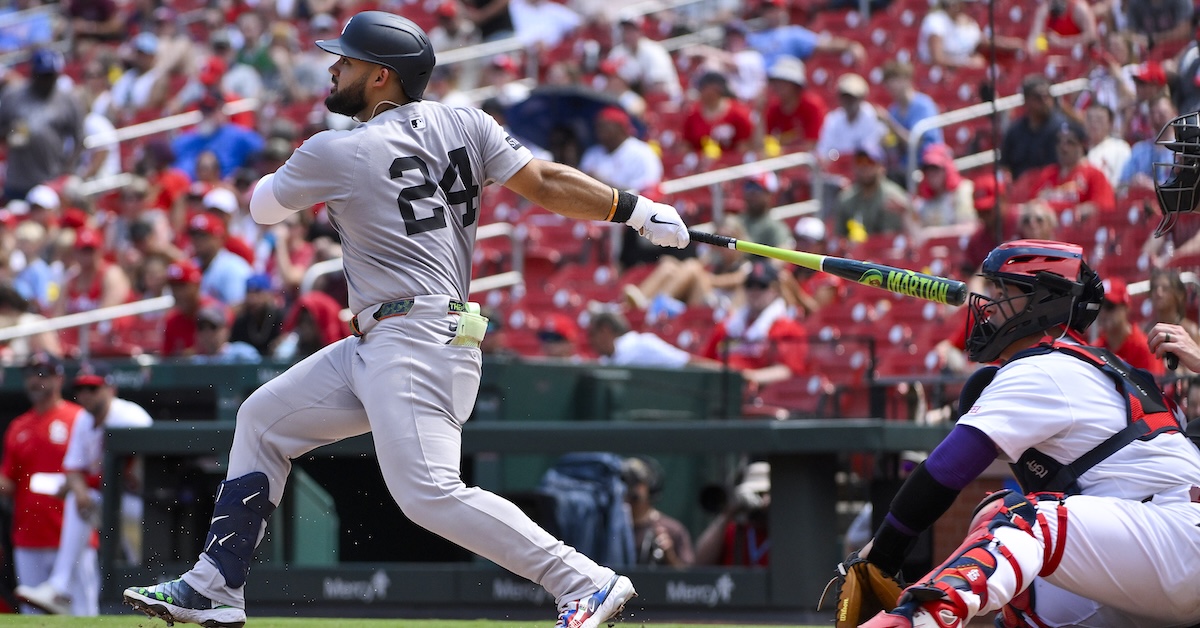
For Jasson Domínguez, it’s a matter of when, not if. The former heralded prospect and top 150 ADP selection from 2025 has seen his 2026 draft stock fall over the last couple of months with expectations of starting the season in Triple-A. After all, the Yankees re-signed Cody Bellinger and Trent Grisham, Giancarlo Stanton (the DH) is healthy (for now) and the great Aaron Judge mans right field. Manager Aaron Boone wants Domínguez to be playing every day, but that opportunity doesn’t yet present itself in the majors. Boone’s problem though is that Domínguez has been forcing his hand with exceptional production in spring training – .371/.395/.686, 3 HR, 10 RBI, 3 SB, 170 wRC+ in 38 plate appearances. Domínguez had a decent rookie season (.257/.331/.388, 58 R, 23-of-27 SB in 429 PA), but his playing time was reduced down the stretch and he essentially didn’t play in the playoffs.
For the last couple of months, RosterResource projected Cam Smith as a short side platoon outfielder. That designation has been shifted to full-time right fielder batting eighth on Opening Day. His RosterResource batting order projection will certainly influence his market price these next couple of weeks. What is more important for drafters is to solidify whether they’re buying or fading based on his profile, not projected playing time, because the latter could fluctuate all season like it did in his rookie year. Smith hit lefties better (130 wRC+, .191 ISO) than he did righties (75, .098), but the sample is a small one and not predictive. Jake Myers will be play centerfield, and the other two spots will be split between Smith and lefty bats Joey Loperfido (welcome back to Houston!) and Zach Cole. Smith played 132 games in right field last season.
Matt Wallner can absolutely mash and he may earn the opportunity for full-time at-bats in the context of a weaker lineup that needs him. In 97 plate appearances against lefties last season, Wallner actually had a higher wRC+ (118) than he did against righties (113 in 295 PA) as well as a similar ISO (.247 vs. RHP, .267 vs. LHP). So far this spring, he is hitting .294 with two homers, a stolen base, and a 14.6% walk rate, through 41 plate appearances.
Cedric Mullins signed with the Rays in December in what will the first Opening Day in his career that he doesn’t don an Orioles uniform. A left-handed hitter, Mullins has avoided being platooned for most of his career, but experienced a little bit of it the last two seasons. We expect the Rays to include him in their lineup against both lefties and righties, though if he struggles, this outfield room is loaded with alternatives, including recently acquired rookie prospect, Jacob Melton. Mullins is 31 and has never been an elite defender in center, posting negative UZR’s in all but one season. Mullins dealt with a back flare-up a couple of weeks ago, but appears healthy now. Through his first nine spring games, Mullins has two homers and a swipe.
Carson Benge is the sweet-swinging, lefty-batting, first-round selection of the Mets in the 2024 draft. He is having a strong camp (.367/.406/.433) and is projected to crack the Opening Day roster. Though he will likely begin the year on the strong side of a right field platoon with slick defender, Tyrone Taylor.
Jung Hoo Lee was a KBO star who signed a 6-year ($18.8M AAV) deal with the Giants two years ago, missed most of the 2024 season with injury, and produced mediocre results in 2025. Lee played 147 of 149 games in centerfield last season, but is being moved back to his original position from his KBO days (right field), primarily because of the offseason acquisition of Harrison Bader. Lee was a better hitter against righties (118 wRC+) than lefties (77) last season, though new manager Tony Vitello will likely start him every game. If Lee happens to stumble against lefties around a time when Luis Matos or Jerar Encarnacion heat up, it’s possible for Lee to fall into a platoon, but I wouldn’t bet on it.
Health/Durability
None of the outfielders in this cluster have current injuries to worry about, but most of them have had their fair share of injuries over the years.
Cedric Mullins – The oldest of this group (31), Mullins has had a few lower-body related injury stints over the last few seasons. He missed time with a right hamstring strain last spring and missed over a month with a right groin strain in May of 2023.
Jasson Domínguez – He tore his UCL at the end of the 2023 minor-league season and had Tommy John surgery. He suffered a left oblique strain in the summer of 2024 and missed a couple of games (no IL stint) in June of 2025 with a left thumb contusion.
Jung Hoo Lee – He remained relatively health in his South Korea days, though he broke his ankle and missed half the 2023 season. The following year, his first in the Majors, he dislocated his shoulder crashing into an outfield wall in mid-May and underwent season-ending surgery. He tweaked his ankle in the WBC last week, but it turned out to be a minor issue.
Matt Wallner – He missed five weeks early last season after suffering a left hamstring strain. He also dealt with oblique strains in each of the past two seasons. Not surprising considering the big dude swings hard and carries a big stick.
Carson Benge missed his first season of college at Oklahoma State after an elbow injury caused him to undergo Tommy John surgery. His injury was pitching-related, and the two-way player shifted his focus to hitting and playing the outfield.
Cam Smith does not have an injury history other than minor nicks and bruises.
The two who I’d slightly ding fantasy value for their health and durability are Mullins and Wallner.
Skills/Categorical Contributions
Matt Wallner is in a class of his own here because of his prolific power. Some slight data manipulation here, but Wallner’s 16.1% barrel rate is tied with Mike Trout’s for seventh in the majors among hitters with at least 900 plate appearances since 2023. The guys ahead of him: Aaron Judge (26.2%), Shohei Ohtani (21.5%), Giancarlo Stanton (19.1%), Kyle Schwarber (17.7%), Juan Soto (17%), and Oneil Cruz (16.2%) – elite company, indeed. Wallner hit 22 home runs in 104 games (392 PA) last season, and has 30+ HR upside if he can stay off the IL. His batting average won’t be helpful, but he may throw in a few stolen bases and is one of the rare late-round boons for fantasy squads that might be power deficient.
Cedric Mullins had that magical 30-30 (HR-SB) season in 2021. In his past four seasons, he has swiped at least 30 bags twice, and has averaged 16.5 home runs. He has been a batting average killer though – .228 since 2023. A fair expectation for Mullins in his first season with the Rays would be 12-15 homers, 25 stolen bases, 100-130 R/RBI (combined) and another season with a sub-.240 average.
Jung Hoo Lee has the highest batting average upside of the cluster. He hit .319 in his first 30 games of 2025, went through a rough three-month stretch from May through July (.218), then hit .306 from August 1 until the end of the season. He is capable of hitting .290+ over a full season. His only positive roto category contribution was runs scored (73 in 150 games). He is a solid floor contributor, but you won’t see many projection models bless him with anything more than 10 HR and 10 SB. His allure lies within his potential batting average contributions.
Jasson Domínguez, Cam Smith, and Carson Benge are the three young, upside guys. All would project for double-digit homers and swipes with 500+ plate appearances. Dominguez’s distribution would lie higher on the SBs, though he is capable of 20-plus homers if he earns consistent playing time. Domínguez sported a 49.6% hard-hit rate and stole 23 bases on 28 attempts in 429 plate appearances last season. Smith and Benge have 20-HR, 15-SB potential though neither is likely to get there in 2026. Benge is certainly intriguing as a toolsy prospect with the eventual possibility of being a five-category contributor. Note that he only has 103 plate appearances at Triple-A and he struggled there (.178/.272/.311) after crushing it with a .300+ AVG and .400+ OBP in 92 games at High-A and Double-A.
Context of Team Offense
The best team context here is Domínguez’s with the Yankees, but that is if he is able to earn consistent playing time. Wallner’s team context is sneaky as a middle of the order power hitter, though his counting category contributions hinge on Byron Buxton, Luke Keaschall and Royce Lewis staying healthy, which may be asking a lot. Based on home parks, divisions and other hitters in the lineup, the other four from this cluster have a neutral context.
Verdict (with value grades, A-F)
Jasson Domínguez (A-) may have been overpriced in the 125-150 ADP range last season, but he is being greatly undervalued this draft season, at half the cost, because of lack of role clarity. Dominguez is pushing to crack the Opening Day roster and deserves it, but it would be better if he got the reps in Triple-A. Make the low-cost investment in Dominguez late in your drafts if your roster doesn’t have a bench stash already, and you believe that his everyday role with the Yankees is simply a matter of when.
Jung Hoo Lee (B+) won’t wow us in any category other than potentially batting average. He has a high floor and could easily outproduce his draft cost with another 600+ plate appearances. Perhaps he surprises us with a bit more than what models are projecting.
Matt Wallner (B+) is the ideal power-boost option towards the end of drafts, specifically for folks whose roster construction feel light on power after 20 rounds. I’m less worried about a platoon split than oblique issues or other ailments resurfacing.
Cam Smith (B) and Carson Benge (B-) have the widest range of potential outcomes. Spending a chunk of the season isn’t off the table for either of them, but less so for Smith. Benge rocked a 81% contact rate, and despite last season’s struggles with consistency at the plate in Triple-A, he is less likely than Smith to tank us in the batting average category. Smith could fall into a platoon with Loperfido or Cole, but this is unlikely to happen for a prolonged time period.
Cedric Mullins (C+) may seem like a sneaky and savvy late-round option due to his HR-SB upside, but Tropicana Field is a downgrade from Oriole Park and his projected batting average is a massive detractor to his overall projected value.
Manoah still remains the favorite, but right-hander Jack Kochanowicz has pitched well with a 2.08 ERA with one walk in 8 2/3 innings this spring to make himself a candidate for the fifth starter role, while No. 5 prospect George Klassen has also excelled with a 2.25 ERA and nine strikeouts in eight innings.
“He’s still definitely in the mix,” manager Kurt Suzuki said of Manoah. “We haven’t decided on anything. There’s a lot of guys still going, still pitching.”
Manoah still remains the favorite, but right-hander Jack Kochanowicz has pitched well with a 2.08 ERA with one walk in 8 2/3 innings this spring to make himself a candidate for the fifth starter role, while No. 5 prospect George Klassen has also excelled with a 2.25 ERA and nine strikeouts in eight innings.
“He’s still definitely in the mix,” manager Kurt Suzuki said of Manoah. “We haven’t decided on anything. There’s a lot of guys still going, still pitching.”
This past Saturday morning, I hopped on the NYC subway for the quick trip to Hotel Edison to participate in the annual Tout Wars AL-Only live auction and try to win a third AL-Only and fourth overall Tout Wars championship. It’s one of the most exciting days of the year, and it’s always bittersweet when it’s over, knowing that I’ll have to wait an entire year to auction with these lads again.
Last weekend, the largest national fantasy baseball contest kicked off – the NFBC Main Event. For those unfamiliar, it’s a 30-round, 15-team, 5×5 roto contest with an $1,800 entry fee. This year, 855 teams will be drafted (57 leagues), and only one person will win the overall grand prize of $200,000. Most of these leagues are drafted online. A dozen or so are drafted in person, in Las Vegas, on the weekend of March 20.
I’ve been to Vegas for the Main Event every year since 2014, except for the COVID-shortened season. It’s an incredible experience filled with camaraderie among diehard fantasy baseball enthusiasts, many of us long-time friends. Many of the attendees are incredibly sharp, skilled managers, though not everyone who enters and attends is a fantasy savant. As math would have it, every league has 12 losers, since only the top three cash. For the most part, and of importance to fantasy baseball managers everywhere, is that Main Event drafters are highly invested and motivated. The draft boards and ADP movement in these leagues is worth looking at closely. We can extract actionable takeaways from such highly invested players that can assist with our roto drafts, no matter the entry fee.
Main Event drafters are human. They can be swayed by spring training production and swept away in ADP helium, a chain reaction of pushing players higher and higher in drafts, far beyond their November-February market prices. Last March, Main Event helium rose Cristopher Sánchez by several rounds, from a 175 ADP in January to 101 by Vegas, including a min pick of 63. Obviously, that worked out. A similar thing happened with Nick Pivetta, Robbie Ray, Kris Bubic, but also with Will Warren, Hayden Birdsong, and a slew of out-of-nowhere “closers” who bombed – Luke Jackson, Jordan Romano, and Mike Clevinger. And who can forget the rise of red-hot Astros outfielder Cam Smith? We call it helium because it’s literally akin to a balloon taking you up, up, and away – oftentimes directly into the scorching sun.
One interesting nuance of the Main Event: since there is overall prize money on the line as well, and we’re competing against 800+ others, it does not behoove us to punt roto categories – specifically, pitching ones. One adage is always true here: pitching always gets pushed up in the Main Event. Elite ratios (ERA, WHIP) are a scarce commodity; hence, most NFBC managers focus on anchoring their teams with strong pitching to avoid the inevitable blowups when chasing mediocre two-start pitchers in FAAB during the season. With strong planning, execution, and a bit of luck, we can punt saves in our standalone home leagues. This strategy rarely works in the Main Events, where roto categorical balance is vital and where league-mates research incessantly to make competitive bids every FAAB period for 27 weeks. Teams at the top of the Main Event standings last year didn’t win and do well in pitching because they drafted breakouts like Sánchez, Bryan Woo and/or Hunter Brown alone. Many of them used a first or second round pick on Tarik Skubal, Paul Skenes, or Garrett Crochetand drafted Woo and Pivetta, or Brown and Nathan Eovaldi, and picked up Trevor Rogers in-season for pennies on the dollar in May. A decade ago, the fantasy world would scoff at the idea of drafting starting pitchers or closers early. In the Main Event world in recent years, no one has besmirched their fellow competitors for drafting Skubal with the first pick of the draft or the elite, top closer in the second round.
Many of us enjoy digging deep into pitcher profiles and advanced stats at FanGraphs and other sites, hoping to discover prospect pitchers who are ready to break out, or undervalued “sleeper” pitchers the market is currently undervaluing. We want to be first on the next big thing. We want to draft him before others, and if we can’t, sometimes we’ll grab one of those helium balloons and set some min picks.
Biggest SP Risers
With the first five 2026 Main Event drafts in the books, the fresh ADPs are available for all to peruse (select ‘Main Event’ in the dropdown). The original plan for this piece was to compare the last 10 days of NFBC Draft Champions ADP (50 rounds, no FAAB) to these first five Main Event drafts to see who the biggest risers and fallers were at each position. After a quick visit with my good friend XLOOKUP and building out some comparison tables, my focus (and impetus for this piece) was inspired by the massive helium with starting pitchers after 200 ADP. This is where the action was at, with blasts from our past like Kyle Harrison, Taj Bradley, Luis Gil in all his Ricky Vaughn-esque glory, and even the legend himself, Justin Verlander, who is back with the Tigers.
I sorted and discovered the starting pitchers whose Main Event ADP is at least three rounds higher than where it was just last week in the 50-round Draft Champions format. Pitchers in this group have risen exorbitantly over the last week for various reasons: increased spring velocity, introducing an effective new pitch, having a productive (in some cases, dominant) spring, and the increasing likelihood of an Opening Day rotation spot and aspirations of massive profit from a late-round selection.
The table below consists of 25 starting pitchers – mostly from the middle and late rounds – whose ADPs have risen by at least three rounds (45 picks) from early-March DCs to these first five Main Events. I’ve listed ADPs and their pick differences, the number of 15-team rounds increased by, and the percentage increase.
Justin Wrobleski | River Ryan, Los Angeles Dodgers
If a pitcher has a pulse, wears Dodger Blue, and has a shot at the rotation, expect helium to ensue. Blake Snell will likely spend the first month of the season on the injured list. Most drafters don’t trust Roki Sasaki, whose ADP has fallen from the the low 200’s to the mid 300’s over the past two months. Manager Dave Roberts says he will be in the rotation, which means there will be at least one rotation spot open for Wrobleski or Ryan. Both have been solid in spring – Wrobleski has 0 ER, 0 BB, 4 K in 6 IP and Ryan has a 7:3 K:BB with one earned run allowed, also in six innings. Ryan is the more exciting and dynamic pitcher, but both his and Wrobleski’s ADPs remain close to each other until more definitive news is presented. Whoever is officially announced as the guy joining the rotation should see a spike of 100+ draft slots. For our shallower home leagues, these are names to monitor, but not specifically target.
Both are beneficiaries of the Roki Sasaki spring rollercoaster ride. As the market continues to lose market confidence in Sasaki and Blake Snell’s timetable continues to be pushed, Wrobleski and Ryan’s preseason
Mick Abel | Taj Bradley, Minnesota Twins
Both Abel and Bradley had horrific 2025 seasons and were mostly off our radars this draft season. Bradley had success at this level before, with the Rays in 2024, but owns a career 4.86 ERA in 385 innings. Abel was a promising first-round draft pick of the Phillies whose stock plummeted after his rough 39-inning debut last season (6.23, 1.51). Abel has 13 punchouts and no walks allowed in 10 spring innings. Bradley has a 19:5 K:BB with 7 ER in 14 innings. Given Abel’s pedigree, he is likely to rise up ADP at a higher rate than Bradley, depending on how his next spring starts go. Nevertheless, both pitch for a declining Twins team and run support may be tough to come by. Abel and Bradley’s high ADPs in the Main Event are tough pills to swallow and it might be best to not chase either one.
Kyle Harrison | Brandon Sproat, Milwaukee Brewers
With Freddy Peralta traded and Quinn Priester dealing with nerve issues in his wrist and starting the season on the IL, opportunities arise for the Brewers’ newest, talented young arms, Harrison and Sproat. Both are projected to begin the season in the rotation, though Sproat’s inclusion may depend on the health status of Logan Henderson. Harrison’s ADP has ballooned as it gets close to Round 20 of 15-team Main Events. Sproat’s current price is a bit more palatable, though it too will likely rise over the next two weeks. Both are former impact prospects and familiar names. Fantasy managers usually feel comfortable investing in Milwaukee starters, and this does feel like a great opportunity for both Harrison and Sproat. Harrison is a strong end-game target in shallower non-NFBC leagues as well.
Dustin May | Richard Fitts | Matthew Liberatore, St. Louis Cardinals
It really is comical how much preseason baseball influences the market. Two months ago, fantasy analysts (myself included) preached to avoid Cardinals pitchers outright. Fast forward to March, and the helium begins impacting every potential starting pitcher who looks good in the spring. Liberatore had somewhat of a breakout season in 2025, producing respectably in 29 starts, posting an above-average walk rate of 6.2%. May has teased us for years and there is no doubt he will draw many drafters back in. May finally threw more than 60 innings in a season last year (132.1 between two teams), but the results were poor (4.96 ERA, 4.47 SIERA, 1.42 WHIP. The most important thing to monitor with May this spring is his control. He walked batters at a 9.6% clip last year and has three walks in 6.2 innings so far this spring. Fitts is throwing hard (touching 99 mph) and having a nice spring. It’s possible that he beats out Kyle Leahy for the fifth spot, but is more likely to begin the season in Triple-A. Of the three, Liberatore is the one I’d want to target in deeper drafts. For 12-team drafts, stay away from all three.
Grant Holmes | J.R. Ritchie, Atlanta Braves
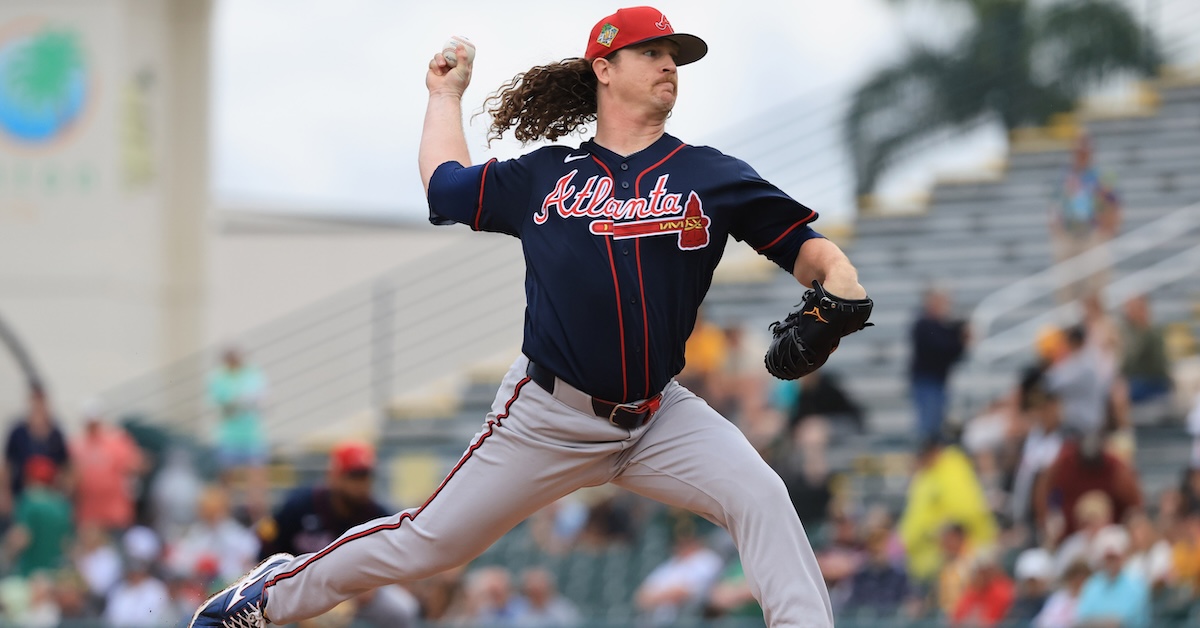
Traditionally, Atlanta Braves rotations have been a strong source of March helium – AJ Smith-Shawver anyone? With Spencer Schwellenbach and Hurston Waldrep sidelined for a while, opportunities to snag rotation spots have risen. Holmes is all but locked into a spot, especially after a masterful nine-strikeout performance against the Pirates on Thursday. Holmes did not allow a hit in five innings. Holmes boasted a 25% strikeout rate (22 starts, one relief appearance), though his 11% walk rate was a huge issue. Holmes is capable of reducing it to the 9% range, though don’t expect a helpful WHIP from him. As long as Holmes is healthy, he will be in this rotation. His 358 ADP is very reasonable, though it’s certainly going up after that masterful performance. Ritchie is a stud prospect who returned from Tommy John in June of 2024 and had a strong season in the minors in 2025 (140 IP – 2.64 ERA – 1.01 WHIP – 24.8% K – 9.6% BB). Though he is likely to start the year in Triple-A, he is certainly ready to dominate in the Majors. He is one spring injury away from earning a rotation spot before Opening Day. Both Holmes and Ritchie are strong targets in deeper formats and in the Main Event.
Wrapping It Up
There are other intriguing risers like Shane McClanahan, though we must always proceed with caution chasing massive ADP jumps with pitchers like him and Joe Musgrove who are working their way back after long delays. It’s difficult to field competitive fantasy squads if they’re loaded with injury risks and promising prospects. Hey, it’s great that Cade Cavalli is healthy and looks fantastic this spring. But there’s no chance I’m going to chase a Washington Nationals’ starter into the top 250 ADP when there are oodles of viable, safer options in this draft range. For every few risers, there are fallers. Sometimes players fall because we’re too dialed into small spring samples and missing the forest for the trees.
Though some of the best fantasy players around play the NFBC Main Event, we must remember that no one can predict the future. We can still take occasional risks, but they must be calculated and logical ones. Taking a shot on the Braves and Brewers pitchers who have been rising feel like a sharper move than chasing ADP helium on lesser talented starters who aren’t guaranteed rotation spots and play on worse teams. Good starting pitching is a key to success in all roto formats, but chasing helium blindly will often carry our balloon directly into getting burnt. Stay cool out there.