Archive for Kris Bryant

Breaking Down BABIP: What Impacts Flyball BABIP for Hitters?

In a pair of recent columns, I looked into what factors have impacted flyball BABIP (or FB BABIP) and ground ball batting average for pitchers, and those analyses were linked by a common finding. Whether pitchers are allowing balls that are in play in the air or on the ground, the launch angles of those batted balls go a long way towards explaining whether they become base hits. Now I am turning my attention to flyball BABIP for hitters, and the trend continues. While flyball pull rate, average flyball distance and average exit velocity, both on flyballs and line drives combined and on flyballs alone, did not have significant relationships with FB BABIP for hitters, average flyball launch angle (FB LA) turned out to be a statistically significant factor yet again (p < .0006, r = .19)
Read the rest of this entry »


Heading in Opposite Directions: Kris Bryant and Yoán Moncada

This season, Yoán Moncada narrowly surpassed Kris Bryant as the most valuable Chicago third baseman in 5×5 Roto value. Figuring out whether he is likely to keep the crown in 2020 is not an easy task.

Even though Moncada made 75 fewer plate appearances than Bryant did, as he missed three weeks in August with a strained hamstring, he outearned his North Side counterpart, $18.0 to $17.0. Moncada made up deficits of 25 runs and six homers by driving in two more runs, stealing six more bases and, most important, hitting .315, which gave him a 33-point advantage in batting average. He improved in every category, other than steals, but Moncada’s surge from a .235 batting average in 2018 played the biggest role in catapulting him into the top 10 at third base (he ranked ninth and Bryant ranked 10th).
Read the rest of this entry »


Kris Bryant Injury Outlook 2019

Injuries of the Leading Shoulder in Power Hitters

When a hitter is in the batting stance, their leading shoulder is more responsible for power production than the trailing shoulder. For a right-handed hitters the leader shoulder is the left shoulder and it is just the opposite for left-handed batters. An injury to either shoulder will affect a hitter, but an injury to the leading shoulder is far impactful. The leading shoulder deals with a tremendous amount of force at two points during the swing. First, when the hitter accelerates the arm forward and extends their elbow. Second, during the follow through the front shoulder has to decelerate the arm and bat. An injury would cause pain at both points. The body is very good at protecting itself subconsciously from pain. Despite a player’s best efforts, the body will decrease the amount of force produced to avoid pain. Read the rest of this entry »


Is Kris Bryant Really Sacrificing Power for Contact?

It’s an interesting thing to think about that as far as MVP candidates go, Kris Bryant has managed, in the span of a year, to go from the choice for National League MVP to not even in the conversation. What’s even stranger about such a situation is that it’s not like Bryant has fallen off dramatically from a sophomore campaign that featured a WAR over 8. In addition to the early inconsistencies that his team experienced, some of the changes in his game might be leading to him being somewhat of an overlooked quantity at this point, even with the Cubs serving as one of the best teams in baseball since the All-Star break.

Despite his virtual exclusion from any sort of Most Valuable Player discussion, Bryant has actually managed to improve in a number of ways. Sure, there are a couple of aspects in which he’s taken a modest step back, but overall, we’re still talking about a player that ranks at or near the top of the third base category in a number of ways on the offensive side of things. In fact, as far as his Off rating alone is concerned, Bryant ranks at the top of the 26 qualifying players at the hot corner, with his park-adjusted offense coming in at a 142 mark that trails only Justin Turner. Turner is also the only player that bests Bryant in reaching base overall, as Bryant has posted a .402 mark to date that has been the result of some adjustments he made over the course of last year’s offseason.

Read the rest of this entry »


Potentially Too Early February Rankings: Third Base

It’s that wonderful time of year where preliminary positional rankings starting pouring out for the upcoming season. Because I needed another reason to look like a fool by the end of it. The third base position opens 2017 with plenty of intrigue, with a couple of newish faces to the mix and one notable name departing for a new position. Let’s all pour one out for Matt Carpenter. My goal is to be far more consistent on the rankings side in 2017, which means more opportunity for folks to ponder, “Just what in the world is this guy thinking?”

Let’s get to it with some cleverly named tiers:

Read the rest of this entry »


The Inevitable Alex Bregman Conversation

When it comes to the third base position, we already know a lot of what to expect in 2017. In a sense, we largely know who will reside at the top and serve as an upper tier fantasy asset, while it’s also relatively apparent who can provide steady production at the position as a secondary choice in upcoming drafts. It’s almost somewhat black and white in a sport that is almost never just black and white.

But beyond my incessant rambling, there’s the “first full year” factor (note: I referred to him as a rookie multiple times because I lacked coffee and common sense this morning), something that you can just barely adequately prepare for. In this case, though, there’s one predominant exception: Alex Bregman. The Houston Astros product figures to be an intriguing option as that first-full-year guy that folks will be all over in the early rounds of drafts. A lot of that is justified, but any time you’re talking about a player coming into his first full season in the big leagues, there is at least some reason for a certain level of apprehension.

Read the rest of this entry »


World Series Game 7 Primer: Kris Bryant vs. Jose Ramirez

Regardless of the events that transpire on Wednesday night in Cleveland, the evening will conclude with a 2016 Champion of Major League Baseball being crowned. The elation that one club and its fans will experience with an extensive drought ending will only be matched in its intensity by the devastation felt by the club and the fans on the other side at seeing their own drought continue. As such, I would be remiss if I didn’t touch on and reflect on the third base matchup that the evening will entail.

Game 7 will feature the overwhelming favorite for the National League Most Valuable Player award in Kris Bryant, while his counterpart, Jose Ramirez, has ridden a breakout regular season to a key role on this gritty Cleveland squad. Bryant represents the best of the best at the hot corner. He’s a member of the elite. Ramirez was mired in an obscure role until Michael Brantley’s injury allowed him an opportunity to crack the everyday lineup. He’s seized that opportunity by utilizing his high contact and baserunning abilities, as well as some clutch play.

While the overall skill set and season statistics obviously favor Bryant, in glaringly obvious fashion, it’ll certainly be interesting to see how each performs at the most strenuous point of the game’s brightest stage. Across a nine inning game, we’re talking about the most minuscule of sample sizes. But it’s still worth wondering what challenges each could present for his opponent, particularly in regard to their ability to make contact, their ability to make strong contact, and the threat that they represent on the bases.

Here’s a broader overview of their regular season performances.

OBP OPS ISO K% BB% wRC+ Off WAR
Kris Bryant .385 .939 .262 22.0 10.7 149 49.1 8.4
Jose Ramirez .363 .825 .150 10.0 7.1 122 24.9 4.8

In some regards, they’re not quite as far apart as one might initially think. Both are able to reach base at a really nice clip, but what Ramirez has going for him is his ability to get on base and utilize that speed, while striking out a at a far lower rate. Whereas Bryant represents the significantly more impactful bat in the power game. Ramirez embodies that scrappy type of play that has become the Cleveland narrative. As such, he won’t be an easy out at any point for Kyle Hendricks, especially with his success against the changeup. It’ll be interesting to watch Bryant against Corey Kluber for a third time as well, with Bryant having found his groove at the plate over the last pair of games.

In terms of the ability and type of contact we’ve seen from both, refer to the graph below:

Swing% Contact% O-Contact% Z-Contact% SwStr% Soft% Hard%
Kris Bryant 48.8 73.3 59.8 81.1 13.0 17.0 40.3
Jose Ramirez 43.9 88.8 84.4 91.2 4.9 14.4 26.8

Ramirez has been one of the higher contact guys throughout the season. He’s been aggressive in his approach, and he’s been able to utilize that speed effectively in notching a few extra hits because of it. Bryant may strike out more regularly, but his contact rate is also significantly improved from 2015 and his contact ends up being far harder and, subsequently farther, than that of Ramirez. If what we’ve seen thus far in the series is any indication, Ramirez will use that high contact and baserunning ability to be a thorn in the side of Chicago, and if there’s a big time hit to be made on the part of the Cubs, it could very likely come off the bat of Bryant.

It should be relatively well known at this point what each can do on the bases, as the pair rank 1-2 in BsR. Ramirez sports an 8.8 mark, while Bryant comes in not far behind, at 7.3. Ramirez is a legitimate threat to go, with 22 swipes on the season. This could prompt the Cubs to go with David Ross in order to try and slow he and the other Cleveland runners to an extent. While Bryant isn’t as active in the run game, with only eight steals, he’s still a capable baserunner who has been lauded for his intelligence on the basepaths.

As one-sided as it may seem based off of name recognition alone, it’s still a fun matchup that we’ve been able to watch at the hot corner. You have two players in the top eight in WAR at their position, with both bringing different skill sets to the table. While Bryant obviously represents the higher quality player in a variety of ways, the ways in which both could find a way to impact Game 7 in Cleveland on Wednesday night are countless. Bryant with the big power bat, Ramirez with the high contact ability. With perhaps only nine innings remaining in the 2016 Major League year, this will be one fun matchup in a multitude of things to watch in Wednesday’s final tilt.


Examining the Kris Bryant-Nolan Arenado Debate

With the Chicago Cubs set to wrap up the National League Central in the coming days/weeks, it’s looking more and more difficult for anyone to make a case that will topple that of Kris Bryant for the National League Most Valuable Player Award. That hasn’t stopped some from trying, and there are cases to be made for a small handful of players outside of the Chicago third sacker. One of those potential finalists could be one of Bryant’s third base counterparts, in Colorado Rockies third baseman Nolan Arenado.

Our job here isn’t necessarily to decide that debate. While it does look like Bryant is currently the frontrunner, there are numerous factors to be considered in regard to the MVP beyond the offensive numbers which we will illustrate here. There’s defense to be considered as well as versatility, WAR, etc. That’s almost another debate entirely. Here, we’re only worried about the offense. So let’s delve into some of the numbers for a pair of extraordinary National League players.

Heading into Tuesday’s slate of games, here’s how the two stacked up in a general sense:

AVG OBP OPS ISO K% BB% wRC+
Kris Bryant .305 .402 .988 .281 21.9 11.3 160
Nolan Arenado .293 .362 .939 .285 13.1 10.1 125

The general perspective would certainly seem to favor Bryant in most regards. He reaches base at a far higher rate, while notching an OPS that comes in almost 50 points higher than Arenado. In regard to ISO, the two are tied in home runs, while Bryant leads in doubles. It’s Arenado’s four triples that give him an edge there. But even the higher K rate for Bryant doesn’t make this a win for Arenado, considering everywhere else on the board that Sparkle Eyes has an edge. At the same time, we’re comparing two elite players here. The numbers are going to look great anyway you slice it. While we could certainly make a judgment about which is more valuable based off of this information alone, let’s dig just a bit deeper. Spoiler alert: we’re going to the splits.

Home/road splits tend to always be Arenado’s undoing. Playing at Coors Field is both a blessing and a curse in that regard. While nobody is questioning his offensive potency overall, it’s hard to ignore the disparity in production between his home and road splits:

AVG OBP OPS ISO K% BB% wRC+
Arenado (Home) .317 .390 1.052 .346 11.2 11.2 136
Arenado (Away) .270 .336 .832 .227 14.9 9.0 115

At Coors, Arenado is predictably off the charts. His ISO is, to use a technical term, stupid when he’s playing in the confines of his home ballpark. But there isn’t a statistic here that doesn’t experience significant decline when he steps out of Denver. In most respects, the road numbers are still impressive, but not so much that they don’t still take away from the total body of work. Hooray for double negatives.

Conversely, Bryant has posted more impressive numbers on the road than at the Friendly Confines:

AVG OBP OPS ISO K% BB% wRC+
Bryant (Home) .276 .375 .910 .259 24.5 9.7 142
Bryant (Away) .332 .425 1.058 .301 19.6 12.7 176

The favorable road split is something I touched on earlier this season, and it’s a trend that hasn’t exactly dissipated as the season has worn on. Even with that more impressive road split in mind, it’s hard not to look at that home line and still be overwhelmingly impressed. While there’s a clear decline, he still maintains a higher level in almost every single respect above Arenado, strikeout rate notwithstanding. So to this point, the general overview and the splits both seem to favor Bryant.

To some degree, consistency should be taken into account, illustrated below with Arenado’s wRC+ throughout the season, followed by Bryant’s:

ArenadowRC

And Bryant…

BryantwRC

Obviously, with the scope of each graph, there’s going to be the appearance of a great deal of fluctuation. And it’s hard to put too much stock into the day-to-day happenings of the wRC+ world. At the same time, this does provide a nice visual when considering each player’s total offensive value in a more intricate sense. Just as the splits did, this would also appear to favor Kris Bryant, as the actual variation in his wRC+ is not nearly as significant. Perhaps more importantly, Bryant has managed to exclusively stay at or above that 100 mark since the very beginning of the season, something Arenado has not accomplished.

If we were going to take this debate out of the fantasy arena and put it on the MVP plane, then we’re bringing in other factors. Defensively, the edge would probably go to Arenado. But you also have to take defensive versatility into account, as Bryant moves around the diamond and is still an above average defender wherever he is. Sparkles in the eyes? Game: Bryant. It’s a really fascinating debate, and one that will likely continue as the regular season winds down. But for our purpose here of examining that offensive value, and thus assessing their fantasy relevance in a very general sense, the edge has to go to the Chicago Cubs superstar.

And obviously none of this is meant to disparage Nolan Arenado. He’s a supremely talented offensive player and one of Major League Baseball’s elite. But when we’re talking offense and offensive value, there is not a shred of doubt in my mind that the edge, in almost every single respect, goes to Kris Bryant.

Kris Bryant’s Apparent Struggles vs. Offspeed Pitches

As surprising as it may seem, given his immense success in his less than two years at the Major League level, Kris Bryant has come a long way as an offensive player. He’s cut down on his strikeouts. He’s improved his contact rate. These developments have helped to culminate in his status as the top position player in the National League thus far in 2016, according to WAR. But as we saw against James Shields on Tuesday night, which always seems to be the case when the two players meet, there are still some respects in which Bryant could stand to improve.

Now, given where my Major League sympathies lie and the undeniable success that Bryant has experienced in such a short time, it should remain relatively apparent that none of this is meant to disparage the Chicago Cubs third sacker in any sort of manner. And even if one wanted to do so, it’d be very difficult. He’s cut down on his strikeout rate by about seven percent (down to 23.3%, with a decreased swinging strike rate of 13.9%). His overall contact rate is up about five percent (to 71.4%). He’s sporting a .261 ISO. There’s not much of anything to dislike, and that’s just in regard to his offensive game.

But what was abundantly clear on Tuesday night, as Bryant served as the team’s designated hitter, was that he still struggles against the offspeed stuff. In striking out three times against James Shields, just as he did in his Major League debut, Bryant found himself peppered with changeups from the veteran hurler, as he fell to just 1-for-10 with seven punchouts against him in his short career. The goal here is to simply illustrate Kris Bryant’s battle against the offspeed pitches that Shields registered so much success with on Tuesday.

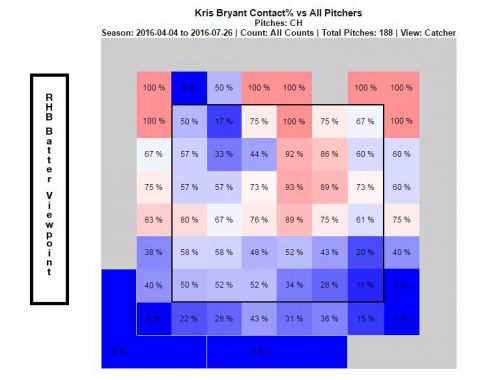
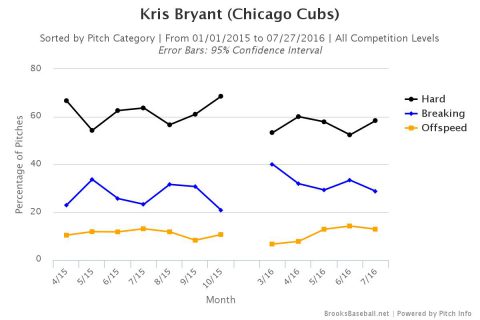
It isn’t that Bryant’s struggles have been magnified beyond that game on Tuesday on the South Side. But it did help to spark acknowledgement of what he has turned in against offspeed pitches throughout his time at the Major League level. The following represent the distribution of pitches that Bryant has seen, swung, and whiffed, respectively:

Brooksbaseball-Chart (10)

Brooksbaseball-Chart (11)

Brooksbaseball-Chart (12)

As is typically the case, offspeed pitches represent the lowest percentage of pitch type that Bryant has seen. And with the exception of an outlier of a month or two over the course of the last two seasons, his swing trends have been relatively consistent in a general sense, regardless of pitch type. Even with those ideas in mind, offspeed pitches have represented the largest percentage of pitches at which he’s swung and missed on a fairly consistent basis.

An additional trio of graphs helps to further illustrate Bryant’s issues with the offspeed stuff, specifically changeups, based off of Tuesday night:

Bryant

Bryant2

Bryant3

Again, while the percentage isn’t high, low offspeed does represent the majority where Bryant actually see that stuff, in terms of location. Mainly because if you’re a pitcher leaving offspeed up for a hitter like Bryant, you’re probably looking for that ball in another area code. And while he obviously loves the high offspeed (and what Major League hitter doesn’t?), he’s also demonstrated a pretty high Swing% on those low changeups. And he’s demonstrated a low contact rate on those pitches that he’s shown something of a penchant for swinging at, even if the overall amount of times he actually sees offspeed pitching is relatively low. But, again, the purpose here is to illustrate a potential trend more than anything else.

Obviously, there’s plenty to note here. In summation:

  • He demonstrates a lower contact rate vs. offspeed than other pitch types.
  • The percentage in which he does see offspeed could be increasing ever so slightly.
  • BUT..
  • He sees offspeed less than other pitch types.
  • AND ULTIMATELY..
  • Kris Bryant is still a very, very good hitter of baseballs.

At the end of the day, is the offspeed stuff a cause for concern? Not necessarily in any real regard. Bryant typically has the type of approach that can prevent him from falling into a void like he did on Tuesday, thus largely avoiding offspeed pitches. One thing certainly is worth noting, though, that he’s seen offspeed stuff at an average of 13.33% of the time over these past three months, which represents the highest percentage of his short career over any span. It’ll be interesting to see if Major League pitchers continue to make that adjustment, and if they do, it’ll be equally as interesting to see how Kris Bryant makes his own.


2016 MLB Third Base Tiered Rankings: All-Star Break Edition

We haven’t done a good ol’ fashioned rankings since the start of the season, so the All-Star Break seems like the perfect time to re-examine some of the selections that were made in the initial 2016 set. Obviously things have changed, but given that it’s the middle of July, nobody is surprising us anymore. We know largely who is who and what they bring to the table, while others have dropped off due to positional eligibility. While there’s still room for bounce back or decline, we know where we stand at the season’s midway point.

While these rankings still remain somewhat subjective, based on the individual elements I tend to look at, neither Kris Bryant or Jake Lamb ended up no. 1, so the bias may not have shone through as much as it otherwise could have. Enjoy the rest of your break before the stove starts to heat up.

Read the rest of this entry »