Archive for 2018

Early 2018 Hitter Blind Résumés, Pt. 2

A month ago, I compared “name-brand” and “generic-brand” players using blind résumés, an exercise we’ve reiterated across several authors and years at RotoGraphs. A few years ago, you’d never find me in a mock draft, let alone several in one preseason. (More a matter of blocking out three hours on a whim, but also I probably (very foolishly) thought I didn’t need to partake in such trivialities.)

I’m super, super into the whole slow draft mock thing, though; I’ve completed a few this preseason, and I think they have already helped me understand the kinds of market inefficiencies (i.e., differences between perceived and actual values) that will arise on draft day. One of the easiest ways to identify said inefficiencies is to compare similarly skilled players, then assess their other pros and cons — the intangibles, if you will, such as health and age — to determine who’s the better value.

Here are a couple more pairings:

Read the rest of this entry »


Early 2018 Hitter Blind Résumés

I’ve done this before — compare similar players, one of whom is “name-brand,” the other “generic-brand,” using blind résumés — as have many others. Ben Kaspick carried the torch a while this year, but he credited Joe Douglas with the idea. So let’s say it’s a group effort to which I’ll contribute once again.

In anticipation of 2018 drafts, I wanted to carry out a “buying generic” style of analysis, borrowing in part from too-early mock draft average draft position (ADP) data. I do not intend to construe the following comparisons as rigorous analysis. I do, however, intend to highlight some potential bargains that, if the too-early mock ADP information is concerned, warrant your attention on draft day.

Comparison #1: Outfielders

Read the rest of this entry »


Another Draft, Another Review: NFBC Draft-and-Hold

I had participated in a too-early industry mock draft that ended a couple of weeks ago. Then I attended First Pitch Arizona (FPAZ), which I reviewed and at which I participated in another arguably too-early draft. This post is about that latter draft. Sorry for all the reviews lately.

The draft, which took place live at FPAZ, is hosted by the National Fantasy Baseball Championship (NFBC). It’s a 15-team league, but instead of being a standard 30-round draft (seven bench players) with in-season transactions, it’s a 50-round draft-and-hold with no transactions (don’t worry, this only covers the first 23 rounds). I won’t say it completely changes the dynamic, but it does, or at least should, dramatically alter the plans of owners who take a lot of risks and plan to hedge them using their free agent acquisition budgets (FAABs).

What’s worse is I had, and still have, done virtually zero planning for the 2018 season. Accordingly, I relied on a strategy I outlined in the previously hyperlinked too-early mock draft review. I’m a risk-averse guy, so I typically draft player who are boring — boring because they’re old and/or you know what you’re getting. Low variance, things of that nature. This strategy inadvertently exacerbated this tendency of mine in these drafts, and the draft-and-hold nature of this league further compounded it. Without looking, the average age of my team must be, like, 33 years old.

But I like it. It’s so unsexy, so unapologetically (actually, very apologetically) boring that it’s almost not worth review. Except when I talk about boring, unsexy teams, I hear from guys like Jeff Zimmerman, Mike Gianella and so on — guys in the industry expert leagues such as Tout Wars and LABR — who say this is their jam, and that’s reassuring.

Read the rest of this entry »


2018 Top 100 Fantasy Prospects: First Look

Happy Game 7 Day!

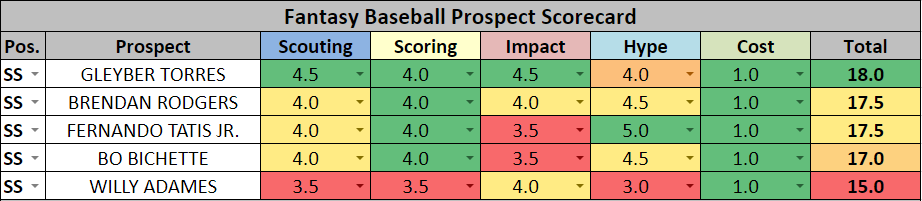
About a year ago I released my (2017) Top 50 Fantasy Prospect rankings using the Prospect Scorecard to weight a variety of important variables in the context of fantasy baseball.  Today I’m publishing an (early) expanded list of the Top 100 Fantasy Prospects for 2018 for both Ottoneu’s FanGraphs Points leagues (where wOBA is a key measure on offense) and Roto leagues (5 x 5).

A few quick notes before we begin:

  • Since “Cost” is league-dependent (auction salary, keeper round, etc.), I’ve ignored it here for simplicity by keeping it constant for every prospect listed. Feel free to use the Scorecard to make changes that reflect true player costs for your league, which will impact these rankings.
  • These rankings below are intended to represent the 100 most valuable prospects for fantasy leagues (depending on scoring format).
  • It’s quite possible I’m missing an obvious player that should be ranked, so let me know in the comments.  We can discuss the specific rationale for player rankings in the comments, too.  Player ages are current ages.
  • For a lot more prospect resources, check out the Ottoneu community.

Here are the (early) 2018 Top 100 prospects for the linear-weights-based FanGraphs Points scoring format (a good proxy for those in OBP leagues):

Read the rest of this entry »


Too-Early Mock Draft On-Time Review

Fantasy owners participate in mock drafts to practice for their actual league drafts. Without the internet, neither mock drafts nor average draft position (ADP) data would be possible or available to us. The union of the two allow owners to understand approximately when they can expect players they plan to target and devise an appropriate plan of action.

What ensues when you draft for the next baseball season before the current season has ended and without ADP data and having not refined/run your 2018 projections yet? Chaos, namely. For the second year, the Honourable Justin Mason organized the Too-Early (#2early) mock drafts for me and a few dozen other analysts, the final ADP “data” (in air quotes, because a sample size of four drafts is not particularly strong data, and, as aforementioned, it is way too early to be mock-drafting) for which can be found here.

I drafted out of the 11th spot (of 15) in draft #4. I made a concerted effort to draft a good team, but I also deliberately avoided certain players just to see where other owners would draft them. (Had I drafted these players for my team, I would have a weaker understanding of how other owners valued them.) The lack of ADP data made it incredibly difficult to implement this plan. In a nutshell, my plan consisted of drafting the best player with a track record still available on the draft board (mind-blowing, I know), with a strong preference for hitting. There’s an objective basis to this that, rather than trying to explain, I’ll let reveal and define itself as I go. This plan served me admirably in all rounds of the draft.

Here’s my team, by round. “Rk” indicates a player’s draft rank within his assigned position. Columns labeled “All” and “Pos” depict players’ end-of-season values overall and by position, respectively, each of the last four years. These ranks come courtesy of Rudy Gamble, who concocts them for Razzball. If you’re concerned that these might somehow be inferior to ESPN’s Player Rater, know that Rudy won this year’s Tout Wars Mixed by a landslide, so I thoroughly trust his process.

Read the rest of this entry »


Forgive the Pitchers Who Wronged You

Masahiro Tanaka and Jeff Samardzija had perplexing, enigmatic, and ultimately bad seasons. Many attempts were made to ascribe reasons or causes for their struggles. I think both will bounce back for very simple reasons; accordingly, I think both will be undervalued in 2018 for equally simple reasons.

Masahiro Tanaka

Travis Sawchik and Eno Sarris discussed his various ailments, so to speak, long after I gave up trying to diagnose him. The heat maps are interesting, and the splits are interesting, albeit a bit of an archaism.

Read the rest of this entry »


Kevin Gausman’s Very-Bad-but-Actually-Very-Good Season

For all intents and purposes, Kevin Gausman had a bad season. Like, catastrophically bad, such that has ERA was 10th-worst among qualified starters. That he was allowed to see enough innings to become a qualified starter should be construed as nothing short of a blessing for him.

On paper, sure. This narrative works on the surface, at the macro level. But Gausman had himself a season of two incredibly different halves. An aside: if you don’t pay attention to FanGraphs’ community research, you should. User jkved10 wrote a post about Gausman on July 24 — about the time I reluctantly convinced myself to roster him in my primary home league — in which jkved10 noticed a sudden change in Gausman’s release point. Kudos to the author for doing all the heavy lifting for me. Click through to familiarize yourself with the events that unfolded and the ensuing analysis, or dig around Brooks Baseball for yourself.

The results weren’t immediately promising at the time of his/her writing: a 4.94 ERA across six starts. Everything else under the hood, however, had changed: 12.2 strikeouts and only 2.6 walks per nine innings (K/9, BB/9), good for a 3.19 xFIP. Sure, everything else stunk; he was still allowing home runs and hits on balls in play at astronomical rates. But the peripherals very dramatically improved, having essentially doubled his K’s and halving his walks in that span.

Such success continued. In his 19 starts from June 21 onward, Gausman struck out 10 hitters-per-nine and recorded a 3.39 ERA despite a still-inflated rate of home runs to fly balls (HR/FB). A tale of two halves, indeed: prior to June 21, his 6.60 ERA was almost exactly doubly large. He was a second-half ace, and this was more than just regression to the mean — his success correlated, if not directly resulted from, his adjustment.

Read the rest of this entry »


Very Prematurely Anticipating 2018’s Value Picks

I’m already thinking about 2018. It’s not that my teams are doing poorly; they’re fine, for the most part. It’s that the economist nerd in me, when thinking abut fantasy baseball, most often evaluates the disparities between perceived and actual values, and how long, if ever, it takes for the market (aka fantasy owners) to come to equilibrium, to use economic parlance.

For example: you may or may not be aware that Kevin Gausman, despite his atrocious start to the season, has been magnificent the last five weeks. In seven starts from July 2 onward, he’s posted a 3.24 ERA (supported peripherally by a 2.81 xFIP and 3.40 FIP) with 11.4 strikeouts and 2.6 walks per nine innings. The strikeout rate is fueled by a 15% swinging strike rate (SwStr%), which have come consistently, ascending into double-digit percentages in all seven starts (and in eight of his last nine). His strikeout-to-walk differential (K-BB%) by month: 2.0%, 8.8%, 9.2%, 23.4%, and, in one August start, 28.0%.

Meanwhile, he’s inducing ground balls almost half the time (49.5% GB). You could say he’s due for batting average on balls in play (BABIP) regression, and he probably still is. His BABIP constantly hovering above .349 does not inspire confidence, but few pitchers have ever been BABIP’d so hard in a single season — I discussed this phenomenon in regard to Robbie Ray. All said, while there’s no guarantee his BABIP regresses before October, Gausman still shows the promise we once expected of him — perhaps more — and it’s going largely unnoticed because of his downright repulsive first half. (He’s baseball’s #12 starter the last month.)

Such is the gist of this post, in which I’ll briefly touch upon players I anticipate to have average draft positions (ADPs) in 2018 that will lend themselves to relatively low-risk, high-reward opportunities in standard mixed leagues. Whether such expectations become reality is another story; that’s why I’m relying on ownership levels as a proxy for perceived value. All ownership levels likely retain some amount of draft day inertia, for better or for worse — in other words, leftover ownership (or lack thereof) in abandoned leagues — so take it all with a grain of salt.

Please note this is, by no means, an exhaustive list — just the first few players who come to mind, mostly because I’ve paid close attention to them all season.

Read the rest of this entry »