Archive for Strategy

Does Postseason Play Hamper Future Production?

There is no need to beat around the bush with an intro full of cliches and examples. Simply does playing in the postseason wear down a player enough to effect their next season’s production?

Simple answer: Not really.

Less simple answer: Some with hitters, not at all with pitchers.

Complex answer: Danger math.

Read the rest of this entry »


Effect on Hitter Production From an Early Season Injury

When I wrote my article on disappointing 2019 hitters, the data diverged from expectations in one subset of hitters. Injured players dominated the list but they also saw a huge drop in their production to the tune of about 100 points of OPS. While the season-to-season OPS values are never exactly one-for-one, a 100 point dropped is huge especially since the league’s overall OPS jumped 30 points last season. I needed to dig in.

It’s going to get a little nerdy as I have to explain how I examined the data. To try to minimize the pre and post-injury production from the investigation, I only looked at players who were placed on the IL in March or April. Little if any of their production should have been before the injury. A second reason was to help project hitters who are dealing with offseason surgeries (e.g. Adalberto Mondesi). So, over the past 10 seasons, 627 hitters met these criteria.
Read the rest of this entry »


Justin Mason’s FPAZ Draft (Rounds 1-10)

After years of jealousy sitting at home, I finally was able to attend First Pitch Arizona earlier this month. Quick Plug: if you have the opportunity to do go, it is a fantastic experience that is well worth the money. First Pitch has amazing panels and seminars that will really sharpen your game, but more importantly than that, the discussions you have with some of the smartest people in the industry are invaluable.

Now, every year there are drafts that occur at FPAZ. I thought it would be a fun experiment for me to try a new strategy I have been game planning for the 2020 season. The draft was a NFBC style 15-team 50 round draft and hold. We drafted the first 21 rounds in Arizona and then will draft the rest in January. Read the rest of this entry »


2019 Ottoneu Arbitration Targets

Ottoneu arbitration begins today, and it is one of the highlights of the fantasy season.  Much has been written about the various arbitration (usually via allocation) strategies available to owners over the past few winters, but if you’re entering your very first Ottoneu off season, or just researching how the game works before joining a new league, here is the official breakdown of how arbitration works:

In the interest of maintaining competitive balance, there are two distinct arbitration options:

Allocations

The allocation system gives a $25 budget to each team in the league.

The team must allocate this budget towards players on other teams.

Each team must allocate at least one dollar to every other team, and no team can allocate more than $3 to any other team.

At the end of the allocation period, all players have their salary increased by the amount allocated towards them.

Allocations take place after the initial offseason salary increase, so any allocations will be in addition to the $1 or $2 increase each player gets at the end of the season.

If a team does not allocate at least one dollar to every other team, none of their allocations will count and it will be as if they did not participate at all.

If a team does not allocate all $25, none of their allocations will count and it will be as if they did not participate at all.

Vote Off

The vote-off system gives each team in the league the ability to vote on a player on each other team.

The player that receives the most votes collectively on each team is turned into a restricted free agent that can be bid on by other teams during the auction draft.

In the case of a tie, the standings of all the relevant voting teams is examined. Whichever player has the team with the worst standings voting for them is the restricted free agent.

The team they were voted off from will get an automatic $5 discount towards that player, so if they get the player back, they will get the player for $5 under what they bid.

Players who have been voted into restricted free agency cannot be traded.

Players who have been voted into restricted free agency will not appear as free agents on the site.

The majority of Ottoneu leagues now use the Allocation system referenced above since it is the most engaging and usually the most disruptive.

As arbitration kicks off, I’ve provided links to a few strategic arbitration resources below.  However, taking it one step further this year, I’m releasing a list of players I expect will receive the most arbitration allocations across Ottoneu leagues.  Since player salaries are league-dependent, I’ve used average current salaries across all FGPTS leagues to estimate the attractiveness of these players and their likelihood to be hit with allocations from your league owners.  As a practical application of the list, you could say I see a $31 Anthony Rendon as more valuable than an $8 Marcus Semien, for example.  In this case, I think you should apply more of your allocations to Rendon instead of Semien.

If you own these players for salaries below the average salary listed, for example, expect their chances of receiving allocations to increase, moving them up the list compared to others.  Roto values (particulary 5 x 5) would be reflected differently, and I would recommend posting those specific questions to the community here.

Read the rest of this entry »


5 Things I Learned From 2019

I had a rather middling season in my fantasy leagues this year. My Main Event team was a nightmare, but everything else meandered around the middle (save a tough finals loss in my H2H league), looking like a real competitor for weeks at a time and a lost cause in others. Whether you win big, lose big, or land somewhere in the middle, you should learn something from the eight-month grind (including February and March).

Sometimes the Players Fail, Not the Strategy

Gee Paul, really starting off with some self-examination here by blaming the players! I don’t say this to shirk responsibility, but rather to remind myself that a strategy falling short doesn’t automatically mean it’s a loser. That’s where running a similar strategy across multiple leagues with different players can be useful. I really wanted two big arms to headline my rotations this year, but when Noah Syndergaard’s nauseatingly inconsistent year was one of them in many leagues, I was doomed.

Read the rest of this entry »


Who Supplied the Speed?

For today I just wanted to conduct a quick little exercise regarding stolen bases. So I looked at the top 20 finishers in the NFBC Main Event and tabulated all the players they got at least 10+ stolen bases from and then figured out how often each player showed up. As we turn our attention to 2020, I’m finding what I believe is too heavy of a focus on speed to the point of pushing down otherwise excellent players simply because they don’t run.

I understand the value of someone who does it all, but I’m not bypassing the brilliant contributions of someone like Nolan Arenado just because he nabs 2-3 SBs a year. There’s always a balance, right? You can’t completely ignore speed, but with premium SB contributors dwindling, you also don’t need as many at the draft table. At any rate, let’s get into it and see how it panned out.

Read the rest of this entry »


Why We Missed: Breakout Hitters

Note: For my next few articles, I’m going to examine the hitters and pitchers who underperformed and overperformed in 2019. Each article may spawn off others since some areas may need to be explored in more detail. After performing horribly in 2019, I need to take take a hard look at why I missed last season and what I can do to improve.

I’m going to start with the one player class every owner hopes to hit on, breakout hitters. A couple of these cheaply acquired star hitters can help carry a team. It could be a prospect turned uber-prospect (e.g. Pete Alonso) or just a hitter displaying new skills (e.g. Ketel Marte). I’m going to dig into the reason these breakouts were not draft-day targets and look for any common themes.

To get the test subjects, I ran our auction calculator for end-of-season production and then compared the auction dollars to the values created from their ADP. I didn’t want to just use the difference in ranks because the gap from #1 to #15 could be over $10 but the difference between #250 to #300 might just be $1. Using this method, I found 62 hitters who outperformed their value by $10 or more.
Read the rest of this entry »


My Final 2019 Results: It Could Have Been Worse …

… but not by much for teams I just owned …

My 2019 fantasy season did not live up to my standards with most of the struggles being self-inflicted. Here are some overarching themes I spotted with each league plus some additional points at the end.

Horrible FAAB management

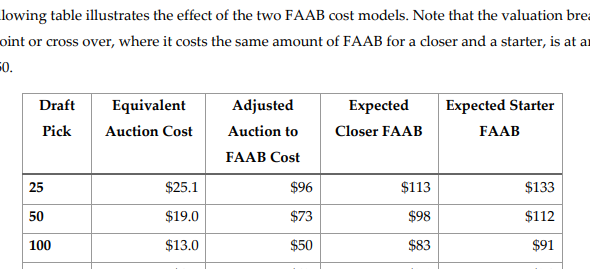
I ran out of money in almost every league and spent too much FAAB on worthless assets. Looking back over the leagues, the root cause was chasing week-only plays. From my work writing “The Process”, I found out how valuable it is to grind out each week. Additionally, I ran the weekly FAAB projections here so I knew around what it would take to get each. Initially, I got the players and but dropped them a week or two later for better options with little to show for the FAAB spent

I need to set a FAAB limit for chasing week-only plays and just accept it’s fine to miss out on a few players. A week’s advantage is worth the same in week 1 or the final week. The rest of my FAAB can be used for chasing long term improvements. Some players may straddle the long-term and weekly play so the FAAB may come from both the weekly and long term pools. I need to have a plan and stick to it.
Read the rest of this entry »


The Case for a Second-Tier Closer

Should you spend for an elite closer?

Earlier this year, I broke down the profitability potential of the starting pitcher tiers. We learned that it was profitable from a return on investment perspective to purchase an “ace” starting pitcher in your auctions and/or drafts. I am referring to the article entitled, “The Case for An Ace”.

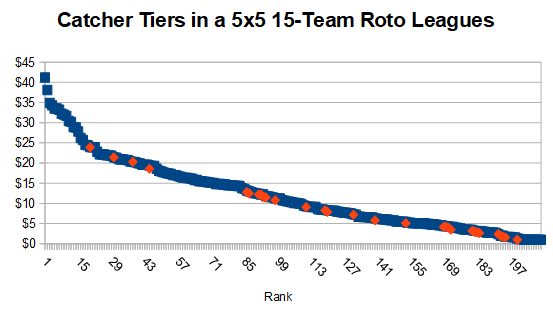
Today, I dive into the hit rates and profitability for various relief pitcher tiers. Sure, there will always be hits and busts in each draft round. If you happen to strike the right player, you will be set … and vice versa if you happen to draft a dud. From a game theory perspective, knowing the more profitable price points for players at particular positions (or for particular scoring statistics) is extremely valuable to the shrewd fantasy owner.

In the long run – it is better to know that saves have a better ROI in Round X vs. Round Y, whereas steals have a better ROI in Round W vs. Round Z, etc. Why not maximize your potential sources of profit in fantasy baseball, by being efficient with your draft selections and with your auction dollars? Sure, you are free to draft Aristides Aquino in the 1st round if you so choose – but it is prudent to keep in your back pocket what the numbers say about what the best investments are.

The Experts / Tout Wars

In my days of playing fantasy baseball, I have come across two opposing strategies regarding closers. Both approaches have been heavily publicized over the years.

  • Never. Pay. For. Saves.
  • Buy a top closer.

Read the rest of this entry »


The Sleeper and the Bust Episode: 738 – 2-Starts & Platoons for Week of Sept. 16th

9/13/19

The latest episode of “The Sleeper and the Bust” is live. Support the show by subscribing to Fangraphs! With a standard $20 membership, you help maintain and improve our database of stats and graphs as well as our staff of 8 full-time employees and over 50 contributors. The premium ad-free membership at $50 year supports site growth and also includes faster load speeds and better site performance. You can also support monthly for just $3.

Follow us on Twitter

Paul runs through the scheduled two-start pitchers and righty/lefty schedule splits of each team for next week highlighting who to start and potential platoon bats who could benefit.

Read the rest of this entry »