Archive for Keeper Strategy

2019 Ottoneu Arbitration Results – Top 25 Players

Brad recently posted his Ottoneu Arbitration Omnibus which will tell you everything you need to know about one of the highlights of the Ottoneu off season.  In summary, arbitration in Ottoneu refers to the competitive process all leagues go through to bring individual player salaries back into balance.  In other words, it’s the economic counter weight to full scale dynasty that makes Ottoneu so unique compared to other fantasy platforms.

Most leagues choose the arbitration “allocation” process, which allows each owner in the league to assign a small salary increase to the players they believe are most valuable to their opponents’ rosters.  This rule specifically states:

In the interest of maintaining competitive balance, there are two distinct arbitration options.

a. The allocation system gives a $25 budget to each team in the league.

b. The team must allocate this budget towards players on other teams.

c. Each team must allocate at least one dollar to every other team, and no team can allocate more than $3 to any other team.

d. At the end of the allocation period, all players have their salary increased by the amount allocated towards them.

e. Allocations take place after the initial offseason salary increase, so any allocations will be in addition to the $1 or $2 increase each player gets at the end of the season.

f. If a team does not allocate at least one dollar to every other team, none of their allocations will count and it will be as if they did not participate at all.

g. If a team does not allocate all $25, none of their allocations will count and it will be as if they did not participate at all.

Which players receive the most allocation dollars in arbitration? In general, it’s the best players from the previous season, and usually the players that have jumped in significant value from a previously low market price (salary).

With 2019 arbitration complete, here’s a quick look at the top 25 players to receive arbitration increases across several Ottoneu formats:

Read the rest of this entry »


Ottoneu Top 20 Third Basemen for 2020

Using a format similar to the one Paul Sporer recently posted for 2020 Roto player rankings, below is the 2020 ranking of the Top 20 Third Basemen for Ottoneu fantasy baseball.  Ottoneu leagues are auction style, but with no salaries listed (league dependent), think of these lists as simplified “snake draft” rankings (“which player would I take before the next”), or a value ranking of players above replacement level for 2020. Players with multi-position eligibility may receive a slight bump in value (2020 positions listed).  You can reference average Ottoneu player salaries here, but keep in mind these salaries fluctuate throughout the winter as rosters shape up towards the January 31st keeper deadline for all leagues.

Previous 2020 Ottoneu rankings:

Read the rest of this entry »


2019 Ottoneu Arbitration Targets

Ottoneu arbitration begins today, and it is one of the highlights of the fantasy season.  Much has been written about the various arbitration (usually via allocation) strategies available to owners over the past few winters, but if you’re entering your very first Ottoneu off season, or just researching how the game works before joining a new league, here is the official breakdown of how arbitration works:

In the interest of maintaining competitive balance, there are two distinct arbitration options:

Allocations

The allocation system gives a $25 budget to each team in the league.

The team must allocate this budget towards players on other teams.

Each team must allocate at least one dollar to every other team, and no team can allocate more than $3 to any other team.

At the end of the allocation period, all players have their salary increased by the amount allocated towards them.

Allocations take place after the initial offseason salary increase, so any allocations will be in addition to the $1 or $2 increase each player gets at the end of the season.

If a team does not allocate at least one dollar to every other team, none of their allocations will count and it will be as if they did not participate at all.

If a team does not allocate all $25, none of their allocations will count and it will be as if they did not participate at all.

Vote Off

The vote-off system gives each team in the league the ability to vote on a player on each other team.

The player that receives the most votes collectively on each team is turned into a restricted free agent that can be bid on by other teams during the auction draft.

In the case of a tie, the standings of all the relevant voting teams is examined. Whichever player has the team with the worst standings voting for them is the restricted free agent.

The team they were voted off from will get an automatic $5 discount towards that player, so if they get the player back, they will get the player for $5 under what they bid.

Players who have been voted into restricted free agency cannot be traded.

Players who have been voted into restricted free agency will not appear as free agents on the site.

The majority of Ottoneu leagues now use the Allocation system referenced above since it is the most engaging and usually the most disruptive.

As arbitration kicks off, I’ve provided links to a few strategic arbitration resources below.  However, taking it one step further this year, I’m releasing a list of players I expect will receive the most arbitration allocations across Ottoneu leagues.  Since player salaries are league-dependent, I’ve used average current salaries across all FGPTS leagues to estimate the attractiveness of these players and their likelihood to be hit with allocations from your league owners.  As a practical application of the list, you could say I see a $31 Anthony Rendon as more valuable than an $8 Marcus Semien, for example.  In this case, I think you should apply more of your allocations to Rendon instead of Semien.

If you own these players for salaries below the average salary listed, for example, expect their chances of receiving allocations to increase, moving them up the list compared to others.  Roto values (particulary 5 x 5) would be reflected differently, and I would recommend posting those specific questions to the community here.

Read the rest of this entry »


How To Win Ottoneu: An Interview with Josh Jessar

There’s somewhat of a tradition to interview the annual winner of the Ottoneu Champions league.  This year I have the honor of picking the brain of the first ever repeat winner, Josh Jessar, who also happens to be the first back to back champion of the league.  You can see a full breakdown of his winning roster here.

Q: How long have you been playing fantasy baseball? Ottoneu?

I’ve been playing fantasy sports since the late 80’s, starting with football teams based on Christian Okoye and Barry Word.  I became the only east coast Chiefs fan I knew. Baseball followed shortly after. My collection of friends have played on and off ever since across a variety of platforms.  I started playing Ottoneu in 2013. Longtime readers of your work may remember an interview with previous Champs winner Keith Smith…I recruited him to join the Ottoneu movement.  It was a natural extension of our after school sessions from back in the day.

Q: How did you stumble upon Ottoneu?

Another longtime friend from back in those early leagues brought me to it.  We’d actually kicked around the idea of starting our own fantasy site complete with termed-contract players in the early 2000s.  When he told me of this great site he’d discovered with a lot of the same concepts, we decided to try it out and were both hooked immediately.  He’s a great player who was in Champs B for a while, but after his fourth kid arrived he went into retirement. I’m hopeful he’ll one day make a triumphant return.

Read the rest of this entry »


Ottoneu Top 20 First Basemen for 2020

Using a format similar to the one Paul Sporer recently posted for 2020 Roto player rankings, below is the 2020 ranking of the Top 20 First Basemen for Ottoneu fantasy baseball.  Ottoneu leagues are auction style, but with no salaries listed (league dependent), think of these lists as simplified “snake draft” rankings (“which player would I take before the next”), or a value ranking of players above replacement level for 2020. Players with multi-position eligibility may receive a slight bump in value (2020 positions listed).  You can reference average Ottoneu player salaries here, but keep in mind these salaries fluctuate throughout the winter as rosters shape up towards the January 31st keeper deadline for all leagues.

Since a majority of Ottoneu leagues are points leagues (offense based on linear weights), you’ll notice speed is less of a factor here than Paul’s rotisserie ranking lists.  Even if you don’t play Ottoneu, this list might be a good proxy for OBP, OPS, or sabermetric leagues, so keep that context in mind as you review.  If I’ve missed an important player, or you believe I’ve wildly over or under-valued someone, please let me know in the comments and I’ll be sure to update.

In 2019, the 29 qualified first basemen averaged the following production:

  • 5.88 Points Per Game (P/G)
  • 30 HR
  • 10% BB%
  • 22% K%
  • .227 ISO
  • .268 AVG
  • .353 OBP
  • .495 SLG
  • .354 wOBA
  • 120 wRC+

Read the rest of this entry »


Relegation Will Fix Your Broken Fantasy League

Dictionary.com defines the word commission as “the act of committing or entrusting a person, group, etc. with supervisory power or authority.” I’ve been playing and commissioning fantasy baseball for almost 25 years now and have on occasion abused that authority to influence change within my leagues.  Always with the long-term good of the league in mind, I have encouraged owners to adopt a wide variety of incentive structures that have included elaborate prize payouts, keeper contract systems, supplemental minor league drafts, arbitration and inflation offsets, and a few other random gimmicks.  Furthermore, as a regular member of an active, daily fantasy baseball community, I’ve seen countless other versions of these ideas and have had all the common debates about incentives vs. penalties, owner competitiveness vs. engagement, and all the nuances that make for good, healthy ownership and game play.  In short, I’ve kind of seen it all.

I’m now ready to admit defeat.  Despite my best efforts, there are no universals when it comes to motivating every type of owner to engage fully over the course of a long 162 game baseball schedule.  This revelation should be obvious, and perhaps only fellow commissioners will sympathize with this drive to create the perfect league, but it has taken me some time to finally come to grips with this truth.  To be clear, it’s not that some of these ideas haven’t worked (I have years of anecdotal evidence that they can and do), it’s just that they are usually designed to address the symptoms that plague poor leagues rather than the core issue.

Read the rest of this entry »


Dump Trading Madness: A Follow-Up

On Tuesday, I described the issues us keeper league owners face in handling “dump” trades, using my current AL-Only keeper league as an example of the madness that began about two weeks ago. One commenter suggested I publish a follow-up summarizing some of the best solutions and outlining the pros and cons of each. Since the post did receive some excellent comments, this is that requested follow-up.

Read the rest of this entry »


Dump Trading Madness

In 2003 as a wee 21-year-old, I founded a standard 12-team mixed redraft league with a live auction. Ever since, I had toyed with the idea of starting a sister keeper format, but always decided against it. I have rarely played in keeper leagues, joining one many years ago and lasting just one year due to quirky rules I wasn’t a fan of, but am now playing a second year in my current keeper league, an AL-Only format. The last two weeks have just reinforced my opinion that a strong keeper league is extremely difficult to establish and run. The problem has always been handling “dump” trades, the term used for the trading of prospects or quality keepers for better high-priced or unkeepable players, with a bottom tier team serving in the dumper role, while a team fighting for a money spot acting as dumpee.

Read the rest of this entry »


Ottoneu Most Wanted: April 20, 2019

Ottoneu Most Wanted 7 Days
PLAYER NAME OWNED % ADD % CHANGE (7 DAYS)
Daniel Vogelbach 84.72% 42.36%
Jason Heyward 78.82% 38.54%
Richard Lovelady 38.19% 37.50%
Nick Anderson 59.03% 37.15%
Freddy Galvis 59.38% 34.72%
Alex Gordon 47.22% 30.21%
J.D. Davis 68.4% 28.47%
J.B. Wendelken 46.53% 27.43%
Nick Margevicius 36.11% 23.26%
Brandon Brennan 25.35% 21.53%
Top 10 players added in Ottoneu leagues over the past seven days.

Read the rest of this entry »


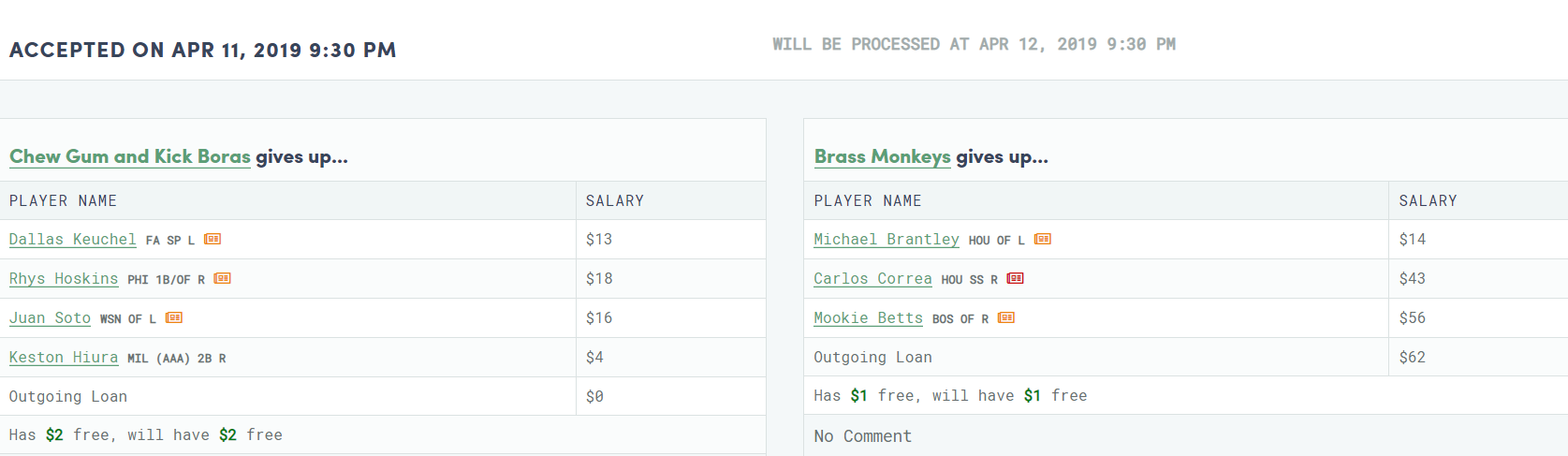
Trade Reviews: Early April Edition (2019)

Last season I kicked off April with some early trade reviews from the Ottoneu community, and today I’ll do the same, hoping to peek under the hood of some early player perceptions as transactions start to take shape across the fantasy baseball world.

As a quick reminder, Ottoneu is a keeper system by design that shifts the balance just short of traditional dynasty leagues, and offers a variety of scoring systems (including H2H).

Read the rest of this entry »