On June 27, I had a team sitting in second place in a 4×4 league, 6.5 points out of first. This particular league, an Ottoneu league called the Food and Travel League, pays out prizes in the form of food and/or beverages. It is one of my favorite leagues, both for the prizes and the competition, and finishing top three in that league is a goal every year – it’s much more fun to receive food than to figure out how to ship it.
I had never won this league and while the gap to first made me wonder if this was the right year to push in my chips, I also saw a clear path to finishing second or third (fourth place was 7.5 points behind me). But I was behind the pace on innings pitched and needed arms. I was third in all of the pitching rate stats (HR/9, ERA, WHIP), but was ninth in IP and, as a result, tied for eighth in strikeouts. Gaining points in Ks while maintaining my rates was an obvious path forward.
So I made a trade. I ended up winning the league, but the trade was costly and it is worth wondering if the trade is why I won the league, or if I could have won without the deal.
Those analyses, though, held one thing constant: the value of draft picks. To get those points across, I assumed a standard 12-team redraft setting, and flexed the value of players based on scoring scheme. Here, I’m doing the opposite: I’m messing with the timeline draft pool while keeping scoring scheme constant to show you how the value of a draft pick itself can change based on league size, keepers, and whether you use projections or actual realized dollar value.
What do we know about value in fantasy baseball? We know a player’s value can rise swiftly based on recent production, or drop drastically due to injury or underperformance. We also know that a player’s fantasy value can be quite subjective. It is in the eye of the beholder and is often bolstered by bias. A lifelong Yankee fan who plays fantasy baseball may overvalue Trent Grisham because he leads off for the Yankees and hits tanks. An embittered Padres fan who overpaid for Grisham in 2022 and 2023 drafts when Grisham hit below the Mendoza Line those two seasons won’t see him in the same light. A player’s true value lies on a spectrum between those extremes. The other, and even more important element, is how a player can specifically help a roto team. Assuming these two managers were friends in the same league, and the Padres fan had a big lead on second place in the BA category, but had standings points to gain in HR, and was offering a fair return, the Padres fan might be able to put his bias aside for the good of his roto squad. If he had a massive lead in HR, but low in BA, the two sides would be even further apart; there wouldn’t be a trade conversation in the first place.
So, what about player values in keeper or dynasty formats or Ottoneu? Keeper leagues are an entirely different animal than redraft because there are so many more layers to the onion. Values are even more subjective and skewed because of the longer-term approach; it’s not just about what a player projects for “ROS”. Every season, some teams are rebuilding while others are contending, so specific player archetypes (ie, injured, declining, blossoming prospect) don’t have the same baseline value across all leagues. Moreover, keeper league managers are what the kids call “extra”, in a good way, of course. Though league titles are won every season, keepers are more of a journey than a destination. It requires attention and commitment throughout the entire calendar year. It’s even more important for keeper league managers to filter out personal bias, since the manager-fantasy player relationships are deeper. There’s a lot more attachment and connection to players, especially those that have been on one’s squad for a long time. Nevertheless, keeper league players are usually very serious, well-informed, and dialed in. The management of one’s portfolio of assets and the potential long-term consequences, for good or for bad, makes it generally more difficult to make deals. But when Manager A is in a clear rebuild mode, and Manager B is going for the title now, deals can align organically.
Last Saturday night was the Ottoneu keeper deadline. If you’re like me, you might have spent too much time the last few months weighing which players deserve a spot on your 2026 roster. A handful of last minute offseason trades ahead of the deadline got things in order and then came the chopping block. For better or worse, everything is locked in until draft day arrives for your league.
Before looking ahead towards your draft this spring, let’s take a look at what happened at the keeper deadline. There isn’t much immediately actionable information here since rosters are locked until your league’s draft, but I found it interesting to dig into the players who were cut the most and how average salaries have changed over the course of the offseason.
There aren’t a lot of surprises on the list of most cut players. It’s mostly populated with guys who were either injured in 2025 or who struggled mightily last season. When looking ahead towards this season, the uncertainty surrounding all of these players made them all easy cuts at the deadline.
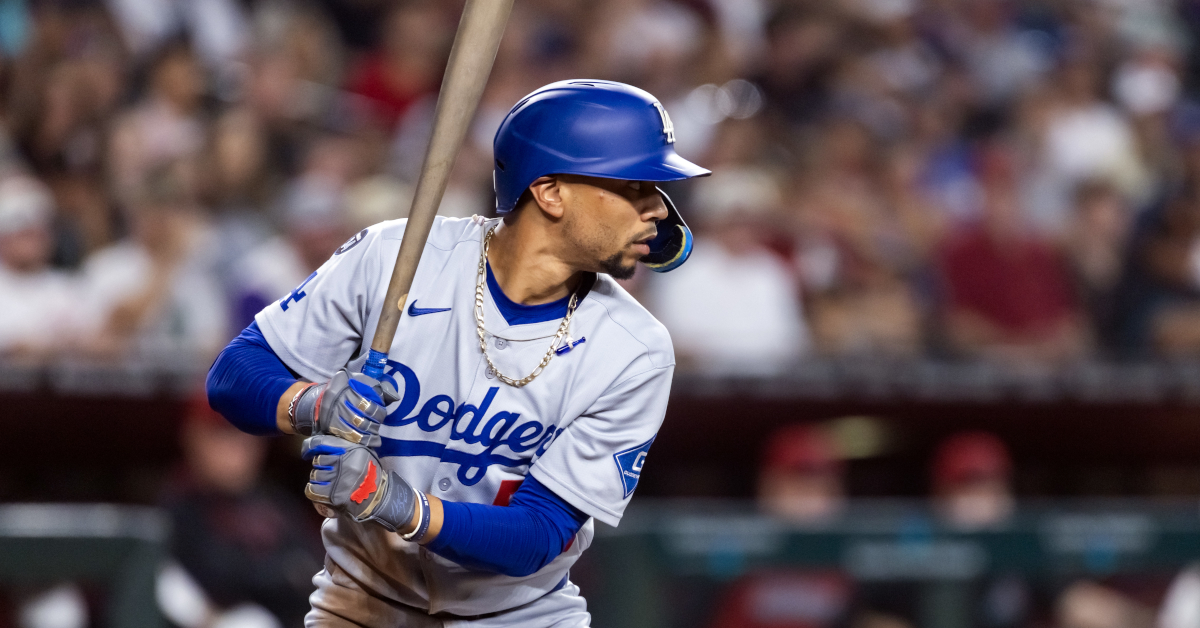
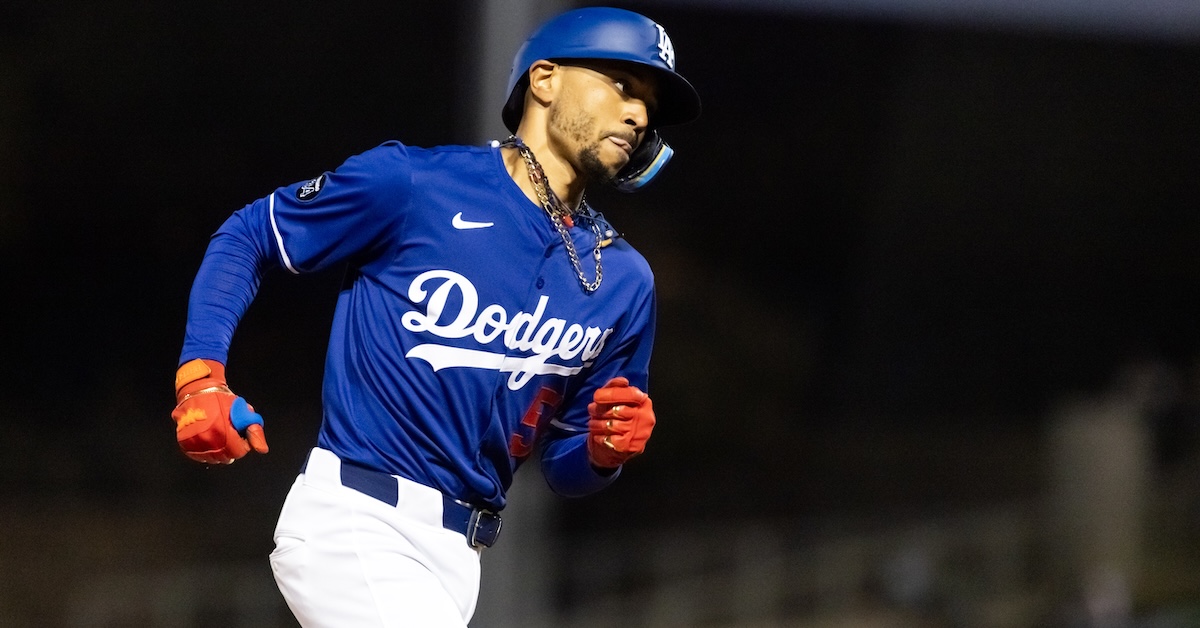
A spring illness caused Mookie Betts to lose nearly 20 pounds in two weeks and forced him to miss the Dodgers’ two-game series in Japan to start the season. His conditioning never really caught up once the season got underway and he struggled for nearly the entire season. He did finish on a high note, posting a 128 wRC+ in August and September, but the early season damage was already done. As one of the most expensive players in the Ottoneu universe, a lost season from Betts was bound to have repercussions, and he wound up being the second most cut player at the deadline. Still, if we chalk up his struggles in 2025 to his spring illness, then a bounce back season in ‘26 is more than likely. The projections see a wide range of potential outcomes — ZiPS is projecting him at a 131 wRC+ while OOPSY is all the way down at 118 — but his history of production is good enough that you should expect to pay top dollar for him in the draft. His average salary after the cut deadline is nearly $50, though I’d expect that to fall a bit once he’s drafted in all those leagues where he’s available.
I really want to believe in Lars Nootbaar’s skillset. He’s got an excellent approach at the plate and his contact quality is fantastic. He lowered his groundball rate by nearly 15 points in 2025, but despite a hard hit rate of 50%, he didn’t see a big improvement in results on contact. A lot of that added air contact was hit at too high launch angles or hit to the opposite field. In other words, despite embracing “elevate and celebrate,” all that elevated contact wasn’t optimized for damage. To make matters worse, he played through a rib injury for some of the season and then had surgery to correct issues in both of his heels this offseason. I want to believe in Nootbaar, but between the injury issues and the difficulty translating his contact quality into real results, I’m not sold on a bounce back from him.
After a very successful first year in the US, Shota Imanaga took a pretty significant step back in his second season in Chicago. The twin culprits were a strikeout rate that dropped by nearly five points and a groundball rate that fell eight points. With all that extra elevated contact allowed, he saw a corresponding jump in home runs allowed that shot his FIP up by more than a run. Homers are a death knell for any pitcher in Ottoneu and so it’s no surprise to see Imanaga on the chopping block. I think it’s probably reasonable to expect a bit of a bounce back — his SIERA and xFIP were both well below his actual FIP in 2025 — but getting back to his outstanding ‘24 season is probably out of the question. As a fly ball heavy pitcher, his success will wax and wane based on his home run rate which gives him a pretty volatile profile.
Largest Drop in Average Salary — All Ottoneu Leagues
The table above lists players who saw their average salaries drop the most after the cut deadline. As you’d expect, there are a bunch of aging stars and once-great players who suffered a sudden dip in performance in 2025.
Man, what happened to Ozzie Albies? You could chalk up his power outage in 2024 to a broken wrist suffered in July of that season. But then he didn’t bounce back in ‘25; his ISO dropped to a career-low .124 and he blasted only 16 home runs. Even though we only have limited bat speed data, Albies’s average bat speed dropped a full tick from 2023 to ‘24 and it didn’t bounce back last year when he was supposedly healthy. His contact quality has never really been all that great but he made the most of it every season until last year. He’s still only 29 years old, but unless he rediscovers an extra gear with his bat speed, I’m afraid his best days are already in the past.
Oh look, another Braves hitter who really struggled last year. At least with Austin Riley, you can point to a hand injury in 2024 and three separate core injuries in ‘25 to explain his struggles. Then again, his production at the plate had already started to decline slightly in 2023, and really reached fever pitch when his plate discipline started slipping in ‘24. It deteriorated further in 2025 when he got more aggressive at the plate while running a slightly higher whiff rate. The good news is that his contact quality was still elite which means the only thing he needs to work on is his approach. Of all the guys on the two lists in this article, Riley is the one I’m most confident in predicting a bounce back this year.
Finally, here’s a long list of players cut in more than 50% of all Ottoneu leagues.
The Ottoneu keeper deadline is quickly approaching. There’s less than a month left to make your roster decisions before the January 31 cut deadline. I’m going through a handful of difficult keep or cut decisions at every position group to give you a transparent look at my decision making process and hopefully help you with theses specific cases for these specific players. I’ve already covered hitters in three separate articles — corner infielders, middle infielders, and outfielders — now I’m wrapping everything by covering three starting pitchers.
I’m not sure the Mets know what to do with Kodai Senga so I wouldn’t blame you if you didn’t know what to do with him on your fantasy squad. Injuries cost him nearly all of 2024 and a hamstring injury in June derailed his season a year later. Before that injury, he had put up a 1.47 ERA and a 3.24 FIP in 13 starts. During the rehab from his injury, his mechanics were thrown out of whack, and after he returned to the majors, he produced a 5.90 ERA and 5.76 FIP across nine starts. Ultimately, he was demoted to Triple-A in September to work on those mechanical inconsistencies.
Even if Senga is completely healthy in 2026, there were enough yellow flags in his first-half performance that a rebound back to the level of his excellent 2023 debut isn’t necessarily guaranteed. During those first 13 starts of the season, his strikeout-minus-walk rate was 13.3%, just a hair below league average and well short of the 18.0% K-BB% he posted during his first season in the US. Most of that was driven by a significant drop in strikeout rate.
You could point to his signature pitch, the ghost fork, as the reason why he wasn’t seeing as many swings and misses in 2025. And while that pitch was a little less effective last year, it was his cutter that saw the most dramatic drop in effectiveness. In 2023, his cutter was the fourth most valuable pitch in baseball by Run Value with a 2.9 RV/100, far outpacing his forkball (1.0 RV/100). In 2025, his cutter was exactly neutral with a 0.0 RV/100. Unlike his diving forkball, Senga’s cutter was a contact suppression machine during its peak, but batters made much higher quality contact against that pitch last year. That combination — a forkball that wasn’t getting as many swings and misses and a cutter that wasn’t generating as much weak contact — has me worried that Senga’s ceiling is far lower than we might think.
The projections are picking up on those concerns and see Senga taking a pretty significant step back in 2026. Health concerns aside, there are enough flags in his pitch arsenal that present enough risk to steer clear. And when you add his mechanical issues and injury history back into the picture, it’s a pretty easy call to avoid paying too high a price for Senga in 2026.
Keep or cut?
I’m cutting Senga in both of my leagues where I’m rostering him and I doubt I’ll be looking to redraft him in the spring.
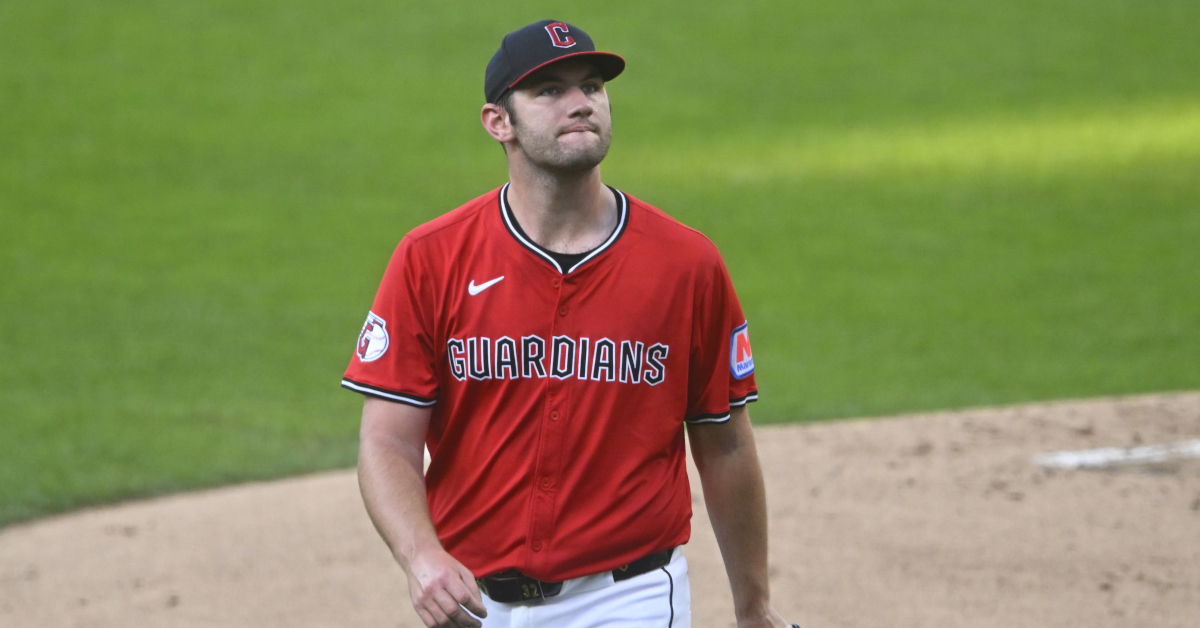
Through his first 11 starts of the year, Gavin Williams put up a rough 4.27 ERA and 4.65 FIP. It wasn’t terrible, but it was a concerning start to the season after an up-and-down year in 2024. From the beginning of June through the end of the season, his ERA fell by nearly two full runs down to 2.50 but his FIP only dropped to 4.27. His strikeout-to-walk ratio improved slightly during those final four months of the season but the biggest reason his ERA improved was thanks to a .221 BABIP and a 87.5% strand rate. Most of his underlying peripherals pointed to the same pitcher on the mound, but a ton of good batted ball luck helped him flip his season.
For Ottoneu players, an improved ERA shouldn’t necessarily help Williams’s fantasy production and a FIP above four is usually a bad sign. But here’s where understanding the ins and outs of your given format becomes extremely important.
Gavin Williams, Ottoneu Points Performance
Time Period
FIP
BABIP
FGpts/IP
SABRpts/IP
Prior to June
4.65
0.323
3.43
3.47
June Onward
4.27
0.221
4.57
3.86
In Ottoneu leagues using the FanGraphs points system — which critically takes hits allowed into account — Williams dramatically improved his production during the later half of the season. In leagues using the SABR points system — using only the inputs for FIP — Williams’s season was frustrating from start to finish.
As for Williams’s pitch arsenal, he was able to develop a very effective sweeper last year that returned a 44.0% whiff rate. That’s an excellent pitch to add to his repertoire, though his lack of command holds him back from really raising his ceiling. That’s sort of the big issue with his profile. He has a good, hard fastball, two excellent breaking balls, but he needed some incredible batted ball luck to turn into an effective pitcher for fantasy. His command was still an issue throughout the season, leading to some pretty inconsistent outings. Still, his Location+ improved from 91 during the first two months to 96 through the end of the year. That’s something to build off of, but until he’s able to make some significant improvements in that area, I fear his excellent stuff will be held back from reaching its maximum potential.
Keep or cut?
Thankfully, all three leagues where I’m rostering Williams use FanGraphs points, so I was able to partially enjoy his second half improvements in 2025. I’m probably keeping him at $8 and $9 but I think I’ll be cutting him at $11. His inconsistencies and command issues make him a risk to roster at a double-digit salary.
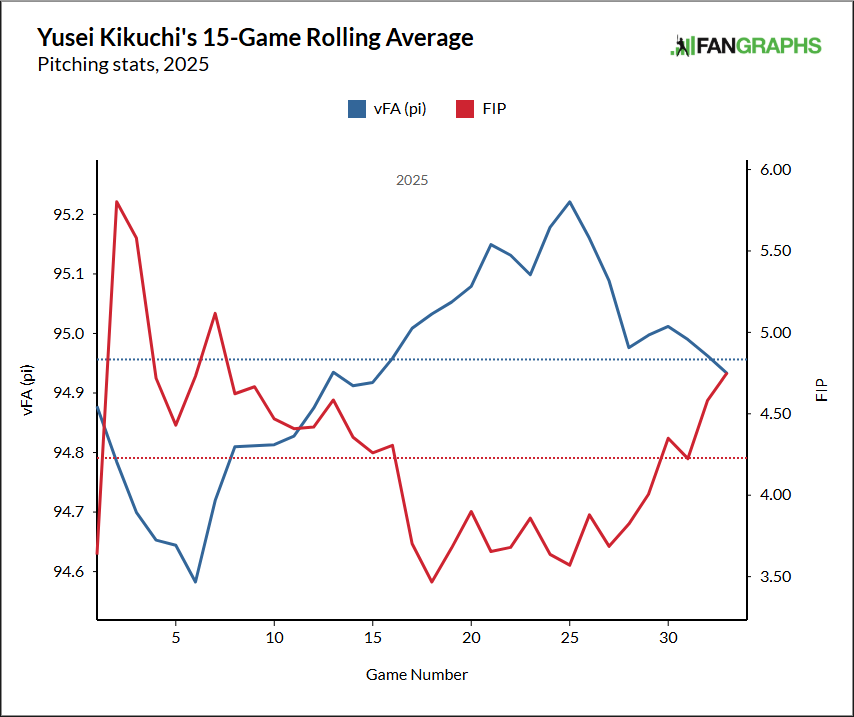
Coming off what seemed to be a mini-breakout during his short 10 start stint with the Astros during the second half of 2024, Yusei Kikuchi latched on with the Angels last year. Even though he was leaving the pitching development powerhouse in Houston, I expected the changes he implemented while he was there to stick in Los Angeles. Unfortunately, they didn’t. Some mechanical issues led to a drop in velocity and a lower arm slot affected the shapes of all his pitches. He spent most of the season working out the kinks in his delivery, slowly raising his arm slot and regaining some of his velocity.
I think the thing that worries me the most is the effectiveness of Kikuchi’s fastball. He’s one of the hardest throwing left-handers in baseball, but he’s entering his age-35 season in 2026. His velocity dropped early last year, and even though he regained it in the middle of the season, it dropped again in August and September and his results tanked along with it.
Last year, he generated the lowest whiff rate on his fastball since his debut season in 2019. Both his slider and changeup were a little less effective at getting swings and misses too. It all added up to a 5.5 point drop in strikeout rate and a much higher walk rate that was more in line with what he was posting during his time in Seattle.
Kikuchi has never been a model of consistency during his career. He’ll have dominant stretches from time to time, but his command issues have often held him back from reaching his ceiling. It looked like he had turned a corner in Toronto and Houston in 2023 and ‘24, but he came crashing back down last year thanks to his mechanical troubles. Steamer projects a small bounce back but he’s getting to the point in his career where the velocity of his fastball is sitting on a knife’s edge; dip just a little and the whole repertoire comes crashing down.
Keep or cut?
$5 is probably the highest I’d want to roster Kikuchi for heading into next season. There’s always the possibility he’ll figure out his mechanics over the offseason and post another strong season like he did in 2024, but there are too many flags to risk anything higher than that. I’ll probably keep him at $5, but he’s a quick cut if his fastball isn’t looking good in the spring.
The Ottoneu keeper deadline is quickly approaching. There’s less than a month left to make your roster decisions before the January 31 cut deadline. I’m going through a handful of difficult keep or cut decisions at every position group to give you a transparent look at my decision making process and hopefully help you with theses specific cases for these specific players. I started with the corner infielders and middle infielders before the holidays and will wrap up with pitchers later this week.
–
Teoscar Hernández, OF
Salary: $18, $19, $20
Average Salary: $21
2025 P/G: 4.55
Projected 2026 P/G: 5.04
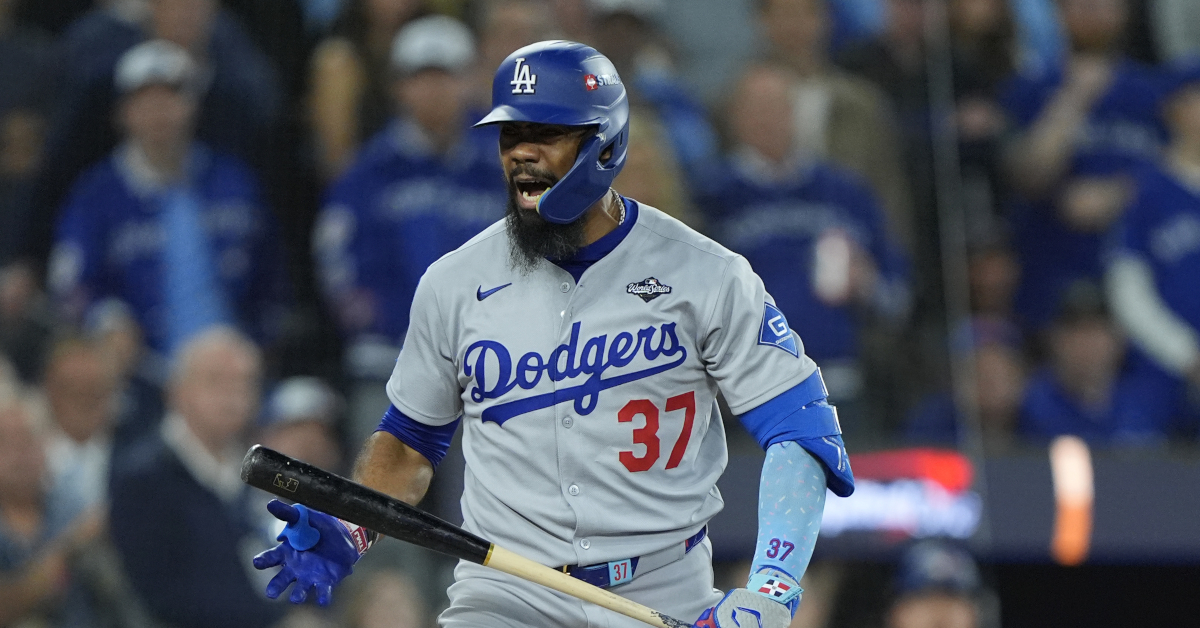
A big bounce back season during his first year in Los Angeles had me hopeful that Teoscar Hernández’s down year in Seattle in 2023 was a one year blip. A year later, it kind of seems like the bounce back was the blip after Hernández posted a 102 wRC+ in ‘25, slightly worse than the 107 he posted with the Mariners a few years ago. Entering his age-33 season this year, which Hernández should we expect to see in 2026?
Let’s get the good news out of the way first: Hernández’s contact quality looked pretty good despite the underwhelming results. His hard hit rate was still well above average, and even though his barrel rate fell by more than three points, it was still barely outside the top quartile among qualified batters. That drop in barrel rate might have had an outsized effect on his bottom line results however. His expected wOBA on contact fell from .457 in 2024 to .403 in ‘25 despite no significant change to his batted ball mix. He wasn’t pounding the ball into the ground more often, he was simply less productive on the contact he was making. His average bat speed was down a little, but not dramatically which does provide some hope that he can rediscover his knack for barrelling up pitches.
The other concerning trend last year was a walk rate that fell to the lowest it’s been in his career. Hernández has never really been a patient hitter, but his walk rate usually fell right around league average when he was a middle-of-the-order run producer in Toronto. In 2025, it dropped to 4.8%. There were no dramatic changes to his underlying plate discipline metrics which makes his walk rate even more of a mystery. His swing rate in three-ball counts was 72.7%, much higher than his norm and the second highest three-ball swing rate in baseball. That tells me he was trying to swing his way out of his struggles rather than maintaining his measured aggression that served him so well in the past.
Steamer is essentially splitting the difference between Hernández’s down seasons in 2023 and ‘25 and the rest of his productive history. That’s probably a pretty reasonable expectation — he’s getting to the age where power output starts to slide and he doesn’t have the kind of approach that would allow him to thrive once his bat speed falls off a cliff. I think he’s probably got one or two more productive seasons left in his bat and there’s always the possibility he bounces all the way back to his ‘24 level.
Keep or cut?
I think I’m cutting all three of my shares of Hernández. His projection isn’t terrible but two out of the last three years have been extremely disappointing. I’m just not comfortable paying that much salary to see if he can figure things out in 2026 as he enters the decline phase of his career.
–
Kerry Carpenter, OF
Salary: $15
Average Salary: $10
2025 P/G: 4.44
Projected 2026 P/G: 5.37
How do you evaluate a part-time player who absolutely scorches the ball as the strong side of a platoon but useless when facing same-handed pitching. And what if that part-time player was coming off a down season where many of his offensive metrics took significant steps backwards. That’s the dilemma posed by Kerry Carpenter.
Because he’s the strong side of a platoon, Carpenter’s fantasy performance needs all sorts of context to fully understand. He’s primarily used against right-handed pitching and often pinch hits late in games if he isn’t starting. Those extra appearances off the bench artificially depress his overall points per game, though we can use points per game started, or more simply, points per plate appearance, to cut through some of that noise. Here’s a look at the various lenses we can use to clear up our evaluation of his production:
Kerry Carpenter, Ottoneu Fantasy Production
Year
Overall P/G
vR P/G
Starting P/G
Overall P/PA
vR P/PA
Starting P/PA
2023
5.18
4.61
5.41
1.33
1.39
1.33
2024
5.43
5.61
6.07
1.60
1.78
1.59
2025
4.44
4.07
5.08
1.24
1.31
1.27
When looking at points earned in games he started, Carpenter wasn’t too far off his production from his breakout two years ago and he looks a lot better from a points per plate appearance stand point as well.
The source of his struggles in 2025 seem to stem from a 54 point drop in BABIP and a 3.5 drop in walk rate. All of his underlying batted ball and plate discipline metrics look in line with his established norms and he even posted a career-best 22.8% strikeout rate last year.
Keep or cut?
I’m having a hard time justifying keeping a platoon outfielder for $15, even if he absolutely crushes right-handed pitching. The highs of 2024 are probably a high-water mark for him and Steamer isn’t predicting a big step forward for him in 2026. $10 is a more reasonable value for a really good part-time player like Carpenter, but a $15 salary gets squeezed off the roster.
–
Trent Grisham, OF
Salary: $7, $5, $4
Average Salary: $5
2025 P/G: 5.35
Projected 2026 P/G: 5.19
After settling in as a defense-first center fielder in San Diego, Trent Grisham enjoyed a huge breakout in New York in 2025. He’s shown he’s capable of producing at the plate in the distant past — he posted a 110 wRC+ across his first two seasons in San Diego in 2020 and ‘21 — but hasn’t hit very well until last year. All of a sudden, he started mashing the ball and wound up blasting a career-high 34 home runs in 2025.
Grisham has always had a patient approach at the plate and his batted ball quality significantly improved after joining the Yankees in 2024. The biggest difference was turning his sometimes overly patient approach into selective aggression on pitches in the zone early in the count. Ambushing pitchers when they tried to steal strikes worked wonders for Grisham and represents a real change in approach for him.
Surprisingly, Steamer believes in the changes Grisham made. It would have been easy to write off his breakout as a one-year blip, but the projections are calling for a solid follow-up season, though not necessarily up to the heights of his breakout.
Keep or cut?
I see the improvements in Grisham’s approach and batted ball quality and I’m willing to bet that they stick around in 2026. I’m keeping all three of my shares.
The Ottoneu keeper deadline is quickly approaching. There’s about a month and a half left to make your roster decisions before the January 31 cut deadline. I’m going through a handful of difficult keep or cut decisions at every position group to give you a transparent look at my decision making process and hopefully help you with theses specific cases for these specific players. I started with the corner infielders last week and will have outfield and pitchers after the holidays.
–
Carlos Correa, SS/3B
Salary: $26, $15
Average Salary: $15
2025 P/G: 4.42
Projected 2026 P/G: 5.19
Carlos Correa’s capacity for greatness still resides somewhere within him. Just a year ago, he posted a 154 wRC+, though he was limited to just 86 games thanks to a significant foot injury. He played through that same issue this year and it’s likely that it seriously affected his ability to perform for most of the season. He limped to a .267/.319/.386 slash line (97 wRC+) through the first half of the season, though he improved on that after being traded back to the Astros at the trade deadline.
The most concerning yellow flag in Correa’s peripherals was a groundball rate that jumped 4.5 points from 2024. He was still hitting the ball with authority, but all that additional contact on the ground meant that his barrel rate fell to 6.8%, the second lowest mark of his career. His top level plate discipline metrics were a little out of whack too; his strikeout rate was mostly stable but his walk rate fell by more than three points. There was nothing really amiss in his underlying metrics; he was a little more aggressive at the plate because he saw more pitches in the zone than ever before but that doesn’t fully explain the drop in free passes.
The projections are a little more pessimistic than I’d expect based on his history, though his excellence in 2024 seems like the outlier when looking at his down seasons in ‘23 and ‘25. It all boils down to how his foot is fairing. If he’s truly healthy heading into next season, it’s reasonable to expect him to beat his projections. There’s also the matter of his position switch. Correa will retain shortstop eligibility next year, but he’ll probably lose it the year after unless something surprising happens in Houston.
Keep or cut?
I’m happy to keep Correa at $15 and I’d probably be comfortable up to $18 or $20 just based on his history of production. There’s a risk that he won’t be healthy, but he was valued around $25 during his abbreviated 2024 season. That’s the upside, even if he misses some time next year. But that same health risk means that I’m probably not keeping my $26 share.
–
Xander Bogaerts, SS
Salary: $9
Average Salary: $13
2025 P/G: 4.49
Projected 2026 P/G: 4.76
At this point in his career, Xander Bogaerts is a much more valuable real life shortstop than a fantasy one. There’s been a steady drop in offensive production over the last three years, though the good news is that his 2025 was an improvement on his dismal ‘24 season. Even though he’s likely well past the era of posting wRC+’s in the 130s, he’s only a couple of years removed from putting up a 119 wRC+ in 2023. While that first season in San Diego was a step back from his time in Boston, his fantasy value still sat around $20 for his efforts.
Despite the league average results on the field, there were some encouraging signs in Bogaerts’s underlying metrics. Never one to post outrageous batted ball peripherals, his hard hit rate was the highest it’s been since 2022 and his barrel rate, air contact rate, and pull rate the highest they’ve been since 2021. The main reason behind all those improvements? A 1.5 mph increase in his bat speed this year. Those gains in those specific metrics should have resulted in better outcomes but his actual wOBA trailed behind his expected wOBA by 12 points.
Steamer sees a bounce back season in Bogaerts’s future and I think I can see what the computer is picking up on. His down season in 2024 was marred by a serious shoulder injury and the improvements to his bat speed and batted ball peripherals tell me that his body has mostly returned to normal.
Keep or cut?
I’m going to keep at $9 and I think I’d be comfortable keeping up to $12 or $13. There’s some risk of age related decline, but he showed he was healthy last year. Don’t pay for his name recognition or the production you’d expect if he still played in Boston, but he still can be a useful middle infield option for your fantasy squad.
–
Jackson Holliday, 2B/SS
Salary: $9
Average Salary: $14
2025 P/G: 4.26
Projected 2026 P/G: 5.08
How do you properly assess a 21-year-old phenom who hasn’t lived up to the sky-high hype across his first two seasons in the majors? The scouting reports were so glowing, I imagine plenty of fantasy players paid a pretty penny for Jackson Holliday, hoping that they were getting a future star to anchor their lineups. Holliday could certainly still turn into that star, but he didn’t make the immediate impact many were expecting.
The good news is that Holliday is still exceedingly young and he improved by leaps and bounds during his second taste of the big leagues.His overall batting line was a hair below league average but he made some strides to elevate the ball more often and improved his contact rate by more than eight points. You can still dream on the ceiling because he still has so much more growing to do — both from a physical standpoint and just learning how major league pitchers will approach him — but he could be a year or two away from realizing that potential.
The projections see a small step forward from him in 2026 which is pretty reasonable given his pedigree and age. Still, those improvements only get him to the level of a replacement level middle infielder in fantasy baseball. Could he blow past those projections with a post-hype breakout? Absolutely! Do I want to bank on that happening next year? Eh…
Keep or cut?
I’m probably keeping at $9 though I think that’s probably the highest I’d be comfortable going at this point. Any higher and I’m buying his potential ceiling without any real indicators he’s about to breakout in a meaningful way. I also recognize that your place in your team’s competitive window will have a huge bearing on your willingness to keep Holliday. If you’re in win-now mode, keeping Holliday with a double-digit salary is a tougher pill to swallow than if you’re still rebuilding your roster and looking to compete in a year or two.
From July 23 through the end of the season, Bryson Stott posted a .307/.376/.508 slash line, good for a 143 wRC+ and 5.5 P/G. That hot streak corresponded with a pretty dramatic change to his swing mechanics. He was able to improve the quality of his contact while still maintaining the excellent plate discipline that buoyed his value as a batter throughout his career. With a solid approach now enhanced by more hard contact, Stott has all the underlying indicators of a potential breakout in 2026.
The projections aren’t yet picking up on those mechanical changes — to the silicon circuits, his hot streak to end the season was just that, no real signal to affect next year’s projection. But if his improved swing carries over to 2026, there’s real reason to believe he’ll be able to beat those projections easily. The risk is that he falls back to his previous career norms and remains a replacement level middle infielder for fantasy purposes.
Keep or cut?
I’m willing to pay $6 (and $4) to see if his swing changes carry over to next year. Those salaries are low enough that it’s easy to cut bait if he’s the same old Stott next year, but the potential for a huge breakout is real enough that it’s not a problem to carry him on my rosters to start the season. I’m not sure I’d go into double digits to keep him but I do think the ceiling is a lot higher than the projections think it is.
The Ottoneu keeper deadline is quickly approaching. There’s about a month and a half left to make your roster decisions before the January 31 cut deadline. Over the next few weeks, I’ll be going through a handful of difficult keep or cut decisions at every position group. I’ll start with the four infield positions this week and move on to the outfield and pitchers next week.
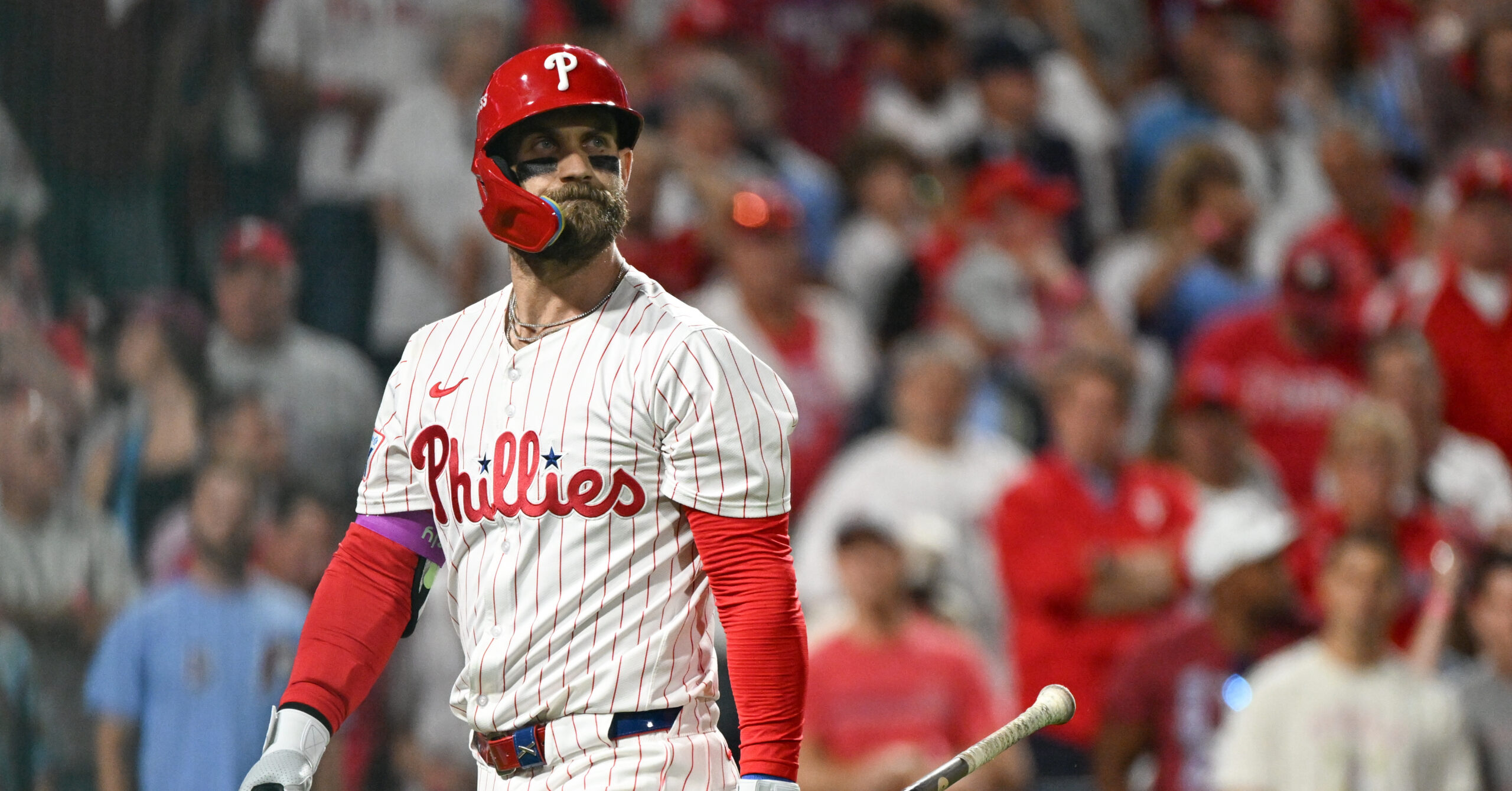
While Bryce Harper probably isn’t going to hit like he’s one of the top 5 batters in baseball again, he’s still extremely productive as he enters his age-33 season in 2026. A wrist injury in June cost him about a month of the ‘25 season and he’s averaged a little under 130 games played per season over the last five years. While he might not be an iron man, he’s been productive while he’s on the field, putting up a 146 wRC+ during that same five year period. His batted ball peripherals all looked in line with his career norms; his 47.5% hard hit rate and 12.3% barrel rate both look good and his .368 xwOBA was right in line with his actual results on the field.
While his strikeout and walk rates look good on the surface, there are a few yellow flags in his underlying plate discipline stats. His chase rate has significantly jumped over the last few years and it was up to 36.0% in 2025, the second highest mark of his career. He’s being forced to hunt for pitches out of the zone because pitchers simply refuse to give him anything to hit. Since winning his MVP award in 2021, he’s seen the fewest pitches in the strike zone of any batter in baseball by a pretty wide margin. This year, his zone rate was just 42.9%, the lowest in the majors and three points lower than the guy right ahead of him.
Steamer is predicting a bit of a bounce back season for Harper in 2026, though it’s mostly fueled by a jump in BABIP. He’s at the age where power starts waning a bit and the projections see him essentially holding his power numbers steady next year. I guess that’s what worries me. Harper has already slipped a bit from his peak and he’s not getting any younger (no matter how many weird blood procedures he wants to try). If you’re paying a premium in the hopes that he’ll get back to his MVP caliber seasons, you’re likely going to be disappointed.
Keep or cut?
I think Harper’s current average salary of $45 is reasonable for the projected production you’re hoping to get from him in 2026. Like with any aging slugger, there’s some risk involved in paying that much for the downslope of a career. I’m keeping at $42 and I’m shopping my $49 Harper, hoping to pass the buck for that decision to someone else.
Now that Willson Contreras finally lost his catcher eligibility, he’s lost a ton of his fantasy value. A catcher who can put up 5.2 P/G is quite useful — just six other catchers surpassed that mark in 2025 — but a 5.2 P/G first baseman is quite another matter. Fifteen other first basemen surpassed that mark this year and eighteen are projected to be better than that in 2026. Instead of being a top tier option at catcher, Contreras is now a third or fourth tier option at first base.
To be fair, his batted ball peripherals all looked good during his first full season out from behind the plate. The biggest reason why his overall value took a hit in 2025 was because his walk rate dropped nearly five points, down to 7.8%. There was nothing amiss in his underlying plate discipline metrics; his chase rate, contact rate, and swing rates all looked normal. The biggest difference, then, was a higher rate of pitches seen in the zone — the highest zone rate of his career — and a corresponding increase in called strikes seen.
Steamer sees a bounce back in walk rate next year, but his BABIP takes a hit, leading to an overall projection a little worse than what he accomplished in 2025. I don’t have any qualms with the projection — it seems like it’s pretty reasonable — so my issue is with his positional eligibility. Right now, I’ve got him ranked in the same tier as Kyle Manzardo, Spencer Torkelson, and Christian Walker. Each of those players is useful in their own way, but I wouldn’t be comfortable with any of them as my primary first baseman in 2026.
Keep or cut?
I’m cutting both of my shares of Contreras. Paying up to $10 for him in next year’s auction is probably reasonable, but getting up to the mid-teens seems like an overpay.
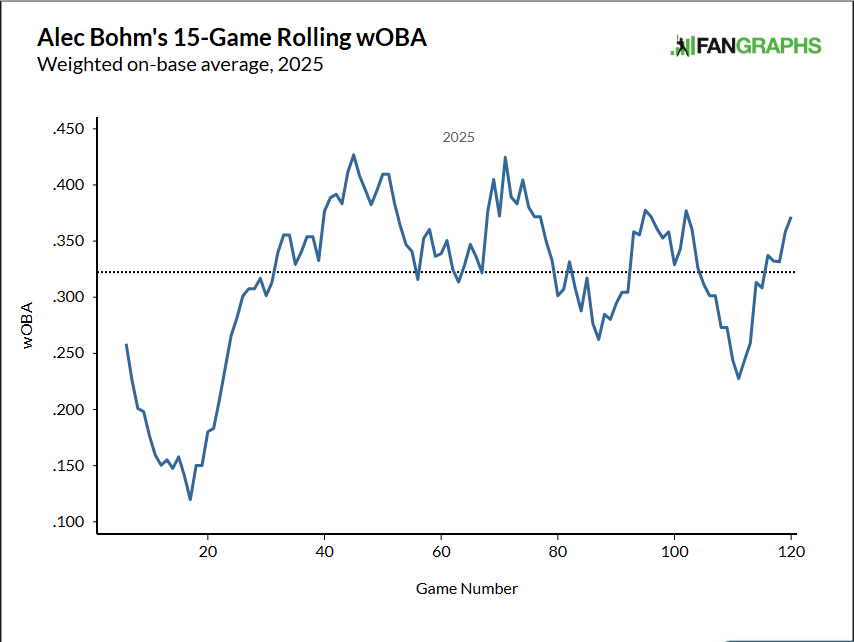
An abysmal first month of the season is bringing down Alec Bohm’s overall numbers from 2025. From May 1 through the end of the season, he posted a .308/.356/.453 slash line, good for a 124 wRC+ and 5.4 P/G.
That’s the kind of production we’ve been expecting to see from Bohm since his exciting debut back in 2020. The unfortunate thing about his excellent finish to the season is that it wasn’t really fueled by a change in any underlying batted ball metrics. He was the same hitter he’s always been, just really unlucky for the first month of the season and then a little luckier than normal over the next five months.
So which version of Bohm can we count on in 2026? Probably the same one we’ve come to know over the last few years — the same one who posted around 5.0 P/G in 2023 and ‘24. That’s a useful corner infielder, but not necessarily a high quality starting option. That’s what Steamer sees as the most likely outcome. If there’s one thing to latch onto as a source of hope, it’s that he ran the highest contact rate of his career this year. With his above average hard hit rate, putting the ball in play more often should lead to more positive results. Unfortunately, his ceiling is capped by how often he puts the ball on the ground and his correspondingly low barrel rate. Unless he can make a significant adjustment to start lofting the ball more often, his hot streak from the second half of this season will likely be the best version of Bohm we’ll see.
Keep or cut?
I’m really on the fence about Bohm. He fits better as a third baseman where the pool is a lot shallower than at first base but the roster where I have him rostered for $9 already has third base covered by José Ramírez. I’m not sure I want to keep him at $11 either, but that’s probably about what he’s going to be auctioned for if I end up cutting him. I think it’ll ultimately come down to my salary cap situation on both teams — if there’s room to roster a premium bench CI, then Bohm seems keepable. If not, he’ll end up a casualty of being good enough without a high potential ceiling to boost his value.
–
Adley Rutschman, C
Salary: $30
Average Salary: $21
2025 P/G: 3.79
Projected 2026 P/G: 5.03
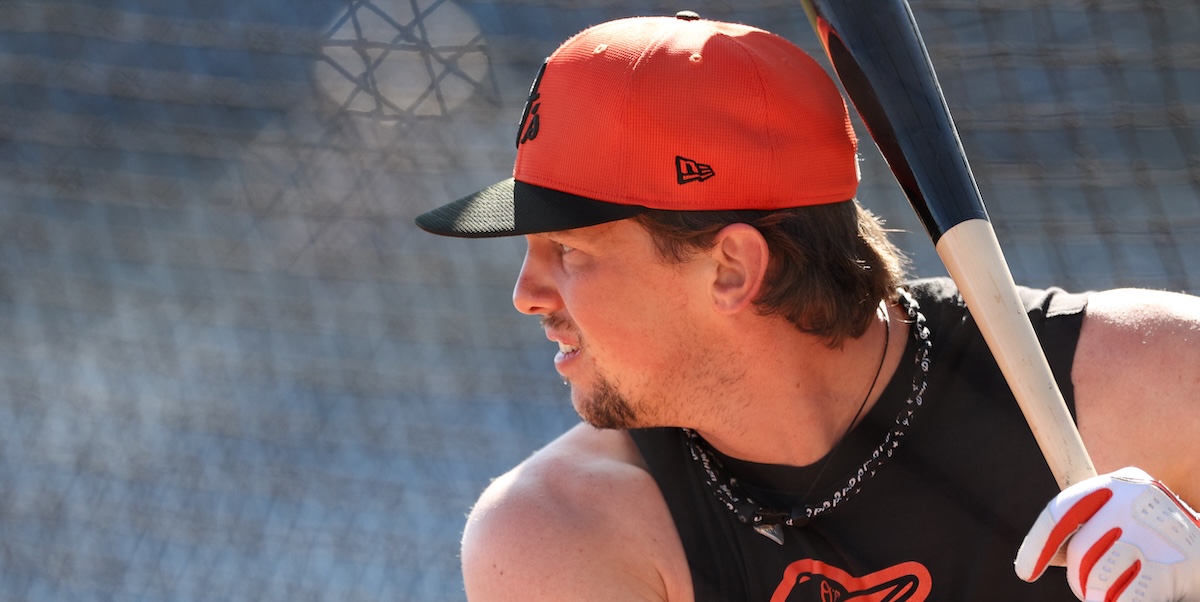
I have no idea what to do with Adley Rutschman. To be fair, I don’t think the Orioles know what to do with him either. He had such a promising start to his career and then suddenly collapsed partway through the 2024 season. There was some hope that an offseason would help him get healthy for this year and he’d find a way to bounce back. That obviously didn’t happen. He suffered through two separate oblique strains, and even when he was healthy, he wasn’t producing at the plate.
The weird thing is that his underlying batted ball metrics aren’t out of whack, his plate discipline is still excellent, but he simply isn’t seeing the results that he enjoyed during his first two seasons in the big leagues. Some of that is a dramatic drop from his BABIP but it’s also a deterioration of his plate approach. His strikeout and walk rates aren’t affected, but his ability to hunt for pitches to do damage against has diminished over the last two years — his SEAGER dropped from 21.1 during his rookie campaign to 11.6 in 2025.
Steamer sees a pretty significant bounce back from Rutschman in 2026, but the projection has hedged against his ceiling based on his struggles these past two years. Like I mentioned with Contreras above, just seven catchers crossed the 5.0 P/G threshold this year. If Rutschman can get back to that level of production, he’ll be one of the best hitting catchers in baseball. There’s so much risk in paying for that projection knowing that he’s been a below average catcher for a season and a half now.
Keep or cut?
I’m obviously cutting at $30. That’s simply far too expensive for any catcher unless his name is Cal Raleigh. I’d be open to keeping Rutschman around $15, but even at that high a salary, you really need him to figure things out next year and hit his projection.
When preparing for a draft or auction, it is pretty typical to determine what positions you feel best about the deep options and therefore don’t have to spend big resources upfront. Love a bunch of shortstops you can get after pick 200/for less than $5? Then you don’t need to break the bank for Francisco Lindor.
In keeper auctions, that depth can shift unexpectedly (as we discussed earlier this week), so you need to now only know what positions are deep but what positions are deep among players actually available. But there is another factor that impacts position depth: what other teams need.
Google’s AI Overview on the search “what is inflation” (proper grammar not necessary) is:
Inflation is when prices of goods and services increase over time. It’s a broad measure of how much more expensive things are becoming.
In Anthony Clark’s Economics Through Everday Life, he writes:
The presence of inflation simply means that prices on average are rising.
This time last year, Chad Young wrote:
Inflation is simply the increase or decrease in average player price you can expect as a result of the relationship between amount of money spent on keepers and the amount of value those keepers represent.
Let’s use a few of the FanGraphs Staff II keepers as examples of how this all plays out to cause inflation in Ottoneu fantasy baseball. Read the rest of this entry »