Archive for Keeper Strategy

Ottoneu: Lucas’ Keep or Cut Decisions at OF Part I

It can’t all be cut, cut, cut. You need to roster at least five outfielders in this game and once the season gets going, it can be challenging to find good ones to fill the gaps. Trust me, the gaps will appear. Sure, you can pick up an outfielder from auction anytime you need one, but will they perform anywhere near my calculated 4.14 replacement level points per game (P/G) mark for the position? Probably not. Go ahead, give it a shot. Go to the players page in your Ottoneu points league and see how many free agents who played in at least 20 games last season with a P/G mark higher than 4.14 are available. That makes it all the more important to make good keep/cut decisions. So let’s go. Read the rest of this entry »


Ottoneu: Jake’s Keep or Cut Decisions at OF

After covering difficult keep/cut decisions at the infield positions the last few weeks, the RotoGraphs Ottoneu team will turn our attention to the outfield this week (and possibly next week too). Here are five guys on my keep/cut bubble.

Michael Harris II, OF
Salary: $27
Average Salary: $18
2024 P/G: 4.55
Projected 2025 P/G: 6.02

Michael Harris’ struggles in his third big league season were all the result of the hamstring injury that cost him two months of the season, right? When you split his season pre-injury and post-injury, things don’t really line up with that narrative. Before he hit the IL, he was posting a rather disappointing .250/.295/.358 slash line, good for an 80 wRC+ with a particularly conspicuous absence of power. After he returned from his injury, he was a lot more productive at the plate, slashing .283/.318/.506 (125 wRC+) but stole just two bases through the end of the season.

Under the hood, everything looked right in line with the norms he had established for himself through the first two seasons of his career. His hard hit rate, barrel rate, xwOBA, and wOBA were all well above league average and his aggressive high contact approach at the plate remained intact. It wasn’t just simple bad luck either, though his BABIP did fall 34 points from 2023; his BABIP was nearly exactly the same before and after his hamstring injury. The only thing I can see is a batted ball mix that was a little out of whack early in the season; his groundball rate was over 53% through mid-June and his pull rate was nearly 10 points higher than what it was the year prior. Both of those metrics came back down towards his norms in August and September and his results on balls in play benefitted.

And then there’s his Steamer projection for 2025. The computer is enamoured with his potential to breakout next year and ZiPS shares in the optimism. Harris will turn 24 under a month before Opening Day and apparently his rebound during the second half of this season was enough to convince the computers that his struggles during the first half were just a mirage.

Keep or cut?

I’m keeping Harris at $27 (or I would have if I hadn’t just traded him away in that league for a $43 Corbin Carroll). Still, that feels like a ceiling for him. It assumes the projections are right and that he’s due for a significant improvement in 2025, but it doesn’t leave much room for him to produce much surplus value if that improvement comes to fruition.

Luis Robert Jr., OF
Salary: $29
Average Salary: $28
2024 P/G: 4.03
Projected 2025 P/G: 5.07

A hip injury sustained in early April sidelined Luis Robert Jr. for two months of the season and he never really recovered once he returned to the field. Between the injury, the constant trade rumors, and the historically bad team surrounding him, it was a miserable year for Robert. His strikeout rate spiked to 33.2% and his power output dipped to just a .155 ISO as he limped to a career-worst 84 wRC+.

There’s certainly some cause for concern when looking at his peripherals. His hard hit rate dipped slightly but his barrel rate fell by more than five points. That tells me that his overall quality of contact was intact but something else in his batted ball mix was leading to a lower power output. Indeed, his pull rate fell nearly 13 points, down to 34%. In the two seasons where his pull rate has been higher than 40%, Robert has posted wRC+s of 155 (43.1% pull rate) and 128 (46.8%); in his other three seasons in the majors with a pull rate under 40%, his wRC+ has been 111 or lower.

And then there’s his plate discipline issues. He’s always been an aggressive swinger, but the amount of damage he was capable of doing on contact helped him offset some of those strikeout issues. Well, he cut his overall swing rate by more than five points but his contact rate continued a two-year downward trend so the result was a lot more called strikes and a nearly five point jump in strikeout rate.

Honestly, between the lackluster season in 2024, the injury issues, and the red flags in both his batted ball and plate discipline peripherals, it’s agonizingly difficult to evaluate Robert. We know that when everything clicks and he’s firing on all cylinders, he can be a phenomenal offensive producer, but the inconsistency will kill you. His 2025 projection isn’t very rosy either.

Keep or cut?

I’m cutting at $29 and I’d cut all the way down to around $15. Unless he’s traded to a much better team environment this offseason, I’m avoiding him wherever I can.

Spencer Steer, 1B/OF
Salary: $8, $14, $18
Average Salary: $12
2024 P/G: 4.66
Projected 2025 P/G: 5.02

I really loved Spencer Steer for his multi-positional eligibility which is why I rostered him wherever I could. Now that he’s lost 2B and 3B eligibility, I’ve got to figure out how to evaluate him as an OF with a bit of flexibility at 1B. The player pool at his new position isn’t as shallow as it was at 2B or even 3B but it can be tricky to roster five reliable outfielders to fill all five of those lineup spots in Ottoneu. He’s lost a bit of value by simply going from four eligible positions down to two, but not as much as I think you’d expect.

As for his actual on-field production, 2024 was a bit of a weird year for him. Everything in his peripherals looked stable; his batted ball data was solid and his plate discipline even slightly improved. Despite all that, his wOBA fell from .355 to .316 thanks to a 58 point drop in BABIP. There’s nothing amiss with his batted ball data or his plate approach — it really seems like he was just the victim of old fashioned bad luck.

The projections don’t see his BABIP returning to his 2023 levels and nor should they; he isn’t very fast and he elevates too much of his contact to take advantage of a high line drive rate. A BABIP just below league average is a pretty good bet to make and that’s exactly where the computer pegs him.

Keep or cut?

I’m happy to keep him up to $15 or $16 I think. $18 is probably too high, especially without the positional flexibility that made him so valuable the last few years.

Nolan Jones, OF
Salary: $10
Average Salary: $9
2024 P/G: 3.16
Projected 2025 P/G: 4.97

Are you willing to pay for a breakout that’s now two years removed? That’s the central question surrounding Nolan Jones. His season in 2024 was marred by a recurring back injury and he had plenty of issues reproducing his outstanding season from ‘23 when he was on the field. His hard hit rate actually increased by three and half points but his power production cratered despite all the hard contact. It’s not hard to figure out what happened either; his groundball rate jumped almost 10 points and his pull rate fell by more than 10 points. That’s a seriously bad combination for a power hitter.

Assuming he’s healthy in 2025, it’s difficult to know what to expect from Jones. The projection essentially splits the difference between his breakout season and injury marred season. We can be pretty assured that his .401 BABIP from 2023 won’t happen again but his power gains all looked legitimate. If he can figure out how to start pulling and elevating his contact again, his home ballpark and fantastic contact quality give him a pretty high ceiling. There are a lot of “ifs” that need to go right for his 2025 season to be successful, making the risk pretty high if you opt to keep him.

Keep or cut?

I think I’m fine with keeping at $10 but no higher. That feels like a decent price to pay for the potential that he’s healthy and figures out all his batted ball issues. It’s also cheap enough that he becomes an easy cut if his 2023 breakout turns out to be just a flash in the pan.

Matt Wallner, OF
Salary: $4 (x2)
Average Salary: $6
2024 P/G: 5.36
Projected 2025 P/G: 4.90

Chad asked me to include Wallner here because I just acquired him in one of our shared leagues in exchange for Jazz Chisholm Jr. I understand the hesitation surrounding him. He’s got an extremely volatile profile full of strikeouts and tons of power. The highs will be excellent — like the 169 wRC+ he posted from July 7 through the end of the season — but the lows will likely be unplayable. To make matters more complicated, he’s likely to be platooned heavily since he’s absolutely atrocious against left-handed pitching. Thankfully, he’s on the strong side of the platoon, but a part-time player is a little more difficult to roster.

But let’s look at what he’s capable of. The 169 wRC+ over the final three months of the season was fantastic, but that came with a .410 BABIP and a 34.2% strikeout rate. What he does have going for him is outrageously good contact quality. His hard hit and barrel rates, xwOBA, and max exit velocity all sat in the top 5% in the majors. He may not make much contact, but when he does, ball go far.

Keep or cut?

I don’t want to overhype a player because the red flags in Wallner’s profile are certainly glaring, but he’s got a lot of prime Joey Gallo in him and he was an incredibly valuable player in Ottoneu for a long time. I’m happy to keep at $4 on the chance that Wallner actually does turn into the second coming of Gallo, but even if he settles in as a lesser version of Gallo, that’s still a valuable player in a format that rewards power and patience. The ceiling is a bit trickier to determine but I think I’d keep Wallner up to $6 or $7 and there’s probably a good chance he’ll go for even more at auction.


Ottoneu: Jake’s Keep or Cut Decisions at MI

Lucas started off this week with a look at tough keep or cut decisions at 2B and SS. Now it’s my turn with four guys on the keep/cut bubble.

Bo Bichette, SS
Salary: $28, $34
Average Salary: $29
2024 P/G: 3.04
Projected 2025 P/G: 5.31

I’m sure I’m not the only Ottoneu player wondering what the heck to do with Bo Bichette this offseason. His 2024 season was marred by multiple calf injuries and then cut short in the middle of September by a fractured finger. Even when he was on the field, he was horrendous, posting career worsts in WAR, wRC+, batting average, OBP, slugging percentage, wOBA, and xwOBA. It would be easy to chalk up his struggles to those injuries and expect a rebound season for him in 2025, but there were already some yellow flags in his profile before this year.

Bichette’s power output has been steadily declining year-over-year since peaking at a .260 ISO during his rookie year. His 2021 breakout now seems like a distant memory after settling in with a .348 wOBA across the two years afterwards. Despite all his injury issues this year, his hard hit rate stayed relatively stable even if his barrel rate collapsed. That tells me that he had no trouble making solid contact but his batted ball profile was all out of whack. Indeed, when we look at his rate of pulled elevated contact, 2024 represented a career low for him — just 19% of his elevated contact went to his pull side. His 29 home runs in 2021 notwithstanding, Bichette isn’t a traditional slugger but pulling the ball with authority is a surefire way to generate extra-base hits. Without that power, Bichette has produced a lot more empty batting average than you’d like to see, and that type of hitter just isn’t as valuable in Ottoneu than in traditional 5×5 leagues.

Steamer isn’t exactly bought in on a full bounce back either. It’s calling for a .330 wOBA which would have been a career low for him had 2024 not happened. My rankings aren’t sure what to do with him either as they currently show him in the mid-teens at shortstop in a tier with CJ Abrams and Xavier Edwards. That feels too low based on what he’s accomplished in the past but there are just so many question marks about what his product will look like in 2025.

Keep or cut?

I think $34 is too high a price with so much uncertainty surrounding him which makes him an easy cut in that league. $28 feels like it’s right on the cusp of the cut line too, but I think I’m up for gambling at that price. I could probably get him back in the draft somewhere around that price, but I’d rather hold on to him just for the roster clarity.

Brandon Lowe, 1B/2B
Salary: $13
Average Salary: $10
2024 P/G: 4.97
Projected 2025 P/G: 5.12

Oh look, another guy who feels tricky to evaluate due to injuries. Brandon Lowe’s injury history is much more extensive than Bichette’s, but to Lowe’s credit, he’s performed decently well when on the field. This year, he actually posted his best wRC+ since his monster season in 2021, and he only had one trip to the IL for an oblique strain towards the beginning of the season. Once he returned from that injury, he posted a scorching hot 152 wRC+ over the next three months, from May 20 through August 18. Afterwards, he fell into a bit of a slump and finished the season with an overall wRC+ of 123.

His batted ball peripherals all looked good; his hard hit and barrel rates all fell within his established norms and his power production was the best it’s been since 2021. There were some yellow flags in his plate discipline, however. His walk rate had sat at 11% over the last four years but fell to just 7.8% this year. His strikeout rate fell by about a point, which is good news, but the missing free passes are a lot more concerning. It all stems from an approach that was a lot more aggressive; his overall swing rate was a career high and was largely fueled by a five point jump in his zone swing rate. Swinging at more strikes is better than swinging at pitches outside the zone, but unless it comes with a corresponding jump in contact rate, it’s going to negatively affect his walk rate. That’s exactly what happened. He swung more often, didn’t make any more contact, and wound up walking and striking out less.

Of course, the real question for Lowe is how much he’ll end up playing in 2025. Between the injuries and the Rays careful handling of him against left-handed pitching, he’s accumulated more than 450 plate appearances in exactly one season during his career. On a per-plate-appearance basis, he’s one of the most productive second basemen out there, but rostering him means you’ll need to have a backup plan ready to go for 300 or so plate appearances.

Keep or cut?

His injuries and lack of playing time have depressed Lowe’s value these past few seasons, but he can really hit when he’s healthy. Still, $13 feels like it’s a bit too high to bet on a full season from Lowe. His average salary of $10 seems like a much better ceiling.

Tyler Fitzgerald, SS/OF
Salary: $4, $7
Average Salary: $8
2024 P/G: 5.06
Projected 2025 P/G: 4.46

An absolutely ridiculous month of July fueled Tyler Fitzgerald’s surprise breakout this year. Seriously, he hit .321/.390/.849 across 15 games that month and quickly took over the starting shortstop gig for a Giants team that was going nowhere. He continued to hit well through the end of the season and is slated to begin next season as the Giants starting second baseman after they signed Willy Adames.

He was ranked 26th on the Giants preseason prospect list as a 35+ FV prospect so his ascent and subsequent breakout were genuine surprises. Looking at all of his batted ball peripherals explains why no one really believes he’ll be able to replicate his success in 2025. He had below average exit velocity, hard hit rate, whiff rate, and xwOBA and his barrel rate was only slightly above average. His sweet spot rate was very high and his sprint speed was among the highest in baseball which could explain how he sustained such a high BABIP.

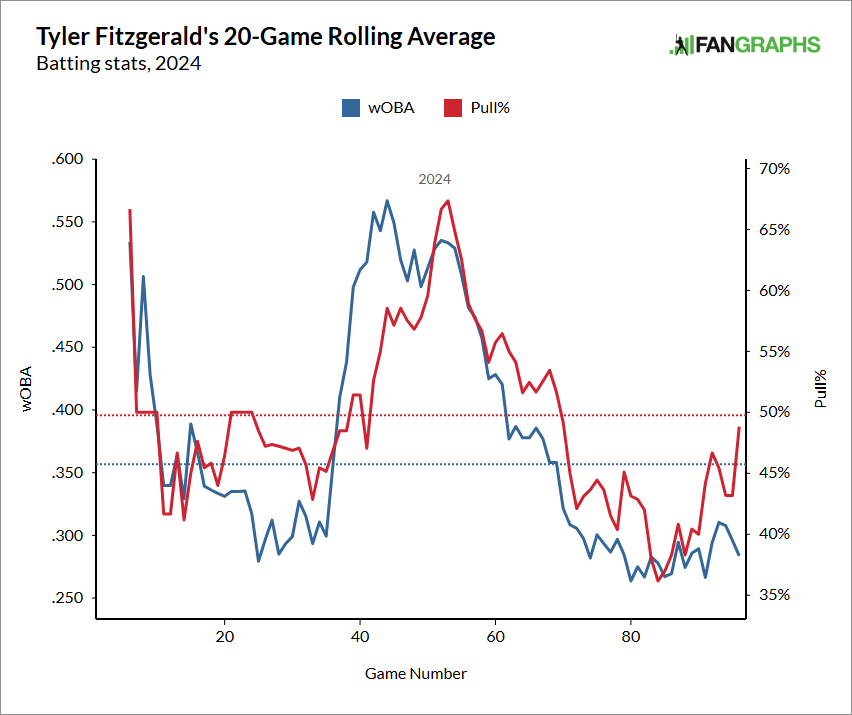
Fitzgerald’s entire approach is based on pulling the ball with authority; it’s the same kind of approach that Isaac Paredes uses with such great success. Indeed, look at how correlated Fizgerald’s pull rate is with his wOBA.

When he was crushing pitches to left field in July and August, he was a legitimate threat in San Francisco’s lineup. The issue is that this kind of approach is easily exploitable unless the batter has a good eye and can wait for the right pitch, like Paredes does. Unfortunately for Fitzgerald, he simply has too much swing-and-miss in his profile and isn’t patient enough to make his pull-happy ways work in the big leagues. My guess is that he’ll be a pretty streaky hitter in 2025, with some peaks like we saw this year, but an overall below average hitter.

Keep or cut?

Despite all the red flags laid out above, I’m not necessarily out on Fitzgerald at $4. He’ll add 2B back to his positional eligibility fairly quickly and a MI with his kind of potential for a hot streak is useful at that price. $7 feels like you’re paying for his July and August with the expectation that that hot streak is closer to his true talent and that’s just not going to be the reality.

Michael Massey, 2B
Salary: $3, $5
Average Salary: $4
2024 P/G: 3.98
Projected 2025 P/G: 4.51

I’m going to make this quick. Let’s play Chad’s favorite game: how many points did Michael Massey earn in games that he started? 4.64 points per game started! That’s a useful bench MI, and because he’s on the strong side of a platoon, it’s pretty easy to know when to lock him into your lineup or leave him on the bench. What’s funny is that even though the Royals protected him against left-handed pitching, Massey’s platoon split was just 4 points of wOBA.

Keep or cut?

I’m keeping at $3. At $5 things get a little dicey but it sounds like the Royals might be open to using Massey in the outfield now that they’ve acquired Jonathan India. Adding that positional flexibility might make him worth the extra couple of dollars.


Ottoneu: Lucas’ Keep or Cut Decisions at MI

The points per game (P/G) mark drops when it hits the middle infield position. In fact, players lined up at second and short hold the lowest P/G replacement level marks among defensive positions. Even Catchers do better. It’s hard to find power-hitting middle infielders and easy to find quick, speedy base-stealing ones. Analyzed below are three who emanate young potential and one who pulsates nostalgia. Each of them bring their own challenges to the keep/cut decision-making process. Read the rest of this entry »


Ottoneu: Jake’s Keep or Cut Decisions at CI

After Chad Young and Lucas Kelly covered their keep or cut decisions at catcher before Thanksgiving, I’m kicking off our coverage of the two corner infield positions this week.

Paul Goldschmidt, 1B
Salary: $11
Average Salary: $21
2024 P/G: 4.55
Projected 2025 P/G: 5.08

Paul Goldschmidt limped through his worst season in the big leagues at age 36, setting career worsts in WAR, wRC+, batting average, OBP, slugging percentage, isolated power, wOBA, xwOBA, walk rate, and strikeout rate. He’s a free agent and entering his age-37 season. He just might be cooked.

So let’s turn to the favorite tool of the fantasy baseball optimists, the rolling graph:

Here we see Goldschmidt’s season in 20-game increments. There’s a noticeable peak during the second half of the season. Indeed, he posted a .271/.319/.480 slash line and a 120 wRC+ after the All-Star break. That’s still a far cry from his peak as a slugging first baseman, but it’s definitely useful and his little hot streak in early September gave us a glimpse of what he could be in his old age.

In a fantasy baseball format so laser focused on future value, aging veterans often go undervalued in Ottoneu. I picked up Goldschmidt for $9 in September after a frustrated owner cut him to clear some cap space. His current $21 average salary is assuredly inflated by owners who held onto him through the end of the season but are planning on cutting him prior to the keeper deadline. In my preliminary rankings based on the currently available Steamer projections (and a homebrew of other data sources), I have Goldschmidt ranked around tenth at the position in a tier with Vinnie Pasquantino and Nathaniel Lowe among others. Of course I’d rather have either of those two younger hitters in my lineup, but Goldschmidt will probably come cheaper than any of the other players in the tier.

Will he be worth $11 next year? Steamer seems to think that he isn’t as cooked as his 2024 season would lead us to believe. Five points per game from a first baseman isn’t as bad as you might expect from the position. I’m not sure if you’ve noticed, but offensive production from first basemen has gone missing the past few years — collectively first basemen produced a 104 wRC+ in 2024, the worst mark for the position since 1963. According to the Auction Calculator, Lowe returned $11 in value in 2024 with a .337 wOBA. Goldschmidt’s wOBA during the second half of the season was .340. I’m willing to bet that a hitter as good as he is will figure out a way to continue to be productive in 2025 and hold off Father Time for at least one more year.

Keep or cut?

I’m keeping at $11 and I’d consider it all the way up to $14 or $15. I wouldn’t want to head into the season with Goldschmidt as the only 1B on my roster, but I think there’s probably a bit of life left in his bat.

Jazz Chisholm Jr., 3B/OF
Salary: $15
Average Salary: $16
2024 P/G: 5.26
Projected 2025 P/G: 5.49

I don’t actually think this decision is all that hard. I’ve got Jazz on my roster at a salary a dollar under the Ottoneu average and I think that average is going to see a lot of inflation during draft season. His helium after getting traded to the Yankees is very real and probably deserved. He increased his hard hit rate from 37.1% with the Marlins to 48.5% in New York fueling a very nice 69 point increase in isolated power. His 132 wRC+ with the Yanks was much more in line with his short-lived breakout back in 2022 than his injury-plagued season in ‘23 and the beginning of this year.

This, then, is more of a warning to keep your expectations in check. This year represented the first time Chisholm was able to cross the 600 PA threshold in his career as he was finally healthy for the majority of the year. Beyond the injury concerns, there’s also his unsustainable home run rate that fueled a lot of his production in New York — nearly a quarter of the fly balls he hit as a Yankee left the park, a level reserved for the best sluggers in the game. Sure, Jazz has enjoyed elevated home run rates in the past (23.3% and 23.5% in 2022 and ‘23), but those both came in injury abbreviated seasons and home run rates usually take a while to stabilize.

I’ll go ahead and argue against myself and point out that Chisholm increased his pull rate after joining the Yankees, no doubt looking to take advantage of the short porch in right field in Yankee Stadium. There’s no question he was energized after the trade and made some key adjustments to improve his batted ball quality, I just think that some level-headed thinking should temper our expectations a bit. Steamer seems to agree, pegging Jazz for a wOBA exactly in line with his overall 2024 line (which includes the lackluster performance he put together in Miami before the trade).

I’ve got him ranked somewhere around eighth at 3B in a tier with Mark Vientos, Matt Chapman, and Max Muncy. The position is actually quite deep these days which means his upside really needs to stand out against all the other options out there. I’d rather roster him or Vientos than Chapman or Muncy if I’m picking one out of that tier.

Keep or cut?

I’m happily keeping at $15 and I think it probably makes sense up to around $18. There’s also the question of where the Yankees will end up playing Jazz next year after the departure of Gleyber Torres. If they move him back to 2B and he ends up regaining eligibility there, his value will skyrocket.

Jake Burger, 1B/3B
Salary: $16
Average Salary: $7
2024 P/G: 4.96
Projected 2025 P/G: 5.03

Jake Burger had a weird season this year. He was injured in early April, really struggled upon his return, and then was pretty streaky through the end of the season. He produced some phenomenal numbers in July and August — a 162 wRC+ during those two summer months — but struggled pretty dramatically during the other four months of the season. His full season slash line ended up being just okay at .250/.301/.460 good for a 106 wRC+. That was a pretty significant step back from his breakout in 2023.

The good news is that his batted ball peripherals looked pretty stable from that breakout year. His hard hit and barrel rates both decreased slightly, but they were still among the best in the game. He incrementally improved his plate discipline and contact rate as well. It kind of seems like his struggles were mostly BABIP related and a product of an elevated ground ball rate.

As soon as he cut his ground ball rate to around 40% in the middle of the season, his power numbers exploded. That’s not surprising for someone with his kind of batted ball quality, but it’s good to see it layed out so nicely in that graph above.

Because of his inconsistent performance this year, I’ve got him ranked around 13th at the position in a tier alongside fellow 1B/3Bs Alec Bohm and Isaac Paredes. His batted ball peripherals are better than both of those other hitters, making his upside a little more tangible.

Keep or cut?

I do like Burger and I think he’ll be better than his ‘24 numbers and Steamer projection suggest, but I think $16 is too much to pay for the risk that he doesn’t figure it out. I think I’d be happier paying between $10 and $12 all things considered.


Beat the Shift Podcast – Trading Episode w/ Fred Zinkie

The Trading episode of the Beat the Shift Podcast – a baseball podcast for fantasy baseball players.

Guest: Fred Zinkie

Strategy Section

  • Trading
    • General trading philosophy
    • When should you look for a trade vs. getting help off of the waiver wire?
    • How to trade in this high information environment?
    • How does your current league standing matter in trading?
    • Don’t stay complacent in 1st place!
      • Stay active in the trading market!
    • Keeper league trading
      • Picking a lane – buy vs. sell
    • Approach individual owners for trades, or make a trading interest public?
    • Lowball offers?
    • Ian Kahn and trading
    • Should you trade with players close to you in the standings?

Waiver Wire

Injury Guru’s Trivia of the Week

Pitcher Preview

Injury Update

Closers who may lose their roles at the trading deadline

Read the rest of this entry »


Ottoneu: Ryan Mountcastle, Points Above Replacement, and Why You Should Wait Until the Last Minute to Make Your Cuts

I don’t really want to cut Ryan Mountcastle. I think he’s a good first baseman. I’m an Orioles fan so I’m biased. If he got traded I’d be sad, but I would be happy for him. Happy for him? Yes, happy for him. The new dimensions at Oriole Park at Camden Yards have been unkind. Imagine being an aeroplane pilot and showing up to work one day being asked to fly a helicopter. That’s what happened to Ryan Mountcastle. Read the rest of this entry »


Ottoneu: Jake’s Keep or Cut Decisions at SP

We’re wrapping up our Ottoneu keep or cut series with a look at starting pitching. Lucas Kelly and Chad Young already shared their difficult choices; now I’ll join them with four more pitchers who are on the bubble for me.

Justin Verlander
Salary: $21
Average Salary: $15.2
2023 P/G: 4.46
Projected 2024 P/G: 3.96

The days of elite production from Justin Verlander appear to be behind us. A year after winning the Cy Young upon his return from Tommy John surgery, father time finally caught up with the flamethrowing right-hander. The velocity on each of his pitches fell by nearly a tick leading to some serious ramifications across his entire profile.

His strikeout rate fell to 21.5%, the lowest it’s been since 2015, and his FIP rose to 3.85, the highest it’s been since 2008. While the loss of velocity significantly impacted his fastball, his secondary offerings appeared to be as effective as ever. The whiff rate on his slider was still intact and batters had an incredibly difficult time putting his breaking balls in play with any authority. That’s a big reason why his home run rate sat below league average and well below the relatively high norms he had established since his career renaissance with the Astros.

Despite the inevitability of time, Verlander isn’t totally cooked yet. He made 27 starts last year even after missing a month to start the season with a minor shoulder injury. His health isn’t a guarantee, but he’s now proven he can be a productive accumulator in Ottoneu. The ceiling isn’t what it once was, but finding a reliable starter who has the potential to turn in a gem or two every once in a while is pretty valuable.

Keep or cut?
Low-ceiling point accumulators are particularly important in head-to-head leagues where you need to make the most of every single start you have every week. That’s the context where Verlander is probably the most valuable these days. You should be relying on him to anchor your rotation and you certainly shouldn’t be paying him for his name value or history. I’m cutting at $21 but it’s more of a cut to recycle because I’ll be targeting him in the draft and hoping to pick him up for around $10.

Joe Musgrove
Salary: $21
Average Salary: $18.7
2023 P/G: 4.80
Projected 2024 P/G: 4.36

Injuries sunk Joe Musgrove’s 2023 season; he fractured his big toe just prior to spring training and then a shoulder issue cut his season short by two months. When he was on the mound, he looked like essentially the same pitcher that had dazzled over the last two seasons. His ERA and FIP were right in line with the norms he’s established since joining San Diego in 2021. He was even in the midst of a particularly dominant stretch of starts before his shoulder injury at the end of July; he had made 12 straight starts allowing three or fewer runs with just a 1.84 ERA and 2.78 FIP.

Under the hood, things looked like they were in good shape, too. His arsenal was as effective as ever and he even made a slight repertoire change that could portend good things in 2024.

Musgrove had relied heavily on his excellent slider since joining the Padres pitching staff — that breaking ball was his primary weapon for the first two years on the team — but that changed last season. He deemphasized that pitch in favor of his curveball and changeup. His other breaking ball is just a slightly slower and deeper version of his slider and it’s just as effective so the overall effect on his repertoire was pretty negligible.

The biggest difference was the increase in changeup usage. That pitch has always been an afterthought in his pitch mix, especially after moving to San Diego, but it’s been an effective pitch when he has used it. Last year, he increased the whiff rate on the pitch to 40.6% and opposing batters collected just three extra-base hits off it. It gives him a solid weapon to use against left-handed batters and yet another pitch with an above average whiff rate in his arsenal.

Keep or cut?
Steamer is projecting a pretty significant step back from Musgrove in 2024 and I definitely don’t see why. The projection calls for a huge jump in home run rate despite his recent history of running below average rates. His injuries last year are certainly a concern but I don’t see anything in his peripherals or pitch arsenal that raise any red flags. I’m keeping him at $21 and hope to see him cut in a bunch of leagues so I can target him in the draft.

Sonny Gray
Salary: $15, $17
Average Salary: $14.4
2023 P/G: 5.66
Projected 2024 P/G: 4.37

Fun fact: Sonny Gray’s 0.39 HR/9 in 2023 was the fifth lowest single-season HR/9 from a qualified starting pitcher in the last decade. Unsurprisingly, Steamer does not believe he’ll be able to pull that feat off again in 2024. Still, he’s shown that contact management is a skill of his — or at least as much as contact management can be a skill for a pitcher. Over the last five years, his HR/9 has risen above 1.0 just once — in 2021 when it was 1.26 — otherwise it’s been an astonishingly low 0.67.

Even if you think there will be some home run rate regression in Gray’s future, there are plenty of other reasons to be bullish about his future. His ability to spin a pitch has always been a strength, particularly since his fastball velocity started dropping as he’s aged. Last year, he added a cutter and a changeup to his arsenal, doubled the usage of his sweeper, cut out his traditional gyro slider, and dialed back the usage of his curve and sinker.

His strikeout and walk rates essentially stayed static from what he accomplished in 2022 so you could argue about the efficacy of all those pitch mix changes. From a stuff perspective, he’s emphasizing his most effective pitches in his pitch mix while giving himself a wide repertoire with multiple movement profiles to keep batters off balance. As Esteban Rivera put it last summer:

Gray has has done almost everything possible to assure he maintains deception. His release points are consistent. He has multiple layers of movement both vertically and horizontally. He can vary velocity and movement within a given pitch. If you were to build a pitcher who doesn’t have great velocity but can spin the heck out of the ball, this is a darn good blueprint.

Keep or cut?
I’d be happy to keep Gray up to $18 or even $20 depending on your league and roster context. I like his landing spot in St. Louis and the changes he made to his pitch mix seem promising.

Zack Littell
Salary: $4
Average Salary: $3.9
2023 P/G: 4.05
Projected 2024 P/G: 3.34

Zack Littell seems like one of those starters who is always available on the waiver wire during the season, never good enough to hold a roster spot but a nice plug-and-play option if you need it. He made the switch from relieving to starting in the middle of the season and actually fared better in longer outings than he did out of the bullpen. From July 30 through September 23, he made 11 starts and posted a 3.38 ERA and a 4.04 FIP — and for our purposes, a 4.28 points per inning pitched. That’s … not bad.

The biggest differentiator for him was adding a sinker and sweeper to his pitch mix. That gave him five weapons to call on and an excellent breaking ball to use against right-handed batters. His gyro slider had been effective in the past, but with the addition of the horizontally moving sweeper, he changed that pitch into more of a hard cutter. With an overhauled repertoire, he took to the transition quickly and was a key member of the Rays rotation down the stretch.

It would be easy to write off someone like Littell with his history and lack of consistent success in the majors, but he was a completely different pitcher as a starter. And with so many injuries in the Rays rotation, Littell will have a guaranteed spot in the rotation to start this year. Tampa Bay has given no indication that they think his success last year was a flash in the pan and their development group has a track record of taking pitchers like Littell and turning them into effective contributors.

Keep or cut?
I think I’ve convinced myself to keep Littell in both leagues where I’m rostering him for $4. I don’t think there’s much ceiling that would push his value over that salary, and I think a lot of fantasy players would be happy to churn Littell. I’m happy to keep the player I know rather than try and find a like-for-like replacement in the draft, even if the potential reward isn’t as high.


Ottoneu: Lucas’ Keep or Cut Decisions at SP

“Good pitching beats good hitting.” I think Casey Stengel said that. The replacement level for a starting pitcher in Ottoneu FanGraphs points leagues is 4.55 P/IP. I said that. What is “good pitching?” from a fantasy baseball standpoint in a very specific format? Well, there are many inputs you can add to the calculation to help answer that question. In this post, I’ll analyze four starting (or expected to be starting) pitchers who I have to make keep or cut decisions on, and soon!

Read the rest of this entry »


Ottoneu: Jake’s Keep or Cut Decisions at OF

Before the holidays, Lucas Kelly ran through his keep or cut decisions in the outfield, part of our ongoing series heading into the keeper deadline on January 31. To catch up with him, Chad Young and I are finally getting around to our entries in the series before we move onto pitchers next week. I’ll run through three players on my bubble and where I think the keep line could be for each of them. All P/G projections are from the 2024 Steamer projections.

Cedric Mullins OF
Salary: $15
Average Salary: $17.1
2023 P/G: 4.37
Projected 2024 P/G: 4.80

We’re now two years removed from Cedric Mullins’ huge breakout in 2021 and it really seems like that was his high water mark. In the two years since posting a 136 wRC+, that metric has fallen year-over-year to just a point below league average last year. He did struggle through a recurring groin injury that cut into his playing time and definitely affected his ability to use his speed to his advantage. Now we’re left with plenty of questions about how valuable he’ll be moving forward.

There are a few encouraging signs under the hood though each of them is tempered by a red flag. After seeing his ISO drop from .228 during his breakout season to .145 in 2022, he was able to punish the ball more often last year, pushing his ISO back up to .183. That improvement was backed by an improved barrel rate and a batted ball profile that leaned even more heavily into pulled contact in the air. Elevating his batted balls was one of the keys to his success back in ‘21, though he might have gone a little too far last year. His groundball rate was the lowest of his career and nearly half of his batted balls were categorized as fly balls, but the expected wOBA on that elevated contact was nowhere near where it was two years ago.

Cedric Mullins, Batted Ball Peripherals
Year Pull% Sweet Spot% Hard Hit% Barrel% FB+LD wOBAcon FB+LD xwOBAcon
2021 41.7% 35.7% 39.4% 8.1% 0.583 0.541
2022 41.8% 29.3% 37.3% 3.6% 0.503 0.443
2023 44.5% 28.1% 37.1% 4.4% 0.535 0.437

His sweet spot rate — the rate at which he makes contact at ideal launch angles — was at a three-year low last year. Despite elevating his batted balls on the regular, he was hitting far too many at uncompetitive launch angles or without much power behind them, leading to a ton of weak fly balls.

On the plate discipline side of things, Mullins cut his chase rate to the lowest it’s been since a brief cup of coffee back in 2018 in his first exposure to big league pitching. That helped him post a career-high 9.5% walk rate. Unfortunately, his contact rate also fell three points and the corresponding increase in whiffs drove his strikeout rate up to 22.2%.

The other complicating factor is that the Orioles started to platoon Mullins pretty heavily last year even though his platoon split was pretty even. It’s hard to take that split seriously since he only accumulated 119 plate appearances against left-handed pitching last year but it’s something to monitor, especially with a crowded outfield in Baltimore.

Keep or Cut?
As much as I’d like to dream about Mullins reaching his 2021 heights again, I don’t think he’ll be worth $15 this year. Steamer has him bouncing back in 2024 with a .317 wOBA which would be higher than what he posted each of the last two years. Still, that’s more like a $8-$10 outfielder, not the $20 outfielder he was in 2021. I’m gonna cut and see where he goes in the draft because I think a lot of people will be overlooking him due to his struggles.

Seiya Suzuki OF
Salary: $18 and $24
Average Salary: $21.8
2023 P/G: 5.76
Projected 2024 P/G: 5.53

In his second season stateside, Seiya Suzuki improved across nearly every significant offensive category. But simply looking at his full season stats hides some of the ups-and-downs he experienced during the season and I think some of that narrative is affecting how he’s valued heading into this upcoming season. Here’s his rolling 20-game wOBA from last year:

He had an early slump, dealt with a few minor injuries, and really slumped in June and July and was finally benched for a short time in early August. But from August 9th onwards — the day he returned to the lineup full-time — he was the second best hitter in baseball, a hot streak that salvaged his full season stat line. So which version of Suzuki is the real one?

As Ben Clemens laid out in the article linked above, the adjustments Suzuki made in August were specific to his approach and directly addressed the reasons why he was struggling in the first place. He was specifically hunting breaking balls located in the zone while continuing to wallop the fastballs he saw up the middle and to the opposite field. It was a change to his approach that got him out of the middle ground between trying to adjust to hard and soft stuff. As Clemens put it, “This isn’t some fluke of soft line drives falling in all over the place or grounders finding holes in the infield. He’s just pummeling the ball, and doing it in a way that suits his game.”

It’s possible some of the hesitation around drafting Suzuki is related to his bearish Steamer projection. It sees him taking a slight step back in 2024, with a .345 wOBA that sits right in between what he’s accomplished over the last two years. But remember, his .358 wOBA from last year included those two significant slumps during the first half of the season. With another season of exposure to major league pitching under his belt and the assurance that he was able to make significant adjustments to his approach on the fly, I’m thinking he’s got a good shot at beating that projection this year.

Keep or Cut?
I’m extremely happy to keep at $18 and I’m trying to find room in my budget to keep him at $24. I’d think I’d be comfortable keeping him at up to $26 or even $28 depending on the league context and cap situation.

Masataka Yoshida OF
Salary: $20
Average Salary: $23.4
2023 P/G: 5.16
Projected 2024 P/G: 5.63

When Masataka Yoshida made the leap from NPB to the majors, the biggest question was whether or not his low-strikeout, high-walk approach would translate against big league pitching. It’s a little complicated but I’d say his rookie year was a modest success; he posted a 109 wRC+ though his overall value was seriously hurt by his lead glove in left field. His defense isn’t a concern for fantasy baseball, but even his offensive production had some curious red flags.

Through the end of June, he was posting a 129 wRC+ with a good 8.7% walk rate and a great 11.3% strikeout rate. More importantly, he was hitting for power and generally looked like he had made the transition without much fuss. From July 1 through the end of the season, he took just seven walks total, his strikeout rate spiked to 17.0%, and his power output dried up a bit. The contours of his season look pretty ugly once you pull up his 20-game rolling averages.

Even though his plate discipline fell apart in July, he was still producing at the plate. Once the calendar flipped to August, that production dried up and he slumped all the way through the end of the season. Looking under the hood, it really seems like he started pressing as soon as he started to struggle. His patient approach went right out the window and he started aggressively swinging at everything.

Masataka Yoshida, Plate Discipline
Timeperiod Swing% O-Swing% Contact% Z-Contact%
Before July 1 40.4% 23.9% 84.0% 87.1%
After July 1 46.8% 28.4% 82.2% 87.8%

His overall swing and chase rates spiked during the second half as he tried to swing his way out of his troubles. That led to a collapse of his walk rate and a corresponding spike in strikeout rate. The good thing is that his contact rate stayed relatively unchanged. He wasn’t generating as much power with his swing during his slump, but he was still putting the ball in play regularly.

Keep or Cut?
Were his second half struggles indicative of what to expect moving forward or was it just a particularly bad slump compounded by an aggressive turn to try and break out of it? Steamer seems to think it was just a blip and is projecting a pretty significant improvement in 2024. I’m leaning towards believing in the projection but there’s still some risk involved here. $20 feels right without leaning too heavily into that risk. I’m not excited to keep him at that salary but I don’t think I’d be able to get him any cheaper in the draft.