Yesterday, the Cubs signed 2019 National League MVP Cody Bellinger to a one-year, $17.5 million contract. On the one hand, who would have ever guessed that the former star would have to settle for a one-year deal in his age 27 season?! On the other hand, he still managed to receive a $17.5 million contract, despite posting an ugly .266 wOBA over the past two seasons. Clearly, teams aren’t ready to give up on him, but are hesitant enough that a multi-year deal wasn’t in the cards. So with the move to Chicago, will a fresh start turn around his career? Let’s consult the park factors to see if the park could help spark a rebound or if he’s on his own.
After diving into the top-100 hitters, I ranked the next 100. The talent in this group is so flat that a change of 50 projected plate appearances could move a batter 50 spots in the rankings. There will be tons of disagreements and I completely understand. I kept moving guys around until the last minute.
When I did the first list, I went about 120 deep into the projections to see if anyone popped, but I missed a couple who need a plate appearance boost. For this reason, I included all the hitters this time. Besides the actual ranks, I have explained some of the up and down rankings after the table. Also, I had a tough time setting a plate appearance total for some players, so some tiered ranks.
Notes:
The rankings start with a weighted average of several available projections. From there, I moved hitters up or down based on my perceived playing time (PA) or talent (Talent)
I had to pick one format to rank off of and I went with 5×5 Roto.
No catchers were ranked(article coming soon).
I did NOT take any position scarcity into account (besides catchers). There hasn’t been any for at least a dozen years, so I don’t expect any this season.
I didn’t give any player a multi-position boost or DH hit with each hosting site having its own settings.
Replacement level is not included since that value will change based on each league’s settings.
• Vaughn Grissom: Grissom’s playing time is tough to set. I see him with less than 100 PA (most of the season in the minors), 250 PA to 350 PA (bench bat), or near 600 PA (full-time).Those totals are entirely based on if the Braves do or don’t resign Dansby Swanson.
• Lane Thomas: The playing time will be way up for him. He leadoff in 31 of the last 32 games while hitting .244/.333/.390 during that time.
• C.J Cron (all the other current Rockies): They are tough to ever start on the road. Cron for instance has a 1.010 OPS in Colorado and a .671 OPS on the road. None of them are good enough to start on the road. The one exception might have been Kris Bryant, but now that he has plantar fasciitis (career killers for Chase Utley and Albert Pujols) so I’m staying away.
• Marcell Ozuna: There are a ton of issues surrounding Ozuna, but at the season’s end, he showed some decent signs of life (.321/.368/.585 in September). I’d not be surprised if he gets a shot to start the season, but gets relegated to the bench if he struggles any bit.
• CJ Abrams: I’m just not sure the 22-year-old is a major-league hitter (.604 OPS in 2022) and could spend some time in the minors.
• Harrison Bader: First, he’s dealing with plantar fasciitis, so I’m out (see Kris Bryant). Also, he hasn’t had over 500 PA in a season since 2017, so why should he start this season? I gave him a bit under his season high.
• Josh Naylor: The Guardians have pretty much come out and said Naylor will sit against lefties (.565 OPS vs LHP, .781 OPS vs RHP).
• Bryan De La Cruz: He has some solid skills starting with a 86th percentile Hard Hit% but dealt with a May forearm injury. Before the injury, he was hitting .325/.417/.475. Until September 1st, he struggled and just posted a .181/.211/.304 triple slash line. He finally got healthy in September when he hit .388/.419/.718.
• Eric Hosmer: I can’t get a read on his playing time at all. I could see the Red Sox going with him all season as the 1B/DH or he gets just 150 PA as a bench bat.
• DJ LeMahieu: He’s dealing with a messed up foot that will require surgery or he’ll try to play through it. Either way, I’m way down on him.
• Jarred Kelenic: I don’t buy he showed any improvement in September when all he faced were the A’s, Royals, Rangers, and Tigers pitching staffs. Editor & Tigers fan Note: RUDE!
• Anthony Rendon: I can’t trust he’ll be healthy. I’m fine missing out if he happens to rebound this season.
Here are several guys I had a tough time guessing their playing time. I added several options here to see how much they would go up or down depending on their projected role.
• Garrett Mitchell: The 24-year-old projects to be a nice power-speed threat but with a 41% K% in 68 PA. Projections have him around 400 PA, probably hedging for a demotion. I gave him a small PA bump but if he plays more, this ranking jumps.
• Christopher Morel: The Cubs just jacked him around by moving him up and down and in and out of their lineup. He is a really nice fantasy option if playing.
• Oswaldo Cabrera: There seems to be a ton of Anthony Volpe hedging with the projections. I think the Yankees shortstop job is Cabrera’s or he’s on the bench or in the minors. I don’t see any 50/50 split.
• Trayce Thompson: The Dodgers have a couple of open outfield spots and Thompson can fill one of those roles. Steamer Projections have him with 24 HR in 471 PA or prorated to 31 HR over 600 PA. It’s tough to find that kind of power going with an NFBC ADP of 511. James Outman could also be in play for one of these jobs.
• Kyle Stowers: He has 25 HR power with a full season of at-bats with a non-negative batting average. Currently, he’s projected for the 5th highest OPS on the Orioles but some other bats (Cameron, McKenna, Mazara, and Cordero) might get a crack.
• Luis Garcia: He has some split issues (.589 OPS vs LHP. .729 OPS vs RHP) so his playing time might be limited. As a 22-year-old, his power profile has some interesting age-similar comps.
• Leody Taveras: I think the 23-year-old gets the first shot at being the center fielder but he’s not been a replacement-level hitter (career .624 OPS). His range of outcomes seems all over the place.
Last Friday, the Padres signed Xander Bogaerts to an 11-year, $280 million contract, which gives them quite the middle of the order assuming a healthy Fernando Tatis Jr. Having spent his entire career in Boston, let’s consult the park factors to see how a move to a new home park for the first time might affect his results.
The 2022 American League batting title was won with .316. It was the lowest batting average to earn the award in the American League since Carl Yastrzemski hit .301 in 1968. Rod Carew earned the best AL batting average in 1972 with .318 and Tony Gwynn hit .313 in 1988 to earn the NL award. But typically, the batting title is awarded for a higher average. The average batting average of players winning the batting title in both the AL and NL over the past 50 seasons has been .345. Arraez’s .316 average was impressive, but it probably won’t benefit your fantasy team when quite enough when it brings only 8 home runs along with it.
Is there room for more power in Arraez’s approach? Don’t tinker with a good thing is what I immediately think, but then again, will .316 and probably slightly below (Arraez steamer 2022: avg .305), continue to top leaderboards? Furthermore, Arraez is up for arbitration prior to the 2023 season and won’t be a free agent until 2026. He has plenty of room to work for a few extra dollars in the power department. Shoot, he even said he wanted to add power himself when speaking with two of the most powerful in Giancarlo Stanton and Aaron Judge at the All-Star game (0:36):
So, what can he do? How can Luis Arraez add a little more power without changing who he is? I’m not a swing expert, but I did stay at a Holiday Inn last night and I know how to run a clustering model on high-dimensional data. But we’ll get to that in a minute.
Let’s start with who he is. First, he’s a man who does not strike out. He had the lowest K% at 7.1% among qualified hitters in 2022. He also never swings and misses. His 2.5% SwStr% was also the lowest among qualified hitters and lower than the new kid on the block Steven Kwan’s second place 3.1%. Second, he doesn’t steal bases. Four bags in 2022 and two bags in 2021 didn’t accentuate Arraez’s ability to get on base. Lastly, he doesn’t hit for power. His .104 ISO ranked 12th from the bottom among qualified hitters in 2022. From a fantasy perspective, Arraez is not necessarily a one-sided player, but he’s close. He got on base enough times to be driven in to score enough times and both his mR and mAVG returned positive value according to our auction calculator:
Luis Arraez, 2022 YTD Value
Name
PA
mAVG
mRBI
mR
mSB
mHR
PTS
aPOS
Dollars
Luis Arraez
603
$6.93
-$2.79
$3.07
-$1.53
-$3.61
$2.07
$9.51
$12.59
So where does this profile place him amongst his peers? Well, looking at a lot of columns in a spreadsheet can make it difficult to put a single label on a player. There’s just too much to sway your opinion. In order to combat this and help us create a more summarized view of many metrics, I’ll use a Principal Component Analysis (PCA) to “increas[e] the interpretability of data while preserving the maximum amount of information, and enabling the visualization of multidimensional data”. I created two sets of variables, one mostly batted ball, and plate discipline and the other Statcast metrics with a few non-Statcast metrics that more or less define power. Here they are:
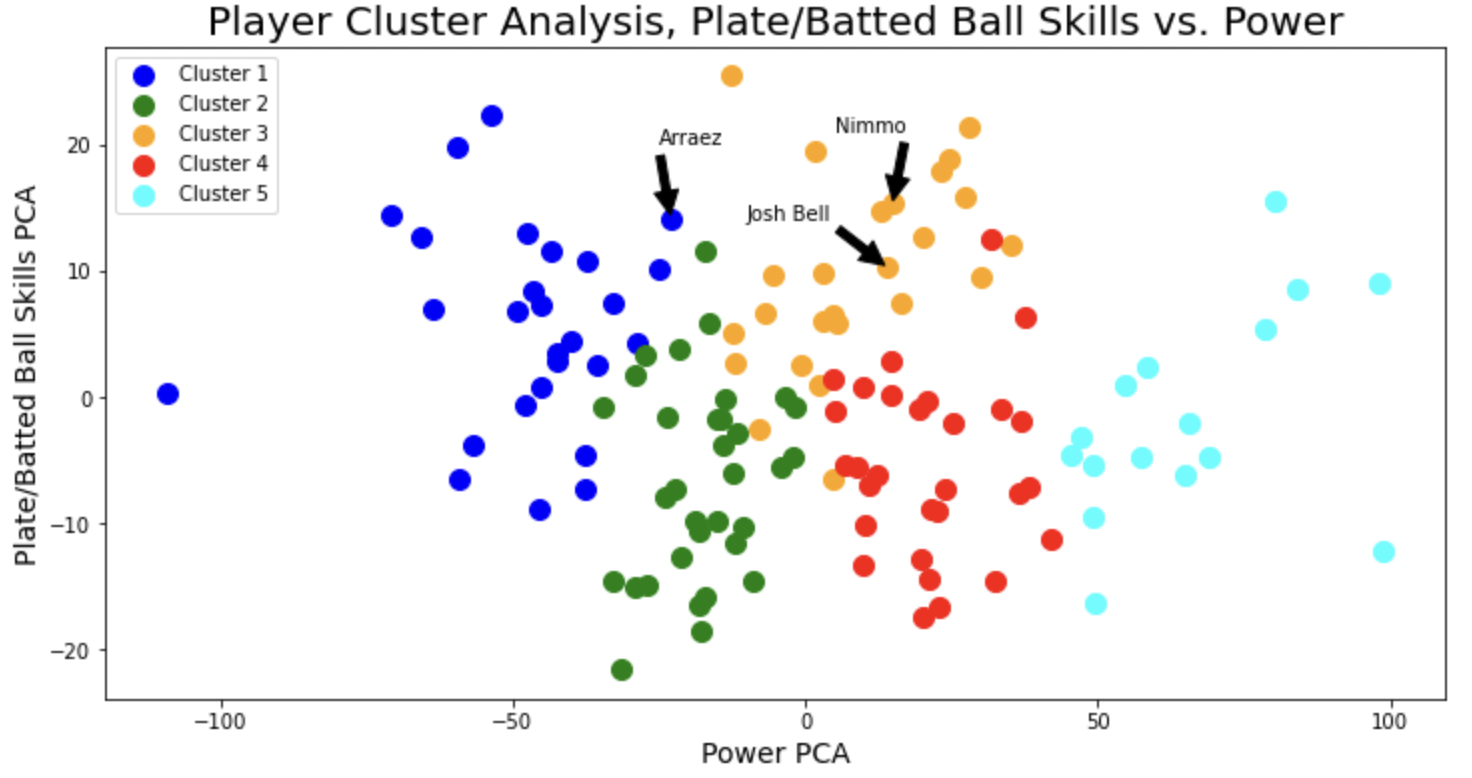
With a PCA I’m able to reduce these lists to two numbers which can then be passed through a k-means cluster analysis, grouping players into nice segments for visualization. Typically, a cluster analysis is used to gather insights on unlabeled data and it is a type of unsupervised learning. In this case, we’re using it to make comparisons we otherwise wouldn’t have:
Arraez finds himself, surprisingly, in the high-power end of cluster 1. To better understand why that is, we can compare his Statcast/power metrics with the averages from cluster 1. In addition, I’ll throw in that player all the way to the left, Tony Kemp, to help us compare Arraez with his cluster-mates:
Cluster 1 Metrics
Name
HR/FB
EV
maxEV
LA
Barrels
Barrel%
HardHit
SLG
xSLG
Tony Kemp
4.3
84.4
103.2
15.0
7
1.6
65
0.334
0.291
Luis Arraez
4.8
88.9
107.3
12.9
18
3.6
153
0.420
0.408
Cluster 1 Average
7.7
86.7
108.8
12.2
17
4.2
126
0.383
0.365
SOURCE: Statcast
Now we have a group for Arraez that makes sense. Next, let’s look at a few players who are higher up on the power scale, but aren’t changing too much in the batted ball/plate discipline area. Here’s our cluster image from before but with two new names identified that might be able to help Arraez inch over to the next cluster:
I am not saying that Luis Arraez should just go up there and try to be more like Josh. But I am using him as an example to determine what makes his profile more powerful. Josh Bell, 6′ 4″ / 255, and Luis Arraez, 5′ 10″ / 175, are different. While I don’t expect Luis Arraez to just suddenly increase his exit velocity, I am certain he has the skills to change his approach. One place to start would be adding more pull.
Shifting into Cluster 3
Name
LD%
GB%
FB%
Pull%
Cent%
Oppo%
Swing%
Contact%
SwStr%
Josh Bell
18.6
50.4
30.9
38.4
36.0
25.7
45.3
80.6
8.8
Brandon Nimmo
17.7
50.5
31.7
32.1
38.5
29.4
43.7
82.6
7.6
Luis Arraez
25.8
41.2
32.9
31.6
37.9
30.6
42.7
94.1
2.5
SOURCE: Statcast
Josh pulls the ball more. Josh also swings and misses more often. But while not swinging and missing is really impressive in this day and age, how valuable is it from both a fantasy perspective and a real-life perspective? Increasing his swinging-strike percentage while also increasing his slugging percentage would benefit everyone involved. Arraez is already hitting the ball with decent slugging results when it’s put inside, though he could improve on high-inside pitches, and all of his 2022 home runs came off pulled balls:
–
–
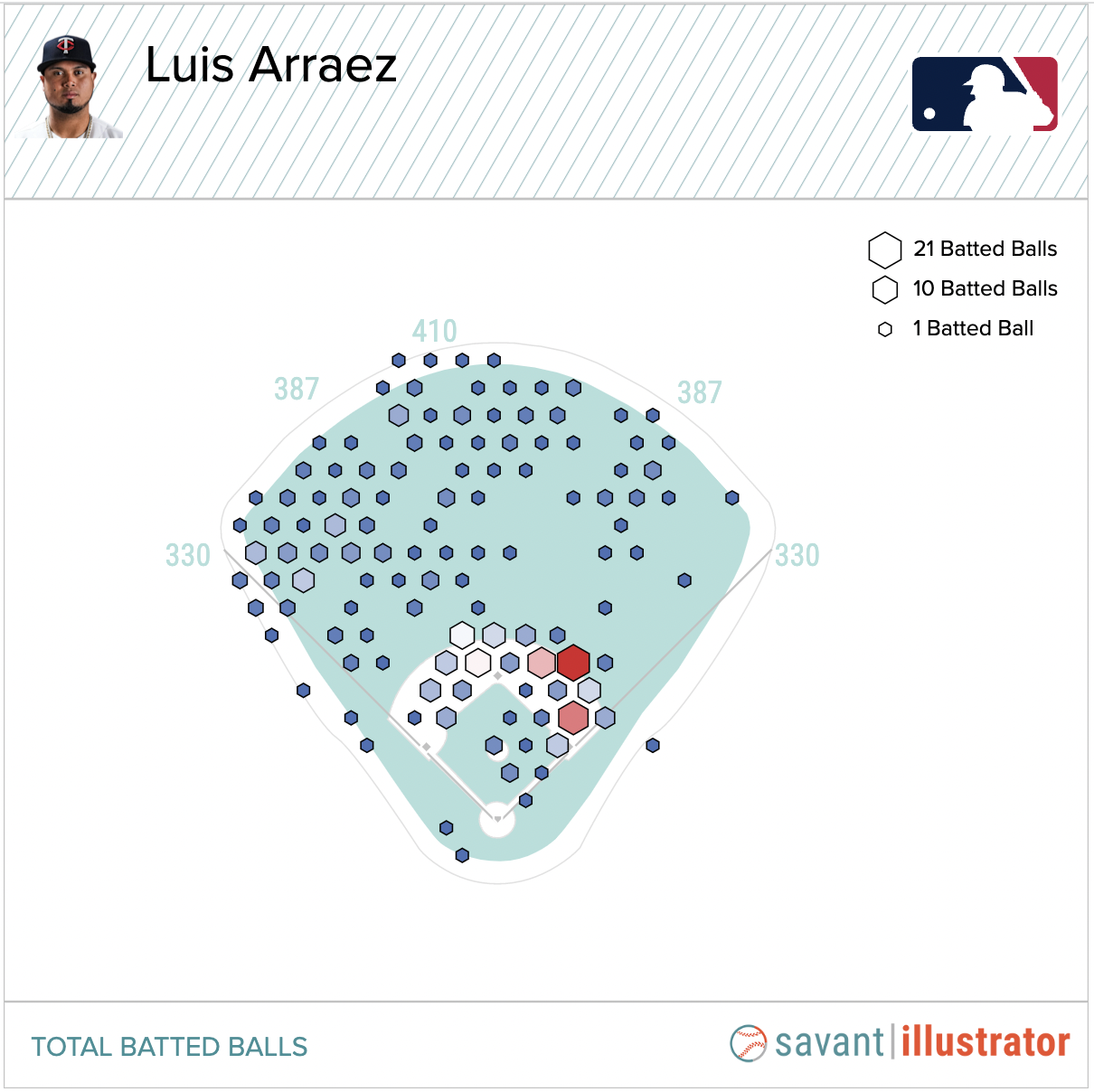
While watching a player who can spray the ball all over the field is fun, Arraez’s numbers aren’t great when going oppo. He slugged .638 when pulling the ball but when he slapped the ball the other way in 2022, he had mediocre results and his slugging percentage was brought down to .364. Just look at how many outs he hit into the opposite direction:
In 2022, Arraez’s HardHit% increased from 27.8% to 30.6% when he pulled the ball. When he was ahead in the count and pulled the ball, it jumped to 32.5%. Given a little more freedom from the worry of striking out, he added more power. But, here’s where things get a little odd. Arraez put the ball in the air more often than Bell and Nimmo in 2022 and his average launch angle was higher as well. If we look at his baseball savant radial chart isolated to singles, doubles and home runs (he only hit one triple in 2022), he clearly knows how to elevate the ball to hit for power:
But, without the exit velocity to take the ball out, he ends up with a lot of fly ball outs. Looking at the table above, he’s putting the ball in the air more often than Nimmo and Bell but with a significantly lower HR/FB rate.
Let’s summarize. Luis Arraez could be more valuable if he hit with a little more power. One way he might add power is to start pulling the ball more and leveling out his swing ever-so-slightly. This may cause him to swing and miss more often, but he can afford it. Arraez earned nearly $13 in 2022 and we should expect that to increase if he can adjust. It may seem nuts, but Luis Arraez needs to start swinging and missing more often.
In mid-May, I reviewed a group of hitters who had most underperformed their Statcast calculated xwOBA marks. While we all acknowledge that xwOBA isn’t perfect, it’s the best all-encompassing estimator we have, so it’s a good star to identifying players who are underperforming and overperforming. Now, I want to find out how these xwOBA underperformers ended up doing over the rest of the season. Did their wOBA marks rebound close to their early season xwOBA marks? Did their skills improve or decline so their rest of season xwOBA marks varied, making the RoS and early season comparison apples to oranges? I’m always curious how my lists turn out, so let’s dive in.
It’s time for my top-100 hitter ranks. While more is expected to be available on the website (in production), I went through and ranked my top 100 guys… for now. The rankings could change at any time as players get traded or sign with a team, but I feel good about this top group. Besides the actual ranks, I have explained each up and down ranking after the table. Finally, here are the caveats for today’s rankings.
Notes:
The rankings started with a weighted average of several available projections.
I had to pick one format to rank off of and I went with 5×5 Roto this time.
No catchers were ranked (article coming soon).
I did not take any position scarcity into account (besides catchers). There hasn’t been any for at least a dozen years, so I don’t expect any this season.
I didn’t give any player a multi-position boost or DH hit with each hosting site having its own settings.
Replacement level is not included since that value will change based on each league’s settings. Bryce Harper is not ranked without any replacement level.
For AVG and OBP leagues, I usually drop guys for not hitting enough to be better than the last-place team, but I didn’t with all three systems being ranked.
I ding highly drafted guys (top-75) who aren’t good hitters (projected OPS under .750). After that point, all the hitters are average or worse.
• Kyle Tucker: Where in the lineup he bats is going to be huge for his value. I dropped him to fifth in the lineup but if he bats second or third, he could be the overall top bat. Hitting leadoff might drop him down for the lack of RBI.
• Julio Rodriguez: After stealing 21 bases in the first half, he only stole four in the second. Rodriguez put the stop sign on himself.
The club and Rodríguez himself are being more strategic about when to steal. Early in the season, Servais said, it was probably easier for Julio to run because people probably didn’t assume a player of his size was going to run as often as he did. So, effectively, Julio has sort of put the stop sign on himself. This isn’t something the team has mandated or anything like that. Opposing pitchers know he can run, so they’ll pay more attention to him, throw over more and vary their set time on the mound. Doesn’t mean he won’t run more, but he’ll just be smarter/more strategic about it.
I dinged him a bit but if his second-half pace is done for the entire season (projected ~16 SB), it could even be even more of a drop.
• Bo Bichette: I’m not sure the stolen bases are coming back after going 13 for 21 (62%) last season.
• Fernando Tatis Jr.: I dinged him for the unknown screwup. I have zero faith that he has done his rehab and not endangered his shoulder again while riding dirt bikes.
• Mike Trout: I just can’t put over 600 PA on him with 550 PA seeming reasonable. Here are his ranks at the different plate appearance thresholds.
PA: Rank
650: 10
600: 21
550: 28
500: 48
• Michael Harris II: There is a chance he might get platoon after hitting .238/.284/.365 with just 2 of his 19 home runs against lefties.
• Luis Robert Jr.: He has always been hurt and never accumulated over 550 PA (547 PA across three minor league levels in 2019), so I can’t put him over that number this year.
• Eloy Jimenez: I like that Jimenez will have the DH spot all to himself this year to stay healthy thereby staying 100% and in the lineup.
• Adolis Garcia: I never feel good about rostering an early bat projected for a sub-.300 OBP (.284 on Steamer) and a near .700 OPS (.712 on Steamer). I try to roster good baseball players and I’m not 100% sure Garcia is one.
• Oneil Cruz: I don’t know how to rank a guy with just 370 career plate appearances but with a 20/20 projection. I don’t believe the narrative that he improved in September. The team just stopped playing him against lefties who he struggled massively against (53% K% vs LHP) so I dinged his playing time. If a person assumes his projection holds and he gets more playing time, here are his ranks.
PA: Rank
650: 11
600: 24
550: 31
500: 54
If he gets some helium, there are some managers hoping for these extra plate appearances.
• Dansby Swanson: His plate appearances could head south depending on where he hits in his new lineup.
• Gunnar Henderson: His 580 PA seemed light since the Orioles plan on playing time while hitting in the heart of the order. If he hits there, I’d have him up. The issue is that he has never hit lefties in the minors (.956 OPS vs RHP, .697 vs LHP) and in his short MLB time (.872 OPS vs RHP, .448 vs LHP). He was not really platooned by just sitting against three of the eight lefty starters. It’s just something to track.
• Jazz Chisholm Jr.: He has never hit lefties with a career .661 OPS against them (.616 OPS vs LHP in the minors). The deal is that the Marlins were sitting him against lefties. Of the 17 lefty starters the team faced before he went on the IL, he only started in eight of them.R
• Jake McCarthy: I’m not 100% sure he is even an average hitter as seen by his .753 OPS Steamer projection. The 550 PA is a hedge, but here are his rank at different plate appearances
PA: Rank
650: 16
600: 24
550: 39
500: 57
• Cedric Mullins II: Another guy with major platoon issues (career .813 OPS vs RHP, .646 vs LHP). From July 28th on, the Orioles face 15 left-handed starters with Mullins only starting against four of them. I’m not sure if 580 is the right number of PA, but I am dropping him from some near 650 PA projections.
• Taylor Ward: Projections don’t like his playing time (sub 600 PA), so a small boost there. Also, they don’t know about him playing through a shoulder injury.
• Mitch Haniger: I don’t see him with sub-600 PA as a DH.
• Tyler O’Neill: I can’t argue too much with a 530 PA projection but if he ever gets over it he has a nice upside based on more volume.
• Tommy Edman: Not a great hitter (career .732 OPS) especially against righties (career .701 OPS). Sometimes he struggles and then gets buried in the ninth spot. When batting later in the lineup, he doesn’t steal as much with 21 SB in 400 PA while leading off and 2 SB in 112 PA batting ninth.
• Anthony Santander: For a 28-year-old nearing 200 career IL days to be projected for over 650 PA seems high.
• Christian Walker: I dinged him down on the +650 PA projection but his ability to hit 30 HR has him way higher than expected in my rankings.
• Thairo Estrada: He is not a good hitter (.733 OPS Steamer Projection) so he might lose playing time if he struggles.
• Javier Báez: I don’t know how to rank him… at all. Anyone with the potential for 20 HR and 10 SB is going to have decent Roto value. Baez’s projection is similar to Jeremy Peña and Ian Happ’s and I don’t have a problem with their ranks.
• Joey Meneses: I think he’s going to get an everyday chance to play next season, so I moved up the playing time. What I don’t agree with is his 25 to 30 HR projection with a ~.265 AVG. Some fantasy managers are getting a Frank Schwindel vibe while I’m seeing some similarities to Jose Bautista. The right course of action is to be in between.
• Giancarlo Stanton: If he’s healthy and the plate appearances jump, he would leap up to about 50th with just 600 PA.
• Triston Casas: I’m worried that the Red Sox will bring in a decent first-base option or play Hosmer if Casas struggles for a week or two.
The hot stove is in full swing! Yesterday, fantasy superstar Trea Turner agreed to an 11-year, $300 million contract with the Philadelphia Phillies. Finally, Philadelphians will learn whether Turner prefers Geno’s Steaks, or its competitor across the street, Pat’s King of Steaks. I took a weekend trip to Philly last year and tried neither, but did highly enjoy a version from Woodrow’s sandwich shop that was topped with truffle whiz. If you’re a fan of truffles (not the chocolates!), this is the pick. So now Turner joins his third team and a new home ballpark. Let’s consult the park factors to find out how his performance might be affected.
In early April, I discussed three less heralded prospects that entered the season with starting jobs and used bulleted lists to share what I liked and didn’t like about each rookie. Let’s now review my likes and dislikes versus what actually transpired. Below each of my original bullet points will be an update in italics describing what ended up happening that relates to that bullet point.
Let’s finish my review of my imaginary NFBC rosters with a team of hitters that weren’t purchased in a single NFBC auction in March. I had 110 players to choose from to build this elite squad. Let’s find out how they performed!
One downside I have noticed in this stat-heavy era of fantasy baseball is that we sometimes struggle to see potential breakouts from guys who don’t have clear indicators in their underlying data. I understand why, but it can lead to glossing over growth candidates who take development strides beyond what their numbers suggested.
It was an unquestionably bad season at the dish for Grish. He posted a career-low 83 wRC+ with 17 HR, 7 SB, and a career-high 29% K rate in 524 PA. He played enough strong defense to net a second Gold Glove win and put up a third straight 2-WAR season. He had the desired 100-point AVG/OBP split but that’s less impressive when he hit just .184! He values his walks with an 11% rate this past season and for his career, but perhaps being a bit more aggressive would favor him.