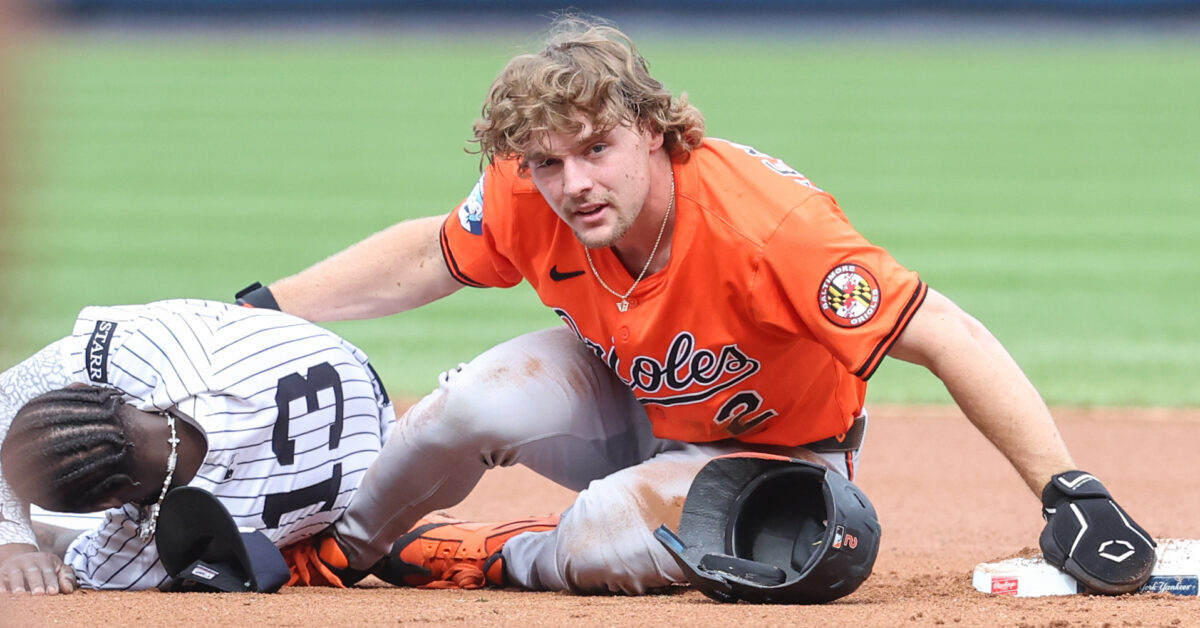
Welcome back to Position Player Playing Time Changes! Now that the season has started, I’m shifting the weekly table from displaying plate appearance changes to displaying the change in the percent of remaining playing time allocated to each player. All changes are over the past seven days, as they will be from here on out.
In the first few days of the season, I have heard (and made!) a number of references to swing speed changes. As fantasy players, we are always looking for that leg up, the first piece of actionable data that we can act on to make a move that no one else is ready to make. Bat speed certainly seems like early useful data. If a guy has gained or lost bat speed, that might not show up in the results yet, and even if it does, we know better than to overreact to a guy hitting one more or one less homer than we might have expected.
But bat speed is subject to small samples sizes, as well. I looked into two specific examples of names that came up this weekend and – in both cases – found reasons to pause before acting.
Quick note before we dive into tiny samples: I recently launched ProjectingX IQ, which is now focused on in-season edge by identifying real skill changes and separating signal from noise as the season unfolds. If you want to see which players are actually improving (or quietly regressing) before the results catch up, you can learn more at ProjectingX.com
Now back to your regularly scheduled programming. Though no actionable advice may come from taking a plunge into the icy tiny sample size waters, it’s still fun to swim around and explore what’s happening. This is an annual ritual of mine since it’s only this early that a player can have a wOBA and xwOBA over 1.000, which is totes super fun.
Welcome to the first Position Player Playing Time Changes roundup of 2026! Normally, you can expect this to hit RotoGraphs on Tuesday afternoons, but we’re publishing here on Wednesday since there’s much more clarity with Opening Day rosters now than there was 24 hours ago. As a reminder for how this works, I use our database of playing time projections, managed by RosterResource wizard Jason Martin 마틴ez, to query significant changes over a certain period of time. Mostly, that’ll be over a weeklong period — between roundups — but I’m using March 1 as the cutoff for this first one. As for what qualifies as significant, this is every change of at least 10% (70 plate appearances) in either direction in that time period. So this’ll be a longer list than usual, chock-full of info:
As usual, my rankings have a heavy projection base and, for now, will closely mirror the auction calculator. I suspect more changes as I receive feedback and dive further into the player pool.
Two items. The rank is not specific to the tier order. For the tiers, I grouped batters by their skill type (e.g., power, speed, etc). Also, the placement of the catchers in the overall ranks will be league-specific, especially between one and two-catcher leagues. I need to dive into the current market on them. I’ll write a full analysis in a future update or separate article.
Changelog
12/5/2025 – First release
1/5/2026 – Post-holiday update. A few movers.
1/21/2026 – Update with a few players on new teams.
2/2/2026 – Update, little movement
2/10/2026 – Update
2/12/2026 – Spring Training update. I have bullets of the bullets
Dinged Lindor, Corbin Carroll, and Jackson Holliday on plate appearances and a 5% talent reduction.
Kyle Schwarber and Ivan Herrera should take a round or two hit in leagues where they are Utility-only.
Previously, for a player to be in the “Change” column, they needed to move 20 or more spots. I dropped the minimum mark down to 10 spots.
Updated ADP data from NFBC Draft Champions to NFBC Online Championships.
2/25/2026 – Just moving a few players around
3/12/2026 – Minor moves with some injury updates
3/19/2026 – Not much movement among these top guys, dig through the positional ones for late movers.
Ranking Methodology
ADP is based on 30-day rolling NFBC Online Championship Leagues.
$ Values are based on a standard 5×5 12-team league using the FanGraphs Depth Charts and these Auction Calculator settings. They default to a player’s most valuable position, so if the first base list includes a catcher, it will show that player’s value at catcher.
ADP and $ Values are updated as of the last update date on this post.
5-game eligibility was used for these lists to cast the widest net.
Five-Category Studs
These hitters provide value in every aspect of the game with speed, power, and batting average. There are no flaws in their game.
Balanced 2nd Division Bat (Pick Your Poison Tiers)
This tier and the next six tiers comprise the point in the draft where the talent starts to level off, and fantasy managers can focus on category specialists. Some of the unbalanced bats may provide some other category juice, but most of their value is wrapped up in a single category. This is another balanced tier, but in these instances, their trait is not being a drag in any category. They won’t allow a manager to catch up in any category.
Balanced 2nd Division Bat (Pick Your Poison Tiers)
3/17/2026 – More reranking based on spring training performance and locked down starting roles, updated ADPs
3/6/2026 – A little bit of reranking, updated ADPs
2/25/2026 – More capsules, no reranking this time.
2/17/2026 – Jordan Westburg’s UCL injury 🙁
2/16/2026 – Just a little bit of reranking, more capsules. Updated ADP data from NFBC Draft Champions to NFBC Online Championships.
2/9/2026 – Light reranking, a couple more capsules, some team changes
2/2/2026 – Some reranking based on Suárez signing with the Reds, a few more capsules
1/23/2026 – Moved Arenado to a tier now that we know where he’s playing, some team changes, updated ADPs
1/13/2026 – Updated ADPs, more capsules, reranking with Alex Bregman signing (and some other minor FA deals)
12/31/2025 – Updated ADPs, more capsules, and some reranking.
12/24/2025 – Updated ADPs — rerank and more capsules coming between Christmas and New Year’s!
12/16/2025 – First Release
Ranking Methodology
ADP is based on 30-day rolling NFBC Online Championship Leagues.
$ Values are based on standard 5×5 12-team league using the FanGraphs Depth Charts and these Auction Calculator settings. They default to a player’s most valuable position, so if the first base list includes a catcher, it will show that player’s value at catcher.
ADP and $ Values are updated as of the last update date on this post.
5-game eligibility was used for these lists to cast the widest net.
Hello, and welcome to the 2026 3B rankings! Third base has been a weird position for a while, one that fits a bunch of different types of players; there’s no one archetype that works above all the others. That makes ranking them a little tough, but hey, at least Nos. 1 and 2 were layups (that’s a basketball term).
There’s little that Ramírez is yet to accomplish in MLB, though winning MVP might forever be his white whale. (He’d also love to go 40/40 at least once, I’m sure.) His counting stats at the plate took a little bit of a step back as he had even more wear and tear than usual in 2025, but he’s showing no long-term signs of slowing down and continues to command the zone while not striking out as well as anyone.
At the onset of the 2025 season it looked like Caminero would be missing some valuable plate appearances as he was frequently replaced for defense, but he improved enough at third to actually play full games with the Rays leading as the season went on. The massive homer power is Caminero’s calling card and considering his precocious youth combined with a lack of big swing-and-miss, the sky is the limit. He was weirdly average away from Steinbrenner Field but I don’t have much concern there since his BABIP was a ridiculously low .197 on the road.
Enjoy the 3B eligibility while you can! Jazz won’t be sniffing the hot corner any time soon after couping DJ LeMahieu out of a roster spot so he could move back to second base, and he responded with a career year despite missing time with an oblique strain. Coming off back-to-back almost-fully-healthy seasons in which he proved he’s got star output to go with his star-level skills, here’s hoping we can finally see what 150 games of Jazz looks like.
Are Garcia’s gains at the plate legit? The Royals sure think so, rewarding his breakout with a five-year, $57.5 million extension. He’s got almost three years of service time but is still just 25 years old, so it’s entirely possible we haven’t seen the best of him yet. He’s more of a “jack of all trades, master of none” than a guy who will give you insane production in a particular category, but there’s .300/20/40 potential in there.
The very definition of borderline between the top tier and second tier, Machado continues to perform like a metronome. The only thing that concerns me is Father Time’s undefeated record, and Machado is entering his age-33 season. His bat speed is still excellent but it has been going down each year for the three years it’s been tracked by Statcast, so it’s not as if he’s completely ageless.
I want Riley to go back to being great, and I’ll concede that it’s entirely possible if not likely that injuries are part of the explanation for his wRC+ declining each year since his career-high in 2022. But we can’t just ignore that in 2025 he walked less and whiffed and struck out more. This is about as high as I’m comfortable putting him.
Suárez could not have signed with a better team. He’s familiar with the Reds, he’ll need fewer days off as a DH, and most importantly for fantasy, he’ll absolutely mash at GABP. He couldn’t figure out the Park Formerly Known As Safeco across his two stints in Seattle, and there was a worry in the back of my mind that he’d end up back there anyway. He’ll feature prominently in a Reds lineup that was starved for power all last year with Elly De La Cruz battling a quad injury throughout the second half.
Paredes would be higher on this list if I was fully confident that he’s (a) fully healthy after rushing back from a horrible hamstring strain and (b) definitely an Astro in 2026. So much of Paredes’ value comes from his elite ability to pull the ball in the air, and there’s nowhere better to do that than Daikin Park. But with the Astros probably needing to offload an infielder to open up DH for Yordan Alvarez and Paredes’ name being the most-often mentioned, I’m just wary enough to ding him a bit.
Muncy has been as good as ever on a rate basis in the last two seasons, but I’m conscious of his age (35) and the fact that he’s only played 173 games in the last two seasons. Plus, he had his worst showing ever against lefties, albeit in only 80 plate appearances, and he could continue to be shielded from them by Miguel Rojas and Alex Call.
I moved Bregman down just a tad because Wrigley isn’t an amazing ballpark fit for him. He’s not as dead-pull as Paredes (nobody is) but he still relies on pulling the ball in the air. Wrigley’s dimensions themselves aren’t a huge needle-mover for me; yes, left field is deep, but Bregman has the pop to hit homers there. The bigger concern is the wind, which will knock down would-be homers for even the most prolific of power hitters — something Bregman isn’t.
2025 Breakouts
If they continue in 2026, they’ll be fantasy stars.
With Kazuma Okamoto in the fold, Barger’s going to be spending more time in right field than at third base, so enjoy that 3B eligibility while you can in 2026! The power has always been real, but getting to it in MLB games was a problem in 2024. No longer was that the case in 2025: Barger mashed 21 homers in 135 games followed by another three in 17 postseason games. With a fantastic hard-hit rate above 50%, I’m taking the over on 24 homers if he can get into 152 games this year. The biggest impediment to that will be solving lefties, against whom he had a wRC+ of 69 in 89 plate appearances.
Montgomery burst onto the scene in his rookie half-season last year, with 21 homers and 55 RBI in just 71 games. If you’re a fan of extrapolating stats out to 162 games and dreaming from there, that’s 48 homers and 125 RBI. No, I don’t think he’ll reach those heights in 2026, as his HR/FB was a ridiculous 26% and his hard-hit rate was a very good but not elite 44%. But he’ll be playing every single day at short (again, enjoy that 3B eligibility while it’s there!), and unimpeded playing time is important.
He’s streaky within seasons, but you ultimately know what you’re gonna get at the end of the year from Chapman: solidly above-average output and 20+ homers. His hand injury led to a career-low in games but he still got into 128 of them, and it didn’t seem to impact his hitting ability upon his return, unlike many hand injuries. In his age-33 season, we’ve got to be careful when considering the aging curve for Chapman, but he actually cut down the strikeouts in 2025 while continuing to walk a ton. I don’t see big concern here yet, the guy’s a grinder.
Well, Bohm is certainly a Steady Vet, just steady at a lower output than you’d like. But the ballpark he plays in and the lineup around him means he’ll rack up RBI in all likelihood, and his 2025 hard hit rate was his best since 2021. Does that portend better power output or just more frustration?
He’s in this tier because I wanted to rank him right about here, not because he’s actually particularly steady. Correa hasn’t been both healthy and very good at the plate since 2022. 2023 was healthy but below-average, 2024 was excellent over 86 games, and 2025 was 144 games of a 106 wRC+. Maybe a full season at third will keep him a little healthier, and Houston is certainly a better place to hit than Minnesota, but you just don’t know what you’re going to get from him. His mere presence on the roster also means Isaac Paredes may be playing elsewhere this year.
NPB “Rookies”
How they convert to MLB remains to be seen, but there’s plenty of upside here.
Murakami could hit 40 homers; he could hit 15. He could strike out a manageable 30% of the time; he could strike out an untenable 40%. There’s no player in the league, at any position, with as much boom-or-bust potential, and I think I’ve ranked him accordingly. Whatever you get from him — good or bad — don’t be surprised.
Okamoto doesn’t posess the upside that Murakami has (almost nobody on the planet does!) but he’s a much safer bet to produce for the Jays than Murakami is for the White Sox. That’s why he signed for $60 million with a contender and Murakami got just $34 million from the White Sox. Okamoto may have to earn time against tough righties but is widely expected to mash lefties, and his versaility — he should get some time at first base and maybe left field, too — will keep him in the lineup along with the bat.
Big Bummer of an Injury
A medium-term injury knocks Westburg down quite a bit.
I had Westburg pretty aggressively ranked for the first several iterations of the rankings, but I of course had to rerank after learning that his partial UCL tear would lead to a PRP injection and keep him out all of April, at minimum. If there’s more clarity on exactly how long he’ll miss I may move him down even further, but I can’t see him going up at this point.
You Should Be Better Than This!
A guy who hits the ball hard but haven’t put it all together yet.
Lewis’ career has been perplexing, to say the least. Much like the recent vintage of Carlos Correa, Lewis has struggled to be simultaneously healthy and good. 2025 was by far his healthiest season as a big-leaguer, but also by far his worst. Despite being around seemingly forever, though, he’s still just in his age-27 season and he’s got all the talent in the world.
We don’t know where exactly Durbin will be playing with the Red Sox between second and third, but what we do know is that he’s playing every day, and he may well maintain eligibility at both positions. He’s great at nothing but good at everything and if you’re in an OBP league, you have to love how much he gets drilled by pitches.
I’ll admit it: I love Ernie Clement, and it’s not just because he went nuclear in the playoffs. A solidly average hitter with the potential for more who doesn’t really walk or strike out? That’s the good stuff. He’ll play mostly second base this year but I’d expect cameos at third and short, at least, to continue.
The Mets did a lot this offseason, but they did nothing to displace Baty’s status as a starter. He’s ostensibly the “starting DH,” but what that really means is that he’ll be playing every day against righties, whether it’s at DH or spelling the starters at third, second, first, left, right, and perhaps even shortstop. The gains he made on offense look legit, too.
McKinstry broke out with an All-Star campaign in 2025 as the Tigers’ Swiss Army Knife. Something like the lefty version of Clement, he got way more playing time than was expected and ran with it, hitting 11 triples and 12 homers while playing all over. I’ve got him below Clement because his path to playing time in 2026 is a little murkier with Kevin McGonigle fast approaching.
The same playing time concerns I have with McKinstry apply to Keith, except that Keith is coming off a worse season. He did improve as a sophomore from his down-and-then-up rookie year, and his extension keeping him under contract through at least 2029 and as late as 2032 makes the Tigers committed to him. Here’s hoping he can tap into that pop he showed in the minors.
I moved Edman down because it’s now set in stone that he’ll miss Opening Day. I don’t want to react too much to that because it’s a long season, but I also expect the Dodgers to do plenty of load management with him as they try to have him fully unleashed for a threepeat in the playoffs.
Smith is the odds-on favorite to replace Marcus Semien as the Rangers’ starting second baseman, so it’s unclear how much positional eligibility he’ll maintain beyond that if Josh Jung stays healthy (a massive if). Something of a McKinstry Lite, Smith was bang average with the bat while playing all over last year.
Lux’s one season in Cincinnati didn’t go well, and the Reds gave up Mike Sirota for him, to boot. A 102 wRC+ doesn’t cut it when you’re as rough defensively as he was, especially in left field at third base. Now with the Rays, he’ll be the starting second baseman (at least against righties) and I wouldn’t expect him to get much time anywhere else, though it’s still possible.
Caballero will begin the season filling in for Anthony Volpe while the latter recovers from offseason shoulder surgery and end it as a superutility sparkplug who can play all over. Caballero runs with reckless abandon and if you’re in need of steals, there are few better options across the league.
Andujar picked a good team for playing time. His lefty-mashing ways will guarantee his presence in the lineup against all southpaws, and the Padres haven’t done much of anything to take away playing time from him against righties, either. He could still maintain eligibility at third with Manny Machado likely to get plenty of DH days sprinkled in.
What Even Are You?
These guys have shown flashes, maybe even lots of them, in recent years, but they’re all so inconsistent.
Arenado’s downturn continued in 2025, as he had his worst full-season wRC+ since his rookie year of 2013 with the Rockies. He slugged under .400 for the second straight year, and while I could see an uptick in power assuming he’s fully healthy thanks to Chase Field and a less balky shoulder, I’m not going to count on it for the soon-to-be 35-year-old. This is about as highly as I could justify ranking him.
Norby only got into 88 games last year thanks to a couple IL stints, and while he wasn’t awful, he obviously didn’t take the leap forward the Marlins were expecting him to. That said, he’s still got the leg up for the 3B job and is getting reps at 1B as well, so he shouldn’t have a big problem staying in the lineup if his health allows.
We’ve reached the point in Jung’s career where it’s plausible to say that the idea of Jung is far better than the player. He was at least healthy last year after just 46 games in 2024, but his wRC+ dipped to below-average, and he’s pretty allergic to walks. The Rangers didn’t do much to buttress last year’s struggling offense so they’re hoping for internal gains from players like Jung; he’ll get plenty of runway once again.
The trade of Arenado (and Brendan Donovan) was good news for Gorman, who should get a chance to play every day even if the exact positioning is somewhat up in the air. He’ll make you want to pull your hair out for large chunks of the season but it’s hard to not dream on the raw power even if he continually struggled to get to it in games.
It’s easy to forget how good Vientos was in 2024, though many Mets fans would tell you that Vientos certainly “helped” expedite the memoryholing process by performing poorly outside of a really good August last year. He’s got an uphill battle for playing time but at minimum should play against every lefty.
Rengifo signing with the Brewers got him ranked higher than I expected he would be, as he’s got unimpeded playing time at third base. But it can’t be ignored just how bad he was last year, nor can we brush aside how badly he’s graded out at third base.
Vargas had a solid first full big-league season bouncing between third and first and will now return to his customary third base with Murakami set to take over at first. But he’s a slump away from losing time to Lenyn Sosa.
The thing that gives me pause with Moncada isn’t how he’s performed on the field, but his laundry list of injuries for basically his entire big-league career. He hasn’t gotten into 100+ games since 2022 or 125+ since 2021, and he’s limited to being a strong-side platoon bat who’s almost entirely hidden away from lefty pitching.
McMahon hit worse as a Yankee than as a Rockie but I actually hypothetically like the idea of him at Yankee Stadium more than at Coors. There’s no Coors Effect to make him worse on the road, anymore, and the short porch in YS3 is plenty inviting for a lefty pull hitter like McMahon. It’s just unfortunate that your league probably doesn’t care how great of a fielder he is.
Marte probably loses 3B eligibility this year, as he’s expected to continue to start in right field, a position he took to very well in his first action last year. He was essentially average at the plate and there’s certainly room for growth for Marte, who’s still just 24.
Castro nosedived after a trade to the Cubs, putting a sour pall over his free agency. Still, he was able to secure a multi-year deal with the Rockies and ought to continue to play all over just about every day. His value is in his versatility and availability.
If your league doesn’t care how well McMahon fields, it really doesn’t care how well Hayes fields. But, the elite glove will keep him in the lineup on a daily basis, and he went from 43% below-average as a Pirate last year to 18% below-average as a Red. Progress!
Báez making the All-Star team as the starting center fielder was a great story, to be sure, but it hid how mediocre his season turned out to be overall. The versatility will help him play pretty often but with Kevin McGonigle fast approaching, it’s unclear how long even semi-regular playing time will last.
India was awful in 2025. He took horribly to both third base and left field, and he’ll be back at his customary second base and DH this season. That he was tendered a contract at all qualified as a surprise to me, but the strong strikeout and walk ratios are at least very Royals-y.
Unproven Youngsters
This collection has shown a little bit in relatively limited MLB time.
Mayer looks likely to get significant playing time, at least against righties, even with Durbin, Isiah Kiner-Falefa, and Andruw Monasterio in the fold. The pop is legit, the question is how much the hit tool will be able to keep up.
Alexander was set to be a super-utilityman for the Orioles until Westburg and Jackson Holliday’s injuries, and now should get significant regular time on the infield while still getting some run in the outfield, too. He’s got a good power/speed combo at an affordable price.
Arias swings way, way too often; his hit tool might be the worst of any non-catching regular in the sport. But he’s still a regular at least until Travis Bazzana is ready, and will run into some homers.
Schmitt has been quietly solid when he’s gotten into games the last couple years, and although the signing of Luis Arraez complicates his playing time, he’s just an injury away from significant plate appearance totals.
Shaw had an extremely streaky rookie year that ultimately mathed out to being slightly below-average at the plate. With Bregman in the fold, he’ll take on a superutility role and seems likeliest to gain eligibility in the outfield
Lawlar’s star has faded dramatically, but perhaps a position change to the outfield will do him some good. He lines up to be the Snakes’ starting CF and has been hitting well thus far in Spring Training.
House has been excellent in Spring Training so he moves up two tiers with the third base job unquestionably his.
Muncy shoots up the list thanks to a great spring training that has him running away with the starting 3B job, but I’ll need more than this small sample to think he’s legit.
Lee will be the starting shortstop this year despite being bad on both sides of the ball in 2025, so his 3B eligibility is waning. There’s not much to like about his profile, either.
Good Bench Guys
They won’t play too much, but production will be good when they do.
“Don’t it always seem to go, you don’t know what you got ‘til it’s gone.”
Joni Mitchell may not be a roto savant, but even she might agree that the best part of the fantasy baseball season is research-and-draft season. Every day, from February until Opening Day, is so incredibly thrilling – nonstop spring training news, draft rankings adjustments, and player pool deep-dives – there’s always some rabbit hole of research to go down. As we continue studying and gaining confidence in the fresh player pool and a new year’s ADP, more questions arise, and the more work there is to be done.
Whether in NFBC or best ball contests, high-volume early drafters subconsciously form bad habits in draft rooms. We get too comfortable targeting and drafting the same players over and over. Conversely, we avoid players who have burned us in previous seasons and those we have some subjective bias against. Rarely do we deep dive and reassess those players because we’ve already made up our minds. That’s why it’s crucial to explore every nook and cranny of a positional tier. We have all fallen victim to draft room paralysis, where a decision between several similarly ranked shortstops or starting pitchers becomes gut-wrenching when we’re on the clock. This preseason column aims to help with those tough calls. We will explore some of the most confusing ADP clusters, by position, beyond the simple “I need to boost my batting average, so I’m taking this guy.”
Let’s dive into these ADP pockets logically and systematically, reviewing four analytical components of the players within each cluster.
Playing Time (and Role)
Health/Durability
Skills/Categorical Contributions
Context of Team Offense
ADP Cluster: Post-300 Outfielders
ADP from 17 NFBC 12-team Online Championships (OC) drafts over the last five days (March 12 – March 16)
These outfielders are drafted in the Rounds 25-26 of OCs, typically as an OF5. For shallower 12-teamers with 23-25 rounds, some of these hitters may be early-season waiver targets. Carson Benge is the only one here without major league experience. Jasson Dominguez is rumored to start the season in the minors. Cam Smith, Matt Wallner, Cedric Mullins and Jung Hoo Lee are projected as everyday starters in their respective lineups. Domínguez, Smith, Wallner, and Mullins were all utilized as part of a platoon for parts of the 2025 season.
Playing Time (and Role)
For Jasson Domínguez, it’s a matter of when, not if. The former heralded prospect and top 150 ADP selection from 2025 has seen his 2026 draft stock fall over the last couple of months with expectations of starting the season in Triple-A. After all, the Yankees re-signed Cody Bellinger and Trent Grisham, Giancarlo Stanton (the DH) is healthy (for now) and the great Aaron Judge mans right field. Manager Aaron Boone wants Domínguez to be playing every day, but that opportunity doesn’t yet present itself in the majors. Boone’s problem though is that Domínguez has been forcing his hand with exceptional production in spring training – .371/.395/.686, 3 HR, 10 RBI, 3 SB, 170 wRC+ in 38 plate appearances. Domínguez had a decent rookie season (.257/.331/.388, 58 R, 23-of-27 SB in 429 PA), but his playing time was reduced down the stretch and he essentially didn’t play in the playoffs.
For the last couple of months, RosterResource projected Cam Smith as a short side platoon outfielder. That designation has been shifted to full-time right fielder batting eighth on Opening Day. His RosterResource batting order projection will certainly influence his market price these next couple of weeks. What is more important for drafters is to solidify whether they’re buying or fading based on his profile, not projected playing time, because the latter could fluctuate all season like it did in his rookie year. Smith hit lefties better (130 wRC+, .191 ISO) than he did righties (75, .098), but the sample is a small one and not predictive. Jake Myers will be play centerfield, and the other two spots will be split between Smith and lefty bats Joey Loperfido (welcome back to Houston!) and Zach Cole. Smith played 132 games in right field last season.
Matt Wallner can absolutely mash and he may earn the opportunity for full-time at-bats in the context of a weaker lineup that needs him. In 97 plate appearances against lefties last season, Wallner actually had a higher wRC+ (118) than he did against righties (113 in 295 PA) as well as a similar ISO (.247 vs. RHP, .267 vs. LHP). So far this spring, he is hitting .294 with two homers, a stolen base, and a 14.6% walk rate, through 41 plate appearances.
Cedric Mullins signed with the Rays in December in what will the first Opening Day in his career that he doesn’t don an Orioles uniform. A left-handed hitter, Mullins has avoided being platooned for most of his career, but experienced a little bit of it the last two seasons. We expect the Rays to include him in their lineup against both lefties and righties, though if he struggles, this outfield room is loaded with alternatives, including recently acquired rookie prospect, Jacob Melton. Mullins is 31 and has never been an elite defender in center, posting negative UZR’s in all but one season. Mullins dealt with a back flare-up a couple of weeks ago, but appears healthy now. Through his first nine spring games, Mullins has two homers and a swipe.
Carson Benge is the sweet-swinging, lefty-batting, first-round selection of the Mets in the 2024 draft. He is having a strong camp (.367/.406/.433) and is projected to crack the Opening Day roster. Though he will likely begin the year on the strong side of a right field platoon with slick defender, Tyrone Taylor.
Jung Hoo Lee was a KBO star who signed a 6-year ($18.8M AAV) deal with the Giants two years ago, missed most of the 2024 season with injury, and produced mediocre results in 2025. Lee played 147 of 149 games in centerfield last season, but is being moved back to his original position from his KBO days (right field), primarily because of the offseason acquisition of Harrison Bader. Lee was a better hitter against righties (118 wRC+) than lefties (77) last season, though new manager Tony Vitello will likely start him every game. If Lee happens to stumble against lefties around a time when Luis Matos or Jerar Encarnacion heat up, it’s possible for Lee to fall into a platoon, but I wouldn’t bet on it.
Health/Durability
None of the outfielders in this cluster have current injuries to worry about, but most of them have had their fair share of injuries over the years.
Cedric Mullins – The oldest of this group (31), Mullins has had a few lower-body related injury stints over the last few seasons. He missed time with a right hamstring strain last spring and missed over a month with a right groin strain in May of 2023.
Jasson Domínguez – He tore his UCL at the end of the 2023 minor-league season and had Tommy John surgery. He suffered a left oblique strain in the summer of 2024 and missed a couple of games (no IL stint) in June of 2025 with a left thumb contusion.
Jung Hoo Lee – He remained relatively health in his South Korea days, though he broke his ankle and missed half the 2023 season. The following year, his first in the Majors, he dislocated his shoulder crashing into an outfield wall in mid-May and underwent season-ending surgery. He tweaked his ankle in the WBC last week, but it turned out to be a minor issue.
Matt Wallner – He missed five weeks early last season after suffering a left hamstring strain. He also dealt with oblique strains in each of the past two seasons. Not surprising considering the big dude swings hard and carries a big stick.
Carson Benge missed his first season of college at Oklahoma State after an elbow injury caused him to undergo Tommy John surgery. His injury was pitching-related, and the two-way player shifted his focus to hitting and playing the outfield.
Cam Smith does not have an injury history other than minor nicks and bruises.
The two who I’d slightly ding fantasy value for their health and durability are Mullins and Wallner.
Skills/Categorical Contributions
Matt Wallner is in a class of his own here because of his prolific power. Some slight data manipulation here, but Wallner’s 16.1% barrel rate is tied with Mike Trout’s for seventh in the majors among hitters with at least 900 plate appearances since 2023. The guys ahead of him: Aaron Judge (26.2%), Shohei Ohtani (21.5%), Giancarlo Stanton (19.1%), Kyle Schwarber (17.7%), Juan Soto (17%), and Oneil Cruz (16.2%) – elite company, indeed. Wallner hit 22 home runs in 104 games (392 PA) last season, and has 30+ HR upside if he can stay off the IL. His batting average won’t be helpful, but he may throw in a few stolen bases and is one of the rare late-round boons for fantasy squads that might be power deficient.
Cedric Mullins had that magical 30-30 (HR-SB) season in 2021. In his past four seasons, he has swiped at least 30 bags twice, and has averaged 16.5 home runs. He has been a batting average killer though – .228 since 2023. A fair expectation for Mullins in his first season with the Rays would be 12-15 homers, 25 stolen bases, 100-130 R/RBI (combined) and another season with a sub-.240 average.
Jung Hoo Lee has the highest batting average upside of the cluster. He hit .319 in his first 30 games of 2025, went through a rough three-month stretch from May through July (.218), then hit .306 from August 1 until the end of the season. He is capable of hitting .290+ over a full season. His only positive roto category contribution was runs scored (73 in 150 games). He is a solid floor contributor, but you won’t see many projection models bless him with anything more than 10 HR and 10 SB. His allure lies within his potential batting average contributions.
Jasson Domínguez, Cam Smith, and Carson Benge are the three young, upside guys. All would project for double-digit homers and swipes with 500+ plate appearances. Dominguez’s distribution would lie higher on the SBs, though he is capable of 20-plus homers if he earns consistent playing time. Domínguez sported a 49.6% hard-hit rate and stole 23 bases on 28 attempts in 429 plate appearances last season. Smith and Benge have 20-HR, 15-SB potential though neither is likely to get there in 2026. Benge is certainly intriguing as a toolsy prospect with the eventual possibility of being a five-category contributor. Note that he only has 103 plate appearances at Triple-A and he struggled there (.178/.272/.311) after crushing it with a .300+ AVG and .400+ OBP in 92 games at High-A and Double-A.
Context of Team Offense
The best team context here is Domínguez’s with the Yankees, but that is if he is able to earn consistent playing time. Wallner’s team context is sneaky as a middle of the order power hitter, though his counting category contributions hinge on Byron Buxton, Luke Keaschall and Royce Lewis staying healthy, which may be asking a lot. Based on home parks, divisions and other hitters in the lineup, the other four from this cluster have a neutral context.
Verdict (with value grades, A-F)
Jasson Domínguez (A-) may have been overpriced in the 125-150 ADP range last season, but he is being greatly undervalued this draft season, at half the cost, because of lack of role clarity. Dominguez is pushing to crack the Opening Day roster and deserves it, but it would be better if he got the reps in Triple-A. Make the low-cost investment in Dominguez late in your drafts if your roster doesn’t have a bench stash already, and you believe that his everyday role with the Yankees is simply a matter of when.
Jung Hoo Lee (B+) won’t wow us in any category other than potentially batting average. He has a high floor and could easily outproduce his draft cost with another 600+ plate appearances. Perhaps he surprises us with a bit more than what models are projecting.
Matt Wallner (B+) is the ideal power-boost option towards the end of drafts, specifically for folks whose roster construction feel light on power after 20 rounds. I’m less worried about a platoon split than oblique issues or other ailments resurfacing.
Cam Smith (B) and Carson Benge (B-) have the widest range of potential outcomes. Spending a chunk of the season isn’t off the table for either of them, but less so for Smith. Benge rocked a 81% contact rate, and despite last season’s struggles with consistency at the plate in Triple-A, he is less likely than Smith to tank us in the batting average category. Smith could fall into a platoon with Loperfido or Cole, but this is unlikely to happen for a prolonged time period.
Cedric Mullins (C+) may seem like a sneaky and savvy late-round option due to his HR-SB upside, but Tropicana Field is a downgrade from Oriole Park and his projected batting average is a massive detractor to his overall projected value.
“Don’t it always seem to go, you don’t know what you got ‘til it’s gone.”
Joni Mitchell may not be a roto savant, but even she might agree that the best part of the fantasy baseball season is research-and-draft season. Every day, from February until Opening Day, is so incredibly thrilling – nonstop spring training news, draft rankings adjustments, and player pool deep-dives – there’s always some rabbit hole of research to go down. As we continue studying and gaining confidence in the fresh player pool and a new year’s ADP, more questions arise, and the more work there is to be done.
Whether in NFBC or best ball contests, high-volume early drafters subconsciously form bad habits in draft rooms. We get too comfortable targeting and drafting the same players over and over. Conversely, we avoid players who have burned us in previous seasons and those we have some subjective bias against. Rarely do we deep dive and reassess those players because we’ve already made up our minds. That’s why it’s crucial to explore every nook and cranny of a positional tier. We have all fallen victim to draft room paralysis, where a decision between several similarly ranked shortstops or starting pitchers becomes gut-wrenching when we’re on the clock. This preseason column aims to help with those tough calls. We will explore some of the most confusing ADP clusters, by position, beyond the simple “I need to boost my batting average, so I’m taking this guy.”
Let’s dive into these ADP pockets logically and systematically, reviewing four analytical components of the players within each cluster.
Playing Time (and Role)
Health/Durability
Skills/Categorical Contributions
Context of Team Offense
ADP Cluster: Middle Round Corner Infielders
ADP from 17 NFBC 12-team Online Championships (OC) drafts over the last five days (March 5 – March 9)
These are the seven corner infielders clustered in the Rounds 15 and 16 range of NFBC OCs. Right above them are Matt Chapman (157.8) and Willson Contreras (166.7), and right below them are Christian Walker (210.2) and Munetaka Murakami (211). Rookie prospects, multi-position eligible guys, injury risk, big power – this cluster has it all! Let’s dig into this group using our four defined pillars.
Playing Time (and Role)
The best place to start is with projected playing time. FGDC and OOPSY have identical playing time for all players, as do THE BAT and ATC. Since I manage playing time at FTN, I included my own in the average projection across three sets.
Average Projected Plate Appearances
Name
OOPSY
ATC
FTN
Average
Spencer Torkelson
637
617
602
619
Jonathan Aranda
609
567
611
596
Alec Burleson
602
576
558
579
Kazuma Okamoto
560
523
592
558
Royce Lewis
567
493
483
514
Sal Stewart
504
472
512
496
Addison Barger
518
469
454
480
Addison Barger projects for the lightest workload due to expectations of mostly being a strong-side platoon hitter. He projects to bat cleanup against righties. Last season, Barger mostly batted fifth (109 PA), second (107) and fourth (100).
Sal Stewart has 18 games of big league experience. He is having a strong spring (.318/.423/.636, 2 HR, 2 SB in 26 PA) and projects to be an everyday bat for the Reds. At approximately 117 games, it’s likely we are all under-projecting him. Stewart has been one of the biggest ADP risers among corner infielders, jumping two rounds from February (Rd 17) to March (Rd 15). Stewart should start the season off hitting fifth behind Elly De La Cruz and Eugenio Suárez.
Royce Lewis’ 514 average projected plate appearances may be generous considering his woeful health history. His 403 PA last season (106 games) is a career high. Lewis is expected to hit somewhere between fifth and seventh to start the season, but could move up to third or fourth if he stays healthy and remains productive.
Kazuma Okamoto is expected to be an everyday hitter for the Blue Jays. He was quite the model of health in the NPB, averaging 589 plate appearances in his first seven seasons (2018-2024). Okamoto missed half of 2025 with a left elbow injury following a collision with a batter who was running down the first base line. Roster Resource projects Okamoto to start the season hitting seventh. He could work his way up into the top five, but Blue Jays manager John Schneider will likely utilize lefties (Barger, Daulton Varsho, Jesús Sánchez) to hit between their impact righties, projected leadoff man George Springer and no. 3 hitter, Vladimir Guerrero Jr.
The St. Louis Cardinals’ Opening Day lineup is very much a work in progress. Lars Nootbaar won’t be ready in time and Iván Herrera has been dealing with knee inflammation. Rookie infielder JJ Wetherholt is essentially a lock to make the club, with a prominent role. Left-handed hitting Alec Burleson is a vital middle-of-the-order bat for the Cardinals who will start every day. Burleson greatly improved against left-handed pitching last season, albeit small samples: a 44 wRC+ in 2024 (133 PA) to a 98 wRC+ in 2025 (118 PA). Burleson should hit third to start the season.
Jonathan Aranda was having a breakout season, slashing .316/.393/.489 with 14 HR and 59 RBI in 106 games (422 PA) before fracturing his left wrist on July 31 in a collision with the human wall known as Giancarlo Stanton. Aranda crushed righties (.203 ISO), but struggled to hit for power against lefties (.071 ISO, 1 HR in 98 PA). He did make slight gains against lefties overall though, earning free passes at a 12.2% clip, producing a .378 OBP and 111 wRC+. Aranda should continue facing lefty starters, though he’d likely hit lower in the lineup against them. Against righties, Aranda should bat third.
Former first overall MLB draft pick from 2020, Spencer Torkelson, played in 155 games (649 PA) in 2025 and 159 games (684 PA) in 2023. His 2024 season (92 games, 381 PA) was derailed by an inability to hit baseball and spending nearly half the season in Triple-A. Riley Greene and Torkelson are their most productive hitters. My projected plate appearances for Torkelson are low and I’ll have to readjust for the next update. He is very likely to earn real-life plate appearances closer to where Jason R.R. Martinez (FGDC) and Jordan Rosenblum (OOPSY) have him.
Health/Durability
There are very few concerns of health and durability in this group, except for Royce Lewis, who has been dealing with soft tissue and lower body ailments since becoming a major leaguer. Like Torkelson, Lewis was drafted first overall (2017), though he did not make his MLB debut until 2022. Lewis tore his ACL in 2022 and again in 2023, playing in just 58 games in his official rookie year. He also spent time on the IL that year with hamstring and oblique injuries. He missed half the 2024 season due to quad and abdominal injuries. Last season, he was slowed by two more hamstring injuries – one in late March and the other mid June. His lower body must have been feeling swell when he returned, because he stole nine bases on 10 attempts in the final month (98 PA) after swiping just three in his first 301 plate appearances. Lewis had yet another scare early this spring (side tightness) but was able to return a few days later. In some other dimension where he’s healthy, Lewis is a top 25 hitter, but in this league, his laundry list of injuries have rightfully kept his ADP and fantasy price down.
The rest of this cluster have mostly stayed healthy and have shown durability. Sal Stewart had surgery on his right wrist in 2024 while in High-A following an off-field accident. Alec Burleson had a couple of quick IL stints in 2023 (left thumb fracture) and 2025 (right wrist inflammation). Otherwise, this is a fairly sturdy group.
Skills/Categorical Contributions
Below are average 12-team roto values for the 2026 season using three models. Note that ATC is an aggregate system that may include OOPSY as part of their formula mix, but we’ll use OOPSY separately since their projected playing time is different than ATC’s.
12-Team Projection $ Values
Name
ATC
OOPSY
FTN
AVG
Alec Burleson
$10.8
$8.2
$11.6
$10.2
Jonathan Aranda
$7.6
$3.6
$11.7
$7.6
Spencer Torkelson
$7.6
$7.8
$6.3
$7.2
Kazuma Okamoto
$2.8
$2.5
$8.7
$4.7
Royce Lewis
$1.0
$6.8
$3.6
$3.8
Sal Stewart
$3.6
($0.6)
$8.0
$3.7
Addison Barger
($2.8)
$2.4
$0.0
($0.1)
Alec Burleson comes in as the best value of this group, fueled primarily by a projected batting average in the .270s. Burleson hit .290 last season and boasts a respectable 83.4% career contact rate. His power metrics last year were around league-average (91 mph EV, 9.4% barrel, 43% hard-hit), but he has hit 18 and 21 home runs the last two seasons, and projects for around 20 this season. He’s the toughest guy in this cluster to punch out (career 13.6%). With 600+ plate appearances for the first time ever, Burleson can set career highs in runs and RBIs, producing 80 or more in each category. He may steal a few bases as well. He swiped five on six attempts in 2025 and nine on 13 attempts in 2024.
Jonathan Aranda hit 14 home runs in 422 plate appearances and flashed above-average power metrics (93 EV, 12.8% BRL, 54% HH). His contact rate (77%) was around league average, though he hit .316 with a .291 xBA. Models project his 2026 batting average in the .260-.270 range, a fair regression when we factor in Aranda’s high BABIP (.409), which inflated that average. He likely won’t hit .274 against lefties in a larger sample this season. OOPSY projects Aranda for .249 batting average, and that is why OOPSY’s value for Aranda is low relative to the other two models.
Kazuma Okamoto is the toughest of the group to project, as the 29-year-old will make MLB debut after eight seasons in the NPB. Models project Okamoto for a walk 9-10% walk rate and a 18-20% strikeout rate. OOPSY is least bullish on his strikeout rate (24.8%). With 550+ plate appearances, Okamoto should hit around 20-25 homers with around 135-165 combined R/RBI, with the distribution between the runs and runs batted in depending on where in the batting order he settles. He doesn’t run and isn’t expected to help in stolen bases.
Spencer Torkelson and Addison Barger are the two best bets for above-average power production of this group. Torkelson hit 31 home runs in each of his two full seasons. Barger hit 21 in 502 PAs last season and boasted an elite hard-hit rate (51%), a 91.7 mph average exit velocity and a 116.5 max EV. Barger flashed a .231 ISO against righties (115 wRC+) and a .120 (69 wRC+) against lefties.
Before 2025, Lewis rocked an elite frequency of round-trippers (16.6 AB/HR). He managed to hit only 13 of them last season (403 PA), which took his AB/HR up to around 20. His career EV (89.1), barrel rate (10%), and hard-hit rate (39.8%) are league-average. It’s why we won’t see any model project 25+ homers even though we know he’s capable of it if he stays healthy.
Sal Stewart produced well in Double-A (329 PA) and Triple-A (165 PA) last season: 78 R – 20 HR – 80 RBI – 17 SB – .309. He is one of the few fantasy first basemen who can produce double-digit swipes. Despite having fewer than 60 career plate appearances in the majors, Stewart feels like the corner with the most upside in this group and the one most likely to move up into the ADP tier above this one. On February 12, Mark Sheldon of MLB.com reported that Stewart shed 26 pounds during the offseason.
Context of Team Offense
One thing in common is that none of these corners play on elite offenses – no one here is on the Dodgers, Yankees, Mets or Orioles. The Blue Jays scored the fourth most runs last year (798) and could be a top 10 run-producing crew again, but someone will have to step into Bo Bichette’s shoes. The Jays were 23rd in runs in 2024 when Bichette missed half the season. Okamoto and another year with Barger should help, but this lineup hinges on the consistency of Vladimir Guerrero Jr. and they’ll need both George Springer and Daulton Varsho to stay healthy. Rogers Centre’s Park Factor is neutral (100).
The best offensive context among this group is that of the Reds. Great American Ball Park is an elite hitters’ park, ranking third in overall Park Factor (103) and second in HR Park Factor (123). Stewart currently projects to bat fifth behind Elly De La Cruz and Eugenio Suárez. It’s a righty-heavy lineup that Stewart can earn full-time at-bats in. It would not be shocking to see him smash his aggregate RBI projection of 66. Stewart had a strong success rate in stolen bases (84%, 27-of-32) and should have the green light so long as Elly and Suárez aren’t clogging up the base paths.
Comerica Park in Detroit is considered a pitchers’ park, but it’s Park Factor is neutral (100) as is its HR factor (99). Torkelson has 42 career road homers and 38 at Comerica in a similar number of plate appearances – 1,040 at home, 1,078 on the road. He typically whiffs at a 26-27 percent clip and produces substandard batting averages – .240, .219 and .233 over his first three seasons. Torkelson doesn’t have much lineup protection batting fifth with guys like Wenceel Pérez and Colt Keith behind him. The projected top-four of rookie Kevin McGonigle, Gleyber Torres, Kerry Carpenter (vs. RHP) and Riley Greene looks great on paper and the Tigers are favored to win the AL Central.
Aranda, Lewis and Burleson are on some of the weaker projected offensive teams in the league. Burleson and Aranda are both expected to hit third in their respective lineups. Lewis could work his way up with steady production and just staying healthy. The 2-5 after Byron Buxton looks exceptionally weak: Josh Bell, Luke Keaschall, Trevor Larnach (4th vs. RHP) and Victor Caratini.
Verdict (with value grades, A-F)
Alec Burleson (B) is the best all-around value and has the highest floor. He gets an extra boost to his value for his dual (1B-OF) eligibility.
Kazuma Okamoto (B) feels like a risky proposition considering he’s never played in the majors and will have much to adjust to. He’s the one guy in this tier I’m most confident will produce a profit at his price tag.
Sal Stewart (B-) is the most volatile of the bunch as a rookie with very little big league experience. He has arguably the most upside and offers additional value in the stolen base category. He’s the hitter most likely to surge into the tier above.
Jonathan Aranda (B-) officially broke out last season and has an above-average floor, but we should be careful projecting a plus batting average and assuming that he will play against left-handed pitchers all season.
Spencer Torkelson (C+) has massive batting average downside, but makes up for it with strong power production (30 HR, 85 RBI) for a hitter in this range. If you’re a BA snob, draft other sources of power.
Royce Lewis (C+) is incredibly polarizing because of his massive prospect pedigree and some epic production stretches that balance out with legitimate concerns about his ability to stay on the field.
Addison Barger (C) exhibited plus power against righties in his breakout season. I’m lower on him than the market and haven’t been drafting him because I prefer other corner infielders in this range. His struggles against lefties likely won’t go away this season, and it’s more difficult to roster platoon bats in shallow redraft leagues.