Archive for Shane Victorino

Rankings Update: Outfielders

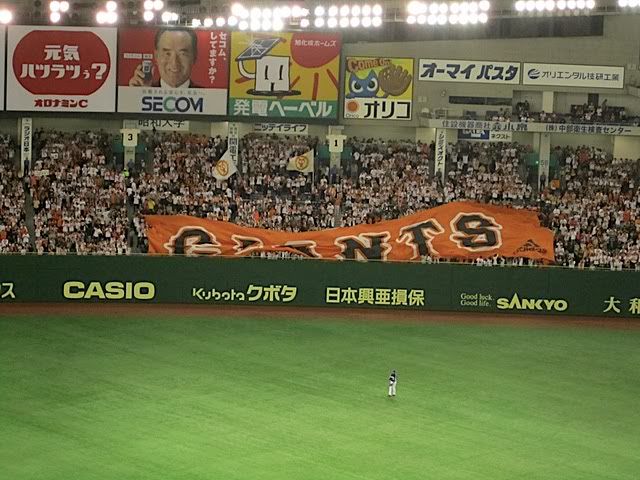
I’m back from Japan and have Basu-Baru pictures for your pleasure. Baseball in Japan has many of the trappings of the American version, but also includes cheerleaders and choreographed songs. Interestingly enough, the game I saw featured two Westerners at cleanup – Tony Blanco for the Chunichi Dragons and Alex Ramirez for the Yomiuri Giants. The pitchers had decent stuff, and the crowd was louder than many (most?) regular season MLB games, but overall the package was something like a AAAA game.

I digress. Time to take ownership of these outfielder rankings and change them up a bit. I will be doing them all season, as a sort of power ranking at the position. We’ll go with the FANS’ projected wOBAs (aka their upside projections) for another week.

The Top Three:
Ryan Braun, Milwaukee (.405 wOBA)
Matt Kemp, Los Angeles NL (.367 wOBA)
Justin Upton, Arizona (.388 wOBA)

Nothing much to say here except it looks like Upton’s ankle isn’t bothering him. These guys are studs and by the end of the year, could easily all be top-five fantasy players despite playing in the outfield.

There’s Nothing Wrong With…
Grady Sizemore, Cleveland (.343 wOBA)
Matt Holliday, St. Louis (.390 wOBA)
Carl Crawford, Tampa Bay (.367 wOBA)
Jacoby Ellsbury, Boston (.354 wOBA)
Curtis Granderson, New York AL (.340 wOBA)
Nelson Cruz, Texas (.368 wOBA)
Ichiro Suzuki, Seattle (.369 wOBA)
Shin-Soo Choo, Cleveland (.389 wOBA)

After the spirited Choo vs Granderson vs Sizemore comments conversation from the last time we updated these rankings, it’s only natural that we find a way to put them all in the same tier where they belong. Nelson Cruz is absolutely on fire, but his BABIP (.357) and K rate (24.1%) together suggest that the batting average should regress to his career norm. Granderson is still having trouble with lefties, but if he continues to bash righties to this extend, he’ll stay out of the next tier.

Not Quite Five-Category Performers
Josh Hamilton, Texas (.321 wOBA)
Jason Bay, New York NL (.397 wOBA)
Adam Lind, Toronto (.394 wOBA)
Nick Markakis, Baltimore (.349 wOBA)
Manny Ramirez, Los Angeles NL (.396 wOBA)

Manny is actually showing that he’s still got something left and with another tater or two could even join the next tier. That said, his missed games will keep the old(er) man back a little. Those same missed games should come into play with Hamilton eventually too. Lind’s power has taken a slight step back, but it’s early going and all it looks like he needs to do is loft the ball a little more (33.3% FB this year, 36.8% last year).

Missing Something?
Jayson Werth, Philadelphia (.382 wOBA)
B.J. Upton, Tampa Bay (.310 wOBA)
Andre Ethier, Los Angeles NL (.370 wOBA)

Werth reminded us that he has some injury issues by missing time with hip soreness, but has otherwise played well. The older Upton is actually playing about as well as can be expected, and in leagues that don’t use batting average, he may yet prove to be an elite option. Ethier will have his supporters, but his fly ball rate already fell, and his power pace should fall with it. The batting average should be strong this year, though, and he’s still a solid option.

Upside to Join the Top
Andrew McCutchen, Pittsburgh (.360 wOBA)
Carlos Quentin (.375 wOBA)
Michael Bourn (.326 wOBA)
Jason Kubel (.370 wOBA)

Outfielders are a tough position to handicap because of the sheer numbers, which also won’t allow me to go too deep. By highlighting some guys that could join the elite with the right years, we can delve a little deeper. So, while Shane Victorino is a fine option in the outfield, McCutchen is stealing bases at a pace (five so far) that would outpace the Flyin’ Hawaiian should it keep up. Bourn has shown the same plus plus speed. Should Quentin stay healthy, and Kubel prove that he can keep his slugging percentage over .500 year-in and year-out, they would join the power elite. So far, so good.

ADP Values in Center Field (Part 2)

Though our tools may not always be at their sharpest, we can still use them in concert to find truth in the fog. Yes, the 2010 projections are not up yet at BaseballMonster, but we have a sweet set here and can use their standard-deviation weighted-category-based rankings to help compare players with different skill sets. Yes, the ADP values on MockDraftCentral are flawed and skewed by their proprietary pre-ranks, but until we have more sources, they’ll have to do (Yahoo ADPs go live February 18).

The flaws of our tools were revealed when we looked at the first couple of center field tiers on Thursday, but the middle tier awaits and we will not be deterred from our goal of finding the strongest values at each position (and yes, we’ll do a post to gather all of these values into one place eventually).

Melvin Bossman Jr Upton is being taken the earliest (59.88), but after reading Dan Budreika’s breakdown of the difficulty of projecting his season (especially his power, in my opinion), I have to think that’s a little early for him. Adam Jones (89.04) comes next, but with most projections having him around 18 and 10 with an okay batting average, that seems a little high for a guy that won’t be a major plus in any category. Andrew McCutchen (91.08) may yet grow into his power, but as Paul Bourdett pointed out here, our perception of the current level of his power might have been skewed by a burst late last year. The fact remains that his minor league ISO was in the .130s, not the .180s like last year. Without plus power, he looks like a Shane Victorino (74.25) who I also believe is going too high (unless he finally steals 40+).

I hate to be so obvious about my man-crushes, but Carlos Gonzalez (124.70) has all the tools to fly past all the center fielders in his tier. We’ve talked extensively about him on the site, but I’ll just add a couple more points. CarGo is in a crowded outfield, yes, but the team hasn’t shown the willingness to make Seth Smith an every-day player, so it really looks like Smith and Dexter Fowler are the ones battling for playing time. CarGo played almost every day down the stretch down last year and I expect that to continue. Second, it makes me drool when a toolsy former top prospect makes good on his tools by improving his walk rate, strikeout rate, reach rates and contact rates across the board, while also returning his ISO to his minor league days of promise. The stars are aligned for CarGo to Go CarGo.

The speed-only tier creates a trio of players that are seemingly projected (by CHONE) to be virtually the same players next year:

Player A: .268, 4 home runs, 37 steals
Player B: .281, 3 home runs, 29 steals
Player C: .270, 4 home runs, 31 steals

What if I added that Player B actually stole 42 bases last year with a 71% success rate? Well, then you’d probably want him, wouldn’t you? Congratulations, you just bought Nyjer Morgan at bargain-basement prices (130.21 ADP). He would almsot certainly make a better value than Michael Bourn (72.45 ADP), and should sport a better batting average (and more guaranteed playing time) than Rajai Davis (171.44 ADP) in that crowded house that is the Oakland outfield.

We may have to go to a part three here to discuss the fantasy fault line (thanks to reader Johnny Tuttle for that wording, which may become a feature here shortly) between Shane Victorino and Denard Span.


Check the Position: Centerfield

Over the offseason we’ll take a look at each position on the diamond and see how the past season affected the positional rankings and where there might be some potential bounceback value picks going into next year’s drafts. (See shortstops, catchers, second basemen, first basemen, third basemen, right fielders and left fielders.)

These rankings are for 5×5 rotisserie fantasy baseball. Eligibility was determined by where the player had the most at-bats last year.

CenterFielders

There might be some grumblings about putting Matt Kemp into a tier of his own. The fact is, he’s the closest to .300 30/30 out there and that means something. Even with the eventual bounce back that both Grady Sizemore (.276 BABIP in 09, .308 xBABIP in 09, .317 career BABIP) and Curtis Granderson (.276 BABIP in 09, .301 xBABIP in 09, .323 career BABIP) will be getting in the average department, they both should fall short of those hallowed numbers. Kemp just needs a few more fly balls to leave the yard, and with his increasing fly ball totals and HR/FB ratios, it doesn’t take much squinting to get him there.

Carlos Beltran doesn’t quite have the speed to join the top tier, but injury concerns aside, he’s pretty much the definition of the second tier. Before last year, he’d cleared 600 plate appearances for eight straight years, so he’s a decent bet as a value pick once the first two rounds are complete. Jacoby Ellsbury is in the news a lot these days, has more speed than anyone on the list, but also has very little power and may be destined for a new position. You could pick him if you are getting plus power from a position on the infield, though, and not miss a beat.

Josh Hamilton’s position in the tier may be the most tenuous. The injury concerns are real (469 average PAs over the last three years), and speed is probably not part of the package any more (20 stolen bases and 7 caught stealings career). I would definitely be tempted to wait on him and pick the surging Carlos Gonzalez instead. CarGo rode a .320/.384/.608 second half (with 12 home runs and 11 stolen bases) into our collective consciousness. One of the main reasons for his effectiveness was that he cut down his strikeouts (23.2% in second half, 26% career), and we know he has the tools to continue producing should the refined approach continue. Bucs wunderkind Andrew McCutchen and O’s rising star Adam Jones help fill the Upside Tier, a trough that many knowledgeable readers will be dipping into next year. With Jones’ tiny walk rate (5.6% career) I just see a little more risk there. We’ve written extensively on B.J. Upton, who may yet have books written about him. Suffice it to say that his oscillating power (ISOs ranging from .046 to .209) and BABIPs (.312 to .399) make him risky.

The next tier we might as well call the “No-Power-All-Speed” tier. With his terrible 2008, of course there’s a reason to doubt Michael Bourn, but his walk rate, BABIP and line drive percentage all finally approached his minor league rates. He might have just found himself on the major league level finally, and he looks to have the best speed of this bunch. Otherwise, there’s not really much difference between Bourn, Nyjer Morgan and Rajai Davis. Take your pick.

The last tier is looking for redemption in some cases. Shane Victorino is being grounded slightly by his splits (.749 career OPS vs righties) but also by rumors that Placido Polanco will take his position in the lineup for reasons unclear. He still could provide tremendous value if he gets drafted at this tier position. It’s unclear why he stole fewer bases as his success rate (79.6%) and speed score (7.5) are still elite. Torii Hunter will get some love in the comments, perhaps, but his BABIP was at a nine-year high last year, and if his average drops, his 20/20 prowess looks a little less sexy. If batting average is not a concern, he’s a decent pickup late in the game. Vernon Wells just needs more space than we have here.

This position was deeper than I expected. Young players like Colby Rasmus, Dexter Fowler, and Franklin Gutierrez could all join the big boys with some steps forward in their games. All of them already make decent bench picks even in mixed leagues.


Week 17 Trade Possibilities

Hopefully you were able to pick up Miguel Montero and trade Todd Helton last week. But even if you stood pat there are still plenty of acquisition targets and trade bait guys out there for you. So, here are five guys to pick up and five guys to move.

Obtain

Ben Francisco – Since the end of June, Francisco has been playing virtually every day, most often in left field and with occasional starts in center. In his last 25 games he has a .289/.421/.539 line. He has some room for growth in his HR output and could exceed RoS ZiPS forecast of five dingers. Francisco is owned in only 13 percent of CBS Sports leagues and has the ability to contribute in all five categories, although he is not likely to offer very much in AVG.

Jonathon Niese – The overall Triple-A numbers do not overwhelm you but he won his last five decisions for Buffalo. In his last eight starts in the International League, Niese went 5-1 with a 0.96 ERA, with 13 BBs and 46 Ks in 56.1 innings. In his first start since being promoted, Niese limited the Astros to one run in seven innings in a start at the Juice Box, and retired 17 of the last 18 batters he faced.

Ryan Garko – With the trade to the Giants, Garko should receive regular playing time as the team’s new first baseman. He mashes LHP (.960 OPS this year) and holds his own versus RHP (.772 OPS). That is not great production for a first baseman but with the Giants in need of an upgrade for Travis Ishikawa, it should be enough to keep him in the lineup, something he struggled with in Cleveland. RoS ZiPS sees him with six HRs, a total I would bump up with the playing time boost.

John Lannan – In his last 10 starts, Lannan is 5-2 with a 2.44 ERA but with only 21 Ks in 73.2 innings. I seriously question whether any pitcher can succeed long term with a strikeout rate this low but I believe he can do it for the remainder of the season. From a fantasy perspective it is difficult to advocate a pitcher who has virtually no chance to help in strikeouts but for some odd reason the guys near the top of the leaderboards in Ks are rarely available in trades or on the waiver wire. Lannan is a player who should not cost much who has the potential to help in ERA, WHIP and W.

C.J. Wilson – Usually I avoid mentioning relievers because this is one area where most people are watching the waiver wire like hawks. Yet Wilson has the closer’s role in Texas while Frank Francisco is on the DL and is owned in only 35 percent of CBS Sports leagues. Now Francisco is not expected out for long because of his bout with pneumonia but he has also had problems with tendinitis, so you never know. Wilson should be an immediate add if you set a daily lineup.

Exchange

Garrett Jones – You would have to be living under a rock to miss the slugging exploits of Jones, who has 10 HR in 88 ABs for the Pirates. That has led to some far out numbers, like a .761 SLG, a .432 ISO and a 1.140 OPS. But he also has a 34.5 percent HR/FB rate which will be a tad difficult to maintain going forward. Last year Jones looked like he was going to settle in for a long career as a AAAA slugger. No one doubts that he has power and can be a useful MLB player. But he has little chance of being a star and owners should see if he has any trade value in their league.

Johan Santana – When owners drafted Santana, they were expecting him to be one of the top starters in the game. He was great in April but has struggled to keep that pace since then. Santana has been very good but the production has not matched either the draft slot or the name value. He is 3-4 in his last seven games and has given up 15 runs despite two scoreless appearances. Santana closed 2008 with a great run and he has the ability to do that again. But owners owe it to themselves to explore his trade value and if he can return third-round level value, well that exceeds what Santana has produced so far in 2009.

Erick Aybar – In his last 17 games, Aybar is batting .471 with 16 RBIs, 13 R, and 3 SB. His trade value may never be higher. His BABIP checks in at .347, 30 points above his lifetime mark in the category. Aybar stole 32 bases in Triple-A in 2006 but has just 26 combined thefts between the majors and minors since then in two and a half seasons. And his lifetime .095 ISO tells you he is not likely to contribute any HR, either.

Randy Wells – It has been an impressive year so far for Wells, with 10 Quality Starts in 14 games. But I am concerned about him being able to maintain his current walk rate, which is under two per game. Also, in two full seasons at Triple-A, Wells’ strand rate was under 70 percent both times but so far this year it checks in at 78.9 percent. Add in a BABIP and a HR/FB rate both slightly below average and it adds up to a pitcher who could fall off some down the stretch.

Shane Victorino – He is unlikely to match last year’s totals in either HR or SB. Yet Victorino has been just as valuable a fantasy player because he is on pace to set career-highs in AVG, R and RBIs. Victorino’s BABIP of .342 is 24 points above his previous career best mark in the category. Also, he is walking more than he has previously in his career. Regression in BABIP would hurt him across the board.


Two Young Center Fielders

Many fantasy leagues break the outfielders up by their respective positions, a quirk that creates a premium outfield position. Consider that, in many formats, the 12th-ranked center fielder going into the season was Chris Young, whose projections were comparable to the 12th-ranked second baseman going into the season (Rickie Weeks).

Defense then becomes a non-fantasy entity that can mean a lot to the fantasy fortunes of the center fielder. Play good defense, and you’ll buy yourself more time to figure out the batting part of the deal. Or at least, that seems to be what’s keeping Carlos Gomez playing in Minnesota. Let’s take a look at two young center fielders, how they are faring, and how defense factors into the decision.

Dexter Fowler – For a 23-year-old getting his first extended burn at the major league level, Fowler is acquitting himself reasonably well. His .264/.354/.405 slash line has a little bit of something for everyone. Walking 12.7% of the time assures that he can take advantage of his prodigious speed (6.5 speed score). He’s stolen 13 bases at a 72% success rate, and he’s hit three homers and 17 doubles in 273 plate appearances.

But it’s not all gravy on this train. He’s striking out 25% of the time after hovering around 20% for the large part of his minor league career. Subsequently, ZiPS RoS has him hitting .271 the rest of the season and continuing his current pace to finish with seven home runs and 25 stolen bases. Until his K-rate falls a little, that’s about the best that can be expected from this young man.

Because his offense is currently adequate, and his team is suddenly playing well, defense may not factor into his playing time too strongly. However, his team is not a strong contender in a crowded division, and things could change quickly. Pack an extended burn of strikeouts into a team-wide slump and a decision by management to focus on next year, and suddenly Fowler’s sub-par defense could become an ‘issue.’

His current 2.1 Range Factor in center field puts him in the Shane Victorino (2.3 RF) – Vernon Wells (2.3 RF) section of center field defenders. That’s the section where the offense helps the poor defense stay on the field. Is Fowler’s bat enough to offset the 5.3 runs he’s giving back on defense? Not if the major league team decides to think about his long-term future and sends him back to the minors to work on his D. That might also allow the team to showcase someone like Ryan Spilborghs for a trade.

Fernando Martinez – While his minor league team had already decided to play him at the corners, his major league team has a major league hole in center field and looks to be plugging it with their highest-ranked prospect. A look at the defense says that this is a short-term solution at best.

If major league defensive stats are still in their infancy, then minor league ones are much worse off. We can see that Martinez had a Range Factor of 2.31 in center field in the minor leagues, and that Carlos Beltran, an elite defender, had a career Range Factor of 2.7 in center field in the major leagues. Using the cruder Range Factor suggests that Martinez, like Fowler, could use some time honing his defense.

The problem in Martinez’ case, though, is that his offense won’t keep him in the position much longer. While his secondary offensive statistics are a little up and down like Fowler’s, Martinez has much more down in his numbers.

The good news is that he’s not striking out a ton (14.5%), and he’s shown improvement in that area over the last two years. His walk rate (6.8%) is in line with his minor league numbers, too.

But he’s not making good contact. He’s reaching outside the zone too much (26.5%) and not squaring the ball well (11.9% line drives). His 55.9% ground-ball percentage is positively Delmon Young-esque. Given that he’s only 20 years old, it’s a lot to ask of him to spell Beltran.

Since the team is in contention, look for Omar Minaya to target a center field platoon partner for Jeremy Reed. Relatively cheap acquisitions like Scott Hairston and Jason Michaels could take the bat out of Reed’s hands against lefties, while also letting young F-Mart work out some more kinks in the minor leagues. Those cheaper veteran outfielders would also still have value once all the injured veterans return.


Should You Fly High with Shane Victorino?

Shane Victorino made a great leap forward in 2007, doubling his HR output and seeing a nine-fold increase in his SB totals. He kept those gains in 2008, although in over 117 more plate appearances. Fantasy owners are big believers in Victorino, as he now holds an ADP of 51 according to the latest update over at Mock Draft Central.

Victorino, while no slouch in other categories, gets most of his value from steals. Over the past two seasons, he ranks 10th overall in SB with 73. So the big question for him going forward is how likely is he to maintain his current level of production.

In 2007, Victorino was safe on 37 of 41 attempts for an outstanding 90 percent of his stolen base tries. Last year his success rate fell to 77 percent, still a fine number but off considerably from just a season ago.

The four projection systems that predict SB all show Victorino with less than 30 in 2009. CHONE gives him 23 SB, which is the 46th-best mark in the system. ZiPS has him down for 24, which is tied for 62nd-best in the majors.

Marcel, which uses a weighted average of the past three seasons, gives him 26 SB which ties him for 13th-best. The Bill James system gives him 27 steals.

A 10-bag drop in stolen bases would have a huge impact on Victorino. Those who spend a late fourth or early fifth-round pick on him are betting that he can beat the projection systems. This is not an unreasonable wager, he has done it the past two seasons, but a pick that early values Victorino at the top of his range.

Last Player Picked has Victorino as the 43rd-best hitter in fantasy baseball last year. If he matches what he did last year, he gives you equivalent value for his ADP. But there seems to be very little upside for Victorino there and the real possibility that he turns into a disappointment if he fails to crack 30 steals.