Archive for Ottoneu101

Ottoneu 201: Roster Management Strategies

Last week I wrote about a few lesser known opportunities within Ottoneu to maximize salary cap space, which is important to understand before your fantasy season begins.  However, by the time you read this post the fantasy season will have already begun, so I want to focus your attention today on strategies that will help you in-season as you attempt to squeeze every bit of value out of your team during what is sure to be a long but very fun Ottoneu season.

Read the rest of this entry »


Arbitration Advice from the Community

Sunday, October 15th is a significant signpost for the fantasy baseball off-season as it marks the beginning of Ottoneu arbitration, the 30 day process that helps leagues maintain competitive, economic balance. Ottoneu offers a ton of great features in its standard platform, but there are few more intimidating to a brand new owner than this annual salary-sharing arbitration event. Here is a summary of the more popular “allocation” option:

Read the rest of this entry »


Ottoneu 101: Navigating Ottoneu Cap Space

As I have mentioned in previous posts, Ottoneu is a different fantasy game. The format has it’s own scoring settings, based on linear weights, and is hosted here on Fangraphs. However the biggest area of adaption required to play the format well is an understanding of the economics surrounding the game. Hopefully this can serve as a general primer to navigating the differences between formats.

The first place I want to start is with the Ottoneu rules. These appear pretty straight forward and can be easy to understand, however, like all things, the devil is in the details. So let’s comb through some of those.

There is no FAAB budget in Ottoneu. That format does not exist within the game. However, According to the Ottoneu rules, each team has a $400 budget that can be used to acquire players at the annual auction (“draft”). The remainder of these funds can then be used to buy free agents during the year. Read the rest of this entry »


Learning Ottoneu

Last Wednesday, I took some time to discuss why you should play Ottoneu. I think Ottoneu is a great fantasy format for anyone who has a sabermetric leaning. Those who play are hyper-involved sports fans who crave a deeper fantasy experience than a casual work league. However, I can totally understand why there are times where the rules/gameplay could seem daunting to a newcomer. This does not need to be the case. I want to help bridge that gap. Today, I wanted to take some time to build off of this and discuss how you learn to play the format. Since the scope of Ottoneu is vast, this will likely divulge into several posts which I will try to group similarly, but today I wanted to start with what drives Ottoneu, it’s communities of owners. I wanted to know what their opinion was on adjusting to the format. Since the scope of Ottoneu is vast, I have tried to group responses similarly – and thanks to everyone who helped me with this. You’re responses are valuable.

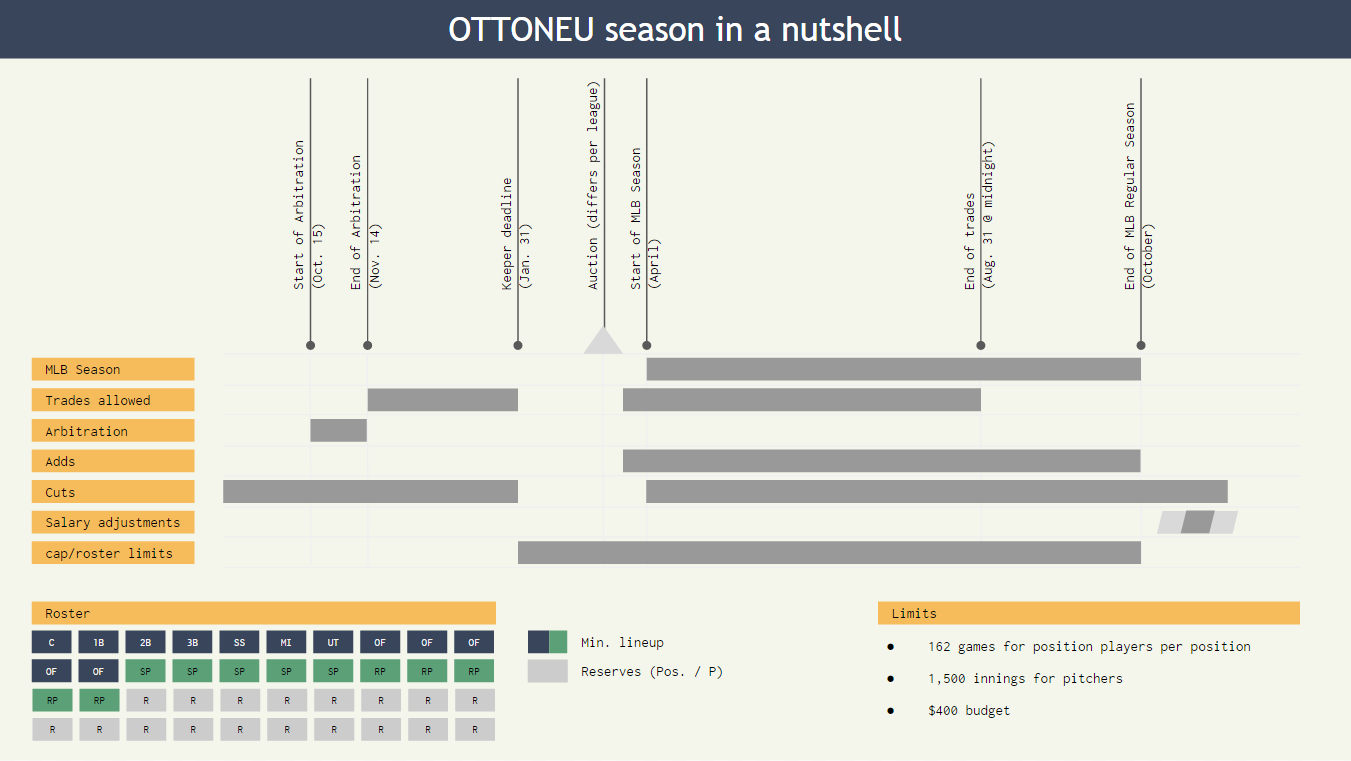
First, a snapshot of the Ottoneu Season (courtesy of ottoneu owner RJ Weise).

pasted-image-at-2016_11_09-09_24 Read the rest of this entry »


Why you should play Ottoneu

With the baseball season down to it’s final game, I find myself in a state of joyous mourning. In the case that you support the Cubs or Indians, your emotions are likely mixed between anxiety and excitement. Regardless, 2016 has been a great year for baseball – and we have been very lucky to finish the season with quite possibly the best ending we could hope for. World Series games 7. The fact that both teams playing for the title have not won in 60+ years ago is icing on the cake. However, as someone without fandom to fall back on, I am left with the question of “what do I do tomorrow?” Baseball will be over, and the prospect of counting down the days till April 2, 2017 is sobering – even amidst the excitement tonight is sure to bring. Luckily, I have Ottoneu.

Maybe you’re asking yourself, “What is Ottoneu?” If you’ve never heard of it, I’d encourage you to check it out. While there are many reasons one could choose to play Ottoneu, I wanted to pose the question of “Why play?” to it’s communities of fans. If you have not played Ottoneu, why should you start? What is the draw? Here are some responses. Most of these fit into one of two main buckets. Increased involvement and in depth game-play. Read the rest of this entry »


Arbitration is Here, Choose Wisely

The Ottoneu respite is almost over! Arbitration starts tomorrow! While I’m sure most of us needed no vacation, someone who plays in 10 leagues probably needed a break. Anyways, the action is about to continue. Arbitration is one of my favorite times of the Ottoneu calendar but, for anyone who has not experience it before, can seem daunting. Today I wanted to run down my thoughts on arbitration as a whole. There have been several arbitration primers here on Rotographs in the past. Chad and Brad have each touched on it a couple of times and have talked about the tactics they like to employ in arbitration, but seeing as I’m not Chad or Brad, my tactics may be slightly different.

First lets start with the basics. Each of the 12 teams in your league will get $25 dollars to allocate to the other 11 teams. Each team may allocate a max of $3 and a minimum of $1 to the other teams. Allocations are blind (you can’t directly see who is allocating to you). Last year, nearly 450 players were allocated to in arbitration. That’s a lot. Certainly the heavy hitters were your big names going into 2016 offseason the offseason Correa, Bryan, Arrieta, etc. but there are always lesser known guys who get a dollar or two. On top of this, post arbitration leagues typically have between 120 and 140 surplus assets. With this in mind, lets talk through two schools of thought that I see applying to the vast majority of teams as they enter arbitration. I will be applying both of these over the next week.

Read the rest of this entry »


Handling September in Ottoneu

I trade a lot. Like Justin, I am also a trade-aholic.  So once the Ottoneu trade deadline has ended my feelings are mixed. There is slight disappointment; I will readily admit that fantasy baseball is a little less fun (for me at least) if I don’t have the ability to make trades. I also feel relieved. After sending out offers constantly since our March draft, I would be lying if I said exhaustion didn’t catch up with me. Not feeling compelled to check trades is a nice change. Baseball is still here after all. I am happy. Leading up to the Ottoneu trade deadline (August 31) I tried to cover how you should prepare for next year (if selling) or how you could stock up for the stretch run if buying. Today, I want to take some time to talk about how you can use September to bolster your chances of clinching the championship, or of improving your odds for 2017. Read the rest of this entry »


Ottoneu 101: Production, Salary, Surplus, Value

If you discuss player valuations with anyone who plays Ottoneu, chances are the word “surplus” has come up. Fellow Rotographs contributor Justin Vibber and his robotic heart love the S word, while others believe it to be a catch all that does a poor job of incorporating context, and therefore should be applied a little more conservatively. Maybe the S word isn’t used; maybe owners mention a player is “overpaid” or “underpaid.” Maybe they mention that they prefer talent they “view as a keeper.” Or maybe they claim someone is a “$30 player” without defining what they mean by “$30 player” and without acknowledging that they actually own this player for $15 salary.

As with all areas of life, communication comes with barriers. Written communication creates more barriers than most. Whatever jargon or form of communication is being used, we should recognize that owners tend to skew heavily toward talent that fits these descriptions “surplus”, “keeper”, “underpaid”, etc. We’re all very loosely trying to define the same thing. First let’s talk about why paying a player less than he produces is important.

If Mike Trout is a $70 player (generally), and you own him for $60, that would be viewed as a very good contract. It doesn’t matter that Trout is eating up $60 of your budget (especially if acquired via trade with a loan), because if he was cut, he would auction for more than $60. So, let’s say this hypothetical Trout is $10 underpaid. Does that change the fact that he is still producing $70 of production? No. Regardless of the salary I own Trout for in my league there is zero impact on his on field production. However, he is certainly more valuable to me at a $1 salary than a $99 salary (extreme I know). In this example, his salary of $60 would allow you to buy around $10 dollars more of production in the auction next season. If I bought Trout at $70, I would still have $70 dollars of production. However, I would now be unable to spend $10 on something else compared to if I had owned Trout at $60. If I owned Trout at a $90 salary, well I am still banking a $70 dollars of production, but now I have given up the ability to spend $20 later. Make sense? Because of this, players who are underpaid tend to be the building blocks of successful teams. They are the most highly coveted assets across leagues.

First, Let’s define a few terms. Then we’ll come back to this example. Read the rest of this entry »

Ottoneu 101: Roster Organizer

With just over 2 months left in the season, it’s likely that your Ottoneu league has started to have some separation at the top of the standings. In reality, this has probably been happening for a while.  Typically races do not stay “close” for this long and (since Ottoneu has no playoff structure) you have probably been faced with the opportunity to start rebuilding in some aspect. A lot of advice could be given on the type of moves you should consider if you’re rebuilding – which trades you should make, players you should claim, which breakouts players are for real, etc. – but instead of commenting on that specifically, today I want talk about a tool that can help you have perspective as you plan toward 2017.

If you’ve played Ottoneu for more than a season, you are probably familiar with the Roster Organizer. If you’re new to Ottoneu, you may not have noticed its existence in season. In the offseason, the roster organizer replaces the lineups page as your offseason planning tool. However, it still can still be accessed in season from your team’s lineup page (boxed in red). The Roster Organizer can be located from your team page as well. The link is in the same place on that page.

Roster Organizer
From this link you will be able to access the Roster Organizer. Clicking the link will take you to a page nearly identical to the Lineups page but with additional slots for cuts, disabled lists, and minor leagues. Note that any player can be put into these three categories, and listing a player as a “cut” does not actually cut them from your squad. However, it reduces the player’s salary from your current cap penalty. This can be useful when trying to determine which of your current players you can build around for next year. I’d highly recommend looking at your squad and seeing where you stand. By doing this, you can get a better idea of players you want to hold on to going into next year, as well as the financial implication of keeping that player. Maybe you have a lot of players you like, but will have trouble meeting the salary cap if you keep all of them. The Roster Organizer can be helpful in realizing this – and can help you organize the players you have who may be worth trading in season. But what about players you want to target? Is there a way to plan for acquiring players? Read the rest of this entry »


Ottoneu 101: The 5MiLB Structure

Ottoneu 101:

Ottoneu 101: The Cap(ps) Space Dilema

Ottoneu 101: Ready, Fire, Aim

Ottoneu 101: How Loans Work in Ottoneu

Over the course of 2014, I became infatuated with two Boston prospects, Manny Margot and Rafael Devers. Margot was in A ball and Devers in Rookie ball at the time, and I wanted to add them to my Ottoneu team. However, I was faced with a dilemma. Was owning Margot or Devers for $1-$2 in 2014 worth the roster spot and cap space I would commit to these players over the next 3-5 seasons? I knew Devers/Margot existed and were talented (probably before my league-mates) but felt the rules were constructed in such a way that it made committing roster spots to Rookie and A ball prospects a poor use of resources. Per Ottoneu rules:

b. Owners shall be permitted to retain any of their players at a salary which is increased based on their previous year salary.  Rules for salary increases are as follows: 

i. Players who have no major league service time (as defined by being placed on an active MLB roster at some point in the past 2 full seasons) will have their salary increase by $1.

So in the case of owning Devers for $1 in 2014, I would likely be looking at a $4 – $8 player by the time he debuts (depending on arbitration) along with committing a roster spot to him for 3-5 seasons. I personally don’t know if that’s a worthwhile trade off, but It’s these types of observations that led me to adding one of my favorite “unofficial” wrinkles to Ottoneu – the 5MILB system. With the help of Trey Baughn, we developed this system to allow prospects outside the scope of the top 50-100 (or in the low levels of the minors) to be owned off roster – where keeping a player for 3-5 seasons can put a real tax on your team. Here are the rules we came up with:

Read the rest of this entry »