Archive for giants prospects

2018 Dynasty Prospect Draft Review: Rounds 10 – 12

My review of a recent Ottoneu dynasty prospect draft continues today with highlights from rounds 10 – 12.

Dynasty Prospect Draft Review: Rounds 1 – 3

Dynasty Prospect Draft Review: Rounds 4 – 6

Dynasty Prospect Draft Review: Rounds 7 – 9

This draft should help you “discover” a few prospect names to keep an eye on going forward.  If you have specific questions about players or the thought process of why they were selected, fire away in the comments section, as I’ve asked each owner in the league to be on standby to provide feedback as we review the rounds.

Before I review my own thoughts on the draft, you should know this Ottoneu league uses the “FanGraphs Points” scoring system based on linear weights, so offense is heavily slanted towards wOBA skills (and speed is almost a non-factor).  We also somewhat arbitrarily removed the Top 12 overall offensive prospects to save them for the standard 40-man auction next spring.  Otherwise, any minor league player without one (1) MLB PA or IP is eligible to be drafted. You can read more about the custom rules of this dynasty league here, and follow along with the draft here.

A few of the prospects below are also featured on the 2018 Top 100 Fantasy Prospects list.

Read the rest of this entry »


2018 Top 100 Fantasy Prospects: First Look

Happy Game 7 Day!

About a year ago I released my (2017) Top 50 Fantasy Prospect rankings using the Prospect Scorecard to weight a variety of important variables in the context of fantasy baseball.  Today I’m publishing an (early) expanded list of the Top 100 Fantasy Prospects for 2018 for both Ottoneu’s FanGraphs Points leagues (where wOBA is a key measure on offense) and Roto leagues (5 x 5).

A few quick notes before we begin:

  • Since “Cost” is league-dependent (auction salary, keeper round, etc.), I’ve ignored it here for simplicity by keeping it constant for every prospect listed. Feel free to use the Scorecard to make changes that reflect true player costs for your league, which will impact these rankings.
  • These rankings below are intended to represent the 100 most valuable prospects for fantasy leagues (depending on scoring format).
  • It’s quite possible I’m missing an obvious player that should be ranked, so let me know in the comments.  We can discuss the specific rationale for player rankings in the comments, too.  Player ages are current ages.
  • For a lot more prospect resources, check out the Ottoneu community.

Here are the (early) 2018 Top 100 prospects for the linear-weights-based FanGraphs Points scoring format (a good proxy for those in OBP leagues):

Read the rest of this entry »


2018 Dynasty Prospect Draft Review: Rounds 7 – 9

Recently I reviewed the results of the first few rounds of a new dynasty league prospect draft.  The review continues today with a quick look at some key selections in rounds 7 – 9.

Dynasty Prospect Draft Review: Rounds 1 – 3

Dynasty Prospect Draft Review: Rounds 4 – 6

This draft should help you “discover” a few names to keep an eye on going forward.  If you have specific questions about players or the thought process of why they were selected, fire away in the comments section, as I’ve asked each owner in the league to be on standby to provide feedback as we review the rounds.

Before I review my own thoughts on the draft, you should know this Ottoneu league uses the “FanGraphs Points” scoring system based on linear weights, so offense is heavily slanted towards wOBA skills (and speed is almost a non-factor).  We also somewhat arbitrarily removed the Top 12 overall offensive prospects to save them for the standard 40-man auction next spring.  Otherwise, any minor league player without one (1) MLB PA or IP is eligible to be drafted.  You can read more about the custom rules of this dynasty league here, and follow along with the draft here.

Many of the prospects below are also featured on the 2018 Top 100 Fantasy Prospects list.

Read the rest of this entry »


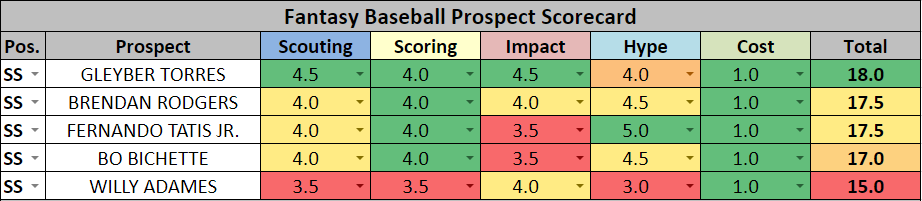
Introducing the Prospect Scorecard

I’ve recently completed two deep Ottoneu minor league drafts and am reminded just how difficult successful “prospecting” can be.  Regardless of how informed you may feel heading into an MiLB draft, you’re often left selecting players based upon small sample sizes, second hand reports, maybe a few brief videos and, as much as we want to deny it, a bias towards “scouting the stat lines”.  At the end of the day you’re making a decision using limited information that could have serious long term consequences for your dynasty team.

Prospecting is actually a lot like another critical business skill: hiring good employees.  The inputs might be a little different (scouting reports might be job references, batting practice videos might be one hour interviews, and stats, however limited, might be the resume sitting on your desk), but the challenge is the same: make an important, timely decision based on limited information, first impressions, and gut feel.

Read the rest of this entry »


San Francisco’s Giant Pitching Prospects

The San Francisco Giants organization recently promoted its two top pitching prospects from high-A ball to double-A. Left-hander Madison Bumgarner and right-hander Tim Alderson – 2007 first-round picks out of high schools – have both taken slightly different paths through the minors but they should spend the bulk of the 2009 season together in double-A.

Bumgarner was the Giants’ first pick (10th overall) in 2007 out of a North Carolina high school. He signed late that year and did not make his debut until 2008. He skipped over both short-season and rookie ball by going straight to low-A ball. The league was not a problem for the lanky lefty, who went 15-3 and lead the league with a 1.46 ERA (1.71 FIP). Bumgarner dominated by allowing just 111 hits and posting rates of 1.33 BB/9 and 10.42 K/9.

In order to avoid the cold weather of the double-A Eastern League, the Giants assigned the now 19-year-old pitcher to high-A San Jose. He posted a 1.48 ERA (2.05 FIP) with 20 hits and just four walks allowed in five starts. With the weather warming in Connecticut, Bumgarner was promoted to double-A last week. In his first start for the Defenders on May 11, Bumgarner faced the last-place New Britain Rock Cats (Minnesota’s affiliate) and allowed just one run in six innings of work. He allowed seven hits and no walks, while striking out two batters.

Alderson, 20, was the club’s second pick (20th overall) of the six selections it had before the second round in 2007 (The club lost a lot of players to free agency the previous winter). He showed excellent stuff and above-average control, but teams were scared away by his mechanics and delivery. Obviously, though, with Tim Lincecum in the big league rotation, the Giants organization is not scared off by unique pitchers.

Alderson, now 20, also took his sweet time signing his first pro contract, although he did make three appearances late in 2007. He did not allow a run or a walk in five rookie-ball innings. Alderson allowed just four hits and struck out 12 batters. The right-hander was so impressive that the Giants challenged him with a 2008 assignment to high-A ball, a move almost unheard of amongst prep draftees in their first full season. He rose to the challenge and went 13-4 with a 2.79 ERA (2.64 FIP) with 125 hits allowed in 145.1 innings of work. Alderson posted a walk rate of 2.11 BB/9 and a strikeout rate of 7.68 K/9 during the course of the season.

Again, because of the weather in Connecticut, Alderson began 2009 by repeating high-A ball for five starts. Perhaps cruising a bit, the Arizona native allowed 31 hits and three walks in 26 innings. He also struck out 20. Along with Bumgarner, Alderson was promoted to double-A and he made his first start against the first-place New Hampshire Fisher Cats (Toronto’s affiliate) on May 10. He did not allow a hit over 6.2 innings of work and was removed due to his pitch count. Alderson walked one and struck out 10 batters.

Bumgarner, 6’4” and 215 lbs, has the makings of a No. 1 or 2 starter. His repertoire includes a moving fastball that can touch the upper 90s. He has above-average command of the pitch. Because his fastball has been so dominating, his secondary pitches, a curveball and change-up, have suffered. He’ll definitely need to work on them to succeed in Double-A – and eventually the Majors.

Alderson, 6’7” and 220 lbs, has an average fastball at 88-92 mph but his command of the pitch makes it play up. His curveball is amongst the best in the minors and his change-up is improving. Alderson is also working to induce more ground balls, which he did effectively in his double-A debut. He could see the Majors by the end of the season – likely from the bullpen. He has the ceiling, though, of a No. 2 or 3 starter.

Both pitchers have bright futures in the Majors and should be extremely valuable to not only the San Francisco Giants organization, but also fantasy baseball owners in keeper leagues.