Archive for B.J. Upton

Mixed League Waiver Wire: B.J. Upton, Brad Miller

It’s a “dudes who have been dropped in a lot of mixed leagues” edition. These two have disappointed in different ways – one with fairly low expectations, one with optimistic forecasts – but both of their outcomes have been roughly equal in terms of suckitude. The signs, lately, both performance-wise and in terms of team dynamics, have given fantasy owners reasons for cautious optimism going forward, though.

Read the rest of this entry »


How to Handle Different Categories: SLG and OPS

In the leagues I run that have inexperienced and/or casual team owners, I always use the standard 5×5 roto categories because I feel that it would give me and the other experienced players an advantage. I know that the casual players in my leagues are using the rankings provided by the website on which we’re drafting or some other set of rankings from a major industry source. And almost all of those rankings are based on standard categories. If I replaced, for example, home runs with slugging percentage, I would be able to identify the players whose valuation or ranking would change with the different category. But the noobs would be using rankings made with home runs in mind.

I polled my Twitter followers to find out the most common uses of non-standard categories so that I could determine the players whose valuation/ranking changed the most when non-standard categories are used. The most common answers were OBP replacing batting average (which I covered here), slugging percentage replacing home runs, and OPS being added as a sixth category to the standard five hitter categories. Sorry if your league has a different non-traditional format.

Below are charts showing the biggest changes in SLG and OPS leagues. For an explanation of the methodology used, check out the OBP piece I just linked to. And if you’d like to see how all 242 hitters that I have projected are affected by SLG replacing HR or OPS being a sixth category, you can find the SLG list here and the OPS list here.

First up, guys who get a bump when slugging percentage replaces home runs.

SLG1

Miguel Cabrera and Paul Goldschmidt are even more valuable in slugging percentage leagues, and they close the gap between them and Trout in auction leagues. Joey Votto shows up on this list just as he did in my OBP post. He’s obviously excellent, but the standard categories aren’t the best measure of his excellence.

Unsurprisingly, we see a few young first basemen here who haven’t reached the ‘power potential’ some thought they might. But really they just haven’t put up big home run totals. Freddie Freeman and Eric Hosmer may never settle in as 30+ HR regulars or even 25-30 HR regulars, but if you play in a slugging percentage league, their power plays. And Brandon Belt gets the biggest boost by switching to SLG. It’s possible his ballpark has something to do with it, but he’s very much in the Freeman/Homser mold. The only non-1B/DH player on this list is Yadier Molina who was 4th in the league in doubles last year.

Now the guys who you would prefer in a home run league. Read the rest of this entry »


Three Guys I Won’t Draft in 2014

We, as fantasy writers, tend to make a lot of favorable recommendations throughout the year. We talk about which players we like, which ones we anticipate having a breakout season, which ones you should think about picking up during the year and which ones you should watch for in-season call-ups. And while all of that “draft this guy” and “pick up that guy” prove to be valuable pieces of information, rarely do we see the equally valuable “I wouldn’t draft this guy if you paid me.” Well, since I’ve already been accused of writing some mean-spirited things about players in the past, I’ve decided to turn that negativity into an entire post and tell you three players who I refuse to draft this season and why you shouldn’t touch them either. Read the rest of this entry »


Taking a Look at Changes in Contact Rate

Back in 2009, Eric Seidman wrote a piece here that looked into when samples become reliable for certain statistics. The piece was based off work done by Pizza Cutter. You can read the piece here for a full explanation of how the conclusions were reached, but below is a list showing how many PAs it takes for a statistic to become reliable. Read the rest of this entry »


Braves Outfield: Depth Chart Discussions

Is there an outfield more exciting than that of the Braves right now? I think not. Sure, maybe the Angels come close now that they’ve added Hamilton, but overall, I don’t see a better starting three that has as much proven talent with still plenty of upside waiting to emerge than the Braves have right now. You’ve got strong power, excellent speed and each one of them plays strong enough defense that Fredi Gonzalez won’t ever hesitate to keep running the same three guys out there so long as everyone is healthy. In the fantasy world, that’s just pure gold. Read the rest of this entry »


If You Must Punt, Punt It Right

For all the years that I’ve been playing fantasy baseball, I’ve never really understood the idea of punting saves. Not that I don’t understand the concept, but that I don’t understand the rationale behind thinking that it’s a good strategy. You load up on starters with the hope of locking up wins and strikeouts while doing your best to stay competitive in WHIP and ERA. Perfectly viable strategy, right? But what about the fact that Wins is, more or less, an arbitrary category and while your guy goes seven strong and exits with the lead, some clown of a set-up man comes in, walks the leadoff guy and then serves up a two-run shot to tie the game. A great game for your starter, for sure, but you make no advancement in a category you’ve supposedly built your team to excel in. Read the rest of this entry »


AL Outfield Fallers: Sizemore, Wells & B.J. Upton

Sometimes you win.  Sometimes you lose.  Sometimes…it rains.  Fortunately, the ominous, dark clouds that usually precede the storm are visible enough to give you fair warning and help keep you from getting wet.  So as we talk about the AL outfielders this week, here are a few that have those dark clouds hovering over that you might want to avoid. Read the rest of this entry »


Assessing B.J. Upton

Power. Patience. Speed. During the course of his career, B.J. Upton has shown more tools than Home Depot. Those tools are the reason that the Rays selected him with the second overall pick in the 2002 draft, and they’re what allowed him to cross the four win threshold in the majors in both 2007 and 2008. Since then, however, Upton has aggravated fantasy owners with his schizophrenic bat. B.J.’s wOBA sat at .387 in ’07 and .354 in ’08, but it dipped to .310 last season and has rebounded mildly to .324 this year. Is he a power hitter? An uber-patient batter with medium pop? Neither? And what about his declining BABIP? Let’s look at Upton’s core skills to get some answers.

Plate Discipline

Upton walked in 11.9% of his plate appearances in 2007, 15.2% in 2008, 9.1% in 2009 and he has drawn a free pass 11.1% this season. As those above-average walk rates indicate, Upton does a better job than most in terms of laying off pitches thrown outside of the strike zone. This season, he’s venturing out of the zone more than he usually does. Here are Upton’s outside swing percentages over the period of 2007-2010, compared to the MLB average:

His O-Swing is about 86 percent of the big league average, compared to 76% in ’07, 59% in ’08 and 78% last season. In addition to swinging at more off-the-plate pitches, his first-pitch strike percentage is 66 percent (58-59% MLB average). It was 63.7% in 2007, 55.2% in 2008 and 61.8% in 2009. I don’t necessarily think this has a ton of predictive value, but Upton’s performance when putting the first pitch in play has plummeted. Here are his sOPS+ numbers on the first pitch over 2007-2010. sOPS+ is a stat that compares a player’s performance in a given split to the league average. One-hundred is average, above 100 means the batters is better than most and under 100 means he is worse than average.

2007: 204 sOPS+
2008: 105 sOPS+
2009: 89 sOPS+
2010: 62 sOPS+

Power

The 6-3, 185 pound righty batter hit for elite power in 2007, posting a .209 ISO with 19.8% of his fly balls leaving the yard. Upton’s ISO fell to .128 (7.4 HR/FB%) in ’08 as he battled through a left shoulder injury that required off-season surgery. Fantasy players were hopeful that a supposedly healed Upton would start going deep more often in ’09, but his ISO barely budged (.132) and his HR/FB% was 6.8. In 2010, B.J.’s pop has rebounded to an extent — his ISO is .163, with an 8.3 HR/FB%. At this point, I think it would be safe to expect power output closer to his current clip — ZiPS pegs Upton for a .156 rest-of-season ISO, and CHONE forecasts a similar .153 ISO.

Speed

This is one area where Upton’s performance hasn’t varied much. He stole 22 bases in 30 tries in 2007 (a 73.3% success rate), then went 44-for-60 in ’08 (73.3%), 42-for-56 last season (75%). In 2010, he has 27 steals in 33 attempts (81.8%). He’s an efficient stolen base threat, and his Speed Score has increased each season (five in ’07, 5.6 in ’08, 6.8 in ’09 and eight in 2010; the MLB average is about five).

BABIP

Upton’s BABIP has been all over the place in his four seasons as a full-time starter — .393 in ’07, .344 in ’08, .310 last year and .292 in 2010. Considering Upton’s wheels, it’s bizarre that his BABIP on grounders is fueling the dip — .341 in ’07, .285 in ’08, .270 in ’09 and just .218 this season. For comparison, The AL average over that period has ranged from .231 to .246.

Is there any particular reason for Upton’s continual BABIP decline? Let’s turn to this expected BABIP (xBABIP) calculator from The Hardball Times, which estimates a hitter’s BABIP based on his rate of home runs, strikeouts, stolen bases, line drives, fly balls, pop ups and ground balls:

While Upton’s actual BABIP has dropped precipitously, his xBABIP totals suggest that little has changed. I don’t think there’s much reason to think that a player with Upton’s speed will continue to post a BABIP on grounders that’s below the league average.

His overall rate of hits on balls put in play should improve. Something closer to his career BABIP, .334, is a good estimate of what to expect from this point forward. Upton should be more of a .250-.260 type hitter than his current .227 mark.

Upton is currently on the waiver wire in one-tenth of Yahoo leagues. If you’re in a league where he’s available, I’d certainly take a gamble. I also think he’s a shrewd buy-low candidate, assuming his recent ankle injury isn’t too serious. Upton possesses a good eye (though it hasn’t been quite as discerning this year) and above-average power, and he’ll add plenty of steals to boot. There’s still upside, too, with Upton not turning 26 until late August. Don’t give up on this guy.


Rankings Update: Outfielders (OF1)

It’s been a little while since we did the first outfielders, and some things have changed. Let’s update these with to-date wOBAs and ZiPs RoS wOBAs and injury information and all that jazz, shan’t we?

The Top Three:
Ryan Braun, Milwaukee (.442 wOBA, .402 ZiPs RoS wOBA)
Matt Kemp, Los Angeles NL (.355 wOBA, .373 ZiPs RoS wOBA)
Justin Upton, Arizona (.350 wOBA, .380 ZiPs RoS wOBA)

Justin Upton is on comeback trail. He’s having a .310/.347/.577 kind of a May which pulls him back into this top-three territory. For those that would like to penalize him for his batting average / strikeout issues, it looks like he either has contact skills that can prop up a decent average or he’s streaky enough to make the final tally look fine. And the counting stats are looking fine – his ZiPs Update has him at 27 home runs and 16 stolen bases. That’s not bad. In fact, it’s good.

There’s Nothing Wrong With…
Nelson Cruz, Texas (.445 wOBA, .383 ZiPs RoS wOBA)
Carl Crawford, Tampa Bay (.384 wOBA, .364 ZiPs RoS wOBA)
Ichiro Suzuki, Seattle (.368 wOBA, .358 ZiPs RoS wOBA)
Matt Holliday, St. Louis (.354 wOBA, .396 ZiPs RoS wOBA)
Shin-Soo Choo, Cleveland (.372 wOBA, .377 ZiPs RoS wOBA)

While Justin Upton doesn’t have the lengthy history to ‘prove’ his batting average risk, Nelson Cruz does. He’s come a long way to even get to this point, really. But we know the strikeouts will bring that average down, so don’t go counting on a .301 batting average to last. The rest of the guys on this list are providing stats in multiple categories despite a tiny bit of disappointment in most cases. A stolen base tear or a little power burst, and they’ll turn in seasons like any other on their resumes.

Hurt But Still Good?
Andre Ethier, Los Angeles NL (.507 wOBA, .402 ZiPs RoS wOBA)
Jacoby Ellsbury, Boston (.366 wOBA, .345 ZiPs RoS wOBA)
Curtis Granderson, New York AL (.315 wOBA, .353 ZiPs RoS wOBA)
Grady Sizemore, Cleveland (.256 wOBA, .359 ZiPs RoS wOBA)

New tier for these guys, who are testing patience across the country. Granderson is close to coming back, as he was shagging fly balls recently. Ellsbury played a rehab game, too. Those two represent decent buy-low candidates. You might want to wait for news on Sizemore’s knee – surgery was rumored – before you go poking around on his availability.

Not Quite Five-Category Performers
Josh Hamilton, Texas (.373 wOBA, .368 ZiPs RoS wOBA)
Jayson Werth, Philadelphia (.441 wOBA, .396 ZiPs RoS wOBA)
Manny Ramirez, Los Angeles NL (.426 wOBA, .413 ZiPs RoS wOBA)

Josh Hamilton and Jayson Werth both look like they are a healthy month away from jumping tiers. Werth is playing a little above his head, but all that contract talk is probably making him salivate. Andre Ethier was leading the triple-crown categories, but maybe he should be in the hurt category. People should be pardoned for being a little skeptical about his huge ISO, given his history. His BABIP should fall, too. There could be some flip-flopping between this tier and the second one with some sustained play.

Missing Something?
Jason Bay, New York NL (.346 wOBA, .383 ZiPs RoS wOBA)
Adam Lind, Toronto (.306 wOBA, .353 ZiPs RoS wOBA)
Nick Markakis, Baltimore (.365 wOBA, .375 ZiPs RoS wOBA)
Andrew McCutchen, Pittsburgh (.394 wOBA, .361 ZiPs RoS wOBA))

McCutchen is moving his way up, but ISO stabilizes latest so we have to be careful about how much we move him up. It’s still possible he belongs with speedsters Michael Bourn and Brett Gardner below. Adam Lind and Nick Markakis in the meantime are moving their way down until they can prove they have some one fantasy tool that we can latch on to. They still have some history to call back on, or else they’d have dropped further.

Upside to Join the Top
B.J. Upton, Tampa Bay (.316 wOBA, .337 ZiPs RoS wOBA)
Carlos Quentin (.304 wOBA, .352 ZiPs RoS wOBA)
Michael Bourn (.340 wOBA, .322 ZiPs RoS wOBA)
Brett Gardner (.391 wOBA, .332 ZiPs RoS wOBA)

The elder Upton’s strikeout rate seems to be the harbinger of a poor batting average, as does Quentin’s poor line drive rate. Michael Bourn just doesn’t have any power, or he’d move up the list himself. Stolen bases are rare enough that some speed-only guys can make their way into the elite, but we do expect some power before they can join the elite of the elite. Brett Gardner is a borderline guy himself until someone drops out, for example. There maybe some movement here in this tier between OF1 and OF2.


Rankings Update: Outfielders

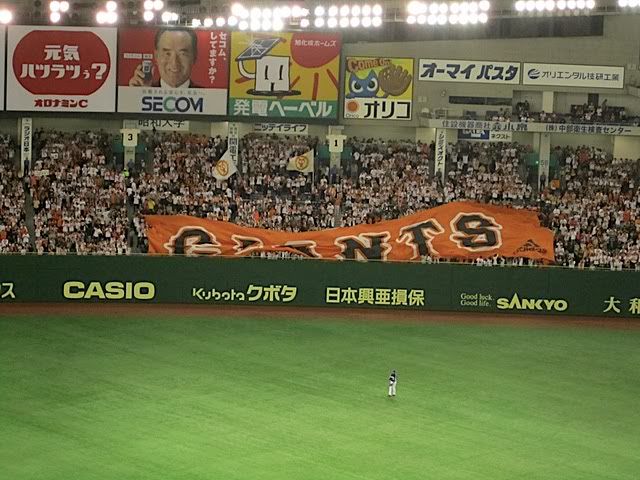
I’m back from Japan and have Basu-Baru pictures for your pleasure. Baseball in Japan has many of the trappings of the American version, but also includes cheerleaders and choreographed songs. Interestingly enough, the game I saw featured two Westerners at cleanup – Tony Blanco for the Chunichi Dragons and Alex Ramirez for the Yomiuri Giants. The pitchers had decent stuff, and the crowd was louder than many (most?) regular season MLB games, but overall the package was something like a AAAA game.

I digress. Time to take ownership of these outfielder rankings and change them up a bit. I will be doing them all season, as a sort of power ranking at the position. We’ll go with the FANS’ projected wOBAs (aka their upside projections) for another week.

The Top Three:
Ryan Braun, Milwaukee (.405 wOBA)
Matt Kemp, Los Angeles NL (.367 wOBA)
Justin Upton, Arizona (.388 wOBA)

Nothing much to say here except it looks like Upton’s ankle isn’t bothering him. These guys are studs and by the end of the year, could easily all be top-five fantasy players despite playing in the outfield.

There’s Nothing Wrong With…
Grady Sizemore, Cleveland (.343 wOBA)
Matt Holliday, St. Louis (.390 wOBA)
Carl Crawford, Tampa Bay (.367 wOBA)
Jacoby Ellsbury, Boston (.354 wOBA)
Curtis Granderson, New York AL (.340 wOBA)
Nelson Cruz, Texas (.368 wOBA)
Ichiro Suzuki, Seattle (.369 wOBA)
Shin-Soo Choo, Cleveland (.389 wOBA)

After the spirited Choo vs Granderson vs Sizemore comments conversation from the last time we updated these rankings, it’s only natural that we find a way to put them all in the same tier where they belong. Nelson Cruz is absolutely on fire, but his BABIP (.357) and K rate (24.1%) together suggest that the batting average should regress to his career norm. Granderson is still having trouble with lefties, but if he continues to bash righties to this extend, he’ll stay out of the next tier.

Not Quite Five-Category Performers
Josh Hamilton, Texas (.321 wOBA)
Jason Bay, New York NL (.397 wOBA)
Adam Lind, Toronto (.394 wOBA)
Nick Markakis, Baltimore (.349 wOBA)
Manny Ramirez, Los Angeles NL (.396 wOBA)

Manny is actually showing that he’s still got something left and with another tater or two could even join the next tier. That said, his missed games will keep the old(er) man back a little. Those same missed games should come into play with Hamilton eventually too. Lind’s power has taken a slight step back, but it’s early going and all it looks like he needs to do is loft the ball a little more (33.3% FB this year, 36.8% last year).

Missing Something?
Jayson Werth, Philadelphia (.382 wOBA)
B.J. Upton, Tampa Bay (.310 wOBA)
Andre Ethier, Los Angeles NL (.370 wOBA)

Werth reminded us that he has some injury issues by missing time with hip soreness, but has otherwise played well. The older Upton is actually playing about as well as can be expected, and in leagues that don’t use batting average, he may yet prove to be an elite option. Ethier will have his supporters, but his fly ball rate already fell, and his power pace should fall with it. The batting average should be strong this year, though, and he’s still a solid option.

Upside to Join the Top
Andrew McCutchen, Pittsburgh (.360 wOBA)
Carlos Quentin (.375 wOBA)
Michael Bourn (.326 wOBA)
Jason Kubel (.370 wOBA)

Outfielders are a tough position to handicap because of the sheer numbers, which also won’t allow me to go too deep. By highlighting some guys that could join the elite with the right years, we can delve a little deeper. So, while Shane Victorino is a fine option in the outfield, McCutchen is stealing bases at a pace (five so far) that would outpace the Flyin’ Hawaiian should it keep up. Bourn has shown the same plus plus speed. Should Quentin stay healthy, and Kubel prove that he can keep his slugging percentage over .500 year-in and year-out, they would join the power elite. So far, so good.