Archive for Andre Ethier

RotoGraphs Audio: The Sleeper and The Bust 01/23/14

Episode 89

The latest episode of The Sleeper and the Bust is now live! Jason Collette joins Eno Sarris to preview the Arizona Diamondbacks and the Los Angeles Dodgers.  Skype was being a bit wonky today so apologies in advance for any audio issues during the podcast.

As usual, don’t hesitate to tweet us any fantasy questions you have that we may answer on our next episode.

You can subscribe to the podcast on iTunes or via the feed.

Thanks to Ian Miller aka Teen Archer, for the new intro music

Approximately 61 min of joyous analysis.

FSTA draft results mentioned several times in the show

01:01:43

Dodgers Outfield Depth Chart Discussions

There’s $53.5 million dollars wrapped up in the Los Angeles Dodger outfield and between Carl Crawford, Matt Kemp, and Andre Ethier, the starting trio is about as solid as a soup sandwich.

All it really takes is for things to go right and those three occupy the respective outfield slots for the duration. But we know what we know. Specifically, that Carl Crawford is fragile and his performance since signing his $142 million dollar contract has been decidedly underwhelming. We know that Matt Kemp is coming off October labrum surgery not to mention repair of a “minor debridement” of the rotator cuff, which sounds like couples counseling in his shoulder. And we know that Andre Ethier mashes in April, becomes enigmatic, and all the while he can’t hit left handed pitchers. It’s not particularly confidence inspiring when you read that two of the three outfielders are currently focused on getting ready for Opening Day but not necessarily Spring Training. This, it seems, makes their outfield depth chart particularly important heading into the season.

Read the rest of this entry »


Why Didn’t Andre Ethier Live Up To Expectations?

As you’ll notice around RotoGraphs this week, many of my fine colleagues are looking back at their “10 Bold Predictions” from before the season and seeing how many of them came true. Having joined the team late, I had time to make only one prediction before the season started: “Andre Ethier Is Going To Have a Huge Season”. You can click back to that article to read the full explanation of why, but it basically came down to two reasons – first, he was finally healthy after two years of finger & knee troubles, and second, he would likely be motivated to prove his worth as he headed into his free agent year. I argued that if everything broke right, he could be a steal as a potential top-15 outfielder who was routinely going in the mid-30s in spring drafts. It didn’t quite happen; Ethier ranked outside the top-30 in most of the major ranking systems.

On the surface, Ethier’s 2012 looked a lot like his 2011, compiling a .348 wOBA as opposed to the previous year’s .343. (An increase in slugging percentage was mostly offset by a lesser OBP.) So what went wrong? For the first two months, not a whole lot, actually; like he’d done in the previous two seasons, Ethier got off to a hot start, hitting .324/.381/.569 with nine homers through the end of May. Read the rest of this entry »


Keeper Conundrums: Requests, Part Two

During the Keeper Conundrum series, I got some nice suggestions in the comments. Today, I continue my look at some of your ideas.

Travis Snider
Snider made some nice strides on the field this year, but he had a hard time staying in the lineup. He improved his contact rate, started to hit lots of liners, and still showed us that he can hit for power. He’s really young (will be 23 next season), and I think he’ll continue to get better next year.
Crude 2011 Projection: .265/.335, 24 HR
Verdict: Keep. I don’t know if he plays a full season, but I’m not banking on it. He’s a nice risk to take, and a good piece to keep in your possession.

Jay Bruce
I thought he was going to hit 30+ homers this season, as did most people, and his ADP reflected that. He ended up doing pretty well for himself, and a big August and September will drive his value up once again. He has the potential to consistently hit 30 bombs, but please remember that he’s only 23 at the moment.
Crude 2011 Projection: .275/.365, 30 HR
Verdict: Keep. He’s only a year or two from putting it all together and getting picked in the third or fourth round.

Desmond Jennings
Everyone thinks that he’ll be handed the LF job once Crawford signs elsewhere this winter, and there’s no reason to think otherwise. His value comes down to how you think he’ll adjust to major league pitching, because we know he can run if he just reaches base.
Crude 2011 Projection: .270/.340, 5 HR, 30 SB
Verdict: Keep. Personally, I don’t like keeping guys just for steals, but I’m not going to let my prejudice tell dictate my response here.

Andre Ethier
The Dodgers outfielder started out hot, but had some injury troubles and cooled off later in the year. He still ended the year with over 20 bombs, a good average and respectable counting stats. He’s right in the middle of his peak, so now’s the time to own him.
Crude 2011 Projection: .290/.365, 28 HR, 5 SB
Verdict: Keep. Odds are that you got him in the seventh round, and that price is right. It’s no bargain, but you’re not overpaying.

Thanks for all the suggestions this week, and check back tomorrow for part three of your requests.


Rankings Update: Outfielders

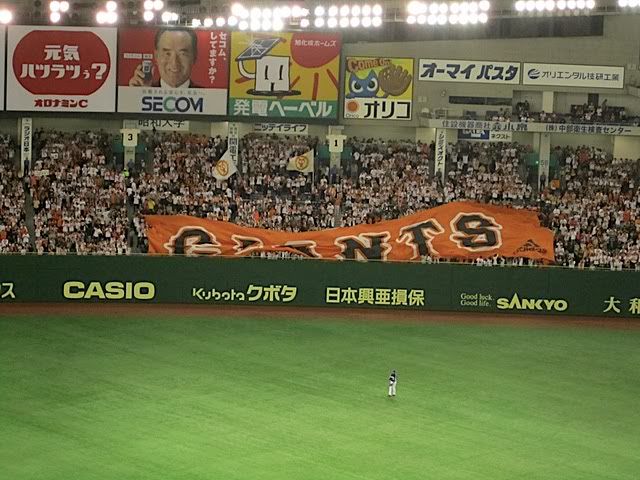
I’m back from Japan and have Basu-Baru pictures for your pleasure. Baseball in Japan has many of the trappings of the American version, but also includes cheerleaders and choreographed songs. Interestingly enough, the game I saw featured two Westerners at cleanup – Tony Blanco for the Chunichi Dragons and Alex Ramirez for the Yomiuri Giants. The pitchers had decent stuff, and the crowd was louder than many (most?) regular season MLB games, but overall the package was something like a AAAA game.

I digress. Time to take ownership of these outfielder rankings and change them up a bit. I will be doing them all season, as a sort of power ranking at the position. We’ll go with the FANS’ projected wOBAs (aka their upside projections) for another week.

The Top Three:
Ryan Braun, Milwaukee (.405 wOBA)
Matt Kemp, Los Angeles NL (.367 wOBA)
Justin Upton, Arizona (.388 wOBA)

Nothing much to say here except it looks like Upton’s ankle isn’t bothering him. These guys are studs and by the end of the year, could easily all be top-five fantasy players despite playing in the outfield.

There’s Nothing Wrong With…
Grady Sizemore, Cleveland (.343 wOBA)
Matt Holliday, St. Louis (.390 wOBA)
Carl Crawford, Tampa Bay (.367 wOBA)
Jacoby Ellsbury, Boston (.354 wOBA)
Curtis Granderson, New York AL (.340 wOBA)
Nelson Cruz, Texas (.368 wOBA)
Ichiro Suzuki, Seattle (.369 wOBA)
Shin-Soo Choo, Cleveland (.389 wOBA)

After the spirited Choo vs Granderson vs Sizemore comments conversation from the last time we updated these rankings, it’s only natural that we find a way to put them all in the same tier where they belong. Nelson Cruz is absolutely on fire, but his BABIP (.357) and K rate (24.1%) together suggest that the batting average should regress to his career norm. Granderson is still having trouble with lefties, but if he continues to bash righties to this extend, he’ll stay out of the next tier.

Not Quite Five-Category Performers
Josh Hamilton, Texas (.321 wOBA)
Jason Bay, New York NL (.397 wOBA)
Adam Lind, Toronto (.394 wOBA)
Nick Markakis, Baltimore (.349 wOBA)
Manny Ramirez, Los Angeles NL (.396 wOBA)

Manny is actually showing that he’s still got something left and with another tater or two could even join the next tier. That said, his missed games will keep the old(er) man back a little. Those same missed games should come into play with Hamilton eventually too. Lind’s power has taken a slight step back, but it’s early going and all it looks like he needs to do is loft the ball a little more (33.3% FB this year, 36.8% last year).

Missing Something?
Jayson Werth, Philadelphia (.382 wOBA)
B.J. Upton, Tampa Bay (.310 wOBA)
Andre Ethier, Los Angeles NL (.370 wOBA)

Werth reminded us that he has some injury issues by missing time with hip soreness, but has otherwise played well. The older Upton is actually playing about as well as can be expected, and in leagues that don’t use batting average, he may yet prove to be an elite option. Ethier will have his supporters, but his fly ball rate already fell, and his power pace should fall with it. The batting average should be strong this year, though, and he’s still a solid option.

Upside to Join the Top
Andrew McCutchen, Pittsburgh (.360 wOBA)
Carlos Quentin (.375 wOBA)
Michael Bourn (.326 wOBA)
Jason Kubel (.370 wOBA)

Outfielders are a tough position to handicap because of the sheer numbers, which also won’t allow me to go too deep. By highlighting some guys that could join the elite with the right years, we can delve a little deeper. So, while Shane Victorino is a fine option in the outfield, McCutchen is stealing bases at a pace (five so far) that would outpace the Flyin’ Hawaiian should it keep up. Bourn has shown the same plus plus speed. Should Quentin stay healthy, and Kubel prove that he can keep his slugging percentage over .500 year-in and year-out, they would join the power elite. So far, so good.


ADP Values in Left Field

Time to get all up in that left field position and see what we can find (sounds dirty). It’s an interesting position because it sports a top-five man (Ryan Braun, at 4.87 ADP), and yet the final tier averages somewhere around a 250 ADP. It’s not the deepest of positions, or it’s at least top-heavy.

The second tier has a bunch of second- and third-round guys that can offer some speed or slugging (in the case of Matt Holliday (21.89 ADP), a little of both), but there’s a curious inclusion in the tier that stands out. Right there, in the fifth round, there’s a player that could give you third-round value a good twenty picks later. Why are people avoiding Manny Ramirez (65.30) like the plague? Of course, there’s the obvious answer that comes in the form of a positive test for the wrong substance – and perhaps that should make people nervous. It’s a fly in the ointment and it probably won’t help to quote the projections that have Manny being the Manny of old (minus a few points for getting older). It’s a risk that has to be accounted for.

But lets say your league doesn’t break things down into separate positions in the outfield, then Manny comes in right around Andre Ethier (67.48 ADP) and Nelson Cruz (67.66 ADP). Those guys come with their own risk attached. Remember that Ethier used to be a 20-home-run-hitting outfielder as recently as 2008, and that Cruz, despite all his power and speed, has a 26% career strikeout percentage and a .255 career batting average (though I will admit to liking his power and speed contributions). Which risk do you take?

The next tier has some nice power, and even bounce-back candidate Alfonso Soriano (ADP 78.40) for power/speed potential too. But again, one man stands out like a sore thumb. Nolan Reimold (ADP 214.72) is young and has power and speed and a starting job that he should keep all year because of the rebuilding nature of his team. Much has been made of his Achilles’ injury, but perhaps many aren’t aware that Reimold made his stellar debut (.279/.369/.466 with 15 home runs and 8 stolen bases and a .365 wOBA) while being hobbled for much of the year with a 25% tear on that same tendon. What will he do once it heals? At that ADP, the shot at a .280 20+/10 outfielder should make you salivate. (At least it does that for me, am I weird?)

I’d hate to go all crazy on young ‘uns because there are plenty of values among the older left fielders. Plenty of old man skills, at least – Josh Willingham (270.94) sports those and is a value when surrounded by players like Carlos Ruiz (275.41 ADP) and Scott Hairston (277.51 ADP).

But I’m drawn to upside, and there’s Matt LaPorta (325.88 ADP) sitting right there for the plucking. He’s had some strikeout issues in the past, and he’s been a little old for his minor league levels, so he may not be the ueber-prospect we thought he was. But he has real power – his .188 debut ISO was low compared to his minor league power – and that’s always got a place in my lineup. Especially at this price.


Mailbag: Keeping Morales, Ethier, Hanson or Hamels?

Reader G. Azama submitted this question to me directly, but it’s a mailbag question nonetheless:

I’m in a 14 Team mixed keeper league. We get to keep any 7 players and as far as I know, there’s no limitation on how many years we get to keep the players.

Positions are C,C,1B,2B,3B,SS,CI,MI, 5 OF, bunch of pitchers and long bench.

Stats are the basic 5×5 plus OPS and Holds. Because of the holds, Closers are hard to come by, in fact very hard to come by if you don’t draft them.

I had a pretty good team and got nip at the end and came in second. My potential keepers are Chase Utley, Tim Lincecum, Joey Votto, Kung-Fu Panda, Kendry Morales, Jonathan Broxton, Andre Ethier, Tommy Hanson, Cole Hamels.

Straight up keepers. Draft position from last year is not a factor.the draft will be done in the reverse order of the finish in every round. In other words, I will be drafting thirteenth on every round, since I came in second last year.

I’ve been banging my head against the wall trying to figure out what makes sense. As you can see I’ve got quite a few good young players! Hard decision. I think the top 4 are keepers for sure. It’s after that that I have a hard time deciding.

I completely agree that Timmy, Utley, Votto and Pablo Sandoval are instant keepers in this case. I also think that you need to keep Broxton to at least have one closer on your roster. That leaves us with Kendry, Ethier, Hanson and Hamels to fill two spots.

Kendry provided owners with more power than they could have ever hoped for, with a fantastic average to boot. For the most part, his 34 homers came out of no where, but he did have a brief history of power in Triple-A during the 2008 season, hitting 15 homers in 340 plate appearances. However, a .335 BABIP is likely to drop bringing his average down below the .300 mark. Also, Kendry doesn’t draw many walks so his value drops in OBP leagues, but an OPS league keeps his value high.

Ethier’s power last year was also a pleasant surprise, but his .272 average was a disappointment. He isn’t likely to hit 31 homers again, but 25 homers is not out of the question. Unlike Kendry, Ethier draws a walk and can keep his OPS high even when he is in a “slump”. His average should rise back to around .285, and a solid lineup around him means good production all around.

David Golebiewski already did quite the workup on Hanson in December, so I’m not going to step on his work and repeat what he said. Cole Hamels had a career year in 2008, and then posted career worst fantasy numbers in 2009. However, his FIP was exactly the same in both years, coming in at 3.72. Will the real Cole Hamels please stand up? 2010 is likely to be an average of 2008 and 2009, with his ERA coming in around 3.70 with good wins, strikeouts and WHIP.

I really like Kendry, but with Votto and Kung-Fu Panda already on the roster he is expendable. In a league with five outfielders, I’m keeping Either, that much I’m sure about. Now we are down to Hanson and Hamels for one last spot. Because there is no limit on how long you can keep players, I’m keeping Hanson.

To recap, I’m keeping Timmy, Utley, Votto, Panda, Broxton, Ethier and Hanson.

Have a question for the mailbag? Send it to rotographs+mailbag@fangraphs.com.


Check the Position: Right Field

Over the offseason we’ll take a look at each position on the diamond and see how the past season affected the positional rankings and where there might be some potential bounceback value picks going into next year’s drafts. (See shortstops, catchers, second basemen, first basemen, third basemen, and left fielders.)

These rankings are for 5×5 rotisserie fantasy baseball. Eligibility was determined by where the player had the most at-bats last year.

RightFielders

The tier-of-his-own player in right field is Justin Upton, and I doubt there will be too much grumbling about this ranking for a guy who hit .300 with 26 home runs and 20 stolen bases in his firs full year. Sure, we may talk a little about his high BABIP (.364), but for now let’s just look at the fan projections and sigh.

That should end the easy portion of our rankings today. Perhaps this is just a little self-pity in anticipation of the comments thread, but the next two tiers could be a single tier, or could be three tiers, and could probably be re-arranged ad infinitum. We’ll give Ichiro! Suzuki credit for his BABIP and (sexy) infield-hitting prowess which are perfect for the right fantasy team.

Now come the players that are impossible to rank. Where do you put a guy like Nelson Cruz, who will give you great power and speed, but will hurt your batting average? Could he be any more different from Shin-Soo Choo, who is is solid across the board but won’t win you a single category? Bobby Abreu is in the Choo-mold, but we’ll move him back a little for the waning power and, to be frank, his old age and body type. It hasn’t hurt him yet, but someday, well it just has to. Right?

I don’t think blame can be attributed for seeing a separation after Abreu. While Nick Markakis is a metronome, his steady ticking doesn’t provide much beyond a .300 average and 20 home runs. The steals in 2007 have proved to be an aberration, and while he may get a power spike some year, there’s no way to predict it. Andre Ethier should, with a better BABIP (.292 in 2009, .316 xBABIP, .322 career BABIP), have a better batting average next year, but is the power real? When Bill James shaves seven home runs off your total, you should take notice. He may not hit 40+% fly balls next year. Some will complain about Jayson Werth’s placement, because he certainly looks like a Nelson-Cruz-lite, and they might be right. But Werth has had issues with staying on the field, and with his batting average and strikeout issues, the tier seems right.

Jay Bruce may just zoom up the charts next year and make his ranking seem silly, but at least the fans are backing my sense that we should temper our enthusiasm on the young slugger just a tad. He does seem like a great upside play, better than the young but inconsistent Hunter Pence behind him, who has seemingly showed us his best already. Brad Hawpe has some strikeout issues, some defense issues, and never really showed the power we thought he might. Forgive me for not believing in the simultaneous spike in both flyball rate (39.6% in 2009, 35.7% career) and HR/FB (17.1% in 2009, 12.9% career) and agreeing with the projections that say Michael Cuddyer’s power may subside next year.

The last tier is not very exciting in my mind. Nick Swisher’s batting average ranges from awful to terrible, Jermaine Dye is getting older and posted a six-year low in line drive percentage (16.9%), Garrett Jones was a 28-year-old rookie who had done nothing before 2007 in the minor leagues, and Magglio Ordonez, well we all saw what happened there. In fact, I would rather wait until the end of the draft to pick someone off of the “just off” list, so the Deep League Value piece this Sunday will feature some gems.


Week 14 Trade Possibilities

Hopefully you were able to pick up Adam LaRoche and trade Derek Lowe last week. But even if you stood pat there are still plenty of acquisition targets and trade bait guys out there for you. So, here are five guys to pick up and five guys to move.

Obtain

Andre Ethier – With Manny Ramirez in the lineup, Ethier had a .317/.438/.558 line. Once Ramirez was suspended, Ethier’s numbers fell to .222/.293/.438. But as you may have heard, Manny is back now and hopefully Ethier’s production picks up, too. Ethier is also being slowed by a .264 BABIP. His lifetime mark in the category is .323 and he had a .336 mark last season.

Charlie Morton – He has been very productive in Triple-A the past two seasons but struggled last year during his MLB debut. He fell behind Tommy Hanson and others in the Braves pecking order but now has a new lease on life in Pittsburgh. Morton averages 91.6 with his fastball and he complements that with both a slider and a changeup. He throws ground balls, keeps the ball in the park and gets a few more strikeouts than you might expect. Morton has a 5.82 K/9, which while lower than his minor league numbers, is consistent with the 5.79 K/9 he put up in 16 games with Atlanta last season.

Martin Prado – Atlanta’s super sub has not fallen off since taking over the full-time second base job. In his last 10 starts, Prado has a .405/.457/.667 line. He has third base eligibility from last year and depending on your league settings, he might qualify at 1B (19) and 2B (14), too. Prado’s BABIP seems high at .329 but he has a lifetime .340 mark in the category.

Ryan Sadowski – The first thing that jumps out at you with the Giants rookie is the 4.17 GB/FB ratio in his first two major league starts. In Triple-A this year he had a 47.6 percent ground ball ratio compared to 29.8 percent fly balls. The Giants rank fifth in the NL in DER with a .703 mark and sixth overall in UZR with a 22.9 rating. And with Juan Uribe taking over at 2B, the Giants have a stronger infield defense than earlier in the season. Sadowski does not have star potential but he could be a nice option to fill out the back of your pitching staff. Scott Ostler in the San Francisco Chronicle had a nice story recently on Sadowski and his path to the majors.

Gordon Beckham – The eighth overall pick in the 2008 draft, Beckham hit 28 homers in 275 at-bats in his junior season at Georgia. After a slow start in the majors, Beckham is batting .405-2-8 in his last 10 games. The big question coming out of college was if Beckham could play SS in the majors. Right now he is settling in as the starting 3B for the White Sox. His power will be nothing special for a 3B but he hit .322 in parts of two seasons in the upper minors and he could be a four-category contributor, with only a limited value in SB.

Exchange

Aaron Rowand – He had a career year in 2007 thanks to a personal-best .348 BABIP. This year he checks in with a .368 mark in the category. In addition to hitting .309, 2007 was such a good year because he hit 27 HR. Rowand should easily top last year’s mark of 13, but updated ZiPS forecasts him to finish with 16. He is not a force in any of the other categories, so trade him while his AVG is flirting with .300

Nick Blackburn – It is tough to succeed consistently while striking out fewer than four batters per game and that is the tightrope that Blackburn walks. Currently, his ERA sits at 2.94 thanks to a 76.3 percent strand rate and a HR/FB mark of 6.5 percent. Right now Blackburn is a plus pitcher in three categories and now is the time to trade him while his value is highest.

Hideki Matsui – After being forced to the bench for eight straight Interleague games, Matsui has been on a mini hot streak, batting .500-3-10 in his last six games. But Matsui’s value is being propped up by a career-best 16.9 percent HR/FB ratio. His .253 ISO is also a career-high and only the third time in his seven-year career he has been over .200 in the category. Matsui has room for improvement in his AVG but is likely to drop off in HR while his R/RBI numbers are nothing special. And since he is limited to DH duty, Matsui faces limits on his playing time, especially if Jorge Posada’s thumb needs extra time off from behind the plate.

Jair Jurrjens – He has lost five of his last six decisions yet Jurrjens has seen his ERA go up only 0.37 runs in that span. But Jurrjens has been a little lucky, too. After allowing a FB% of 26.5 percent last year, in 2009 that number is 40.5 percent. But his HR/FB is 5.4 percent, the eighth-lowest mark in the majors. In addition to the good fortune with homers, Jurrjens has a 75.9 percent strand rate and a .279 BABIP. So, while everyone else focuses on his run support (two runs or fewer in nine of 18 games), be aware that his ERA and WHIP are likely to rise in the coming months.

Michael Cuddyer – ESPN shows Cuddyer on track to hit 27 HR, which would be a career-high for him. He is hitting slightly fewer fly balls than he did last year but the homers are coming thanks to a 17.6 percent HR/FB ratio, which would be (you guessed it) a personal-best.