Archive for Roto

Fun with Visualizations: Choose Your Shortstop

Let’s play a game. Here are the instructions:

Step 1: Don’t scroll down to the table!

That would be like reading the answers in the back of the textbook before you read the question. You did it in fifth grade, don’t do it now.

Step 2: Imagine drawing a vertical line in the visual below that does a good job of maximizing the four roto counting stats, SB, HR, RBI, and R. Try not to pick rank one, two, or three.

Step 3: Note your player rank. Now you can scroll down to the table to see who you have chosen.
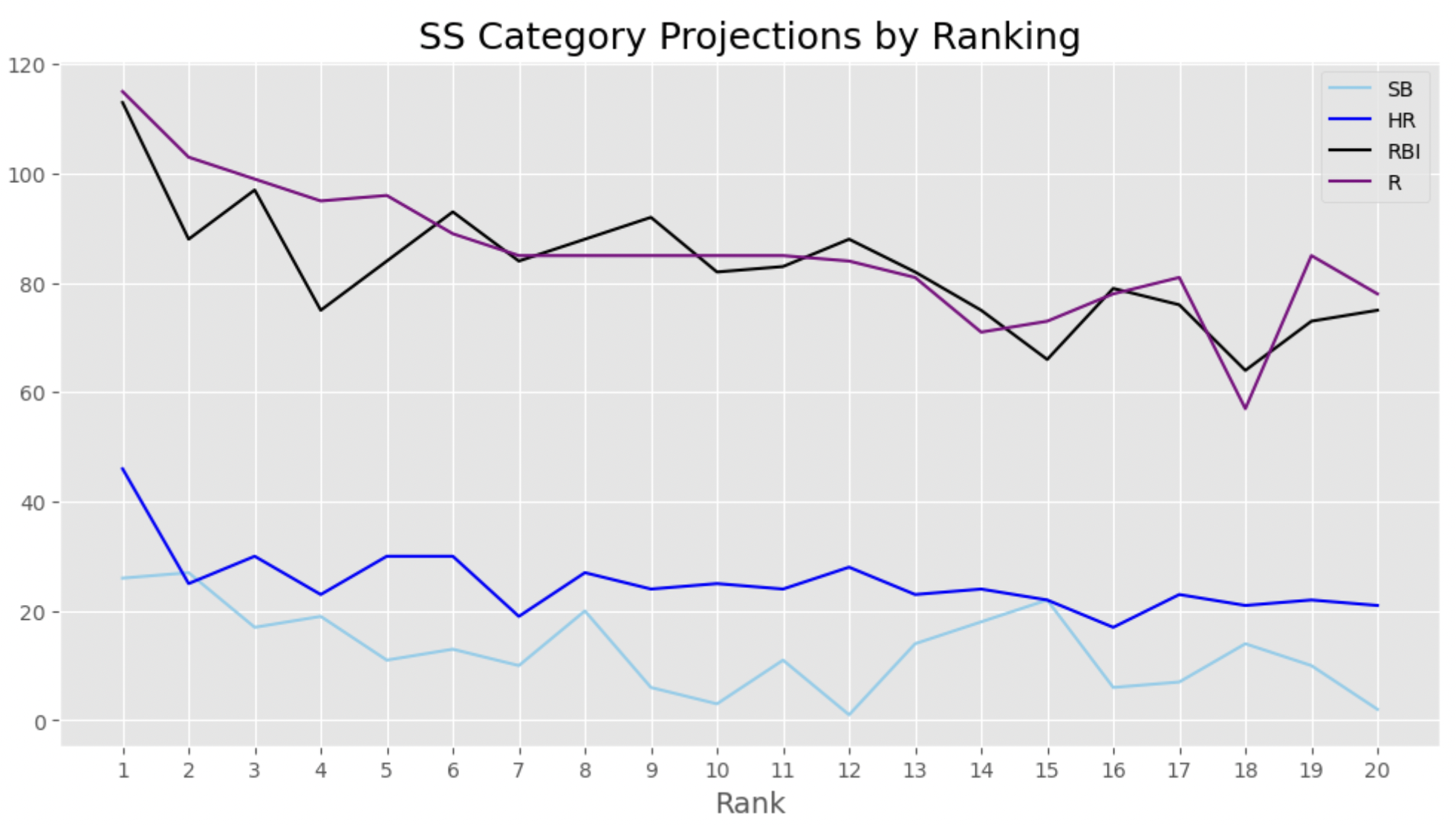


I created these ranks using the default settings of the auction calculator with steamer projections to sort by dollar value. Note that if you wish to do something similar, you should input the parameters of your league accordingly. The point of this exercise is to try to identify players who could be good pickups later in the draft. We so often see tables and spreadsheets and mark single statistics. But, it’s difficult for the human eye to take in all that information and process it. This visual is helpful because it shows us not how single stats like stolen bases decline across the ranks, but how all the counting stats vary across the ranks. For example, if you chose rank 8, you would get a nice little bump in projected (steamer) stolen bases with close to average HR, R, and maybe a little more RBI than some of the lower ranks. Who is this mysterious rank eight? Scroll down to the table to find out.

You, like me, may think, “I can wait for stolen bases. Shortstops seem to have a lot of them.” This visual proves that theory somewhat:
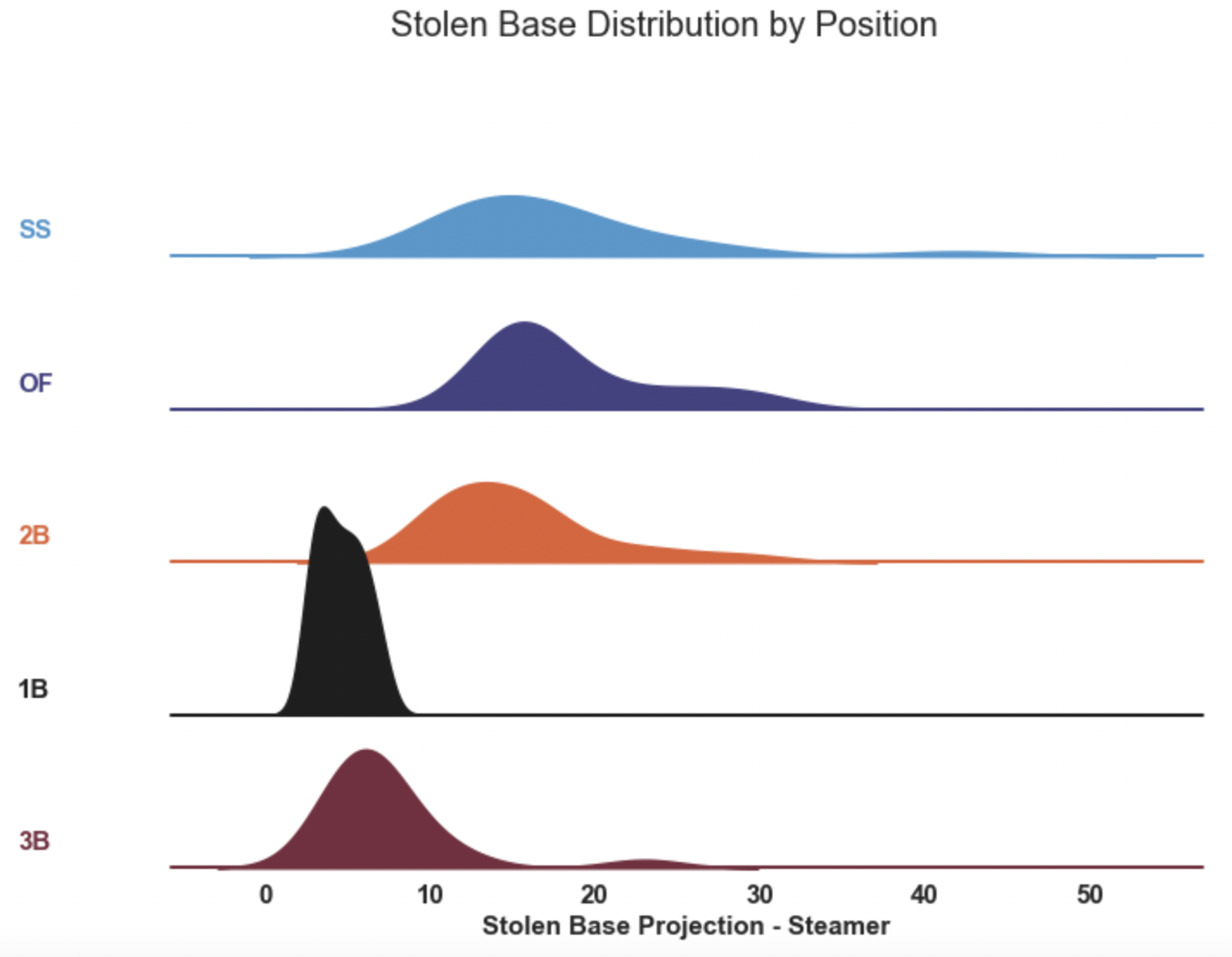
That long tail moving to the right of the shortstop (light blue) distribution shows us that we could potentially pick up a decent amount of steals with a late shortstop pick. However, rank 15 in the first visual shows how much you would sacrifice in projected runs and RBI if you were to employ that strategy. Who is this mysterious rank 15? Scroll down to the table to find out.

I’ve done some mock drafting this offseason using the Fantasy Pros draft simulator and I’ve found that if I don’t get stolen bases early because there are so many good hitters and pitchers that I take instead, I come out very SB-lite. I’ve also noticed that the simulator reaches for base stealers like Tommy Edman, Jazz Chisholm Jr., Akil Baddoo, and Tim Anderson much earlier than I would expect. That’s likely to happen in my actual draft as well. There’s nothing worse than finishing a draft and being really excited about your team and then realizing that you are depleted in a single category, especially if you don’t want to employ a punt strategy. Hopefully, these visuals and a few mock drafts will help you identify optimal draft positions for certain categories. I’m happy to do this same exercise for another position, but only if you’re nice to me in the comments section.

Shortstop Ranks
Rank PlayerName POS ADP PA HR RBI R SB Dollars
1 Fernando Tatis Jr. SS/OF 1.8 677 46 113 115 26 $43.80
2 Trea Turner 2B/SS 2.0 681 25 88 103 27 $31.10
3 Bo Bichette SS 5.4 668 30 97 99 17 $29.70
4 Tim Anderson SS 34.9 692 23 75 95 19 $21.50
5 Marcus Semien 2B/SS 31.8 681 30 84 96 11 $17.10
6 Francisco Lindor SS 48.7 667 30 93 89 13 $16.90
7 Wander Franco SS 53.5 651 19 84 85 10 $16.20
8 Trevor Story SS 41.0 655 27 88 85 20 $16.10
9 Xander Bogaerts SS 42.8 649 24 92 85 6 $15.50
10 Corey Seager SS 72.1 596 25 82 85 3 $14.80
11 Jorge Polanco 2B/SS 79.3 654 24 83 85 11 $14.30
12 Carlos Correa SS 91.8 621 28 88 84 1 $14.20
13 Gleyber Torres SS 149.6 632 23 82 81 14 $14.10
14 Robert Witt SS 90.9 545 24 75 71 18 $12.80
15 Jazz Chisholm Jr. 2B/SS 79.2 568 22 66 73 22 $8.20
16 Jake Cronenworth 1B/2B/SS 111.9 644 17 79 78 6 $7.60
17 Willy Adames SS 133.8 628 23 76 81 7 $7.40
18 Oneil Cruz SS 224.2 457 21 64 57 14 $7.00
19 Dansby Swanson SS 123.1 665 22 73 85 10 $6.60
20 Brendan Rodgers 2B/SS 152.1 586 21 75 78 2 $5.00
*Values from auction calculator (default settings)

Nicklaus Gaut’s 2022 1B Rankings

Draft season is getting in full swing so let’s start going around the field. Below are the first run of my first base rankings, split into tiers and including my projections for the classic categories. But also, let’s be real; we barely know each other and I doubt you’ll be blindly trusting my numbers. However, they form the basis of the dollar values that I base my ranks on, so I might as well include them.

Given a (proper) level of projection hesitancy, I’ll also be comparing my numbers to some of the reputable projection systems that you know and love, in spots where our gaps of disagreement are larger.  Not as a critique of them, mind you, but just to add context. But really, I think this is just the most efficient way to give everyone plenty of ammunition to roast me with later. Read the rest of this entry »


Shortstop Facts For The 2022 Season

The shortstop position used to be shallow years ago but has now become a position with a good amount of depth. In fact, the two players being drafted as the top two picks are shortstops (Turner/Tatis). The shortstop position packs a punch in terms of speed making them popular early picks.

Read the rest of this entry »


2022 Positive BABIP Regression Candidates

Last week I pointed to the great research done before me that shows that a player’s BABIP is likely to regress to their previous 3-year average. What’s the point of doing this before drafting? Well, it allows you to see players who may be over or undervalued. In the case of last week’s post, you can find players who may have gotten lucky and will likely do a little worse, hit-wise, in 2022. For example, last week’s analysis showed that Starling Marte, Brandon Crawford, and Kevin Kiermaier topped the list, in that order, of hitters who outperformed their 3-year (2017-2019) BABIP in 2021. Furthermore, I performed a cluster analysis that tried to explain just how these players overperformed. That allowed us to figure out if there was a skill change or not. Let’s do the same thing for players who underperformed in 2021.

Read the rest of this entry »


Third Base Facts For The 2022 Season

The third base position seems to be the shallowest position of them all for 2022 (besides catcher which is always the most shallow). After consistent players Jose Ramirez, Rafael Devers, Manny Machado, and Austin Riley there seems to be a cliff where the third basemen left over, all have question marks. In my opinion, grabbing a third baseman early in drafts seems pertinent to having success for 2022.

Read the rest of this entry »


Nicklaus Gaut’s 2022 Reliever Ranks

There are a myriad of differences between valuing players and general drafting strategy for a 15-team (or deeper) league versus a 12-team (or shallower) league but I believe the starkest ones lie at reliever. Since this makes doing ‘one-size fits all” rankings particularly difficult, here are a few notes about how I approached them. Read the rest of this entry »


2022 Negative BABIP Regression Candidates

Work done by Voros McCracken has shown that a batter’s previous 3-year BABIP is a good predictor for next year’s BABIP, it is known. Here’s a quote from our own glossary:

..changes in BABIP are to be met with caution. If a batter has consistently produced a .310 BABIP and all of a sudden starts a season with a .370 BABIP, you can likely identify this as an instance in which the batter has been lucky unless there has been a significant change in their style of play.


Read the rest of this entry »


Power Options in the Back Half

After moving from the happy-fun ball era to the great deadening of 2021, it’s hard to know how bouncy the ball will be in 2022. Particularly after MLB admitted to using two different kinds of balls in 2021 due to production delays. But I’d bet the old, fun times aren’t coming back and consequentially don’t want to depend on finding power just laying around in the back part of drafts.

With that in mind, and using a 200 ADP in recent NFBC drafts as our cutoff, let’s look at a few players who could be valuable wells of power in 2022. Here are a few common terms:

Barrel% (from BaseballSavant): “to be Barrelled, a batted ball requires an exit velocity of at least 98 mph. At that speed, balls struck with a launch angle between 26-30 degrees always garner Barreled classification. For every mph over 98, the range of launch angles expands.”

Air% (average EV): The average exit velocity balls hit in the air (fly balls + line drives)

Air% (100+ mph): Percentage of balls hit in the air with a minimum exit velocity of 100 mph.

Barrel% (100+ mph): Percentage of barrels with a minimum exit velocity of 100 mph. Not all barrels are created equal and while there are many great ways to chop them up, I’m not as bright as Alex so I also check in on this simple distinction.

Read the rest of this entry »


Second Base Facts For The 2022 Season

The second base position does have some depth to it, it isn’t the shallowest nor the deepest position for fantasy in 2022. There are a lot of interesting names coming into the season especially when it comes to young players like Jonathan India and Jazz Chisholm. Whether you decide to grab one earl or late here are some fun facts and opinions I gathered while preparing for drafts.

Read the rest of this entry »


K% Gains: Trend, Outlier, Or To Be Expected?

Those who have been smart enough to pick up a copy of the 2021 Baseball HQ Forecaster (and likely posted a picture of it to their Twitter) have already read through the “Other Diamonds” portion of the text. It’s my favorite part. In it, there is a section called Paradoxes and Conundrums and it states that a player’s year to year improvements can be labeled as, “a point in a growth trend, an isolated outlier or a complete anomaly…” I loved that line when I read it. But, so much strange happened in 2020 and I think it should have some say. In this post, I’ll go over three pitchers who increased their K% from 2020 to 2021 but whose gains might be skewed by the 2020 season. Two of these pitchers really just rose back up to where they were in 2019. An increase in K% is wonderful but is it a trend, an outlier, or, to incorporate my own twist, to be expected?

Read the rest of this entry »

