Archive for Hitters

Ottoneu: Prospect Hitters That Might Be Worth Rostering for 2024

Rostering minor leaguers in any Ottoneu format is super fun. It’s fun because you get to take a chance on a player. Build your roster now in order to plan for the future. Isn’t that what so many real-world teams are doing? Yet, it can be cumbersome to hold onto a player for a few years while paying them a $1 or more in salary when you really don’t know when and even if they will pan out.

A few months ago, I was up against this very challenge. Rostering Jack Leiter was exciting. He was a college pitcher with a lot of hype and talent and now a minor leaguer who has held onto both of those traits. But, I needed to try and quantify how much he would be worth in a few years. His MLB ETA isn’t until this season and likely the end of this season. Looking for a range of reasonable salary expectations, I used ZiPs’ 2024 and 2025 projections to get a sense of how to value Leiter in a few years. My analysis concluded that Leiter would likely only return somewhere around $4 in 2023 and that’s if he meets the higher end of likely outcomes. I was paying $6, too much for this year, so I cut him.

Rostering Leiter at $6 doesn’t make sense for 2023. But now that he is back on the waiver wire, should I attempt to re-roster him for $1? In order for that to make sense, two things need to happen. First, he needs to return over $1 of value in 2023. Second, he needs to return over $1 of value in 2024 and pass through arbitration untouched at the end of the 2023 season. Only then is he worth selecting for a $1. In this analysis, I’ll look at the players who are most likely to pass through those qualifiers. Choo! Choo! All aboard the hypothetical train! Here’s a map of our journey:

Step 1: Take a deep breath. A lot of assumptions are going to be made here. This is not an exact science. Please, do not rush to your player page and start auctioning off these players at these exact prices. Use these values as a jumping-off point.

Step 2: Grab a pool of minor league players who have not yet debuted from “The Board” with a Future FV value greater than or equal to 30 and subset it down to players with a “Current Level” not equal to “MLB”.

Step 3: Download ZiPs 2024 projections for the players in Step 2 and calculate their Ottoneu FanGraphs points totals based on those projections.

Step 4: Add those players into the auction calculator’s outputs, sort by rPTS, and see what the value is for players in that same rPTS area. Keep in mind, player value is altered by positional adjustments.

This process ultimately tells us what these players’ auction value could be if they play to their full zips projections in 2024 and the league looks identical to this season’s (2023) player pool. It tells us how much they should be valued for next year.

Out of the 271 prospects I downloaded from the board, 242 had a “Current Level” other than MLB. Of those 242, only 60 have been projected by ZiPs for 2024. Of those 60, only 15 (but number 1 on the list kind of doesn’t count) end up with a positive projected value in 2024. Here they are:

Projected Prospect Value for 2024
Name rPTS Pos aPOS Dollar Range
Masataka Yoshida 769.2 LF $20.33 $22-$26
Christian Encarnacion-Strand 749.0 3B $12.55 $18-20
Anthony Volpe 719.9 2B $15.03 $15-$16
Andy Pages 680.8 RF $20.33 $13-$15
Endy Rodriguez 633.2 C $24.10 $12-$14
Colton Cowser 650.6 LF $20.33 $11-$12
George Valera 640.4 RF $20.33 $9-$10
Noelvi Marte 656.7 3B $12.55 $5-$6
Michael Busch 655.3 DH $12.55 $5-$6
Matt Mervis 638.9 1B $14.73 $4-$5
Ceddanne Rafaela 609.9 CF $20.33 $4-$5
Elly De La Cruz 623.6 SS $14.55 $2-$3
Jordan Westburg 614.8 2B $15.03 $1-$2
Addison Barger 599.7 2B $15.03 $1-$2
Zac Veen 582.5 RF $20.33 $1-$2
*Ottoneu FanGraphs Points Leagues
**ZiPs projections

Now, it’s very, very possible that this process excluded some highly touted prospects. Hopefully, I was clear enough with my process that you can hypothesize as to why they were left out or replicate a version of this for yourself. This is not a top draftable prospects list. I repeat; This is not a top draftable prospects list. For example, where is Jordan Walker? Well, ZiPs doesn’t necessarily project Walker to be roster-able in 2024. Here’s where the Cardinals prospect stands in this process:

Jordan Walker Prospect Value Comps for 2024
Name rPTS Pos aPOS Dollar Range
Josh Lowe 539.1 OF $19.28 -$4.58
Jordan Walker 538.8 RF $19.28
Adam Duvall 537.6 OF $19.28 -$4.79
*Ottoneu FanGraphs Points Leagues
**ZiPs projections

Now, to see why Walker falls out of a roster-able projected salary, let’s look at his 2024 ZiPs projections compared to a couple players high on this list, Colton Cowser and Christian Encarnacion-Strand:

Prospect Comp by ZiPs
Name AB H 2B 3B HR BB HBP SB CS
Christian Encarnacion-Strand 523 136 28 4 29 34 9 4 1
Colton Cowser 525 124 27 1 16 66 14 8 3
Jordan Walker 491 117 26 3 14 39 7 11 3
*Ottoneu FanGraphs Points Leagues
**ZiPs projections

You can see why Cowser has more projected value in 2024, but you can also see how this system has some flaws. Walker has already been creating a lot of buzz in Spring Training and many might look at that 2024 projection and scoff. Projecting players who haven’t appeared in the MLB yet is hard. Time is money and if I had more of it, I would go about the valuation a little more scientifically. Rather than comparing rPTS and suggesting a value range, it would be interesting to iterate through runs of the auction calculator, each time removing the player the minor leaguer would be replacing and determining value from a more believable player pool. I think I’ve gotten close enough for now. Roster any of the players listed above for $1, make it through the end of the 2023 season arbitration without their salaries increasing, and you have a good chance at value in 2024.
2023 Projection Showdown — THE BAT X vs Steamer Hitter Projected $ Value, Part 2

Yesterday, I continued my 2023 projection showdown, pitting THE BAT/THE BAT X forecasts against Steamer projections in the various fantasy categories, by comparing fantasy value projections and identifying the hitters THE BAT X valued more highly. Let’s now turn to the hitters that Steamer values significantly more than THE BAT X.

Read the rest of this entry »


2023 Projection Showdown — THE BAT X vs Steamer Hitter Projected $ Value, Part 1

Over the last couple of weeks, I debuted and published the 2023 projection showdown, pitting THE BAT/THE BAT X forecasts against Steamer projections in the various fantasy categories. Now let’s combine everything we have reviewed and compare projected dollar value. Really, that’s all we care about as fantasy leaguers! Does THE BAT X think the player is more valuable than Steamer, or not?! So let’s now find out which hitters THE BAT X is projecting to earn a higher value than Steamer. These are the hitters THE BAT X believes to be undervalued, at least compared to someone using Steamer forecasts to draft.

Read the rest of this entry »


Who’s Been Unlucky–The Hitters

Join us now on our third and final sojourn among the players upon whom Fortune smiled or frowned in 2022, and whom He/She/It figures to treat differently in 2023. Our method is simple: We look  for players whose underlying stats are significantly better or worse than their overlying ones, and who therefore figure to do better (if unlucky) or worse (if lucky) than the market and/or the projection systems think they will. For hitters, we invert the approach we took in the two preceding installments for pitchers: the lucky guys are the ones whose BABIP and HR/FB% was high while their Hard-Hit Percentage was low, and the unlucky guys are the ones with a high HH% but low BABIP and HR/FB%. It’s simple, and it’s not infallible, but by and large it works.

Read the rest of this entry »


2023 Projection Showdown — THE BAT X vs Steamer wOBA Forecasts, Sleepers Part 2

Yesterday, I identified and discussed five hitters with an ADP of at least 300 who THE BAT X is more bullish on for wOBA than Steamer. You might call these hitters “sleepers”. Let’s now flip over to Steamer’s implied sleepers. I made a small change to my filters here, adding a maximum of 450 PAs, to go along with my 300 PA minimum. This was to remove some names that have appeared multiple times in these showdowns, as there’s no sense in discussing them yet again.

Read the rest of this entry »


2023 Projection Showdown — THE BAT X vs Steamer wOBA Forecasts, Part 2

Last week, I identified and discussed the hitters THE BAT X was most bullish on for wOBA compared with Steamer. While typically not a fantasy category, wOBA is still extremely important to pay attention to since it drives playing time and spot in the batting order, both of which fuel counting stats. So let’s now flip over to the hitters Steamer is more bullish on compared to THE BAT X.

Read the rest of this entry »


Launch Angles, Release Points and Hit Predictability

Through games played on June 23rd, 2022, Luis Arraez held the highest batting average in the MLB at .349. He was just ahead of Paul Goldschmidt (.340), who was in the midst of putting together a career year, and Xander Bogaerts (.335), who was just being Xander Bogaerts. So, if you had chosen a player that you thought was most likely to get a hit the following day, June 24th, any of those three players would have been a safe bet. But, it’s just not that simple, is it? Goldschmidt played the next day but went 0-4. Arraez played and went 0-4. Bogaerts didn’t play. And that really is the challenge in trying to predict something like who will get a hit each day. That’s why there remains a $5.6 Million jackpot on the line.

I’ve written about my ventures in using analytics and a predictive model (Jolt) to help with daily batter hit predictions while playing in the Beat the Streak contest. You can learn more about the contest here, you can listen to a podcast about it during the season and you can sign up to the play game yourself! I won’t write much about the specifics of the contest, but it is the motivation for this research. The general idea is that you choose a player each day that you think will get a hit, if he does, you get a point, if he doesn’t, you go back down to zero. The goal is to reach 56. But, strip away the millions, strip away any contest or fantasy-style game, and what we’re left with is the question of how to best predict the next day’s hitters.

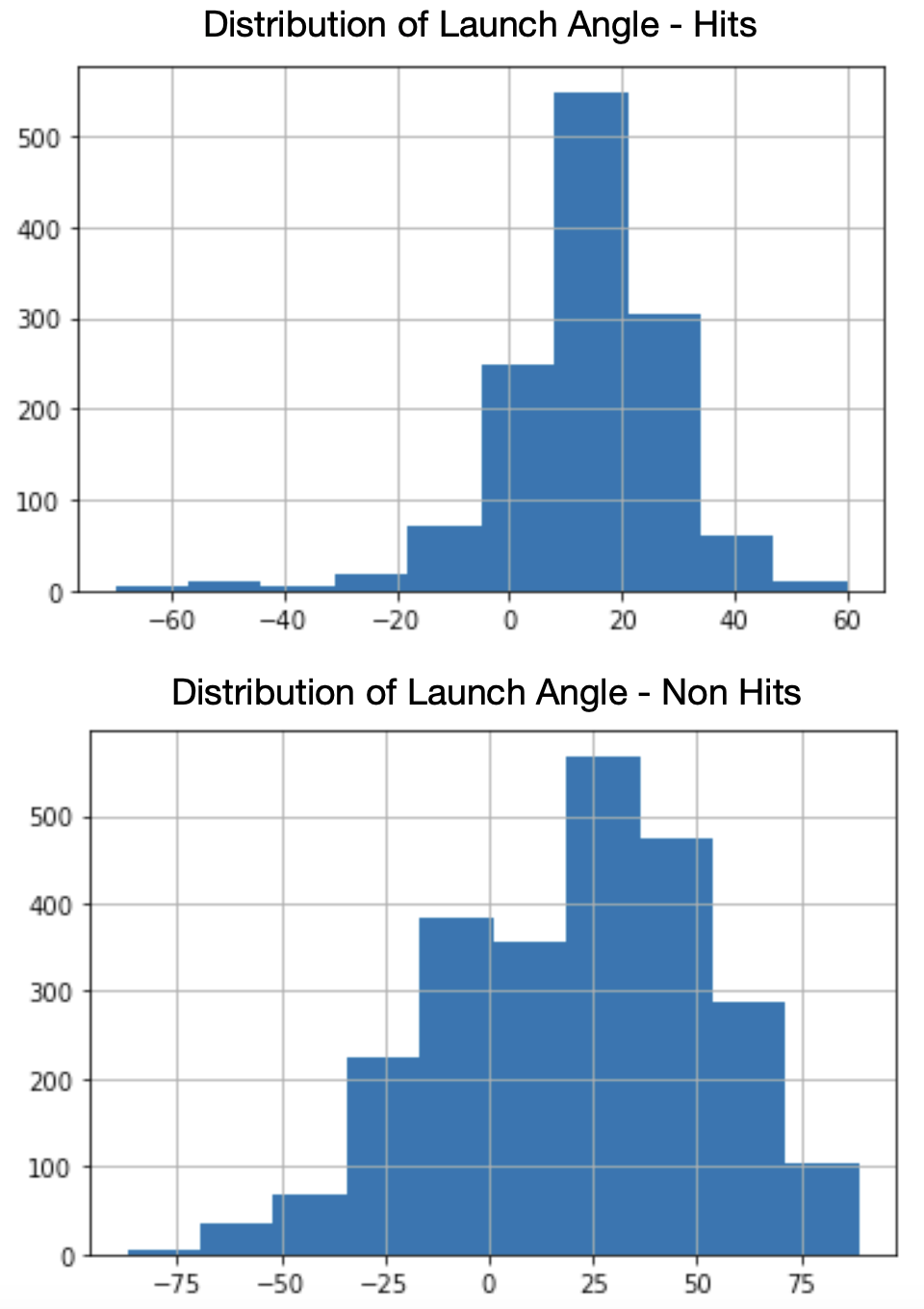
Jolt, the name of the model I’ve built to aid in making this prediction and a tribute to “Joltin” Joe DiMaggio, was built on the concept that the launch angle and launch speed of the hitter matter tremendously. Since we know that certain launch angles are more likely to lead to a hit and that balls hit hard also add to that likelihood, we can look for players who do that type of thing often. To show this in a visualization I randomly sampled a few days’ worth of savant batted ball data for each month of the 2022 season, sub-set that data down to only looking at batted balls from four-seam fastballs, and looked at the distribution of hits versus non-hits:

Launch Angle Distributions - Hits vs. Non-Hits

In this sample of data, batted balls (this does include home runs) ended in hits much more often with launch angles between, roughly, 10 and 20 degrees and that is something we have known for a while now. Balls launched at these angles have a much higher likelihood of being line drives and therefore, more difficult for fielders to get to. Let’s use this information and go back to June 24th. Through games played on the 23rd, there were eight hitters right in that solid average launch angle of 18 degrees bin. Here they are along with their up until that point batting average and June 24th results:

Hit Results 6/24/22, Mid Average LA
Name LA AVG 6/24/22
Mike Yastrzemski 18.8 0.250 1-4
Will Smith 18.8 0.256 2-5
Justin Turner 18.8 0.220 0-4
Ha-Seong Kim 18.8 0.226 1-3
Christian Walker 18.5 0.208 1-4
Cedric Mullins II 18.4 0.248 1-4
Marcus Semien 18.2 0.228 2-5
Mookie Betts 18.1 0.273 0-0
*Among qualified hitters with a 18 degree average launch angle through 6/23/22

Yahtzee! Is it really that easy? Just pick the hitter who has been to the plate a lot and has a level, hit-falling average launch angle? You might think this is basically the same as selecting line-drive hitters, but it’s not. At least, those two measurements aren’t showing the same hitters. Only Will Smith found himself in both the group of players above and in the top 20 qualified hitters by line-drive percentage. The funniest part about this sample of hitters is that the hitter with the highest batting average, Mookie Betts, is one of only two players to not get a hit the following day. This is random of course. But, just for kicks, let’s do it with hitters who had been putting the ball on the ground (5 degrees) too much through June 23rd and look at how they did on the 24th:

Hit Results 6/24/22, Low Average LA
Name LA AVG 6/24/22
Yandy Díaz 5.1 0.263 0-4
Nicky Lopez 5.1 0.217
Vladimir Guerrero Jr. 5.3 0.264 2-5
Miguel Cabrera 5.7 0.299 1-4
Juan Soto 5.8 0.214 1-4
*Among qualified hitters with a 5 degree average launch angle through 6/23/22

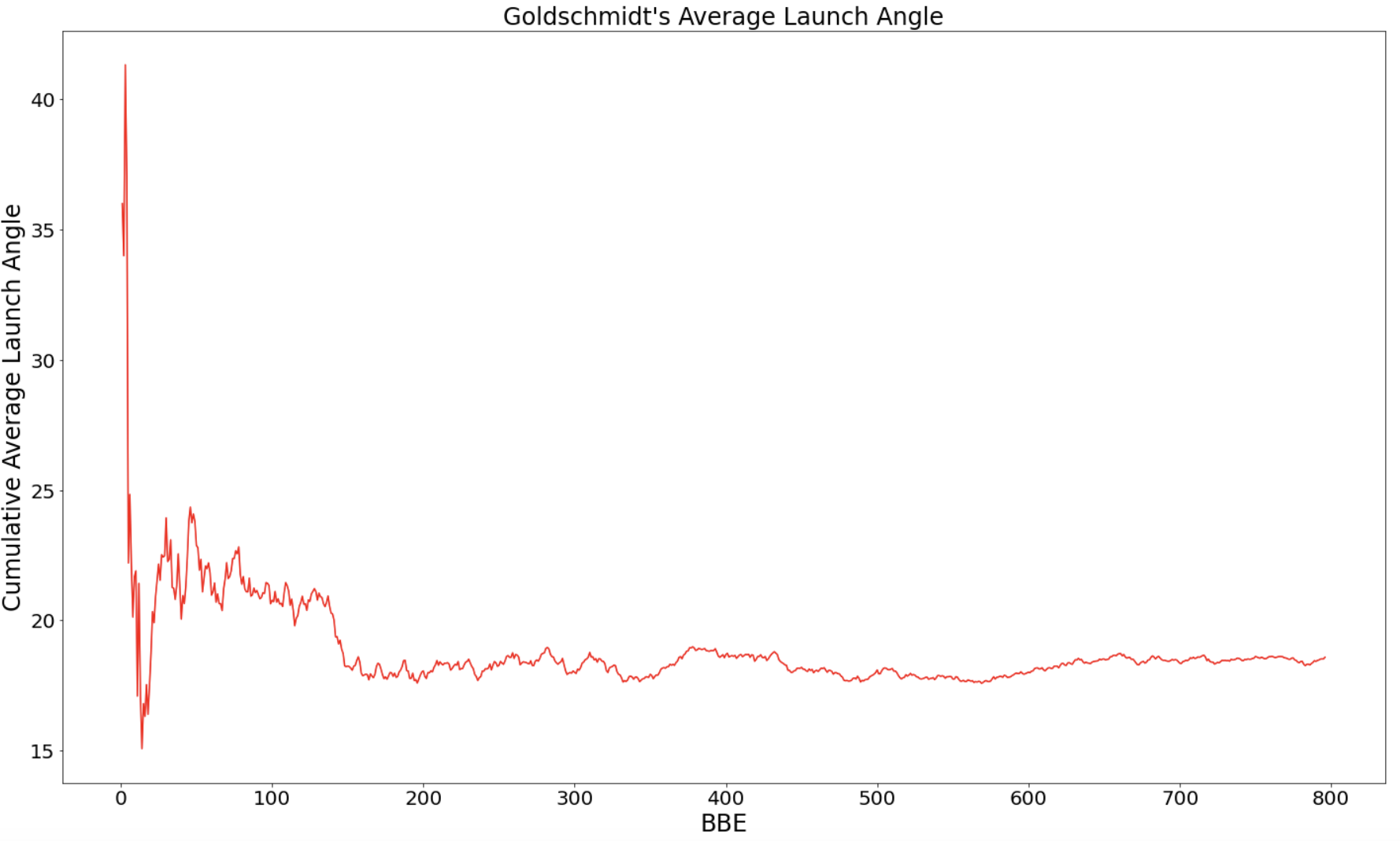
Ok, theory killed? Clearly you can see from the histograms that while a launch angle in the 10 to 20 range falls for a hit more often, there are a lot of other launch angles that fall for hits too. Those same launch angles don’t fall for hits as well. While finding players who have a tight launch angle, Alex Chamberlain style, would be a good strategy, you would likely find yourself choosing the same handful of hitters every day, thus limiting your player pool. Just look at Paul Goldschmidt’s 2022 cumulative average launch angle:

Goldschmidt Cumulative LA

It becomes fairly stable around BBE number 200. Choosing Goldy every day would have been a good strategy in 2022, but for obvious reasons wouldn’t allow you to string together 56 consecutive hits and that’s the name of the game. It would also fail to take into consideration who was throwing the ball, which is arguably 50% (but probably more) of the equation. Jolt’s first iteration sought to find players with good launch angles matching good release points. The thinking was that high release points translate to higher approach angles and that uppercut swings bring the bat through the zone on those particular pitches longer. It’s not a new concept in baseball. Ted Williams’ 1986 book, The Science of Hitting, detailed some of this thinking.

It was even backed up by the model’s validation. Jolt, iteration one, found ‘release_pos_z’, or the “vertical release position of the ball measured in feet from the catcher’s perspective” according to baseball savant, as the fifth most important variable in predicting a hit out of all of statcast’s outputs. Unfortunately, this is much, much more descriptive than it is predictive. A trained model will say that the launch angle of a batted ball and the release point of the pitch help “predict” whether the ball falls for a hit or not. While a release point, especially if you isolate to single pitch like just a fastball, can be predicted, you can’t really predict at which angle the ball will be hit before the batter swings. Here’s an example:

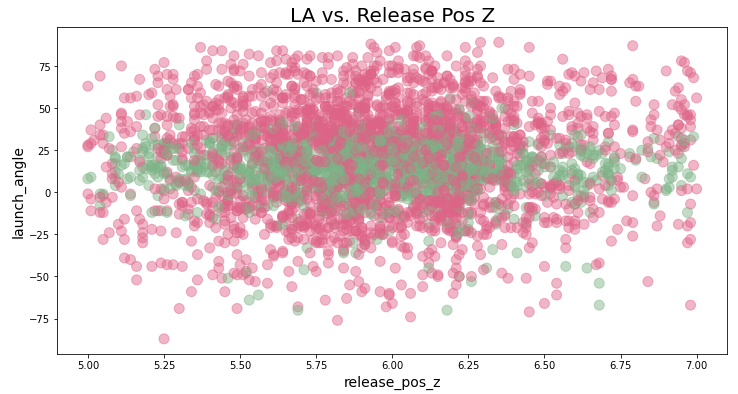
Release Pos Z vs. LA Scatter Plot

In this image, green represents hits in the data and red represents non-hits. The green band going across the chart tells us just how important the launch angle is, but it doesn’t have a relationship with the release point of the pitch. Any of these release points can match up with any of these launch angles and fall for a hit. It is uncommon for any launch angle above ~70 degrees to fall for a hit, but there may be a few outliers in there. Regardless, matching up a pitcher’s release point with a batter’s launch angle doesn’t seem to provide much detail when analyzing this data. Most of us would completely disagree with the data in this case, but it doesn’t mean that hitters are actively upper-cut swinging on high-released fastballs because I would imagine, that’s friggin’ impossible to do. But maybe it naturally happens? Maybe looking at it from a vertical approach angle (VAA), the angle of the ball as it crosses into the zone, is the better…um…approach? Let’s see:

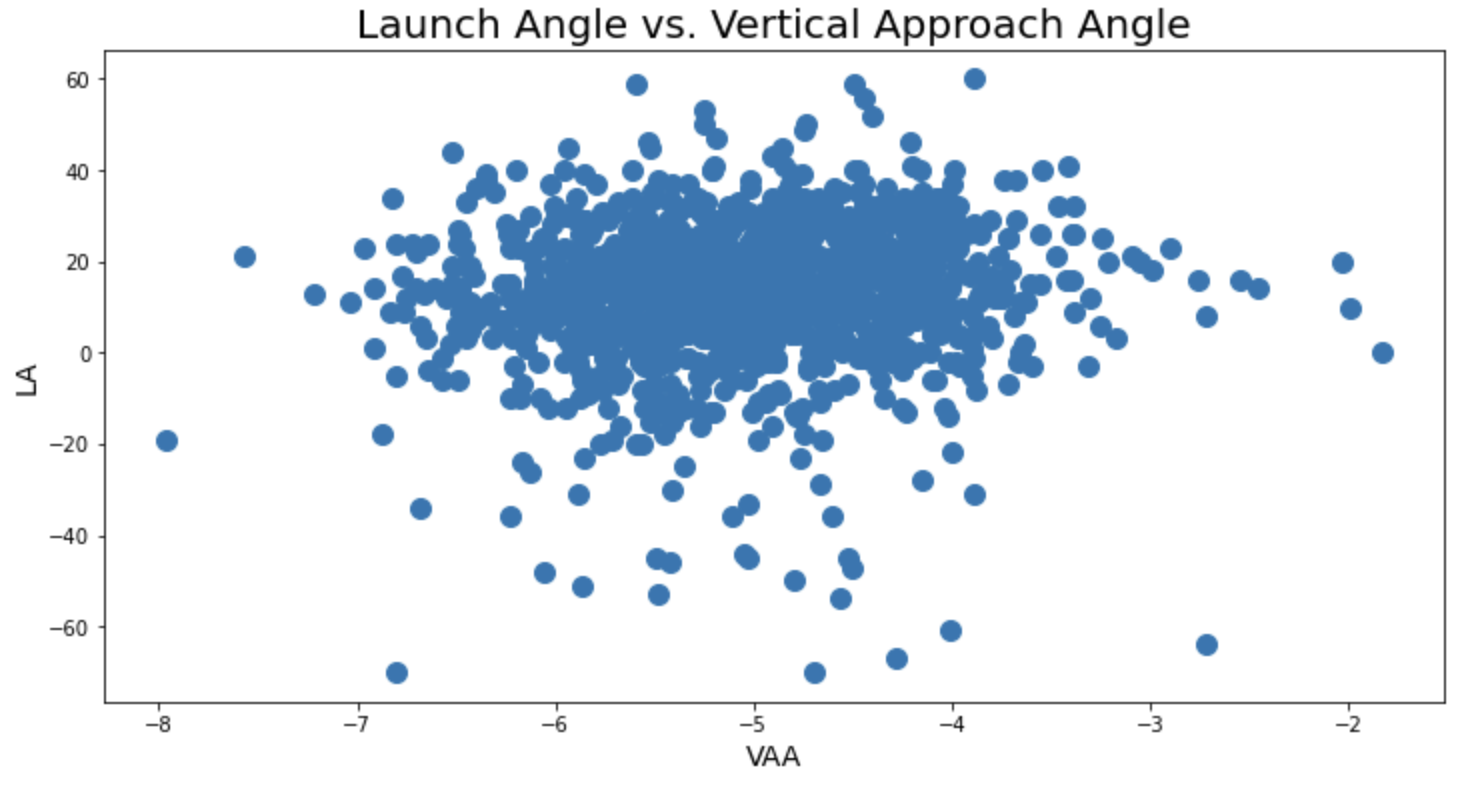
LA vs VAA (FA)

This graph would tell you that besides the outliers, all VAAs can be hit with all LAs. Again, there is a HUGE discrepency between what we computer baseball nerds see and read and think and what a hitter actually does. If there are any hitters out there who know that tomorrow’s starting pitcher has a very steep vertical approach angle, are they altering their swing or approach to match it? Um…I’ll guess…no. It’s hard enough for them to decide to swing or take. But there must be somethign I’m missing. The launch angle in which a ball that falls for a hit is struck may not necessarily relate to how high the pitcher is releasing the ball, but certainly, some swing types are better against those pitches than others. But what is measuring that? What is measuring the actual swing? There have been some attempts made like the data collected by Swing Graphs, but nothing that I’ve seen is freely available to the public.

A model, whether it has a good R-squared, average-squared error, misclassification rate, or get-a-lot-of-likes-on-twitter rate, doesn’t do a good job of telling us whether a certain launch angle will be more successful against a certain vertical approach angle because it’s just too random and there’s too much noise. It’s also too difficult to create that data before it happens in order to make predictions on it. But, Jolt simply won’t quit. Iterations continue and there remains work to be done to better model tomorrow’s hit likelihood. In fact, MLB does it for its Beat the Streak app. But, no one has found success in just picking the top-recommended hitter each day, have they? Of course, I’m not implying that a model will be the only way to win this contest, in fact, I don’t think one single person will ever be able to win this contest. However, sometimes a simple model coupled with logical thinking and sound judgment is best. Jolt’s next attempt will focus on that. Just look at the table of June 24th’s outcomes at the top of this page and you’ll see, there’s something to just choosing who is hot each day and who works well against the guy standing on the mound.


2023 Projection Showdown — THE BAT X vs Steamer wOBA Forecasts, Part 1

I’ve finished the fantasy stat comparisons of the 2023 projection showdown between THE BAT X and Steamer on the hitting side, so now let’s flip to wOBA. Why does wOBA matter if it’s typically not a fantasy category? Because it influences both playing time and lineup spot. It doesn’t matter if a hitter produces the nice mix of home runs and stolen bases that fantasy owners drool over if that same hitter is struggling to keep his wOBA over .300. A poor wOBA could result in a drop in the batting order, which would reduce the hitter’s counting stats, and/or a spot firmly on the bench or even a demotion to the minors. On the other hand, a strong wOBA, especially one that’s beating expectations, could trigger a move to a better lineup spot, increasing counting stats, or increase playing time if the players wasn’t a full-timer at the moment. So wOBA definitely matters…a lot! Let’s begin by identifying the hitters THE BAT X is more bullish on for wOBA than Steamer.

Read the rest of this entry »


2023 Projection Showdown — THE BAT X vs Steamer Runs Scored Forecasts, Part 2

Yesterday, I listed and discussed six hitters who THE BAT X was significantly more bullish on for runs scored than Steamer. Let’s now find out who Steamer’s runs scored favorites are compared to THE BAT X.

Read the rest of this entry »


2023 Projection Showdown — THE BAT X vs Steamer Runs Scored Forecasts, Part 1

Let’s continue rolling on with the 2023 projection showdown, pitting THE BAT X against Steamer in the various fantasy categories and discussing the players each system is more bullish on. Today, we shift over to runs scored (R) and follow the same 650 plate appearance pace calculation I’ve been using. Batting order position plays a huge role here, as the higher up in the lineup, the more plate appearances a hitter will receive, providing more opportunities to score runs. But of course, we’re keeping PAs constant, so batting order doesn’t play that role here. Instead, since all the best hitters are typically in the top five spots, being ahead of the stronger hitters makes it more likely you’ll be knocked in after reaching base. Obviously, home run power also increases runs scored as it’s a guaranteed run. So lineup spot and power are two major factors in runs scored, plus OBP, for obvious reasons. Let’s find out who THE BAT X is most bullish on in runs scored versus Steamer. You might see some familiar names THE BAT X has been bullish on in other categories too, which makes sense given that if a system is more bullish on overall performance, it’s likely that results in higher counting stats across the board.

Read the rest of this entry »