Luis Valbuena & Guillermo Heredia: Deep League Wire
May 3, 2017
This is an interesting pair of recommendations, as an established vet shares the same low ownership as a younger, relatively unknown quantity.

This is an interesting pair of recommendations, as an established vet shares the same low ownership as a younger, relatively unknown quantity.
It’s time to understand how ownership trends are playing out this year. I will start by breaking down one of the most common fantasy sites, ESPN. I will go over the batter ownership rates for different league sizes so owners know which players are applicable to them. Additionally, I will find the current replacement level player for each position.
With fantasy experts using ownership rates to help find potential waiver targets, it is important to know each league’s ownership level. Historically, I know I should only worry about players owned in 10% of leagues or less but not everyone plays in 15-team or deeper leagues.

It’s a well-established fact that AT&T Park is one of the worst ballparks in the major leagues for offense. That’s why, despite putting up a 132 wRC+ over his last 1,500 or so plate appearances, Brandon Belt is not a very valuable fantasy first baseman. It’s also why Buster Posey, a catcher with a career 136 wRC+, has never really been worthy of a top-10 pick on fantasy draft day.
In recent years, however, a new and troubling trend has emerged for the Giants offense. While the league has been on an historic home run tear the last year and a half or so, the Giants have not kept up. In fact, they’ve done the opposite: they’re hitting more ground balls (and fewer fly balls) than just about any other team in baseball.
Ground balls are almost always worse than fly balls, even for a team that plays in a cavernous ballpark like the Giants. Since 2014, Giants hitters have a .245 AVG, .263 SLG, .223 wOBA, and 45 wRC+ on ground balls at home. On their fly balls at home, however, they have a .226 AVG, .598 SLG, .332 wOBA, and 119 wRC+ since 2014.
While the team batting average is actually higher on ground balls, the slugging percentage, wOBA, and wRC+ are so, so much worse. This is strong evidence to the effect that even a team that plays in an extreme pitcher’s park is not better off hitting ground balls — flies seem to be indisputably better no matter what. Read the rest of this entry »
Yesterday, I discussed 10 hitters whose FB% has increased the most compared to last year. So now let’s check in on the other end of the list — the hitters whose FB% has declined the most versus last season. These hitters may be in danger of disappointing in the home run department.
With the availability of Statcast data from the past couple of years, all we hear about now is exit velocities and launch angles. Armed with new data, players are adjusting and learning to become the best versions of themselves. We keep hearing about hitters that are increasing their launch angles, which is just a fancy way of saying they are hitting more fly balls. More fly balls usually results is more home runs. And home runs are good. The league fly ball rate currently sits at its highest mark since 2011, but since the HR/FB rate is at a historical high tied with last year, home runs are flying out like never before.
I am working on a deeper dive into Eric Thames, but he left Wednesday’s game with an apparent injury so I wanted to table it just to see where he’s at because it dive into his value on the trade market and what you should hold out for if you’re looking to sell him. With that said, he won’t be included here. I’ve got five other hot hitters both young and old who are doing big things thus far. Let’s examine what – if anything – is different and then I’ll let you know if I think it’s sustainable and to what level.
Chase Headley | New York Yankees | .339/.431/.565 with 3 HR, 3 SB, 7 RBI, and 14 R in 72 PA
It’s time once again to dive into the free agent pool to uncover some hidden gems.
At the time of this writing, there are 37 major league hitters with a wRC+ of 150 or higher. There are the usual suspects: Bryce Harper, Mike Trout, and Nolan Arenado are on the leaderboard to no one’s surprise. There are exciting young prospects, including Mitch Haniger, Aaron Judge, and Joey Gallo. Then there are unexpected names like Eric Thames, Cesar Hernandez, and Robbie Grossman.
Lengthy articles could be, and have been, written about any of the players above. One player who hasn’t received much publicity despite some relatively prolonged success is Grossman.
He checks in with a 158 wRC+ in 67 plate appearances so far this year. Steamer projects a .322 wOBA and 99 wRC+ for the rest of the season (ROS), and that projection puts him just a few ticks behind his highly-touted teammate Max Kepler. Although Kepler is three years younger and may have a higher ceiling, the point is that name recognition can play a pretty big role in how we analyze players.
Also, Grossman used to be bad. From 2013 to 2015, he had just a .281 wOBA and 77 wRC+ in 202 plate appearances against left-handed pitching, despite being a switch hitter. Since 2016, however, Grossman has a .417 wOBA and 166 wRC+ in 170 plate appearances against lefties. Even with his early-career struggles against lefties, Grossman now has a lifetime .344 wOBA and 118 wRC+ against them. Read the rest of this entry »
Earlier this year, I developed the newest incarnation of my xHR/FB ratio, this time taking advantage of the Splits Leaderboard sent from the heavens. When researching the components of the equation, I calculated a 0.229 correlation between Fly Ball Pull% and HR/FB rate. That’s no surprise, as most batters have far greater pull power than power to any other part of the field. So then it follows that a batter who suddenly pulls their fly balls at a significantly higher rate could enjoy a power breakout. Let’s take a gander at the fantasy relevant hitters that have seen the largest gains in Fly Ball Pull% versus last year.
32 Eugenios.
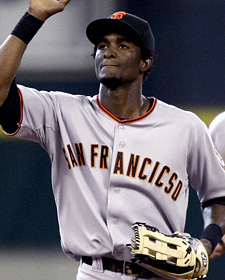
According to Wikipedia, there are 32 notable athletes with the first name Eugenio. Among them are the likes of retired handballer Eugenio Serrano, and the luchador Eugenio “Konan Big” Torres Villarreal. There’s even a baseball player on there, Eugenio Velez! You might remember Velez as the guy who wore the “SAN FRANCICSO” jersey, or for being the MLB record-holder for most consecutive at-bats without a hit (46).
You know who’s *not* one of The 32 Eugenios? Eugenio Suarez, that’s who! As if this wasn’t enough of a crime already, one of The 32 is named Eugenio Suarez Santos, a low-level Spanish footballer. It’s like the Wikipedia curator (is that a thing) for #The32Eugenios — an undoubtedly high-level position within the internal Wikiheirarchy — decided that one Eugenio Suarez was enough for this list, and went with the soccer player whose most notable achievement was a season-long scoreless streak that coincided with his team’s relegation to the Spanish third division.
Meanwhile, Cincinnati Reds third baseman Eugenio Suarez — almost definitely motivated by his Wikipedia snub — is making his case to be the best Eugenio of them all. While we’re still in small-sample land, we’re not quite in teeny-tiny-sampleville anymore, and Suarez looks like he may be in the midst of a breakout.