Archive for Featured

The Sleeper and the Bust Episode: 768 – Potential March Surgers with Dusty Wagner

01/17/19

The latest episode of “The Sleeper and the Bust” is live. Support the show by subscribing to Fangraphs! With a standard $20 membership, you help maintain and improve our database of stats and graphs as well as our staff of 8 full-time employees and over 50 contributors. The premium ad-free membership at $50 year supports site growth and also includes faster load speeds and better site performance. You can also support monthly for just $3.

Follow us on Twitter

10 PLAYERS WHO COULD SURGE IN MARCH DRAFTS

Current Price is January 1st-17th Draft Champions ADP

Read the rest of this entry »


Mining the News (1/17/20)

I’m finally able to mine a few useful bits of information with players, coaches, and owners talking at Fan Fests and caravans.

Maikel Franco played through a hand bruise last season. When I collected information on players who played through an injury, he didn’t come up. The injury happened in early August and initially, his production suffered (.572 OPS). It bounced back in September (.703 OPS) hopefully meaning it’s not major.

Brandon Nimmo is another hitter I missed who played through an injury.

Dragging down the above numbers is Nimmo’s performance last April and May, when he played through a bulging disk in his neck.

• Also, while investigating all the hitters who played through an injury, I found this nugget on Matt Carpenter from 2017.

Carpenter sat out the Cardinals’ final three games and underwent a follow-up MRI to the one he had a month ago. The exam showed the same thing now that the doctors knew then, which is that Carpenter is dealing with inflammation and not a structural issue.

Since then, he has missed a considerable amount of time with back injuries. I just can’t pay for any kind of rebound with what seems to be a chronic injury.

Read the rest of this entry »


The Sleeper and the Bust Episode: 767 – Fireside Chat: Nick Assesses Paul’s Rankings

01/16/19

The latest episode of “The Sleeper and the Bust” is live. Support the show by subscribing to Fangraphs! With a standard $20 membership, you help maintain and improve our database of stats and graphs as well as our staff of 8 full-time employees and over 50 contributors. The premium ad-free membership at $50 year supports site growth and also includes faster load speeds and better site performance. You can also support monthly for just $3.

Follow us on Twitter

NOTABLE TRANSACTIONS/INJURIES/RUMORS

Read the rest of this entry »


Should I Care About Sprint Speed?

Sprint Speed values have been publicly available for a few seasons. While I see it mentioned for this or that, I don’t know how predictive it is or if should I care about it at all. After analyzing the data, Sprint Speed might need to be ignored in favor of Time-to-First. The stopwatch still rules.

The key, in my opinion, is if the ability to run fast can be predictive in any way. No one that I know of is playing in a Sprint Score league, so the speed with have a secondary effect. If a player is running slower, do their stolen bases drop? How about how many infield hits they can leg out? Generally, how will the players change in speed affect their stolen bases and batting average.

One factor to keep in mind is that the aging curve for stolen bases is just a drop with all humans reaching their peak sprinting speed in their early 20’s.  There are going to be a lot of negative speed values coming up but that’s just aging pulling players down.

A second factor to remember is that teams are not allowing hitters to run as much. In 2015, there were over 2500 stolen bases league-wide. Last season, the value was under 2300 for a 9% decline. Again, more negative numbers.

Sprint Speed was first introduced in 2015 at Baseball Savant (links to Time-to-First values) and it is widely cited. Sprint Speed is not the only measured speed metric available. For one fewer season, Baseball Savant has each hitter’s run times to first base which have been the traditional measure of a player’s speed and it’s still used in scouting players. With the two metrics, it’s table time to what conclusions can be drawn.

Read the rest of this entry »


The Sleeper and the Bust Episode: 766 – Donaldson Choose Minnesota

01/15/19

The latest episode of “The Sleeper and the Bust” is live. Support the show by subscribing to Fangraphs! With a standard $20 membership, you help maintain and improve our database of stats and graphs as well as our staff of 8 full-time employees and over 50 contributors. The premium ad-free membership at $50 year supports site growth and also includes faster load speeds and better site performance. You can also support monthly for just $3.

Follow us on Twitter

NOTABLE TRANSACTIONS/INJURIES/RUMORS

Read the rest of this entry »


Good Pitches from Bad Pitchers* Pt. 2

*Bad in this case is a 4.50 ERA or higher^ in 2019

^Except for one guy, who had a 4.49

Yesterday I looked at some quality four-seamers, sliders, and cutters coming from these so-called “bad” pitches – again, we’re talking about bad in the fantasy realm as most leagues won’t have major use for someone with an ERA north of 4.50 – and today we’re looking at changeups, curveballs, and splitters.

CHANGEUP

Lg. average: .653 OPS, 22% K, 17% SwStr, 38% Chase

Daniel Norris, DET | .532 OPS, 31% K, 20% SwStr, 42% Chase

Here’s our guy with the 4.49 ERA, by the way. Norris also had a solid slider, but like so many guys I covered yesterday, his fastball held him back. He allowed a 1.024 OPS with his heat including 19 of his 25 home runs. Homers have been a career-long issue for Norris, too, but especially the last two years with a 1.6 HR/9 in both seasons.

Read the rest of this entry »


Should Projections for Astros Hitters be Tempered?

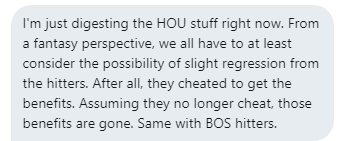
Yesterday, I noticed someone slid into my DM’s and I got my hopes up but instead I got this:

Maybe. Many of the Astros players didn’t think it helped.

Some Astros players told my investigators that they did not believe the sign-stealing scheme was effective, and it was more distracting than useful to hitters.

We just don’t know for sure of the effects of cheating so I guess I better take a stab and find out.

To start with, I went to the projection sources to find out how the projections weigh each year’s results. The weighted averages, along with some aging adjustments and regression, create the final projections. ZiPS is up first.

Dan Szymborski uses individual weightings for each component (strikeouts, doubles, etc) but at the end, the weighting is close to 8-5-4-2 where ‘8’ is the last season. According to the commissioner’s report, the Astros “only” cheated at home in 2017 so only 2 units (half of four, the third value) of the weighting will be boosted. The percentage of the projection’s input from the cheating is 10.5% (2/[8+5+4+2] or 2/19).

Read the rest of this entry »


Good Pitches from Bad Pitchers* Pt. 1

*Bad in this case is a 4.50 ERA or higher^ in 2019

^Except for one guy, who had a 4.49

We all know that ERA isn’t an end-all, be-all on skill, but those of us in the fantasy realm don’t roster guys with ERAs at 4.50 or higher so using that as a cutoff for this exercise felt right. The purpose here is to find some useful pitches these guys could build upon to get them on the right side of a 4.50 ERA going forward.

As for what determines a good pitch, I took a look at the average OPS, K%, SwStr%, and Chase% among starters with at least 700 fastballs thrown and 200 thrown of all the other pitches (slider, curveball, changeup, cutter, and splitter) and then found the strongest offerings of each pitch from those who struggled in 2019. The pitches didn’t have to be better than average in all four categories, but at least two of the four and in most cases, it’s better than three of the four.

I’m going to make this a two-parter with four-seamers, sliders, and cutters today and curves, changeups, and splitters later this week (probably tomorrow).

Read the rest of this entry »


Assessing My Big Differences with ADP, Pt. 1

I recently released my top 125 starting pitchers for 2020 and I couldn’t believe that nobody had a single question about them and everyone who saw them found them to be perfect top to bottom. OK, dumb joke. Anyway, I appreciate everyone getting in the comments and discussing the rankings with me. I’m still responding to questions and comments if you want to ask me about someone in the rankings.

Today I want to look the biggest differences between my rankings and the early average draft position (ADP) information at the NFBC in their Draft Champions leagues (50-round draft-and-hold format). On their list, they group all pitchers together so I took out the relievers making it more of a 1:1 comparison with my SP ranks. This will be a two-part piece with the first being the pitchers where I’m higher.

10 Where I’m Higher

Jeff Samardzija, SF | 107th SP in ADP; 52nd SP by me

I wouldn’t even say I’m a huge fan of The Shark, but his current ADP seems like a great price for someone who finished 33rd among SP on Razzball’s Player Rater last year. Even if you don’t fully buy the 3.52 ERA, he offers high volume with a strong WHIP. At the very least, he has Oracle Park protecting him for half of his starts. It’s a boring investment, but I’ll gladly take him outside the top 100 SPs.

Read the rest of this entry »


Are Catchers a More Volatile Than Other Position Players?

How to correctly value catchers has always been up for debate. As a position, they are by far the worst hitters in the league. Last season, catchers posted a .713 OPS while second basemen were next with a .745 OPS. Most player calculations give catchers a valuation boost to attempt to even them out with the other hitters. This theoretical boost always exceeds the actual cost paid by draft picks or auction dollars. I assumed some experts knew more than me (safe bet) and the catcher projections have a wider range of outcomes. Owners don’t want to pay for these gambles. By examining historical values, I found the complete opposite. Catcher projections are the least volatile.

I’m not going to rehash why catchers need a positional adjustment. I’ve written a whole section on it in The Process. For anyone new to the subject or just wants a refresher, Ariel Cohen wrote an in-depth article on the subject.
Read the rest of this entry »