Author Archive

Mining the News (6/5/20)

I’m cleaning up any news I have a backlog because I’m off on vacation next week and hopefully when I return, a decision will exist on an MLB season. As a reminder, the focus of this article is to dive deeper than the headline news like Chris Archer’s surgery.

General information

The effects of a concussion can still be felt two years later.

Here is a list of players who have been on the IL for a concussion over the past two years.
Read the rest of this entry »


Starter Injury Accumulation Leads To Accelerated Aging

In the final part of my latest injury investigation, I trying to see if pitchers who have accumulated a certain amount of injuries age worse than those who have stayed healthy. And if so, are there any rules-of-thumb that can be used. I’ve already examined chronically injured hitters and if accumulated days missed for pitchers lead to more Injured List (IL) trips. The results aren’t groundbreaking findings that constantly hurt pitchers declining faster at certain thresholds but now some numbers can be added to the narratives.

My overall goal is to see the accumulative effect of various injuries can lead to a pitcher aging faster. The factors I had never accounted for are accumulated IL days and times of the IL for elbow, shoulder, or arm injury. Also, I’m only diving into starters (GS/G >= .5) from 2010 to 2018 because relievers, especially closers, are already tough to project. I divided the starters by their age based on a steep production decline starting at age 29. For the pitcher’s talent level, I used ERA- that increase, like ERA, as a pitcher performs worse. The results were a little mixed.

One item to keep in mind, pitchers have historically, maintained their production, or declined as they age. While there is always the exception of a pitcher improving, most are headed down with the average change of 2.8 points of ERA- a year.

The Difference in Production Based on Total Accumulated IL Days
Total IL days Median ERA- Diff Median IP Diff Avg IL Days
28 and Younger
0 1.9 18.1 20.2
1 to 90 2.2 -18.8 29.9
91 to 180 7.3 5.7 37.6
181 to 270 5.1 13.4 35.9
>270 0.6 58.0 38.3
29 and Older
0 0.6 -24.2 15.5
1 to 90 2.9 -17.2 25.8
91 to 180 0.4 -13.0 27.4
181 to 270 5.7 -23.6 39.8
>270 4.5 -4.1 40.4

What I found from this data run and others not listed, age doesn’t matter. Also, while the average IL days steadily climb, the ERA- value jump seems to increase except when it doesn’t. I simplified the results and settled on a 120-day threshold with the following results.

The Difference in Production Based on Total Accumulated IL Days
Career IL Days Median ERA- Diff Median IP Diff Avg IL Days IL Chance
<= 120 days 1.8 -10.5 24.0 40.0%
> 120 IL days 5.2 -8.0 37.8 54.8%

Once a pitcher goes over the 120-day threshold (i.e. a full MLB season), their career declines at a faster than expected rate. Again, there are always going to expectations but rostering too many of these hurt starters increases the downside potential.

Now for one more angle that I had jotted in my to-do book. Most major pitcher injuries center around the arm, so I decided to focus just on them. I bucketed the information by the number of times a pitcher was on the IL for a general arm (e.g. forearm), elbow, or shoulder injury (no wrist or hand). With more than 99% of all instances in the single digits, a simple workable division was easy to find at 2 IL stints.

The Difference in Production Based on Arm-Related IL Trips
IL Stints for Arm ERA- Change Total IL Days IL Days IL Chances
Two or Fewer 2.3 252.6 26.5 42.0%
Three or More 5.5 358.0 39.6 59.0%

Even pitchers who had two or few IL stints weren’t in great shape with them averaging over 200 days on the IL. That third arm related IL trip can be a deal-breaker because the pitcher will, on average, will see their skill degrade about twice as fast as those with two or fewer trips.

And finally here are the pitchers who have over 120 days on the IL and three or more arm related IL stints (min 10 IP last season).

Starters Who Should Age Faster Than Expected
Name Age Days Arm IL Stints FBv
Brett Anderson 32 918 6 90.8
Clay Buchholz 35 717 4 89.5
Rich Hill 40 667 6 90.3
Jason Vargas 37 657 3 84.3
Homer Bailey 34 626 8 93.0
Adam Wainwright 38 618 4 89.9
Hyun-Jin Ryu 류현진 33 558 4 90.6
Charlie Morton 36 551 4 94.4
Michael Pineda 31 511 5 92.6
Yu Darvish 33 492 5 94.2
Nathan Eovaldi 30 470 5 97.5
Zack Wheeler 30 460 5 96.7
Matt Harvey 31 433 4 93.2
Carlos Carrasco 33 432 5 93.5
Anibal Sanchez 36 427 5 90.5
Stephen Strasburg 31 421 6 93.9
Andrew Heaney 29 419 4 92.5
Danny Duffy 31 414 7 92.4
Mike Minor 32 397 3 92.6
Martin Perez 29 377 5 94.1
Andrew Cashner 33 375 4 93.9
Drew Smyly 31 355 3 91.2
Felix Hernandez 34 313 4 89.6
Jhoulys Chacin 32 300 3 90.0
Ivan Nova 33 299 4 92.4
Jordan Zimmermann 34 289 3 90.5
Steven Matz 29 244 5 93.4
Clayton Kershaw 32 217 3 90.4
David Price 34 199 4 92.0
Cole Hamels 36 182 4 91.4
Vince Velasquez 28 144 4 94.1
Gerrit Cole 29 143 4 97.2
Jake Arrieta 34 140 3 92.5
Chris Sale 31 121 4 93.2

Several high ADP names fill the list like Morton, Darvish, Strasburg, Kershaw, and Cole. Does this information mean I won’t roster the pitcher? Maybe. With a fantasy team only starting nine pitchers, I’d like those pitchers to be as rock-solid as possible with little chance of decline. The downside means that I will need them to come with a discount and is an easy tiebreaker. That’s not helpful since that’s everyone’s injury take.

My stance on the information is wishy-washy because I am unsure. I haven’t fathomed a way to weight the information especially if I want to use it to create auction prices. I need to find a way to change ERA- to fantasy-relevant stats. It wouldn’t be that hard but I’m looking at two different inputs (total days and arm related trips). Also, I should incorporate possible time missed from previous IL trips. I’m going to let the information stew for a bit and unless I come to some divine revelation, I’ll perform a forced dive once this season is over or canceled.

Pitcher IL Chances … Again

I had no plans to write or investigate pitcher injuries again. I’ve done it several times in the past with similar results. Since I needed the same information to investigate if an often injured pitcher ages faster as I did with hitters, I had the data available so why not take another stab at projecting pitcher injury risks with a few different inputs.

For a refresher, here are some of my previous findings:

The small data difference is that instead of limiting the IL days to the previous one to three seasons, I’m just using the accumulated days. Also, I tracking the number of times the pitcher went on the IL for an arm, elbow, or shoulder injury. The two different factors are joined by fastball velocity, Zone%, and age to see what leads to injuries the next season.

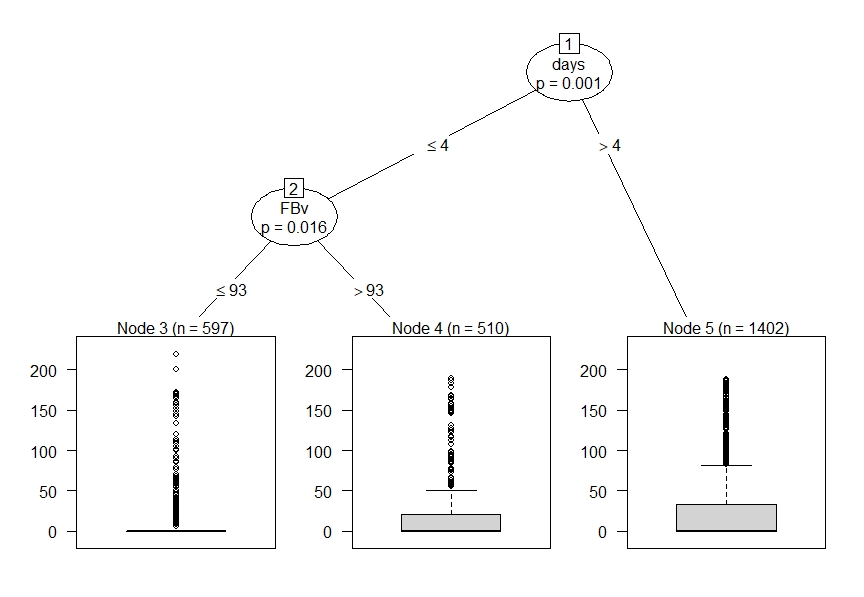
I took all the data from all the pitchers and ran it through a Trees analysis and got the following chart.

This image sums up pitcher injuries perfectly. The best predictor of future injuries is past injuries. And just because a pitcher had never been on the IL, on average, they will still spend ~18 days on it. It’s just re-enforcing common sense backed up by study after study.

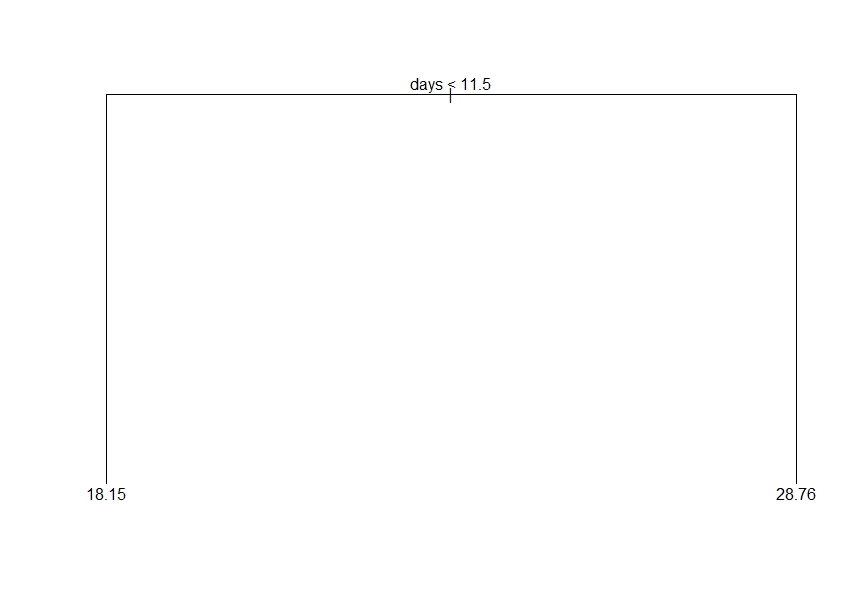
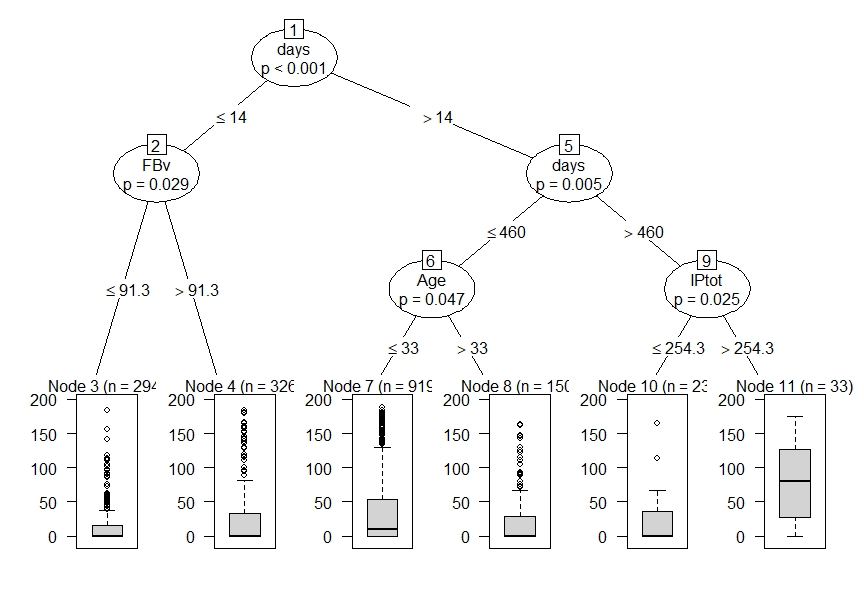
From my previous work, the injury rates between starters and relievers (i.e. starters who can’t stay healthy) are drastically different. For that reason, I ran the analysis splitting out starters (GS/G >= .5) from relievers (GS/G < .5). Here are the two decision trees.

Starters

Relievers

We have some further division taking place fastball velocity on both, a further out 460-day threshold for starters, and age requirement. I’m not a huge fan of the multi-branched tree with many variables. I’m all for keeping it simple. Using the above variables, I cut and diced the data into several possible combinations and came up with the following divisions.

Pitcher IL Chances
Starters Relievers
Category Avg IL Days IL Chances Count Avg IL Days IL Chances Count
0 IL, <= 93 mph 17 28% 463 13 22% 728
0 IL, > 93 mph 28 45% 141 20 32% 628
> 0 IL, <= 93 mph 31 49% 857 23 37% 832
> 0 IL, > 93 mph 34 57% 268 27 43% 668
> 460 days 55 63% 59

Again, the rates are similar to my previous findings. The only changes are the pitch velocity groupings and that rough over-460 IL day group who average two months on the IL a year. For me, I focus on starters and will designate the starters into three risk groups:

  • Low: No IL, low velo.
  • Medium: No IL, high velo, and some IL, low velo.
  • High: Some IL, high velo, and high IL.

Not all injuries can be avoided, but the injury downside is just another factor to consider when setting each pitcher’s fantasy value.

And what’s a study without the players to consider for the upcoming season. Here are the historic IL days and fastball velocity for any pitcher with 10 starts last season.

2020 Starters Group by Historic IL Days & Fastball Velocity
Name Age 2019 IP Combined IL Days FBv
Ryan Yarbrough 28 141 0 88.2
Nick Margevicius 24 57 0 88.3
Alex Young 26 83 0 89.3
Trevor Richards 27 135 0 90.9
Adam Plutko 28 109 0 91.1
Dillon Peters 27 72 0 91.1
Dario Agrazal 25 73 0 91.2
Jose Quintana 31 171 0 91.4
Asher Wojciechowski 31 82 0 91.6
Jaime Barria 23 82 0 91.7
Jose Suarez 22 81 0 91.8
Merrill Kelly 켈리 31 183 0 91.9
Matthew Boyd 29 185 0 92.0
Tanner Roark 33 165 0 92.1
Ariel Jurado 24 122 0 92.4
Yusei Kikuchi 29 161 0 92.5
Aaron Civale 25 57 0 92.6
Peter Lambert 23 89 0 92.7
Jose Berrios 26 200 0 92.8
Zac Gallen 24 80 0 92.9
David Hess 26 80 0 93.0
Shane Bieber 25 214 0 93.1
Brad Keller 24 165 0 93.4
Miles Mikolas 31 184 0 93.6
Brendan McKay 24 49 0 93.7
Dakota Hudson 25 174 0 93.7
Chris Paddack 24 140 0 93.9
Jack Flaherty 24 196 0 93.9
Zach Plesac 25 115 0 94.0
Tyler Beede 27 117 0 94.3
Adrian Houser 27 111 0 94.4
Cal Quantrill 25 103 0 94.5
Mitch Keller 24 48 0 95.4
Sandy Alcantara 24 197 0 95.6
Luis Castillo 27 190 0 96.5
Dylan Cease 24 73 0 96.5
Kyle Hendricks 30 177 66 86.9
Mike Leake 32 197 51 88.4
Dallas Keuchel 32 112 63 88.4
Zach Davies 27 159 120 88.5
Marco Gonzales 28 203 15 88.9
CC Sabathia 39 107 364 89.2
Gio Gonzalez 34 87 80 89.3
Jerad Eickhoff 29 58 284 89.5
Felix Hernandez 34 71 313 89.6
Julio Teheran 29 174 28 89.7
Zack Greinke 36 208 188 90.0
Jhoulys Chacin 32 103 300 90.0
Joey Lucchesi 27 163 36 90.2
Jon Lester 36 171 162 90.3
Mike Fiers 35 184 11 90.4
Clayton Kershaw 32 178 217 90.4
Clayton Richard 36 45 370 90.4
Rick Porcello 31 174 27 90.5
Wade Miley 33 167 83 90.5
Jordan Zimmermann 34 112 289 90.5
Anibal Sanchez 36 166 427 90.5
Dereck Rodriguez 28 99 7 90.6
Elieser Hernandez 25 82 53 90.6
Daniel Norris 27 144 357 90.8
Dylan Bundy 27 161 30 91.2
Drew Smyly 31 114 355 91.2
Trevor Williams 28 145 33 91.3
J.A. Happ 37 161 263 91.3
Madison Bumgarner 30 207 153 91.4
Ross Detwiler 34 69 165 91.4
Cole Hamels 36 141 182 91.4
Tyler Skaggs 28 79 430 91.4
Jakob Junis 27 175 13 91.5
Jordan Yamamoto 24 78 27 91.5
Masahiro Tanaka 31 182 157 91.5
Jacob Waguespack 26 78 35 91.6
Caleb Smith 28 153 117 91.6
John Means 27 155 24 91.8
Eric Lauer 25 149 30 91.9
Kyle Freeland 27 104 51 91.9
Jeff Samardzija 35 181 139 91.9
Patrick Corbin 30 202 272 91.9
Steven Brault 28 113 31 92.0
Aaron Brooks 30 110 183 92.0
David Price 34 107 199 92.0
Kenta Maeda 32 153 37 92.1
Chi Chi Gonzalez 28 63 182 92.2
Brad Peacock 32 91 257 92.2
Erick Fedde 27 78 88 92.3
Joe Musgrove 27 170 76 92.4
Robbie Ray 28 174 94 92.4
Ivan Nova 33 187 299 92.4
Danny Duffy 31 130 414 92.4
Mike Soroka 22 174 129 92.5
Jake Arrieta 34 135 140 92.5
Marcus Stroman 29 184 217 92.5
Andrew Heaney 29 95 419 92.5
Shaun Anderson 25 96 16 92.6
Jordan Lyles 29 141 252 92.6
Mike Minor 32 208 397 92.6
Trent Thornton 26 154 11 92.9
Jake Odorizzi 30 159 75 92.9
Aaron Nola 27 202 143 92.9
Eduardo Rodriguez 27 203 162 93.1
Michael Wacha 28 126 227 93.1
Chris Sale 31 147 121 93.2
Matt Harvey 31 59 433 93.2
Tyler Mahle 25 129 33 93.3
Kyle Gibson 32 160 57 93.3
Sonny Gray 30 175 96 93.3
Chase Anderson 32 139 96 93.4
Edwin Jackson 36 67 148 93.4
Steven Matz 29 160 244 93.4
Glenn Sparkman 28 136 89 93.5
Chris Bassitt 31 144 290 93.5
Carlos Carrasco 33 80 432 93.5
Domingo German 27 143 25 93.6
Pablo Lopez 24 111 108 93.6
Zach Eflin 26 163 122 93.6
Aaron Sanchez 27 131 299 93.6
Taylor Clarke 27 84 16 93.7
Antonio Senzatela 25 124 29 93.7
Jeff Hoffman 27 70 31 93.7
Spencer Turnbull 27 148 32 93.8
Max Fried 26 165 52 93.8
Griffin Canning 24 90 53 93.9
Yonny Chirinos 26 133 81 93.9
Luke Weaver 26 64 117 93.9
Andrew Cashner 33 150 375 93.9
Stephen Strasburg 31 209 421 93.9
Kevin Gausman 29 102 117 94.0
Chris Archer 31 119 92 94.1
Vince Velasquez 28 117 144 94.1
Martin Perez 29 165 377 94.1
Lance Lynn 33 208 249 94.2
Lucas Giolito 25 176 30 94.3
Dylan Covey 28 58 131 94.4
Trevor Bauer 29 213 38 94.6
Justin Verlander 37 223 69 94.7
Anthony DeSclafani 30 166 318 94.7
Max Scherzer 35 172 64 94.9
Mike Foltynewicz 28 117 84 94.9
Reynaldo Lopez 26 184 14 95.5
German Marquez 25 174 38 95.5
Mike Clevinger 29 126 79 95.5
James Paxton 31 150 361 95.5
Blake Snell 27 107 79 95.6
Jose Urena 28 84 124 95.9
Jon Gray 28 150 136 96.1
Dinelson Lamet 27 73 289 96.1
Brandon Woodruff 27 121 57 96.3
Walker Buehler 25 182 16 96.6
Frankie Montas 27 96 183 96.6
Jacob deGrom 32 204 32 96.9
Tyler Glasnow 26 60 155 97.0
Gerrit Cole 29 212 143 97.2
Noah Syndergaard 27 197 213 97.7
Zack Wheeler 30 195 460 96.7
Nathan Eovaldi 30 67 470 97.5
Yu Darvish 33 178 492 94.2
Michael Pineda 31 146 511 92.6
Charlie Morton 36 194 551 94.4
Hyun-Jin Ryu 류현진 33 182 558 90.6
Adam Wainwright 38 171 618 89.9
Homer Bailey 34 163 626 93.0
Jason Vargas 37 149 657 84.3
Rich Hill 40 58 667 90.3
Clay Buchholz 35 59 717 89.5
Brett Anderson 32 176 918 90.8

Notes

  • The pitcher with the highest velocity and IL experience is Noah Syndergaard. That 2020 IL stint didn’t take long.
  • The oldest starter to never have been on the IL is Tanner Roark at 33.
  • Darvish and Morton are going as the 17th and 18th pitchers even though they’ve broken the 460-day threshold.
  • Just go and scroll through the starters who have been on the IL and throw over 93-mph, especially over 95. Lots of them have spent considerable time on the IL over their careers. I’m thinking to target “safer” but elite starters if given the opportunity like Corbin, Bieber, Kershaw, Castillo, and Flaherty. There is no way to completely stay away from the injury risk but why not add a pitcher with a 28% chance (Boyd) than someone with a 63% chance (Ryu)

These conclusions were about 80% in line with what I expected with fastball velocity nudging itself in. Next up will be taking this information and seeing if a higher injury rate ages pitchers more than projected.


Jeff Zimmerman Fantasy Baseball Chat

3:02
Jeff Zimmerman: I will not have a chat next week as I’m taking a week vacation. It was supposed to be a two-week trip to Yellowstone but the park will still be closed.

3:03
Jeff Zimmerman: Hopefully when I get back from the lake, a season will be agreed upon and it’ll be time to dig back in.

3:03
Rennie Stennett: In a startup dynasty, my fringe SP is Stephen Matz and I also added Kim because his RP eligibility is key in our points format which values IP, K causing closers to have diminished value. Would you ride with Matz and Kim or grab Cole Hamels or Spencer Turnbull off the wire?   Thanks Jeff!

3:04
Jeff Zimmerman: I like seeing how Kim’s talent plays and would hold him. The other three are replaceable IMO. I might hold Matz until the schedule comes out and see which of the three has the easier initial schedule

3:04
Rich: Hi Jeff.  Thanks for chatting; fingers crossed for baseball this summer.  In a redraft, OBP, H2H league (12 teams), could you please rank the following hitters (assuming a universal DH):  Ryan Braun, Wil Myers, C.J. Cron, Alex Verdugo, Willie Calhoun, Rougned Odor?  Thanks!

3:06
Jeff Zimmerman: Calhoun, Cron, Braun, Verdugo, Odor, Myers

Read the rest of this entry »


National League Pitchers Value Down With the DH

One of my Launch Angle Podcast partners, Rob Silver, brought up how if there is a universal DH, the NL pitcher will no longer face ineffective bat-wielding pitchers. Simply, pitchers can’t hit. Last season in 4789 PA, National League pitchers hit for a combined .126/.157/.160. Our own Dan Szymborski continued the discussion to see if dominating pitchers hitting was a repeatable trait. I’m going to go a different route to investigate, using Dan’s information, how a pitcher’s projection would change going to an American League team (effectively including a DH) and this number affects a pitcher ranking.

I’m going to start off saying to not take any of the following information as the gospel truth. I’m trying to achieve a better projection that’ll be closer to the final outcome. Each stat and step in the process can be nitpicked along the way. I’m not even sure if the following method is the best way but it’s a way. I’m trying to move the discussion from “The DH will be a try breaker for me when drafting” (quote from a podcast I heard) to actually putting some number behind the possible changes.

Also, I’m not here to argue on why Jacob deGrom started out as the 8th ranked starter and he’s now 9th. I just collect a projection set. Anyone who uses stats to generate their projections will have their own secret sauce. I have my own. I just need a projection framework and live with it. Here is how I set it up.

I downloaded the 2020 ZiPS projections from here at FanGraphs. I used the ZiPS values since Dan created them and I’ll be using the inter-league adjustments provide in his article.

Then I changed each pitcher’s stats using Dan’s 2019 variables.

Variable: Change

  • BB%: +4%
  • K%: -5%
  • AVG: +.007
  • RC/G: +13%

I just adjusted the pitcher’s projected stats by the above values and created a hits estimate from the AVG with few assumptions.

NL pitcher innings projections have two offsetting values that could also be in play. The worse results could lead to fewer innings thrown (i.e. early hook) and the pitcher’s value could drop. On the other hand, the times a pitcher nearing his pitch limit will be replaced by a pinch batter will disappear. One of the two factors will likely dominate

Next, I used the 2019 12-team SGP (Standings Gain Points) formula from The Process to create pitcher valuations. The SGP value is the expected jump in the standings if that pitcher’s stats are added to a team’s stats. Here are results from the final top-40 starting pitcher using the SGP formula and ZiPS projections (I’m not sure why the TJS pitchers are still included but I don’t get paid the big bucks to know such things).

NL Starting Pitcher Adjustments
Initial Adjusted
Rank Name IP W K ERA WHIP SGP Rank W K ERA WHIP SGP Difference
1 Gerrit Cole 200 16 280 3.11 1.01 18.5 1 18.5 0
2 Justin Verlander 190.3 16 243 3.22 0.98 17.5 2 17.5 0
4 Lucas Giolito 176 14 235 3.22 1.07 15.4 3 15.4 1
3 Max Scherzer 174 13 236 3.00 0.98 16.0 4 13 224 3.39 1.02 13.8 -1
7 Chris Sale 164.7 13 216 3.12 1.01 15.0 5 15.0 2
5 Jack Flaherty 189.7 13 236 3.13 1.05 15.4 6 13 224 3.54 1.09 13.2 -1
6 Stephen Strasburg 184.7 15 221 3.22 1.09 15.2 7 15 210 3.63 1.13 13.0 -1
9 Shane Bieber 195.7 13 213 3.63 1.11 14.1 8 14.1 1
8 Jacob deGrom 184.3 12 223 2.88 1.04 14.7 9 12 212 3.26 1.08 12.5 -1
10 Luis Severino 166.3 14 201 3.52 1.12 13.9 10 13.9 0
11 Walker Buehler 167.7 11 201 3.27 1.07 13.3 11 13.3 0
12 Clayton Kershaw 166.7 12 176 3.24 1.04 13.1 12 13.1 0
15 Zack Greinke 179.7 13 172 3.91 1.12 12.7 13 12.7 2
13 Trevor Bauer 190.3 13 222 3.74 1.25 13.0 14 13 211 4.22 1.29 10.7 -1
14 Aaron Nola 194 12 213 3.57 1.2 11.4 15 12 202 4.04 1.24 10.7 -1
20 Charlie Morton 159 12 185 3.34 1.18 10.6 16 10.6 4
21 Jose Berrios 190 13 193 4.17 1.25 10.6 17 10.6 4
16 Luis Castillo 175.3 12 198 3.59 1.19 11.0 18 12 188 4.06 1.23 10.3 -2
24 Lance Lynn 173.3 14 193 4.05 1.33 10.2 19 10.2 5
17 German Marquez 180 12 190 4.00 1.18 10.8 20 12 181 4.52 1.21 10.2 -3
18 Noah Syndergaard 186.7 11 197 3.33 1.17 10.8 21 11 187 3.76 1.21 10.1 -3
19 Patrick Corbin 182.3 12 205 3.80 1.24 10.7 22 12 195 4.30 1.28 10.0 -3
26 Mike Clevinger 146.7 11 175 3.62 1.19 9.8 23 9.8 3
28 Matthew Boyd 173 10 193 4.37 1.24 9.6 24 9.6 4
29 Blake Snell 135.3 11 173 3.33 1.2 9.6 25 9.6 4
23 Zac Gallen 159 12 185 3.62 1.22 10.3 26 12 176 4.09 1.26 9.6 -3
22 Robbie Ray 164.3 11 222 4.00 1.3 10.3 27 11 211 4.52 1.35 9.6 -5
25 Chris Paddack 159 10 174 3.68 1.11 10.1 28 10 165 4.16 1.15 9.5 -3
31 James Paxton 143.7 11 169 3.82 1.21 9.5 29 9.5 2
34 Jake Odorizzi 149.7 12 158 4.09 1.26 9.1 30 9.1 4
27 Yu Darvish 154.3 8 190 3.56 1.13 9.7 31 8 181 4.02 1.17 9.1 -4
30 Sonny Gray 158 11 171 3.82 1.21 9.6 32 11 162 4.31 1.25 8.9 -2
37 Eduardo Rodriguez 174.3 12 177 4.28 1.34 8.9 33 8.9 4
38 Carlos Carrasco 131.3 10 152 3.97 1.16 8.9 34 8.9 4
39 Mike Minor 172.7 12 161 4.48 1.29 8.9 35 8.9 4
32 Mike Soroka 176 11 154 3.32 1.16 9.5 36 11 146 3.76 1.20 8.9 -4
33 Kyle Hendricks 169.3 12 143 3.67 1.18 9.4 37 12 136 4.14 1.21 8.8 -4
41 Corey Kluber 144.7 11 145 3.98 1.2 8.8 38 8.8 3
42 Masahiro Tanaka 168 11 150 4.34 1.23 8.8 39 8.8 3
43 Tyler Glasnow 119.7 9 162 3.53 1.19 8.7 40 8.7 3

The changes are significant once all three factors (WHIP, ERA, strikeouts) are factored in. While the rank changes by just one or two with the top-10 or so arms, the difference becomes significant around pick 20 with moves of four spots. Maybe this change is a tie-breaker for some owners, but if an owner gains an extra ~1 SGP from all nine pitchers, it becomes nine spots in the standings. I think every owner would take those extra spots.

Just eyeballing the differences, it’s ~0.40 increase in ERA and 0.04 bump in WHIP to go with the 5% drop in strikeouts. The near half run increase in ERA will scare off quite a few owners by itself. Other owners will get blow off the possible changes, but in my current opinion, they will be playing catch up if they ignore them.

Again, don’t take my word for it … I’m still coming to grips with Lance Lynn possibly jumping Patrick Corbin. I could be wrong with these calculations but hopefully, some other analysts will step up and perform the calculations. The possible change in production is likely the biggest valuation change with half the pitchers facing legit MLB hitters instead of the irrelevant pitcher.


Jeff Zimmerman Fantasy Baseball Chat

3:00
Jeff Zimmerman: Let’s light this fire.

3:00
Franchy Cordero: With the possibility of universal DH do I benefit the most in San Diego?

3:01
Jeff Zimmerman: I’m not sure with SD. I think it may be Wil Myers since he’ll finally have a defensive position.

3:01
Smoking aces: My Stras and Yandy for his Jram. 8×8, 15 keeper. Stras is expensive, jram is moderately priced and Yandy is as cheap as our league allows. Smell fair?

3:02
Jeff Zimmerman: Yea, I like the JRam side for sure.

3:02
Billy: Assuming we get a 80 game season, has the option of going later into the fall been discussed? I feel relegating games solely in FLA, Ari, and indoor stadiums, perhaps we could stretch out the “season” to say 120 games

Read the rest of this entry »


Batter Injuries and Future Performance

Predicting hitter injuries has been a fool’s errand for me. Besides players with chronic injuries (e.g. Albert Pujols and Ryan Braun), others and myself have made little headway in the field. With few guidelines, many fantasy analysts and owners handle hitter injuries differently. Previously, I focused on a hitter’s recent injury history. This time I attempted a different approach and used the hitter’s career IL days. In the end, I found a useful and easy to remember injury threshold.

For the study, I examined hitters from the 2010 to 2018 seasons. I have IL data going back to 2002, so I hoped the preceding eight years of data would get most of the hitter’s 2010 career total. Additionally, I needed the next season (e.g. 2019) to compare results. Additionally, I set a minimum hitting threshold (100 PA) to include at least some semi-regulars. I know I may miss a hitter who is out the whole season, but the two-week callups were diluting the results. In all, I ended up with a sample of 2365 player seasons.
Read the rest of this entry »


1999 Retro League Preview & Recap

Note: This article was written in two parts, with the first half being before the draft and the second half after completion.

Prep

Tonight, I’m participating in a 1999 retro with several other industry analysts. The premise is simple: the owner drafts a 5×5 roto team based on the 1999 season’s final player stats. That’s where the simplicity ends.

I knew these drafts were going on but as I was busy with other projects, I hadn’t dived into them. Then Fred Zinkie contacted me to do an idiot check on his valuations for the draft that happened last Wednesday. I’m a fan of using SGP (standings gain points) for my normal evaluations, but none were available for 1999. Instead, I had to break out a copy of The Process and create the player valuations based on the Z-score method. (Z-score looks at how much a player’s real or predicted stats are above or below the league average for the draftable player pool. It takes several passes to get the correct valuations since the final player pool is unknown. The z-score method is helpful when no league history exists.)

After I was done, we noticed two differences. Fred used a modified SGP for the season and was valuing stolen bases a little more. We aren’t sure of the cause, but he gave catcher and middle infield a little more of a bump. I think the difference was from the different stolen base values. Read the rest of this entry »


League-wide Batted Ball Changes

About every month, podcast mate Rob Silver pours out his undying love and affection for the Rockies Charlie Blackmon. I’m not as much of Blackmon fan but this comment got me thinking.

Blackmon definitely hit the ball harder last year but so did everyone else with MLB’s juiced ball. Even with noisy data, Rob was right and Blackmon exceeded expectations.
Read the rest of this entry »


Jeff Zimmerman Fantasy Chat

3:00
Jeff Zimmerman: Good afternoon. Time to light this fire.

3:00
Harry: My 12 team H2H league is struggling to figure out a format that fits if there is a 12 week season. Any suggestions on how to play this one?

3:02
Jeff Zimmerman: If the rules allow, allow the same three (or four) teams face off. The number of games increases and the smack talking can still be enjoyed

3:02
Joe: Hi Jeff, have you ever seen a study done on height/weight of players and post-hype breakouts?  I wonder if CHW took a flyer on Mazara due to his great baseball body–6’4″/215.  In general I wonder why the NFL places a lot of value on combine metrics and height, weight, strength, etc, but baseball doesn’t seem to as much.  Maybe there’s an inefficiency to be had there.

3:03
Jeff Zimmerman: I haven’t seen a study done to that level.

3:05
Jeff Zimmerman: Being big isn’t going to help Mazara put the bat on the ball. He just doesn’t make the needed contact.

Read the rest of this entry »