Archive for savant

Blasts: A Subset of Barrels (Not the Same as Statcast Blasts)

Edit (5/13/24): Hi! Alex here, writing to you from the future. MLBAM just published swing data (it’ll be exciting, I promise you), and one of the marquee metrics for swings on Statcast is called a “Blast.” It has nothing to do with the Blasts herein. As far as I’m concerned, Statcast is the ledger of record, so I will brainstorm new terminology for this so it doesn’t create confusion… although changing the name of my metric might create confusion for the four people or whatever who use it. Anyway, just a PSA for y’all. These are not the same blasts!

I’ve heard (read) a lot of hullabaloo about “not all barrels are equal.” Hullabaloo or not, it’s true; although barrels capture exit velocity (EV) and launch angle (LA) combinations that produce optimal wOBAcon (weighted on-base average on contact) results, the Statcast metric is defined broadly enough to include absolute blasts alongside somewhat-pedestrian hard hits within the same grouping.

The algorithm used to classify barrels is not publicly available (edit: an anonymous tipster alerted me that it, indeed, is available! I think I reverse-engineered it correctly just by sight…), but one can reverse-engineer it easily enough. Here’s a plot of all barrels since the start of the 2017 season.
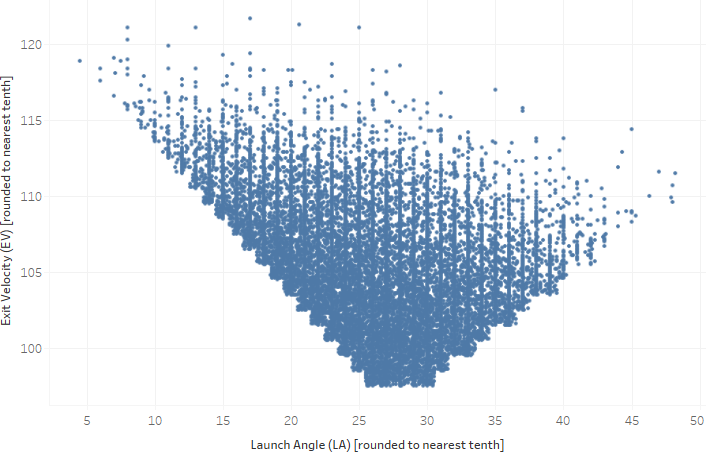
Given the scatterplot, the formula is most likely as follows:

if EV < 97.5 mph, then barrel = no
if LA > 25.5° and LA < 30.5°, then barrel = yes
if LA < 25.5° and (25.5 – LA) < (EV – 97.5), then barrel = yes
if LA > 30.5° and ((LA – 30.5) * 2) < ((EV – 97.5) * 3), then barrel = yes
if EV > 97.5 mph but none of these apply, then barrel = no

“Not all barrels are equal” takes on its meaning once you convert the above scatterplot to a heatmap. I set the low end of the color legend artificially high to show the contrast between barrels that are relatively productive versus those that are massively productive:

Read the rest of this entry »


Which Statcast Measures Correlate Best? 2019 Refresh

A little more than a year ago, Al Melchior had the brilliant and beautifully straightforward idea of investigating how strongly pretty much ever Statcast metric correlated with various traditional power metrics and compiling them in one post. He asked me to help out, which I was more than glad to do.

Recently, I saw folks talking about this again, and someone asked specifically about the 2019 season. I figured I could refresh the values from the original post quickly enough (certainly a lot more quickly than I did last time), and it would also help bring pertinent information to the fore for folks neck-deep in draft prep.

Spoiler alert: the results barely changed. But! I do feel more confident in this particular set of values, as I nerded out with programming instead of pulling dozens of different queries from the Baseball Savant search function and constantly getting frazzled.

OK, here’s the goods. For 2019 hitters:

Read the rest of this entry »


2019 Statcast Park Factors (and the Importance of Spray Angle)

Last year, I took a stab at developing what might be loosely defined as park factors using Statcast data. (I called them park “impacts” because they lacked the requisite rigor to be true factors, although it’s all semantics, truly.) I sought to use Statcast’s expected wOBA (xwOBA) metric, specifically on batted ball events (BBEs), such that we would have a measure of xwOBA on contact (or xwOBAcon). This metric accounts for exit velocity (EV), launch angle (LA), and little else — which makes it perfect for this purpose.

The difference between actual and expected wOBA on contact indicates the amount of luck, whether good or bad, a hitter might have incurred on a particular batted ball event. In other words, given ‘X’ exit velocity and ‘Y’ launch angle, what is the most common wOBA outcome, and how much did the actual wOBA outcome differ from it?

The beautiful part about xwOBAcon is it strips away all other context. It removes elements that confound other park factor calculations, such as hitter and pitcher quality or even sequencing (vis-à-vis run-scoring). Except for fielding. Can’t control for fielding, unfortunately.

With this approach, we have the exit velocity. We have the launch angle. We have historical results for that particular combination of EV and LA to use as a benchmark. And then we compare.

Read the rest of this entry »