Archive for Nelson Cruz

Rankings Update: Outfielders

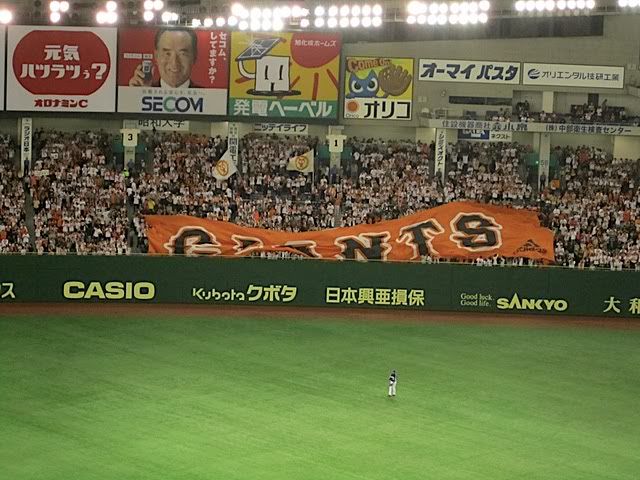
I’m back from Japan and have Basu-Baru pictures for your pleasure. Baseball in Japan has many of the trappings of the American version, but also includes cheerleaders and choreographed songs. Interestingly enough, the game I saw featured two Westerners at cleanup – Tony Blanco for the Chunichi Dragons and Alex Ramirez for the Yomiuri Giants. The pitchers had decent stuff, and the crowd was louder than many (most?) regular season MLB games, but overall the package was something like a AAAA game.

I digress. Time to take ownership of these outfielder rankings and change them up a bit. I will be doing them all season, as a sort of power ranking at the position. We’ll go with the FANS’ projected wOBAs (aka their upside projections) for another week.

The Top Three:
Ryan Braun, Milwaukee (.405 wOBA)
Matt Kemp, Los Angeles NL (.367 wOBA)
Justin Upton, Arizona (.388 wOBA)

Nothing much to say here except it looks like Upton’s ankle isn’t bothering him. These guys are studs and by the end of the year, could easily all be top-five fantasy players despite playing in the outfield.

There’s Nothing Wrong With…
Grady Sizemore, Cleveland (.343 wOBA)
Matt Holliday, St. Louis (.390 wOBA)
Carl Crawford, Tampa Bay (.367 wOBA)
Jacoby Ellsbury, Boston (.354 wOBA)
Curtis Granderson, New York AL (.340 wOBA)
Nelson Cruz, Texas (.368 wOBA)
Ichiro Suzuki, Seattle (.369 wOBA)
Shin-Soo Choo, Cleveland (.389 wOBA)

After the spirited Choo vs Granderson vs Sizemore comments conversation from the last time we updated these rankings, it’s only natural that we find a way to put them all in the same tier where they belong. Nelson Cruz is absolutely on fire, but his BABIP (.357) and K rate (24.1%) together suggest that the batting average should regress to his career norm. Granderson is still having trouble with lefties, but if he continues to bash righties to this extend, he’ll stay out of the next tier.

Not Quite Five-Category Performers
Josh Hamilton, Texas (.321 wOBA)
Jason Bay, New York NL (.397 wOBA)
Adam Lind, Toronto (.394 wOBA)
Nick Markakis, Baltimore (.349 wOBA)
Manny Ramirez, Los Angeles NL (.396 wOBA)

Manny is actually showing that he’s still got something left and with another tater or two could even join the next tier. That said, his missed games will keep the old(er) man back a little. Those same missed games should come into play with Hamilton eventually too. Lind’s power has taken a slight step back, but it’s early going and all it looks like he needs to do is loft the ball a little more (33.3% FB this year, 36.8% last year).

Missing Something?
Jayson Werth, Philadelphia (.382 wOBA)
B.J. Upton, Tampa Bay (.310 wOBA)
Andre Ethier, Los Angeles NL (.370 wOBA)

Werth reminded us that he has some injury issues by missing time with hip soreness, but has otherwise played well. The older Upton is actually playing about as well as can be expected, and in leagues that don’t use batting average, he may yet prove to be an elite option. Ethier will have his supporters, but his fly ball rate already fell, and his power pace should fall with it. The batting average should be strong this year, though, and he’s still a solid option.

Upside to Join the Top
Andrew McCutchen, Pittsburgh (.360 wOBA)
Carlos Quentin (.375 wOBA)
Michael Bourn (.326 wOBA)
Jason Kubel (.370 wOBA)

Outfielders are a tough position to handicap because of the sheer numbers, which also won’t allow me to go too deep. By highlighting some guys that could join the elite with the right years, we can delve a little deeper. So, while Shane Victorino is a fine option in the outfield, McCutchen is stealing bases at a pace (five so far) that would outpace the Flyin’ Hawaiian should it keep up. Bourn has shown the same plus plus speed. Should Quentin stay healthy, and Kubel prove that he can keep his slugging percentage over .500 year-in and year-out, they would join the power elite. So far, so good.

ADP Values in Left Field

Time to get all up in that left field position and see what we can find (sounds dirty). It’s an interesting position because it sports a top-five man (Ryan Braun, at 4.87 ADP), and yet the final tier averages somewhere around a 250 ADP. It’s not the deepest of positions, or it’s at least top-heavy.

The second tier has a bunch of second- and third-round guys that can offer some speed or slugging (in the case of Matt Holliday (21.89 ADP), a little of both), but there’s a curious inclusion in the tier that stands out. Right there, in the fifth round, there’s a player that could give you third-round value a good twenty picks later. Why are people avoiding Manny Ramirez (65.30) like the plague? Of course, there’s the obvious answer that comes in the form of a positive test for the wrong substance – and perhaps that should make people nervous. It’s a fly in the ointment and it probably won’t help to quote the projections that have Manny being the Manny of old (minus a few points for getting older). It’s a risk that has to be accounted for.

But lets say your league doesn’t break things down into separate positions in the outfield, then Manny comes in right around Andre Ethier (67.48 ADP) and Nelson Cruz (67.66 ADP). Those guys come with their own risk attached. Remember that Ethier used to be a 20-home-run-hitting outfielder as recently as 2008, and that Cruz, despite all his power and speed, has a 26% career strikeout percentage and a .255 career batting average (though I will admit to liking his power and speed contributions). Which risk do you take?

The next tier has some nice power, and even bounce-back candidate Alfonso Soriano (ADP 78.40) for power/speed potential too. But again, one man stands out like a sore thumb. Nolan Reimold (ADP 214.72) is young and has power and speed and a starting job that he should keep all year because of the rebuilding nature of his team. Much has been made of his Achilles’ injury, but perhaps many aren’t aware that Reimold made his stellar debut (.279/.369/.466 with 15 home runs and 8 stolen bases and a .365 wOBA) while being hobbled for much of the year with a 25% tear on that same tendon. What will he do once it heals? At that ADP, the shot at a .280 20+/10 outfielder should make you salivate. (At least it does that for me, am I weird?)

I’d hate to go all crazy on young ‘uns because there are plenty of values among the older left fielders. Plenty of old man skills, at least – Josh Willingham (270.94) sports those and is a value when surrounded by players like Carlos Ruiz (275.41 ADP) and Scott Hairston (277.51 ADP).

But I’m drawn to upside, and there’s Matt LaPorta (325.88 ADP) sitting right there for the plucking. He’s had some strikeout issues in the past, and he’s been a little old for his minor league levels, so he may not be the ueber-prospect we thought he was. But he has real power – his .188 debut ISO was low compared to his minor league power – and that’s always got a place in my lineup. Especially at this price.


Check the Position: Right Field

Over the offseason we’ll take a look at each position on the diamond and see how the past season affected the positional rankings and where there might be some potential bounceback value picks going into next year’s drafts. (See shortstops, catchers, second basemen, first basemen, third basemen, and left fielders.)

These rankings are for 5×5 rotisserie fantasy baseball. Eligibility was determined by where the player had the most at-bats last year.

RightFielders

The tier-of-his-own player in right field is Justin Upton, and I doubt there will be too much grumbling about this ranking for a guy who hit .300 with 26 home runs and 20 stolen bases in his firs full year. Sure, we may talk a little about his high BABIP (.364), but for now let’s just look at the fan projections and sigh.

That should end the easy portion of our rankings today. Perhaps this is just a little self-pity in anticipation of the comments thread, but the next two tiers could be a single tier, or could be three tiers, and could probably be re-arranged ad infinitum. We’ll give Ichiro! Suzuki credit for his BABIP and (sexy) infield-hitting prowess which are perfect for the right fantasy team.

Now come the players that are impossible to rank. Where do you put a guy like Nelson Cruz, who will give you great power and speed, but will hurt your batting average? Could he be any more different from Shin-Soo Choo, who is is solid across the board but won’t win you a single category? Bobby Abreu is in the Choo-mold, but we’ll move him back a little for the waning power and, to be frank, his old age and body type. It hasn’t hurt him yet, but someday, well it just has to. Right?

I don’t think blame can be attributed for seeing a separation after Abreu. While Nick Markakis is a metronome, his steady ticking doesn’t provide much beyond a .300 average and 20 home runs. The steals in 2007 have proved to be an aberration, and while he may get a power spike some year, there’s no way to predict it. Andre Ethier should, with a better BABIP (.292 in 2009, .316 xBABIP, .322 career BABIP), have a better batting average next year, but is the power real? When Bill James shaves seven home runs off your total, you should take notice. He may not hit 40+% fly balls next year. Some will complain about Jayson Werth’s placement, because he certainly looks like a Nelson-Cruz-lite, and they might be right. But Werth has had issues with staying on the field, and with his batting average and strikeout issues, the tier seems right.

Jay Bruce may just zoom up the charts next year and make his ranking seem silly, but at least the fans are backing my sense that we should temper our enthusiasm on the young slugger just a tad. He does seem like a great upside play, better than the young but inconsistent Hunter Pence behind him, who has seemingly showed us his best already. Brad Hawpe has some strikeout issues, some defense issues, and never really showed the power we thought he might. Forgive me for not believing in the simultaneous spike in both flyball rate (39.6% in 2009, 35.7% career) and HR/FB (17.1% in 2009, 12.9% career) and agreeing with the projections that say Michael Cuddyer’s power may subside next year.

The last tier is not very exciting in my mind. Nick Swisher’s batting average ranges from awful to terrible, Jermaine Dye is getting older and posted a six-year low in line drive percentage (16.9%), Garrett Jones was a 28-year-old rookie who had done nothing before 2007 in the minor leagues, and Magglio Ordonez, well we all saw what happened there. In fact, I would rather wait until the end of the draft to pick someone off of the “just off” list, so the Deep League Value piece this Sunday will feature some gems.


Position Battles: Rangers’ OF, Pt. 1: Byrd and Cruz

The Texas Rangers received some unexpected performances in the outfield this past season. Sure, newly-imported Josh Hamilton was supposed to provide thump in the middle of the lineup and did just that, but the folks in Arlington also got the benefit of a career year from thirty-something Marlon Byrd, some late-season feats of strength from minor league bopper Nelson Cruz and a decent rookie debut from David Murphy. Heading into 2009, Hamilton (duh) and Cruz appear to have starting spots locked up. Murphy, Byrd, Brandon Boggs, minor league free agent Andruw Jones and Frank Catalanotto will battle for the remaining at-bats. For now, let’s focus on Byrd and Cruz.

Byrd did his finest big league work in 2008, batting .298/.380/.462 with a .370 wOBA. He walked a career- high 10.2% of the time, while also cutting his K rate to 15.4% (21.3% in ’07). The former Philadelphia farm hand was scrounging for a job as recently as 2006, having posted a feeble .294 wOBA with the Nationals in 228 PA. The 31 year-old has found Texas to be to his liking: he batted .356/.406/.510 at Rangers Ballpark in 2007 (.259/.304/.410 on the road) and continued to enjoy the home cooking in ’08, hitting .299/.398/.512 at home and a mild-but-still-useful .297/.362/.411 in the away grays.

The 6-0, 245 pounder has done an admirable job in picking up the pieces of his shattered Philly prospect days, and has at bare minimum turned himself into a very useful fourth outfielder. CHONE projects Byrd to post a .281/.352/.434 line in 2009, while PECOTA calls for a .271/.335/.426 showing. It’s probably best to view Byrd’s ’08 work as his high-water mark, but you could do worse if you’re in need of a short-term fix in the outfield.

Cruz, meanwhile, has previously been discussed at length on this site. The 28 year-old has long creamed minor league pitching (he’s a career .298/.367/.539 hitter), and he took the Triple-A terrorizing to new levels in 2008. Cruz pummeled to PCL to the tune of .342/.429/.695 in 448 PA. While the batting average was the product of a .363 BABIP, Cruz did show a better eye at the plate (12.8 BB%) and carried that over to the big leagues in a late-season trial (12.9 BB%). In 133 PA for the Rangers, the erstwhile Oakland and Milwaukee prospect batted .330/.421/.609 with 7 HR.

Back in November, I cautioned against getting too excited at the prospect of Cruz receiving everyday playing time:

“Cruz’s AAA line was legitimately impressive, but we’re talking about a 28 year-old whose skill set remains the same as it was entering the year: impressive power, but just decent plate patience and lofty strikeout rates. His small-sample mashing might engender lofty expectations, but it’s important to keep the big picture in mind. Cruz had a .388 average on balls in play, a very high number that will regress. Also, the chances of a guy striking out so often hitting .330 are essentially zero. “

That assessment might sound overly pessimistic, but I think it is important to keep in mind that Cruz is a AAA veteran in his late 20’s, not some youthful hot-shot who precociously dominated the upper levels of the minor leagues. The 6-3, 230 pounder could be useful to the Rangers-he has plenty of raw power-but his control of the zone has generally been just fair and he has whiffed nearly a quarter of the time in AAA. He’s interesting, surely, but his small-sample work with the Rangers might lead to unreasonably high expectations. PECOTA calls for a .260/.335/.484 line, which seems reasonable for a righty power hitter in Arlington.


Has Nelson Cruz Broken His Quad-A Ceiling?

Perhaps the most pejorative term in scouting parlance is “Quad-A.” It’s a term loosely applied to player who can dominate in the Pacific Coast League or the International League, but just doesn’t possess the skills to thrive at the highest level of competition.

Coming into the 2008 season, Rangers outfielder Nelson Cruz appeared to fit the label to a T. The 6-3, 230 pounder (who also toiled in the Mets and Athletics farm systems) was acquired along with Carlos Lee as part of a 2006 deadline deal with the Brewers that shipped Francisco Cordero, Kevin Mench, Laynce Nix and Julian Cordero to Milwaukee. Cruz creamed the ball at AAA, but he fell flat on his face in two stints with the Rangers in 2006 and 2007:

2006

AAA (Brewers): .302/.373/.528, 10.2 BB%, 27 K%, .226 ISO in 371 AB
Rangers: .223/.261/.385, 5.1 BB%, 24.6 K%, .162 ISO in 130 AB

2007

AAA (Rangers): .352/.426/.698, 11.5 BB%, 21 K%, .346 ISO in 162 AB
Rangers: .235/.287/.384, 6.4 BB%, 28.3 K%, .150 ISO in 307 AB

Cruz looked like the classic high-power, low-contact slugger that could bash in the PCL but couldn’t cut it in the majors. At 26 and with two failed opportunities to establish himself, Cruz looked destined to ride the AAA bus circuit for years to come.

In 2008, Cruz decided to turn into Oklahoma’s answer to Barry Bonds, hitting a scorching .342/.426/.695 in 383 AB at AAA, with a 12.8 BB% and a 22.7 K%. But, unlike the previous years, Cruz continued to murder the ball upon his recall to Texas. In 115 AB, he batted .330/.421/.609, belting 7 home runs. He drew walks at a healthy clip (12.9 BB%) while striking out in about one quarter of his at-bats (24.3%). So, has Cruz broken out?

No. Sure, Cruz’s AAA line was legitimately impressive, but we’re talking about a 28 year-old whose skill set remains the same as it was entering the year: impressive power, but just decent plate patience and lofty strikeout rates. His small-sample mashing might engender lofty expectations, but it’s important to keep the big picture in mind. Cruz had a .388 average on balls in play, a very high number that will regress. Also, the chances of a guy striking out so often hitting .330 are essentially zero.

In 557 career major league at-bats (roughly a year’s worth of playing time), Cruz is a .251/.312/.431 hitter, with 7.8% walk rate and a 26.4% K rate. For 2009, Marcel projects a .258/.324/.435 line. Expecting something along those lines seems reasonable. However, that’s a level of production that you probably want to shoot higher than for your lineup. Cruz has his uses on a major league roster as a power bat, but keep in mind that he’s a 28 year-old minor league slugger, not a hot young prospect. Don’t be fooled by that small sample size.