A two-start streak — good or bad — is typically not enough for drawing strong conclusions about a pitcher’s value, but hey, a meaningful upturn or downturn has to start somewhere.
For Wei-Yin Chen and Kyle Gibson, a change in fortune would not be totally unexpected. Chen’s three-year tenure with the Marlins has been marred by injury and a level of performance that has paled in comparison to that which he enjoyed with the Orioles. Perhaps we’re finally starting to see the version of the lefty the Marlins expected when they signed him to a five-year, $80 million deal. Gibson, on the other hand, is enjoying the best season of his career, but could he be on the precipice of regression? Read the rest of this entry »
Though he is owned sparingly in fantasy leagues, Sam Gaviglio is a slightly above-average American League pitcher in terms of ERA, WHIP and strikeout rate. His current season, however, is nothing short of extreme.
The typical pitcher in 2018 is less attached to the strike zone. Over the previous eight seasons, Zone% had largely held steady year-to-year, ranging from a low of 44.2 percent in 2013 to a high of 45.8 percent in 2010. So far in 2018, the major league average Zone% is down to 43.1 percent.
While the average pitcher has slightly loosened his grip on throwing in the strike zone, Sam Gaviglio has been radical in his eschewing of the zone. Over 74.1 innings in his rookie 2017 season, split between the Mariners and Royals, a control-minded Gaviglio threw exactly half of his 1,126 pitches in the strike zone. This year, with the Blue Jays, the 28-year-old righty has gone wild, locating only 38.3 percent of his pitches in the zone. Read the rest of this entry »
Over the last few seasons, I have become a more aggressive pitch-and-ditcher. While I have not reached the point of taking action — either adding or dropping — on the basis of a single start, I have come to realize that a new direction taken by a pitcher in back-to-back starts often goads me into considering a move.
Two starts don’t quite represent a trend, but if you wait for a pitcher to show clear signs of trending in a new direction, you usually lose an opportunity to add pitchers who are moving in a positive direction. You may also be unnecessarily saddling yourself with bad starts from a slumping pitcher in the name of patience. Read the rest of this entry »
Fantasy owners tend to give good hitters on bad teams short shrift, and that was certainly the case for Justin Bour this spring. Even though he was coming off a breakout season in which he batted .289 with 25 home runs and 83 RBI in 429 plate appearances, Bour fell to the late rounds in many leagues, lagging behind the less accomplished Greg Bird and Josh Bell in ADP.
Two-and-a-half months into the season, the Marlins first baseman seems to be validating owners’ fears. He ranks 29th in a largely-disappointing pool of first basemen in terms of Roto value (per ESPN’s Player Rater). Bour is batting just .242, and despite posting a .375 OBP, he has scored just 24 runs. With 10 home runs and 27 RBI in 253 plate appearances, he is well behind last season’s pace for both stats. It’s little wonder he is widely available in 12-team mixed leagues. Read the rest of this entry »
It has been 33 days since the Mariners moved Wade LeBlanc into their rotation. In that time he has quietly made six starts, all with game scores of 50 or higher. He has not allowed more than two runs in any of the outings, compiling a 1.72 ERA and 0.99 WHIP.
I say LeBlanc has done all of this quietly, because he is being ignored almost universally in mixed leagues. He is owned in 18 percent of the leagues on CBS and 10 percent of ESPN leagues. You could argue that, for all of LeBlanc’s accomplishments over the last five weeks, there are reasons to avoid him in fantasy. His track record is not exactly distinguished, and in nine prior seasons in the majors, only once did he pitch more than 80 innings. Even with the success LeBlanc has had with preventing runs and limiting baserunners this season, he is striking out batters at a pedestrian 19.1 percent rate.
According to ESPN’s Player Rater, he ranks just 55th in Roto value among starting pitchers over the past 30 days, though he ranks 29th among relief-eligible pitchers. In CBS points leagues with default settings, LeBlanc fares a little better, ranking 4oth among starters and 15th among relievers over the past 28 days.
However, this version of LeBlanc — the one of the last 33 days — has been different. He has been throwing his sinker more often, using it at a 34.0 percent rate, and it’s a pitch he throws for strikes. More importnat, he has substantially decreased his Z-Swing% on the pitch. Last season, hitters offered at his sinkers in the strike zone at a 64.1 percent rate, but this season (including his work in relief) they are swinging at it only 56.8 percent of the time in the zone. LeBlanc has also improved his control on his changeup, but when he locates it outside of the strike zone, he’s getting a few more chases, as his O-Swing% on the pitch has increased from 45.3 percent to 47.7 percent.
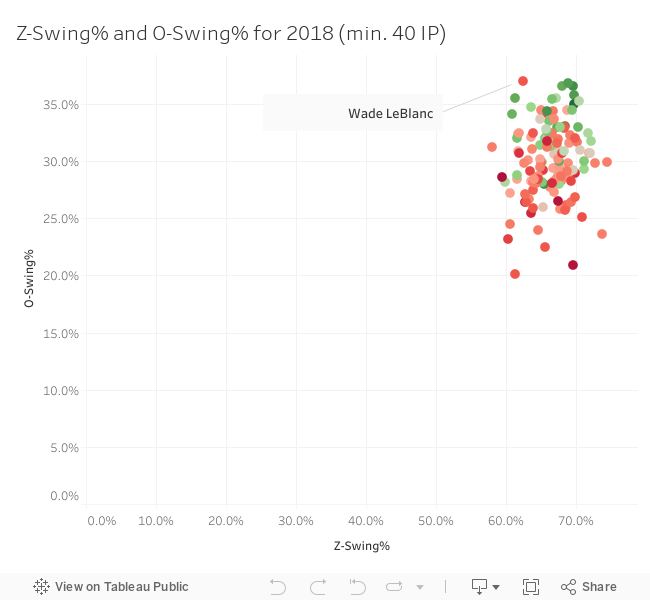
Since the beginning of May, LeBlanc has been almost unique in his ability to both freeze batters on good pitches and induce chases on bad ones. Last month, he and Zack Greinke were the only qualified starters to be among the 10 pitchers with the lowest Z-Swing% and the 10 pitchers with the highest O-Swing%. During that period, LeBlanc was the only one to make the top three of both lists.
The graph below includes stats for the entire 2018 season, and LeBlanc stands out, along with Greinke, Patrick Corbin and Domingo German, as a master of the freeze and the chase. What separates LeBlanc from the other three, aside from fantasy popularity, is the lack of a double-digit swinging strike rate. I have color-coded the pitchers in the graph for swinging strike rate, and the redder the dots, the fewer the whiffs. LeBlanc’s 8.0 swinging strike rate qualifies him for a very red dot.
While I did say that this version of LeBlanc is different, he has posted a high O-Swing% and low Z-Swing in the same season once before. In 2016, he got chases at a 35.7 percent rate and swings on pitches in the zone at a 64.1 percent rate. That year, however, LeBlanc allowed 14 home runs in 62 innings. He did get plenty of harmless flyballs; according to xStats.org, his popup rate was an above-average 22.6 percent. However, his high drive rate — representative of the most damaging type of contact — was 12.6 percent, as compared to the major league average of 10.0 percent.
What truly makes LeBlanc different this season is that he has made his contact-friendly approach work for him. His popup rate is up to 26.8 percent, while his high drive rate is a modest 8.0 percent. LeBlanc has allowed five home runs in 45 innings this season, and as a starter, he has given up three home runs in 31.1 innings. The sheer volume of popups has helped the lefty post a .271 BABIP on the season, and that in turn has contributed to a .240/.279/.368 slash line for opposing hitters.
To sum up, LeBlanc has been getting batters to leave his pitches in the strike zone alone and go after his pitches out of the zone. Hitters are connecting frequently when they do swing, but in contrast to his past track record, LeBlanc is not allowing them to do much damage, particularly in the form of extra-base hits. He is doing several things at an exceedingly high level except the one thing that fantasy owners typically care the most about.
Now that LeBlanc is stretched out, he should build on his grand total of one win, so he may be better than just a top-60 starting pitcher going forward. His lack of strikeouts will limit his value, but the same can be said of Kyle Hendricks, who also relies on favorable walk, called strike and soft contact rates for success. It’s taken Hendricks a while to get his due, and I suspect that even if LeBlanc continues to thrive, it will take him some time to get recognition as well. While there are good reasons to be reluctant to buy into LeBlanc right now, it’s time to take the gamble on him in deeper mixed leagues.
Strikeouts are up again this season, but there’s another trend affecting pitchers that has received less attention. As we approach the six-week mark of the 2018 campaign, pitchers are notably wilder than they have been in a long time.
For each season between 2011 and 2016, the average Zone% for the major leagues hovered between 44.2 and 44,8 percent. Last season, pitchers were less wild than they had been since 2010, locating in the strike zone at a 45.0 percent rate. So far this year, pitchers are wanting to have much less to do with the strike zone, as their collective Zone% has dropped to 43.4 percent.
Subpar control is not an early-season thing. Last March and April, pitchers combined for a 44.8 percent Zone% and in the previous March/April, pitchers were practically trolling hitters into swinging, posting a 47.3 percent Zone%. Another thing that mark from 2016 shows is that there is still plenty of time for Zone% to regress to its norm this season. Read the rest of this entry »
Here in the final week of April, sample sizes are starting to build up, but there is still a lot of statistical weirdness out there. Just in the walk rate leaderboard alone there are some confounding data for fantasy owners to ponder. Jose Quintana and Michael Wacha with double digit rates? Vince Velasquez among the lowest one-fourth? It’s like I hardly know these guys. Read the rest of this entry »
With managers relying more on relievers and less on starters last season, and with the emergence of fantasy-relevant non-closers like Chris Devenski, Chad Green and Archie Bradley, fantasy owners have been taking more interest in relievers who aren’t in line to get steady saves. Andrew Miller has long been on the fantasy radar, and he is currently owned in more than 60 percent of ESPN and CBS leagues. However, Bradley and Adam Ottavino are about as popular as some lower-end closers, as both are owned in more than one-third of the leagues on ESPN and CBS. Devenski, Green and Dellin Betances aren’t far behind in popularity.
On Thursday, the season reached its three-week mark, so we are not quite one-eighth through the schedule. In 2017, only five relievers exceeded 80 innings, but so far this season, there are already 43 relievers who have pitched at least 10 innings. Not everyone in this group will keep up this pace, and it’s not hard to imagine that some who stay on this pace will wear down and may even need some DL time. Read the rest of this entry »
This week’s exploration of lightly-owned hitters includes an aging veteran, a versatile defender with upside and a slugger on the rise. As always, each of the players featured here is worth considering in mixed leagues with at least 15 teams.
Note: Ownership percentages are listed in parentheses, with CBS listed first and Fantrax listed second.
Jose Bautista, OF/3B(?), Braves (9/27): The Braves signed Bautista to a minor league deal on Wednesday, and they are sending him to extended spring training to see if he can handle playing third base. If all goes well, Bautista would spend some time in the Florida State Leauge — perhaps within a week — and then presumably take over third base duties from Ryan Flaherty. Though Johan Camargo was activated from the 10-day disabled list on Wednesday, he would likely fill a utility role, so playing time shouldn’t be a concern for Bautista. In his final season with the Blue Jays, Bautista showed he still had some power left in the tank, slamming 23 homers, but both his hard contact and overall contact rates were on the wane. Taking a flier on Bautista is not without its risks, but if your team is short on power and well-positioned for batting average, he could be a good fit. Read the rest of this entry »
When a pitcher starts off a season with a new look, it’s hard to know whether or not you can trust their success. That’s especially true when that “new look” involves a change that we generally assume to be negative.
This is precisely the situation we find ourselves in with regard to Alex Wood. The Dodgers’ lefty has compiled a career-high K-BB% (23.3 percentage points) through four starts, even though his average sinker velocity is more than 3 mph lower than where it was last April. He seems to be carrying a red flag with the words “SELL HIGH” boldly emblazoned on it, but could it be that he has found a new way to succeed? Read the rest of this entry »