
Mike Podhorzer’s 2026 Tout Wars AL-Only Auction Recap
This past Saturday morning, I hopped on the NYC subway for the quick trip to Hotel Edison to participate in the annual Tout Wars AL-Only live auction and try to win a third AL-Only and fourth overall Tout Wars championship. It’s one of the most exciting days of the year, and it’s always bittersweet when it’s over, knowing that I’ll have to wait an entire year to auction with these lads again.
Before I share my team, let’s review my auction philosophy and the Tout league rules. For every league, whether an auction or snake draft, I calculate dollar values on my own, which helps me understand general replacement level stats at each position.
I don’t generally come in with a “strategy”, as I simply want to maximize the value of my squad by the time my last player is rostered, while being cognizant of statistical balance and risk. The only way to do that is to buy as many discounted players to my calculated values as possible, all the while ensuring I spend my entire budget (obviously it does you no good to buy 23 $1 players, even if they are actually all worth $5 each!). Therefore, it makes no sense to target players (“get your guys”) or allocate a budget to each position. Doing so increases the likelihood that you end up buying only $260 worth of value for your $260, or worse, less than that. That’s not going to result in a championship team without a heavy dose of good fortune and shrewd in-season transactions.
The Tout Wars AL-Only league is a 12-teamer composed of 23-player starting rosters, with the only statistical wrinkle coming from the usage of OBP instead of AVG in the 5×5 categories. This is a massively important distinction, as the switch could dramatically alter a hitter’s value (think Mike Trout, with an ATC projected .234 AVG, but above average .347 OBP thanks to a 13.6% walk rate). So keep that in mind when reviewing the team. In addition, we only require four starting outfield slots instead of five, switching one of those slots to a “Swingman” role. That spot could be filled by either a hitter or a pitcher and can be changed each week. Because hitters contribute in four counting stats and pitchers only three (starting pitchers only two!), I play a hitter there like 99.9% of the time.
In addition, there was another tweak to roster slots a couple of years ago, as the Middle Infield (MI) and Corner Infield (CI) slots were merged into Infield (IF), while a second Swingman slot was added. That means there are now three of 14 hitting slots that could be filled with any position, and two of those three could be filled by a pitcher. Talk about flexibility! It makes rostering a DH-only guy far more palatable, as the inability to move such a player around to another slot isn’t as problematic. Lastly, we have just four IL slots, making rostering already injured or injury-prone players a bit riskier than in the past when there were unlimited slots.
With that background out of the way, let’s check out my roster. You can view the results of the entire auction here.
| Roster Slot | Player | Cost |
|---|---|---|
| C | Ryan Jeffers | 14 |
| C | Logan O’Hoppe | 9 |
| 1B | Willson Contreras | 20 |
| 3B | Munetaka Murakami | 19 |
| 2B | Jonathan India | 7 |
| SS | Kevin McGonigle | 13 |
| IF | Kyle Manzardo | 11 |
| OF | Jarren Duran | 25 |
| OF | Isaac Collins | 7 |
| OF | Chandler Simpson | 16 |
| OF | Trent Grisham | 11 |
| U | Nolan Schanuel | 13 |
| Swing | Matt Wallner | 10 |
| Swing | Josh Bell | 8 |
| P | Jeff Hoffman | 17 |
| P | Jack Flaherty | 14 |
| P | Nathan Eovaldi | 16 |
| P | Ranger Suarez | 12 |
| P | Justin Verlander | 1 |
| P | Joey Cantillo | 4 |
| P | Cody Ponce 폰세 | 4 |
| P | Taj Bradley | 1 |
| P | Grant Taylor | 5 |
| Res | Slade Cecconi | |
| Res | Lance McCullers Jr. | |
| Res | Mark Leiter Jr. | |
| Res | Jordan Romano |
This was a wild auction. I’ve been in this league since 2014, and if it didn’t rank at the top for shock, it was darn near close. Between an owner with lots of money left for his last slot being advised to spend it on an injured player to ultimately convert into FAAB, to the lowest percentage of auction dollars allocated to hitting I’ve seen, to a record setting winning bid, this auction had it all! We did have two new fantasy players join us, which always mixes things up. However, I don’t think either of them were in on the bidding when Aaron Judge ended up being purchased for…$62! The funny thing is that I had just talked myself in going to $50 (versus my ~$53 projected value) for him and for a moment, thought it was possible I can win him for that price. Then a bidding war ensued and when the dust settled, a record winning bid was set, which was followed by some hilarious jokes.
I ended up spending about 71% on my hitting, which is pretty low for me. But that was because pitching was going for significantly more than my values, so I was unable to find the type of discounts I typically count on to build my staff. I don’t think this staff looks a whole lot better heading into the season than the usual Podhorzer Tout Wars staff, it simply cost more. It’s all relative though, so I don’t think my hitting necessarily suffered.
Alright, let’s talk names.
There were absolutely no catcher discounts early on and one of the names I was hoping to roster went well above my value. So I settled for an at-value Ryan Jeffers and then I was still hoping for one of the names I highlighted in green for various reasons. I had to go just above my value for Logan O’Hoppe, but that was okay because I think he has the potential to slaughter his projections after visiting Driveline Baseball this offseason. It’s why he was part of my bold predictions. Evaluating Spring Training stats is mostly a fool’s errand, but O’Hoppe has shown vastly improved plate discipline metrics, and has already recorded a maxEV barely below 2025 and above anything he had posted previous to that year. Perhaps this is the signal that he’s really in for a Driveline-fueled breakout…or merely small sample noise.
The top first base names were flying off the board, many at heavily inflated prices, which made me worry I was going to have to dumpster dive for mine. So I was thrilled to get the Red Sox’s new cleanup hitter in Willson Contreras without having to overpay.
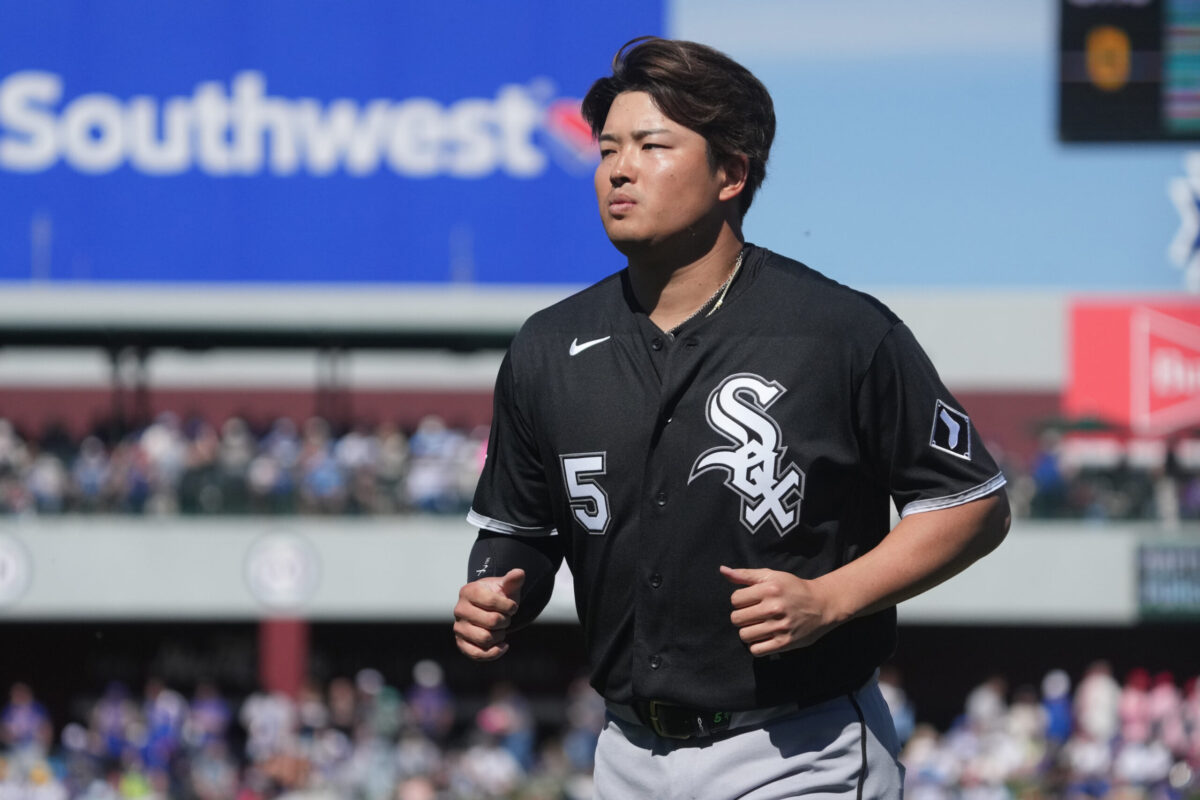
So…Munetaka Murakami. I am so conflicted on him that I actually can’t believe I paid $19 to roster him. On the one hand, I am quite concerned about his ability to hit high velocity fastballs, resulting in tons of strikeouts. Nearly all the projections call for a strikeout rate over 30%. Initially, I wondered if he could hit poorly enough that he earns a demotion. Then I remembered he’s on the White Sox on a $34 million contract, so there’s almost no chance he ends up at Triple-A. So okay, but poor performance is going to kill my team and result in a loss, right? Well, remember the note above about Tout’s usage of OBP instead of average? It comes into play here. Murakami’s lowest walk rate in NPB has been 12.5% and he walked as often as 19.3% of the time, back in 2022. Last year, he posted a 14.3% walk rate. He’s been a walk machine, which is going to likely result in one of the largest AVG vs OBP format value gaps in all of fantasy baseball.
Depending on his strikeout rate and BABIP, he could end up being just a neutral in OBP or a real plus. Even with all the strikeouts, he owns massive power, so he’s really not all that different than a Vinnie Pasquantino (who went for $25) or Spencer Torkelson (who went for $18), with greater OBP upside. The hope here is that he’s some mix of peak Adam Dunn and Joey Gallo, which is quite valuable in OBP formats. Also, third base really stinks in the AL this year after the top two names, so you’re almost certainly speculating on someone.
I loved buying Jonathan India for a second straight season, but after last year’s down performance, ended up saving $10. The fences moving in, plus hopefully better health, should yield a nice profit.
Kevin McGonigle! This could have been my most surprising buy. I a) expected him to be nominated early based on the hype of his top prospect status and strong Spring performance, and b) go for well above any reasonable projected value. Instead, there must have been like 10-12 names qualifying at SS nominated before him and I didn’t nab a single one. With money to spare, I knew I had to buy him, but often times when there’s one player left at a position that’s far and away the best, he goes for way over value. That didn’t happen this time. I would think it would be an upset if he didn’t open the season as the starting shortstop in Detroit at this point and he’s done nothing so far to suggest he’s not ready to succeed, despite nary a PA at Triple-A. A full season, especially in the leadoff slot, would yield lots of profit.
It’s not a Podhorzer team if it doesn’t include a speed-only guy. Okay, so Chandler Simpson is also a slight positive in OBP, but I’m also giving up a lot in three counting categories at that price. This now makes Simpson a part of two of my industry league rosters and I keep asking myself why he’s coming at such a discount. I guess the worry is that with a projected sub-.300 wOBA and poor outfield defense, he’s not going to remain a starter all year. And he’s already likely to platoon as it is, so his playing time outlook is quite cloudy. I absolutely understand the concern and agree with it, but the discount is so large, he doesn’t need to even reach 500 PAs to yield profit. I think in this situation, the market has overcorrected for the concern and he’s significantly undervalued. But hey, Billy Hamilton and his ilk have burned me before, so maybe I should just learn my lesson and let another team take the risk. Ehhh, 2027 will be the year.
Boy, I didn’t expect to roster 2025 fantasy breakout Trent Grisham! Even with massive regression projected, he was still a deal at just $11. Once again, I think he’s the type that industry vets end up overcorrecting on because they figure last year was a fluke and don’t want to be that owner to roster a bust after a surprise breakout.
I knew I would end up with Nolan Schanuel and even though I was looking for more power in that slot, had to take the discount that was presented. That was likely due to so much of his projected value being driven by OBP, which is not as predictable as the counting stats. I was particularly encouraged by new that he spent time over the offseason working to improve his bat speed and barrel control. At least he acknowledges his weaknesses, which is the first step toward improving them. I still feel like there’s gotta be a power spike in here at some point.
I finished my hitting squad with Matt Wallner and Josh Bell, the best combination of value and power still available at that point in the auction. I felt I got values on both and it gave me the additional projected home runs I needed after rostering two guys forecasted for single digit totals.
Phew, finally done with my hitters, so we now move on to my pitching staff.
It was weird to start my staff with a closer, but after every single one went well above my value, I knew I had to just pick one and try to get a relative discount. The AL closer pool is quite shaky, so it’s rather important to get a locked in guy, or you’ll have to speculate in one of the many unsettled situations where the options aren’t very good. After two straight sub-3.00 ERAs and strikeout rates North of 30%, Jeff Hoffman was surprisingly bad last year. However, he posted much better SIERA and xERA marks and plans to throw his elite slider more this year, which could result in a strikeout rate jump. I think he’ll return to the top tier of closers.
Starting pitcher prices were insane. My projected top 10 went for just over 14% more than my calculated values. Of course I can’t say whether my projected values are correct, whether it’s the projections driving them or my valuation methodology, but this has to be the largest inflation I’ve seen. I rarely dip my toes into the top tier of pitching anyway, but even the mid-tier was mostly rich, making it difficult to find any discounts at all.
As such, I ended up with the most boring core imaginable in Jack Flaherty, Nathan Eovaldi, and Ranger Suarez. I don’t have any particularly unique opinions on the trio, and although I’m not expecting Eovaldi to come anywhere close to another sub-2.00 ERA, it’s cool that his four-seam fastball velocity average is back above 95 MPH so far in Spring Training. Last year, it dipped to a career low 94.1 MPH, and while that had absolutely no impact on his results, it’s still not a good thing to see for a pitcher in his mid-30s who could rapidly decline in any season.
I made my first and only oopsy with my Justin Verlander buy. At the time, I had enough money to outbid most on players I wanted, but I still wanted to be prudent and not screw myself by nominating a player and paying more than I hoped for. I nominated Verlander with the full expectation someone would at least say 2. Nope, crickets. Funny, because I preferred Will Warren in that spot, but figured for sure he would go for a couple of bucks, but instead, he was nominated shortly after and went for just a buck. Oh well.
With a wealth of low-upside pitchers left, Joey Cantillo was one of the few that at least has the potential to produce solid value and a good strikeout rate. I wanted Cody Ponce given his work in KBO, making it the second time I’ve rostered him now in these industry leagues. I had no idea what my leaguemates thought of him, so I kept waiting and waiting to nominate him and ended up only having to pay $4 to find out whether his massively increased fastball velocity will result in a strong strikeout rate and huge profit.
At the end, I meekly nominated Taj Bradley, also expecting some sort of enthusiastic bidding, thanks to increased fastball velocity, a 32.2% Spring strikeout rate, and a new team potentially turning around his career to look more like the top prospect he once was. That didn’t happen and I was excited to roster him for just a buck, though I ended up leaving $3 on the table because of the lack of other bidders.
Finally, I decided to speculate on saves with Grant Taylor to round out my staff, rather than buy another starter since there was no one appealing still available. While the White Sox signed
Seranthony Domínguez to serve as their closer, his fastball velocity is down 2.4 MPH so far in just a couple of innings and he really struggled with his control last year. It makes him vulnerable to losing his job. While Taylor might not see more than an occasional save, he shared a goal of reaching 100 innings this year and if the former starter gets there, he’ll make up for a lack of saves with ratio and strikeout contributions.
Finally, I always like to load up my bench with pitching speculations. There were absolutely no hitters I was interested in in the reserve round as I had hoped Rhys Hoskins would make it there before Larry Schechter smartly bought him near the end of the auction for a buck. With him gone, I made Slade Cecconi my first pick. I didn’t care for him before Spring Training, but his four-seam fastball velocity is up and he has totally changed his pitch mix, throwing that pitch, along with his slider, less frequently, while significantly increasing the usage of his cutter, which he rarely threw the last two seasons. With a 13.9% SwStk%, versus single digit marks throughout his short career, we might be witnessing a totally different pitcher rendering the projections pretty meaningless. He makes for a perfect cheap speculation as a result.
Next up was Lance McCullers Jr., the oft-injured Astros starter who was abysmal last year after missing all of 2023 and 2024. Before last year, he was consistently really good, and at the risk of sounding like a broken record, has also seen his velocity up during Spring Training. In fact, it has so far rebounded back to his 2022 level, while he has changed his pitch mix. It makes me a bit more optimistic of a rebound.
Who is the Athletics closer? Beats me! But I do know that none of the options stand out, which means it could be Mark Leiter Jr. He posted poor ERAs the last two years, but the underlying skills were good, leading to significantly better SIERA and xERA marks. A worthy dart throw as a second-to-last reserve pick.
Speaking of dart throw, who is the Angels closer?! Jordan Romano was once an elite closer, but has posted unbelievably inflated ERAs the last two seasons. However, both his SIERA and xERA suggest last year was a massive fluke and clouded by awful luck. He ain’t that bad! With only a 39-year-old Kirby Yates and the left-handed Drew Pomeranz to compete with at the start, Romano seems like another excellent closer speculation.
***
So does this team have a chance of competing for a championship? Who are your favorite buys and those you felt were weakest?
Mike Podhorzer is the founder of ProjectingX IQ, an advanced fantasy baseball analytics platform that transforms projection data and in-season performance signals into actionable intelligence. He is the 2015 Fantasy Sports Writers Association Baseball Writer of the Year and three-time Tout Wars champion. He is the author of the eBook Projecting X 2.0: How to Forecast Baseball Player Performance, which teaches you how to project players yourself. Follow Mike on X@MikePodhorzer and contact him via email.
Wondering:
Thanks!
No, I would bid on shortstops during the first FAAB run to buy a replacement. He’s not going to be a good replacement, but it’ll be better than taking zeroes!
No, I don’t target categories by position. It just so happened to work out that way based on the values that came, which are totally unpredictable.
McGonigle isn’t even on the 40-man.