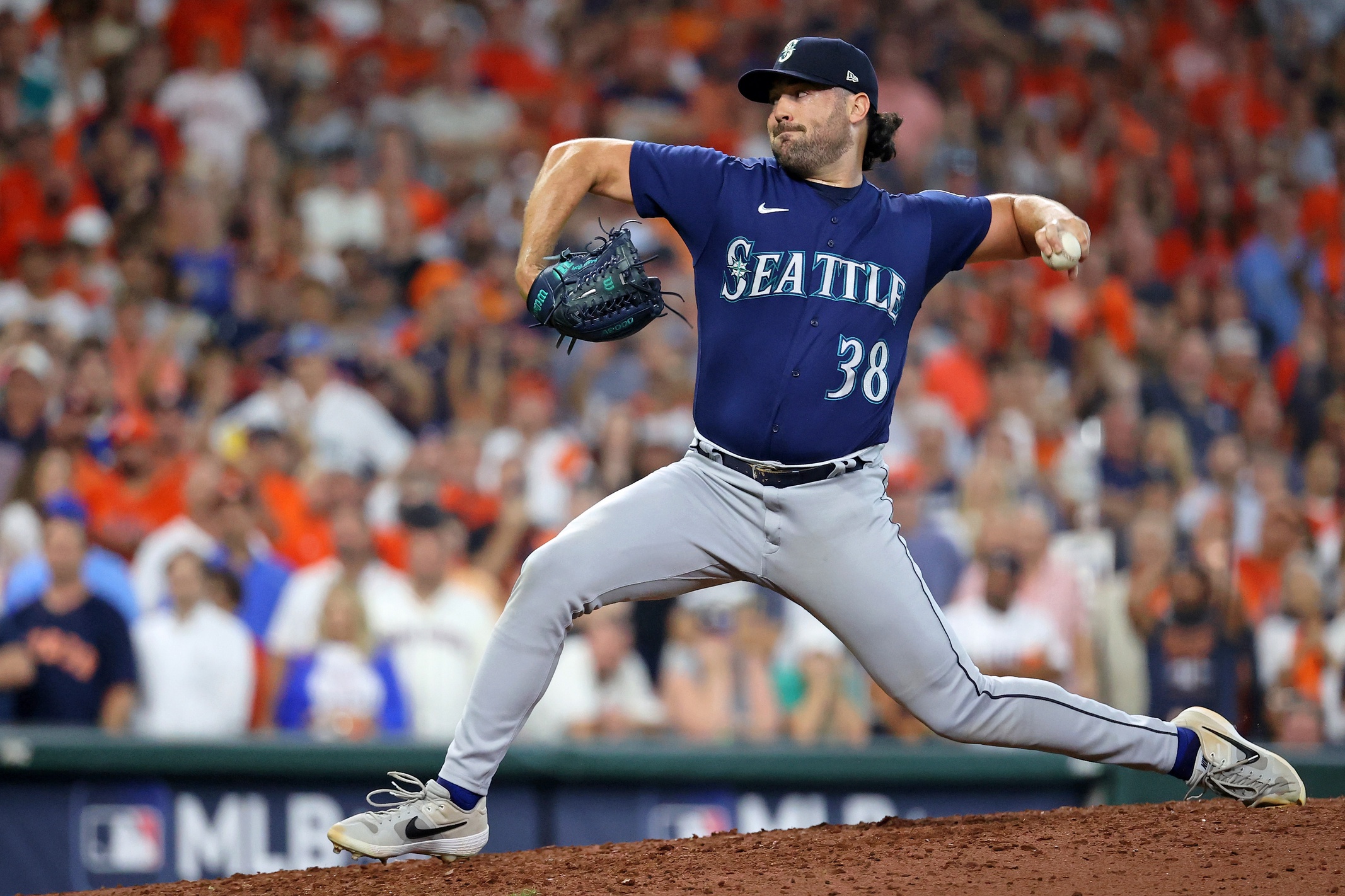
What happened!? That’s the question we ask the morning after a stinker performance by a starting pitcher when we’re looking over our fantasy results from the night before. It’s not an easy question to answer, and even when you come to a conclusion, someone else may have a completely different perspective. This article series serves as the starting point for answering that question in the context of three individual outings. Read the rest of this entry »
The final study I’ll run is looking at how much stock should a person have in a month of pitching stats. I wanted to understand these correlations since I quote them a ton. The usual suspects top the list with an interesting find on WHIP projections. Read the rest of this entry »
Did you load up the auction calculator a few weeks ago and see Mason Miller listed as the 20th-best starter? Load it up again today, and you’ll only see Miller on the relievers page. That’s because Miller’s 2024 role is hard to pin down. Last year, the year Miller made his debut, the young right-hander in Oakland started six games and appeared in relief in four. As a starter, he recorded a 3.70 ERA and as a reliever, 4.00. So after only 33.1 IP in 2023 without a clear role defined, what’s a fantasy manager to do?
Part one of this installment looked at four-seam fastballs and cutters. Part two analyzed sinkers and splitters. Part three, our final act, will detail sliders, curveballs, and changeups.
There are all kinds of ways to measure the effectiveness of a pitch. Pitch Values (pVals) or “Pitch Type Linear Weights” give us a sense of, from the glossary, “…the changes in average run expectancy from one count to another”.
while the changes in run expectancy between an 0-0 count and a 0-1 or 1-0 count are obviously very small, when added up over the course of the season, you can get an idea of which pitch a hitter was best against.
pVals are not predictive and they don’t explain the true talent or raw characteristics of an individual pitch the same way Stuff+ or other pitch models can, but it does tell us what actually happened. Now, imagine that! You can dig into the specifics of pVals on the glossary page but for now, let’s celebrate this season’s greatest pVals.
Part one will look at four-seam fastballs and cutters. Part two (coming soon) will focus on sinkers and splitters.
It has always been difficult for me to understand pitcher volatility. Well, the volatility part isn’t hard to understand, actually, it’s very simple. Pitching in the big leagues is incredibly difficult and one tiny little element of a pitcher’s game could be off to make the whole outing unravel. But, what is hard to understand is what little element that is. Did a 1 mph drop on a four-seamer really make it all go south? Or, was it a matter of half an inch of location? Is it even measurable? Like, what if it was just bad gas from the previous night’s chimichanga that threw things off? Do you see where I’m going? I want to know why a pitcher does so well one day and so poorly the next. For my first round of this, I’ll start slow and focus on only one pitch, narrowing the question down to, why does one pitch perform well one day and bad the next? In today’s investigation, I’ll analyze and compare Robbie Ray’s July 3rd 2.6 wSL Pval (Pitch Info) with his July 24th -3.4 wSL pVal. Let’s have some fun. Read the rest of this entry »
How do you really know how well a pitcher’s fastball will perform before the season starts? You don’t. You basically just make an educated guess. Choosing good fastballs from the previous year seems to be a good way to go. But, choosing changeups that performed well in the past can bite you. While it may seem silly to get this micro, this niche, it can be a lot of fun to make picks before the season begins, and then forget about them. There’s no IL, no waiver claims, and no bench to ride. It’s just your preseason picks and the ever-rolling season and when it ends, you get to look back and either ask yourself, “What was I thinking?”, or, you get to puff your chest out and spend the winter months assuring yourself that you are a pVal prediction wizard. Pitching coaches should really be calling you when spring training kicks off again. Let’s take a look at where each of us FanGraphs contingent pVal competition participants finished out the 2022 season. As a reminder, here are all the picks you can make, provided to us by our friends at Pitcher List.
Here’s a shock; Reynaldo López holds the sixth-best WAR and sixth-best FIP (as of games through 9/28/22) among qualified relievers in 2022. If you rostered him from the start of the season until now, which I’m sure you didn’t, you would have accumulated five wins, leveled out your ERA with a 2.84 contribution, and almost certainly lowered your overall WHIP thanks to his career-low 0.93.
In 2022 López lowered his BB% by nearly eight percentage points and increased his K% by over five percentage points when compared to his 2020 season. Just look at how his statcast percentile ranks have changed over that time:
How did he do it? I won’t dance around the answer trying to build tension, I’ll just deliver it up front; he became a reliever and started throwing harder. In 2022, he only started one game and in that start against the Texas Rangers on June, 10th, he only threw two innings, acting as an opener in what essentially was a bullpen game.
At the end of the 2020 season when López was 26 years old and holding a 6.49 ERA, the White Sox didn’t know what to do with the big righty. He started nine games and only threw 57.2 innings. In 2021, he bounced back and forth between reliever and starter roles, and in his reliever roles, he averaged two innings. In 2022, only 14 of his 59 games have gone over one inning. When a pitcher knows he is only going out for one inning, he can put a little more ompfff in his fastball:
It would certainly seem that throwing the ball harder on all of his four pitches used in 2022 has led to overall improvements, but each pitch on its own has improved in Whiff%. In addition, his overall out-of-zone swing % has improved.
So, is it that simple? Throw the ball harder for a shorter period of time and you’ll be better? You’ll double your WAR in a single season and you’ll more than double your WAR from two seasons ago? Decreasing his FIP has gone a long way when it comes to increasing his WAR. If a pitcher limit’s their home run totals while also limiting the walks they give up, they are on their way to an improved FIP.
But the real kicker here is that while he has lowered his FIP, increased his Whiff%, increased his Chase%, lowered his ERA, his WHIP, and his BB/9, López has held an unsustainably low HR/FB rate in 2022. He has only given up one home run on the year. Last year, he gave up 10. It’s not necessarily crazy for a reliever to give up only one home run. So far in 2022, there have been five qualified relievers who have given up one home run and 14 qualified relievers have given up only two home runs. But, scroll back up and look at López’s statcast percentiles and you will see that he still gives up hard contact.
In every year of his career, López has been above the average of balls in play that are fly balls. If he is still giving up hard contact, but in smaller samples as a reliever, and he is still putting the ball in the air more often than the average, yet he is no longer giving up home runs, what will happen?
Steamer projected 13 home runs to be hit off the Chicago righty, but to be fair, he was mostly projected as a starter. Regardless, let’s re-calculate his FIP on the year and throw in five more home runs for a total of six. His FIP is now 2.96 which is more in line with his xFIP of 3.27. Finally, here’s the point: Reynaldo López has gotten lucky this year with home runs. He has limited his walk rate and the home runs he has given up tremendously, but it’s not sustainable.
This may seem like an off-season article, but we’re nearly there. You may be looking through leaderboards and you may notice López’s excellent reliever WAR standing to finish off the year. You may notice his FIP. You may notice his velocity increase, his new role, and his improved whiff rate. Don’t get me wrong, López has had a nice season. It has been a great way to bounce back and become relevant once again. But, hidden under all those improvements, is fly ball/home run luck.
At the start of the 2022 season, the always gracious Nick Pollack and friends at PitcherList lent the FanGraphs staff the pVal draft template and a few of us conducted a slow draft of all slow drafts. It was great! Tweets were tweeted, points were tallied and now, it’s time to take a look at how we’re doing. If you want a little pVal background, you can read my previous posts, Highfalutin pVals or Sweet Swirlin’ Secondaries. Or, you can read our glossary explainer, or just head over to the 2022 leaderboard and click around.
Before we get into the results, here’s a quick rundown on how this works. Each participant drafts an individual pitch and your goal is to maximize the sum of your pitch pVals. Just like a traditional fantasy manager must draft certain positions (OF, SS, SP, RP, etc.,) the pVal drafters must choose different pitches:
Participant: Lucas Kelly Current Place: 3rd Best Pitch So Far: Michael Kopech’s four-Seam fastball Worst Pitch So Far: Walker Buehler’s four-Seam fastball
Lucas pVals
Player
Category
Pitch
Points
Walker Buehler
3x Fastballs (wFA, wFS, wFC, wSI)
wFA
-9.2
Zack Wheeler
“
wFA
7.9
Alex Cobb
“
wFS
0.2
Max Scherzer
2x Sliders
wSL
6.3
Cristian Javier
“
wSL
-0.2
Corbin Burnes
1x Curveballs
wCU
7.5
Lucas Giolito
1x Changeup
wCH
-2.3
Shohei Ohtani
1x Secondary
wFS
-1.7
Yu Darvish
1x 2021 Negative pVal
wFC
-0.4
Matt Harvey
1x Negative Regression
wCH
0.0
Liam Hendriks
2x Util
wFA
-0.1
Michael Kopech
“
wFA
9.8
Alek Manoah
2x Reserves
wFA
6.4
Hunter Greene
wSL
5.8
*PitchInfo Pitch Type Value
**Highlighted values have been replaced with Reserves
3x Fastballs:
Walker Buehler’s four-seamer was my first pick and I thought I had taken candy from a bunch of babies. The pitch earned a pVal of 17.9 in 2021 and with his 207.2 innings pitched that season, I thought it was a guarantee points getter. This year, however, opponents are hitting .377 against the pitch and slugging .638. It’s being hit hard 51.6% of the time and has a very low 8.6% K%. The pitch has been used only 33.1% of the time, a career-low, and he’s increased his cutter usage to 25.1%. While the cutter is performing better than the four-seamer, the effective combination of both pitches led to success for Buehler in the past. Nicklaus Gaut wrote about Buehler’s spin rate decreases in his latest post. He did a great job of analyzing what has been going wrong with the pitch.
Zack Wheeler‘s four-seamer is right where I want it to be. Its usage is in the low 40% range which is right in line with where it was when it earned 16.7 pVal points last year. It has a 36.7% K%, a career-high, and hitters are getting to it with a .215 batting average. It is being hit hard 47.4% of the time which is a little concerning, but just a little. Alex Cobb’s splitter is being used at a career-high 40.8% and has an xBA of .149! That’s great. We’ll have to see if his health can keep him throwing the pitch. He’s currently on the IL with back trouble.
2x Sliders: Max Scherzer, please come back!..and wear mittens when you’re helping injured dogs. Scherzer’s slider has a very nice 32.5% K% on the year so far, but it’s well below his career-best 50% in 2017. While I don’t expect it to reach career-level marks, the pitch didn’t seem fully refined at the start of the season and I think there’s room for improvement once he’s back. I’m not sure what to make of Cristian Javier’s slider. He’s only thrown 235 of them so far this year, but it has a 44.9% K% and a .182 batting average against. In 2021 the pitch accumulated 12.0 pVal points in 101.1 innings and this year, Javier is on pace (GP%) for 126.0 innings. I think there’s room to grow here as well.
1x Curveball:
I think I did it! I think I picked a good pitch. Corbin Burnes‘ curveball is currently a league leader with a 7.5 pVal. He’s closely followed by Framber Valdez (6.4), Shane McClanahan (6.3), and Kyle Wright (6.3). It has been Burnes’ best secondary and he’s using it a career-high 19.7% of the time. It has a 47.1% K%, hitters are batting .080 against the pitch, and it is hard hit only 15.4% of the time.
1x Changeup:
Yikes! Lucas Giolito hasn’t found the changeup yet and its usage is down. Its K% is still high at 41.5% but hitters are likely laying off (.371 wOBA) and getting to it (.267 BA, 21.7% Hard-Hit%) more than what the man with a fantastic first name would like.
1x Secondary:
I have a thing for splitters and I really just wanted to take a Shohei Ohtani pitch so that I have even more to root for when I watch him pitch. As of now, he’s only thrown the pitch 25 times and it has been hit with a .333 BA. I’d say it’s too early to tell, but he’s got some catching up to do if he wants to get back to the 14.2 pVal points he earned with the splitter in 2021.
1x Negative pVal:
This one is fun. The idea is to draft a pitch that had a negative value last season and bet that it improves this season. Last season Yu Darvish’s cutter earned -2.8 pVal points. To be honest, I saw a GIF of a dirty Darvish cutter from the past and thought, “There’s no way that pitch is negative in 2022.” So far, I’ve been wrong. He’s still using it 32.7% of the time but it’s getting hit hard with a .337 xBA and a .533 xSLG. He’s putting the cutter in the zone (57%) more than the MLB average (45.8%) and that could be part of the reason for the high xBA. Darvish’s PitcherList player page shows a .321 BABIP on the pitch vs. the .295 MLB average on cutters, so perhaps there’s still some hope.
1x Negative Regression: Matt Harvey’s changeup earned 4.7 pVal points in 2021. I didn’t think he could replicate that again and it looks like I might be right, just for reasons other than what I had in mind at the time.
2x Util:
Cool fact; Hanser Alberto and Liam Hendriks have the same wFA pVal, -0.1. Go figure. In one way, this shows how pVals really need to be understood before they’re used to make any grand statements at your local watering hole. In another, it goes to show you that Liam Hendriks has struggled with the pitch in 2022. It’s just getting hit too often and too hard; .349 wOBA, .277 BA, .462 SLG, .578 xSLG. Kopech’s fastball on the other hand is my money maker and currently sits 3rd best in the MLB according to pVal.
2x Reserves:
Last but literally not least are my reserve picks. Lucky for me, the rules of the pVal competition allow me to drop the two worst performing pitches and replace them with my reserve picks. Alek Manoah‘s four-seamer is bringing my total back up and as long as he keeps utilizing his three positive pVal pitches (6.4 wFA, 2.6 wSI, 4.7 wSL), he’ll likely be replacing another pitch all season. Hunter Greene’s slider is the only of his pitches holding positive pVal this season and that’s fine with me. Baseball fans everywhere were excited to see Greene’s 99th statcast percentile fastball velocity on a more regular basis in 2022, but the pitch has not been effective from a pVal standpoint at -12.8. It’s being put in the zone a little too much and getting hit (.352 BA) a lot too much. The slider, however, is only getting a .112 BA and has been impressive thus far with a 40.4% Whiff rate.
Time will tell if my squad will be able to reach Luke Hoopers pVal leaders. What I do know is that this pVal draft was a lot of fun to conduct and has been a lot of fun to score. If you can find a few friends to participate in one, do it. It’s another great way to interact with the game. Thanks again to the PitcherList crew for sharing the rules of the game with us and stay tuned for more updates throughout the season.
The first inning of any spring training game should come with tempered expectations, but I always find myself like the kid in the bleachers whose parents thought it would be a good idea to just get the ice cream out of the way before the first pitch is thrown. With a chocolate-smeared face and wide eyes, I find myself taking in every pitch as if I’ll never see another game again. So, maybe that’s why my reaction to Clarke Schmidt’s first inning against the Phillies motivated me to write about the Yankee righty, or maybe, he’s a pitcher that should be on your radar in keeper and dynasty leagues. Let me preface this article with the mutual understanding that I am not a prospects guy, I’m just a kid watching from the bleachers taking in the sunshine with chocolate on my face, excited to see baseball again.