
Catchers … What a Dumpster Fire
Catchers … what a dumpster fire for a fantasy position. I can’t remember it being worse. It probably was at some point but with the increased knowledge of pitch framing, more horrible hitting catchers are accumulating plate appearances. Today, I’m going to go through the natural catcher tiers for various league types and show where owners need to buy for the best values.
Before I go any further, I need to explain a few concepts. I’m going to be using Standing Gain Points (SGP) to differentiate the various players. The main reason I like to use SGP is it takes all of player’s Roto stats and combine them into a single value. This important with differentiating the value of a speedster leading off or a middle of the lineup slugger. Additionally, I’m using The Process’s 15-team, two-catcher formula for all the following comparisons. It may not be the perfect formula when comparing different league types but it will provide a nice baseline.
To put into perspective how bad catchers are, I’ll start with my recent non-adjusted hitter rankings. The first catcher, Gary Sanchez, was valued as the 88th hitter. The next two were J.T. Realmuto at 169th and Buster Posey at 170th. Overall, the position is a mess but I need to start the analysis by finding the talent range within the position before bringing in other hitters.
There is no better way to start the catcher discussion than the following graph of the top-40 ranked catchers.
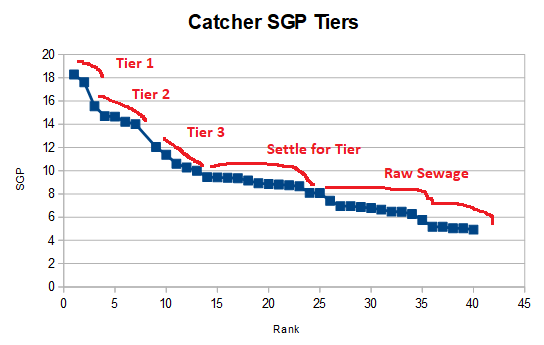
Before I go on, here the top-31 with the SGP for various leagues sizes.
| Rank | NAME1 | Non-Adjusted | 12T, 1C | 15T/2C | 12T/2C | 15T/2C |
|---|---|---|---|---|---|---|
| 1 | Gary Sanchez | 18.3 | 8.3 | 8.9 | 10.2 | 11.6 |
| 2 | J.T. Realmuto | 17.6 | 7.6 | 8.2 | 9.5 | 11.0 |
| 3 | Salvador Perez | 15.5 | 5.6 | 6.2 | 7.5 | 8.9 |
| 4 | Willson Contreras | 14.7 | 4.7 | 5.3 | 6.6 | 8.0 |
| 5 | Yadier Molina | 14.6 | 4.7 | 5.3 | 6.6 | 8.0 |
| 6 | Buster Posey | 14.2 | 4.2 | 4.8 | 6.1 | 7.6 |
| 7 | Yasmani Grandal | 14.0 | 4.0 | 4.6 | 5.9 | 7.4 |
| 9 | Wilson Ramos | 12.0 | 2.0 | 2.7 | 4.0 | 5.4 |
| 10 | Mike Zunino | 11.4 | 1.4 | 2.0 | 3.3 | 4.7 |
| 11 | Danny Jansen | 10.6 | 0.6 | 1.2 | 2.5 | 3.9 |
| 12 | Francisco Cervelli | 10.3 | 0.3 | 0.9 | 2.2 | 3.6 |
| 13 | Tucker Barnhart | 10.0 | 0.6 | 1.9 | 3.3 | |
| 14 | John Hicks | 9.4 | 0.1 | 1.4 | 2.8 | |
| 15 | Jorge Alfaro | 9.4 | 0.0 | 1.3 | 2.8 | |
| 16 | Robinson Chirinos | 9.4 | 1.3 | 2.7 | ||
| 17 | Jonathan Lucroy | 9.4 | 1.3 | 2.7 | ||
| 18 | Kurt Suzuki | 9.1 | 1.1 | 2.5 | ||
| 19 | Welington Castillo | 8.9 | 0.8 | 2.3 | ||
| 20 | Francisco Mejia | 8.9 | 0.8 | 2.2 | ||
| 21 | Austin Hedges | 8.8 | 0.7 | 2.2 | ||
| 22 | Tyler Flowers | 8.7 | 0.7 | 2.1 | ||
| 23 | Mitch Garver | 8.7 | 0.6 | 2.0 | ||
| 24 | Austin Barnes | 8.1 | 0.0 | 1.4 | ||
| 25 | Yan Gomes | 8.1 | 1.4 | |||
| 26 | Christian Vazquez | 7.4 | 0.8 | |||
| 27 | Omar Narvaez | 6.9 | 0.3 | |||
| 28 | Brian McCann | 6.9 | 0.3 | |||
| 29 | Grayson Greiner | 6.9 | 0.2 | |||
| 30 | Isiah Kiner-Falefa | 6.8 | 0.1 | |||
| 31 | Martin Maldonado | 6.6 |
The drop from the first tier to the second and second to the third is about 2 SGP which equates to about $4 in auction value (more on this in a future article) using a 67/33 split. These are significant breaks.
While I personally may be out of the top two who both have an NFBC (15-team, 2 catcher league) ADP (average draft position) of 59. The next five have ADPs of 105, 141, 144, 148, 156. I would like to emulate my closers strategy, I want to own one from this tier but hopefully, pay for just the last one.
The participants in the NFBC have also noticed this gap with the next catcher going at pick 243 and eight more going before pick 276. The similarity in pick and these values are almost eerie.
The talent really begins to thin out with catchers 14 to 23 separated by just 0.7 SGP. From there on, the talent pool just drops as playing time becomes harder to come by.
Using the above table, the replacement level talent in the tiers can be seen. “Talented” catchers with “decent” better replacements can normally be found in both one -catcher leagues. In two-catcher, 12-team leagues, the talent starts dropping off right at the last pick so the key here is to not be the last person taking a catcher. Finally, in two-catcher, 15-team leagues, there are the same top-23 guys and then raw sewage. My goal is to stay out of the sewage and get two of the top-23.
For a comparison of the various replacement levels, here are the stats for the three catchers at and around the last catcher picked for each league type.
| League Type | AB | R | HR | RBI | SB | AVG |
|---|---|---|---|---|---|---|
| 12T/1C | 392 | 45 | 10 | 48 | 3 | .253 |
| 15T/1C | 363 | 42 | 13 | 45 | 2 | .231 |
| 12T/2C | 302 | 37 | 10 | 37 | 3 | .239 |
| 15T/2C | 337 | 33 | 7 | 34 | 2 | .236 |
The one advantage of getting one of the top-12 is a higher batting average and more counting stats.
The final step is to determine how much of a replacement adjustment should be included in for catchers. The key is to stay away from having to roster sewage, especially in both of the two-catcher formats. Here are the replacement level values for catchers and the rest of the hitter pool assuming 14 hitters with an extra Utility spot in the one-catcher leagues.
| League Type | Non-C SGP | C SGP | Diff |
|---|---|---|---|
| 12T/1C | 14.7 | 10.0 | 4.7 |
| 12T/2C | 15.1 | 8.1 | 7.0 |
| 15T/1C | 12.4 | 9.4 | 3.1 |
| 15T/2C | 13.0 | 6.8 | 6.2 |
IMPORTANT NOTE. In the two-catcher formats, the replacement level for the catcher drops but also, the non-catcher adjustment increases. This increases because fewer non-catchers need to be rostered. The biggest replacement-level adjustments exist in two-catcher, 12-team leagues.
Going back to Sanchez, he is ranked as the 88th overall hitter but is going off the board as the 38th hitter in NFBC because of this adjustment. His value was at 19.1 SGP and adding in a 6.2 adjustment places his value at 25.3 SGP or the 16th most valuable hitter between Nelson Cruz and Bryce Harper. Catchers carry with them some extra perceived injury risk, so owners are going to let them fall some, but not too far.
Hopefully, everyone has a better understanding of the catcher landscape and when I post some overall rankings in a few days, I’ll have this article to reference why catchers are so high. It’s a win-win for everyone.
Jeff, one of the authors of the fantasy baseball guide,The Process, writes for RotoGraphs, The Hardball Times, Rotowire, Baseball America, and BaseballHQ. He has been nominated for two SABR Analytics Research Award for Contemporary Analysis and won it in 2013 in tandem with Bill Petti. He has won four FSWA Awards including on for his Mining the News series. He's won Tout Wars three times, LABR twice, and got his first NFBC Main Event win in 2021. Follow him on Twitter @jeffwzimmerman.
It’s a facade, the way fantasy values catchers needs to change. Defensive catching is actually the best its ever been in MLB history. The issue is traditionally catchers were valued by MLB teams and ranked from best to worst strictly off of bat Avg. Now MLB teams could care less if they can hit or not, as you have some of these catchers putting up 4-5 true war in a season hitting .220. True War meaning not here at fan graphs as they don’t calculate war correctly for C as MLB and BP does. All because of the framing and blocking and throwing defensive metrics. Times have changed. Long gone are the days were you have catchers in a game who cant catch but can hit…exception being someone like gary sanchez.
Even if that’s all true, (standard) fantasy baseball isn’t real baseball. Defense only counts to the extent that it may get a poor hitter more playing time, or a good hitter less.
I’m just stating the obvious but there are countless things that are valuable in real baseball that aren’t (directly) valuable in fantasy.
If you want to play in a niche league that counts defense, FIP, WAR, wRC+ or anything like that, feel free. But for the vast majority of us, we use our knowledge of these things to (hopefully) predict how they impact the traditional stats that are directly scored.
100% agree with you. his whole write up is saying how catchers are a dumpster fire and i was just saying why. Because MLB teams are playing catchers because of defensive metrics not how good they can hit like they traditionally did. MLB teams have changed. Really catchers are the best defensively as they have ever been. You just don’t gete points for that.
Agreed. But your first sentence was “the way fantasy values catchers needs to change” – I’m just saying that’s not necessarily the case. I could just as easily say “fantasy should stop giving credit for wins” but standard leagues still award 10% of their points for pitcher wins.
I agree it would be cool in a way if fantasy leagues valued players accurately, but I also think it’s, I don’t know, some combination of charming/nostalgic/challenging to use the old categories and see who’s the best at using newer stats to predict them.
You might like playing in a Diamond Mind league, as defense matters (though it can’t really emulate framing correctly).
tbf this is also the way catcher was handled by clubs back in the day — maybe nowhere more than in catcher defense has the trend of the past 5-10 years marked a return to the status quo from before the steroid era
Hey Jeff- in a draft format do you calculate SGP based on number of starters or total rostered players ( so including bench players)?
Why do you say “extra perceived injury risk”? I’m mostly referring to the “perceived” portion. Granted, I don’t have the *injury-specific* evidence in front of me to suggest otherwise, but based on previous analysis, catchers tend to be among the worst fantasy investments in terms of ROI. My guess is that a good portion of that is driven by higher actual historical injury rates.
Do you have evidence to suggest that catchers are ~equally likely to miss time due to injury as other batters?
Apologies for the crap UI/format and league specificity, but this is the analysis I’m referring to: http://www.rotopope.com/2018/03/overview-last-week-i-explored-common.html
Catcher has among the highest bust rates and lowest b/e and profit rates among positions, as well as a relatively low correlation between draft price and EOS value. The methodology isn’t perfect and it’s somewhat league-specific, but I think the overarching takeaways are fairly relevant to other semi-deep 5×5 leagues.
My guess is that the phrase “perceived _____” also has a connotation of “_____ may or may not be true, but I am not familiar with any research into it. Therefore, I responsibly refuse to take a stance until and unless I am.”
Fair point.
To then expand on Jeff’s point: from 2015-2017, catchers were one of the worst fantasy investments to make and I surmise injuries (e.g., DL time, more “nicks/bruises” contributing to poor performance, etc.) materially contributed to this.
In my main league a 12 team/1 catcher league, I’ve found it pointless to do a positional adjustment for catchers. I’ve tried in years past to do the adjustment, it just doesn’t seem worth it in practice. I generally find that 2-3 catchers are actually worth more than $1 at auction. I think I’ve ended up with one of these guys once (last year with Gattis, funny how that didn’t even work out). My strategy for catchers has turned into draft/roster someone who won’t do his best to single handedly torpedo your AVG. In years past I’ve ended up with the likes of Realmuto (pre-breakout obviosly) and Cervelli for a buck at the end.
I understand the math of the positional adjustment, just for catcher, in a 1 catcher league, I don’t think it’s worth the outrageous cost adjustment to roster someone who doesn’t even deserve to be on a team by raw numbers. If I have to pay for a negative asset, I don’t want to spend more than $2 max. Also, you end up paying a premium for someone who plays maybe 5 games a week and is more likely to get hurt than any other position player. You can have Gary Sanchez and a lottery ticket, I’ll take Bryce Harper and the 10-12th ranked catcher all day.
But it’s not hard to see that the math works. All you have to do is add the stats of Sanchez and the replacement level OF you’ll get in the last round, and see how they compare to what Harper + the replacement level catcher get you. If the positional adjustment is correct, they should be the same. And if they are the same, then Sanchez and Harper are worth about the same, regardless of who you’ll take all day.
Like I said previously I understand the math. The problem with the math is that the Sanchez/OF combo is going to have way more risk. Catchers get hurt way more often than other position players and play through injury pretty often as well. The last round OF that you took has like a 10% chance of still being on your team at the end of the year. I’d rather have Harper (totally hypothetical since he was in the article, he’s obviously an injury risk too) and a catcher with an empty-ish, non-roto killing batting average, like say a Cervelli or even a Suzuki. It’s all about risk minimization with your early picks, and I can’t think of a riskier thing to do than take a cater in the first 3 rounds.
My internet is acting up apologies if this is a double post:
Like I said previously I understand the math. The problem with the math is that the Sanchez/OF combo is going to have way more risk. Catchers get hurt way more often than other position players and play through injury pretty often as well. The last round OF that you took has like a 10% chance of still being on your team at the end of the year. I’d rather have Harper (totally hypothetical since he was in the article, he’s obviously an injury risk too) and a catcher with an empty-ish, non-roto killing batting average, like say a Cervelli or even a Suzuki. It’s all about risk minimization with your early picks, and I can’t think of a riskier thing to do than take a cater in the first 3 rounds.
Sure, but I’d argue that the projections for that catcher already take the injury risk into account. If they don’t, and they’re projecting 500 AB (or however many AB he’d get if he didn’t get hurt), then they’re likely wrong.
That said, there are probably bigger error bars around playing time projections for catchers, for exactly the reasons you mentioned. So if you want to go the “safer” route and draft a, say good 1B and (relatively) poor catcher, then that could make sense too (particularly if your keepers are good enough heading into your draft that can play it safe and still end up with a good time.
But by definition, if you do that, you’re also robbing yourself of some of the upside of drafting a good hitting catcher in the event that he does stay healthy.
I’d say it’s more about risk management – not necessarily risk minimization. If the goal was simply to minimize risk in the early rounds, you’d never see a pitcher taken there, for example.
I guess we just play differently. I do want to minimize risk in the first few rounds, that’s why I won’t take a pitcher in those rounds, or, if at auction spend a ton on an “Ace”. Don’t get me wrong if someone falls to me or is going way too cheap, I’ll take advantage of getting a top pitcher at a discount. However, if I’m investing an early round pick, or a large portion of my budget on a player, I want it to be as safe as possible. Catchers especially are just too risky.
I don’t see how you could possibly think that taking the best catcher and the worst outfielder will ever win you a league compared to the best outfielder and the worst catcher. I’ll use my 12 team AL only as an example based on actual 2018 stats.
Best Outfielder: Mookie Betts
Replacement Catcher: Jose Briceno
Total: HR=37, SB=30, AVG=0.326, OPS=1.007, RP=194
Best Catcher: Yan Gomez
Replacement Outfielder: Jorge Soler
Total: HR=25, SB=3, AVG=0.265, OPS=0.783, RP=130
The team that took the best outfielder kicked the living crap out of the team that took the best catcher, and that’s not even considering the variability aspect.
Why does the ranking jump from 7 to 9? it doesn’t matter all that much, I’m just curious.
Maybe Evan Gattis was included in the analysis and then removed when someone realized he was not catcher-eligible?
All things considered…this is such a grab bag position. I am going into this season looking for catchers who will get the most ABs. Last year I had Chirinos and Yadier at the end of the year. They missed time earlier but were solid in the end. Not certain there is anyone who will see 500+ ABs. Starting with those same two and take it week by week. I started with Sanchez. Not sure he is worth tieing up the $$$ right out of the shoot. IMHO.
Agreed on this, especially if they look to be the #1 guy and aren’t going to implode the batting average (a la Zunino). I like Hicks and Barnes in that list above because they’re bound to be forgotten but could end up as solid end-of-draft at bat accumulators.
I also like Barnhart for the ABs without destroying your average. He approached 500 ABs last year and has run about a 90 WRC+ over the past 2 years which is pretty decent for a catcher. The Reds’ actually look to have a decent line-up this year to boot, so there may be more RBIs as well. He’ll also definitely be available fairly late in your draft, or cheap at auction.
That’s a title even the Great and Mysterious Cistulli would love.
For ease of the reader, in the future can you finish the work and calculate out the $ values implied by the SGP?
Of course $ values all depend on league size and categories. But so do SGP – you’ve already done those calculations to get the SGP for 4 different league types. Stopping at that makes it a lot tougher, I don’t intuitively know how to evaluate the difference between 3.0 and 4.7 SGP, whereas a $ value is something I’m used to comparing.
I’ve seen W Castillo in the top 10 in some rankings. With McCann as his back-up (both righties) it seems like he might get more PT than some others, but I am similarly having trouble value-ing him vs. someone like Suzuki who projections seem to be down on for age-related reasons.
Could you do some analysis and determine, say, once you are into the “raw sewage” tier, if one would be better off just skipping Catcher completely and picking up a good reliever (say an Ottovino or Trevino) instead?
As opposed to what? Pretty sure most leagues require that you field a catcher, so you have to draft one. By waiting until the raw sewage tier, you’re pretty much punting the position anyways. In a 1 catcher league, you’ll never make it to the raw sewage tier either.
@srpst23 I’ve only played in ESPN “free” leagues, both 5x5v and H2H Points. You are required to **draft** a catcher, but not to **keep** one. Last year, in one league, I dropped mine semi-permanently for Lou Trevino. In another league my catcher was frequently dropped for a spot starter.
You forgot someone…….Laaaaaaa Tortuggaaaaaa!!!
Gary Sanchez is going to be so valuable this year
Willians Astudillo?
I bet playing time is the concern here, but I have to believe he’ll be better someone than some guy named Grayson Greiner.
Love that Jeff puts out an article about catchers being a dumpster fire, and then Paul follows with how rough first base is this year. Here’s to hoping that second base is an embarrassment of riches!
just looking at league wide production – in 2018 catchers had their worst season (WRC) with the bats since 2001
2018 was the 4th worst season since 1980 for offensive catchers