
Can Jose Ramirez Rebound? History Say No.
In Tout Wars this season, I’ve run Jose Ramirez out every week. I have no issues sitting a struggling star but in Ramirez’s case, I’m basically running out Billy Hamilton which helps with steals.
One of the following stat lines in for Billy Hamilton and the other for Jose Ramirez
A. .227/.302/.280 with 16 SB
B. .211/.299/.320 with 18 SBWhich one is Ramirez?
— Jeff Zimmerman (@jeffwzimmerman) June 24, 2019
I’ve been waiting for a rebound but nothing so far. He’s hit .286/.310/.500 this past week but it’s just acceptable. It’s not enough to offset the horrible weeks. The numbers are lower than his preseason projections. Today, I want to determine if any hope exists for an offensive rebound. How often has a hitter been projected to hit as well as Ramirez and then struggled so bad and did he rebound? It doesn’t look good.
Before the season, he was projected for .884 OPS and now his OPS sits at .620. I like to use OPS since it’s available on almost every website. Taking all the Steamer projections (only back to 2010), I found the hitters who were projected for an OPS over .850 but had on OPS lower than .650 in the season’s first half. I used first and second half splits because I felt it was a waste of time to find the split from some random day in the middle of June. Also, I took hitters projected for at least 400 PA and had 100 PA (approx one month) in the season’s first half. I wanted results who didn’t have a small sample size OPS because of an injury. A total of six hitters made the cutoff (ranked by 2H OPS).
| Name | Season | Age | Proj PA | Proj OPS | 1H PA | 1H OPS | 2H PA | 2H OPS | Act PA | Act OPS |
|---|---|---|---|---|---|---|---|---|---|---|
| Adam Dunn | 2011 | 31 | 658 | .916 | 322 | .597 | 174 | .519 | 496 | .569 |
| Justin Morneau | 2011 | 30 | 592 | .884 | 231 | .619 | 57 | .612 | 288 | .618 |
| Adam Lind | 2010 | 26 | 697 | .871 | 351 | .640 | 262 | .807 | 613 | .712 |
| Joe Mauer | 2011 | 28 | 578 | .877 | 122 | .592 | 211 | .810 | 333 | .729 |
| Aramis Ramirez | 2010 | 32 | 576 | .874 | 261 | .648 | 246 | .847 | 507 | .745 |
| Carlos Gonzalez | 2017 | 31 | 585 | .854 | 298 | .637 | 236 | .921 | 534 | .762 |
| Jose Ramirez | 2018 | 26 | 656 | .884 | 324 | .620 | – | – | – | – |
There are two distinct groups. Those who stayed unproductive (Dunn and Morneau) and those who snapped out of the funk. Here the quick look at what brought each down.
Adam Dunn
- Power decline: 21% HR/FB to 10%, .276 ISO to .118
- BABIP tanked: .329 to .240
- Strikeouts up: 31% to 36%
Justin Morneau
- Power decline: 17% HR/FB to 4%, .274 ISO to .106
- BABIP tanked: .385 to .257
- Walks down: 14% to 7%
- Pitchers attacked with fastballs: 33% FA% to 40%
Adam Lind
- Strikeouts up: 17% to 25%
- Power down: 20% HR/FB to 12%, .257 ISO to .155
- BABIP tanked: .323 to .253
Joe Mauer
- Power down: .141 ISO to .045
- Bad plate discipline: 11K% to 16% , 9% BB% to 7%
- Higher groundball rate: 47% GB% to 64%
- BABIP down: .348 BABIP to .293
Aramis Ramirez
- BABIP down: .331 BABIP to .220
- Strikeouts up: 13% to 20%
Carlos Gonzalez
- BABIP down: .346 BABIP to .264
- Power down: .207 ISO to .118
Here is how the four improved:
Adam Lind
- BABIP and ISO jumped: .253 to .306 BABIP, .155 ISO to .231
Joe Mauer
- BABIP and ISO jumped: .293 to .333 BABIP, .045 ISO to .103
- Plate discipline returned: 16% K% to 9%, 7% BB% to 11%
Aramis Ramirez
- BABIP and ISO jumped: .220 to .270 BABIP, .173 ISO to .250
- Strikeout rate dropped: 20% to 15%
Carlos Gonzalez
- BABIP and ISO jumped: .264 to .390 BABIP, .118 ISO to .217
While Mauer and Ramirez saw some plate discipline changes, each one saw both their BABIP and power increase. The smaller the HR/FB decline, the more they rebounded.
Name: Y-1 HR/FB, 1H HR/FB, Diff
- Dunn: 21%, 11%, 10%
- Morneau: 17%, 5%, 12%
- Lind: 20%, 12%, 8%
- Mauer: 7%, 0%, 7%
- Ramirez: 12%, 10%, 2%
- Gonzalez: 17%, 10%, 7%
While each player lost some power, those who saw their home run rate plummeted couldn’t rebound. I wonder if some of the power loss from the rebounders was linked to doubles and triples turning into outs. A smooth play by the first baseman could prevent a double lower the player’s BABIP and ISO.
Taking this information back to Jose Ramirez, he rebound chances don’t look good. His plate discipline is down (1.33 BB/K to 0.81 BB/K) but his power is way down (.282 ISO to .109, 17% HR/FB to 4%). It’s not like his HR/FB% is improving, it’s getting worse every month (5.1% to 4.9% to 2.6%). In the meantime, his BABIP has only sunk from .252 to .230. It is by far the smallest change in BABIP for this group.
For those owners hoping he becomes the exception, here is a link to his 20-day rolling average of ISO and HR/FB% (link).
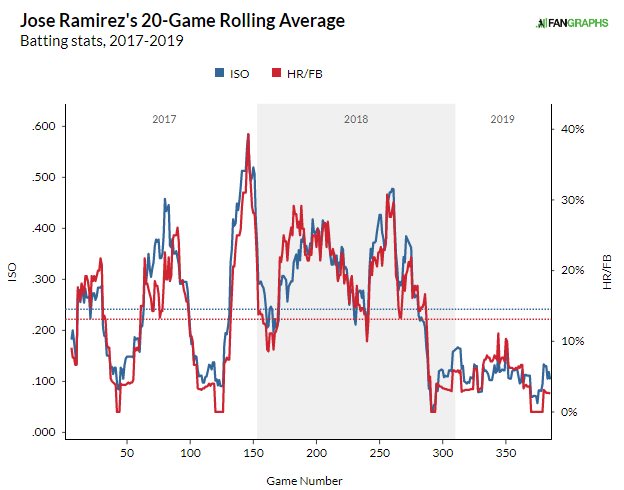
The power production needs to start trending up at some point.
Jose Ramirez’s fantasy owners must accept that fact they may have a Billy Hamilton clone on their hands. He’s showing a complete lack of power and almost none of his struggles are BABIP driven. Besides the power drop, his plate discipline is down. If Hamilton is playable, so is Ramirez but owners shouldn’t hope on a rebound.
Jeff, one of the authors of the fantasy baseball guide,The Process, writes for RotoGraphs, The Hardball Times, Rotowire, Baseball America, and BaseballHQ. He has been nominated for two SABR Analytics Research Award for Contemporary Analysis and won it in 2013 in tandem with Bill Petti. He has won four FSWA Awards including on for his Mining the News series. He's won Tout Wars three times, LABR twice, and got his first NFBC Main Event win in 2021. Follow him on Twitter @jeffwzimmerman.
Interesting article. But some quick fun with arbitrary endpoints. well… not arbitrary for me.
I dealt for him on June 13. Since then, he’s hit:
.326 avg, .946 OPS, .310 babip, .558 SLG, .515 xSLG, .396 wOBA, .400 xwOBA
yay for a good 11 days!
If it wasn’t for the recent rebound, he almost had to get sent down. Fortunately, he has rebounded a little.
About a month ago I just made a mental note to treat him like a top 5 SB guy and take any HR as a pleasant surprise. It hasn’t really helped.
This was my coping tactic.
The problem with that is that it makes him cuttable in many leagues. That’s a tough, TOUGH pill to swallow for a guy who was terribly expensive on draft day.
He Hate Me
But seriously, is the headline an allusion to something?
Ramirez lives and dies with being able to square up the ball. He must be making contact to be able to provide power. He developed a bit of an uppercut and head duck compared to the beginning of last year, which raised his launch angle too high and pitchers have been throwing him the high four seamer as a result. The past two weeks he seems to have corrected this, but what I’m afraid of is that he’s also seen a lot of sinkers those past two weeks.
Time will tell.
Here’s more good times:
A. .223/.297/.274 with 16 SB and .051 ISO
B. .217/.308/.320 with 18 SB and .115 ISO
C. .247/.310/.405 with 15 SB and .157 ISO
D. .253/.314/.357 with 10 SB and .103 ISO
A and B are still Hamilton and Ramirez (updated with last night’s stats)
C is the slugger of the bunch, naturally, and pretty much on point with his projection
D is nearly as disappointing as Ramirez
D is Lorenzo Cain. Sorry, but not nearly the disappointment that Ramirez is. Actually, I think Votto has been more disappointing than Cain at 260/356/407, 7 HR, 37 R and 19 RBI (along with 1 SB). Out of 160 qualified hitters, Votto is:
93rd in AVG
137th in HR
95th in R
135th in SB
159th in RBI
(Yes, 159th in RBI. Only Adam Frazier has fewer RBI with 18. He’s tied with Adam Eaton, Yolmer Sanchez and Leonys Martin. Among the many, many, many guys he trails are noted run producers Miguel Rojas and Joe Panik. . He’s only 9 ahead of German Marquez who has all of 38 PA. )
Votto and Cain were drafted 62 and 66 in NFBC and Cain at least has the steals and has quite a few more R+RBI than Votto even though Votto has hit 2nd basically all year. But Ramirez was drafted 5th on average. Fifth. It’s virtually impossible to compete when you completely miss on your 1st rounder.
I was only looking to highlight a few guys with similar stat lines and wildly different prices. Votto, while tremendously disappointing in his own right, isn’t playing like a version of Billy Hamilton.
The bigger issue is not completely missing but completely missing and having to carry/play him. If he was injured Week 1 it would suck but you’d possibly get a league average or better guy and still compete but here you’ve played him for, at least, 8 weeks and he’s sunk you. Plus, he has little trade value.
Overlooked the following decline/rebound indicators of each player’s batted ball profile:
Adam Dunn:
43.8% hard hit rate and 14.0% soft contact in 2010;
33.1% hard hit rate and 22.7% soft contact in first half of 2011.
(10.7% hard hit decrease; 8.7% soft contact increase).
Justin Morneau:
45.3% hart hit rate and 15.3% soft contact in 2010;
21.6% hard hit rate and 26.0% soft contact in first half of 2011.
(23.7% hard hit decrease; 10.7% soft contact increase).
Meanwhile, those who rebounded experienced much smaller drop offs (if any)…
Adam Lind:
34.5% hard hit rate and 8.5% soft contact rate in 2009;
32.5% hard hit rate and 12.7% soft contact in first half of 2010.
(2.0% hard hit decrease; 4.2% soft contact increase).
**Joe Mauer:
41.7% hard hit rate and 7.3% soft contact rate in 2010;
20.7% hard hit rate and 20.7% soft contact rate in first half of 2011.
(21.0% hard hit rate decrease; 13.4% soft contact increase).
Aramis Ramirez:
30.4% hard hit rate and 16.3% soft contact rate in 2009;
34.8% hard hit rate and 21.4% soft contact rate in first half of 2010.
(4.4% hard hit increase; 5.1% soft contact increase).
**Carlos Gonzalez:
37.1% hard hit rate and 20.2% soft contact rate in 2016;
28.6% hard hit rate and 20.2% soft contact rate in first half of 2017.
(8.5% hard hit decrease; 0.0% soft contact increase).
**Joe Mauer and Carlos Gonzalez are the only two that experienced significant declines in hard hit rate (and increase in soft contact in Mauer’s case) that rebounded. As outlined above, Carlos Gonzalez went on to experience the most significant rebound (no doubt aided by Coors Field, the live ball era, and no increase in his soft contact). Dunn and Morneau experienced drastic declines in hard hit rate and large upticks in soft contact. Those HR/FB ratios and BABIPs weren’t just dropping inexplicably; less hard contact meant less HRs, which meant more fly ball outs and lower OPS and BABIP. Those who rebounded tended to demonstrate the lowest (if any) decline in hard hit rate as well as a lesser/lack of increase in soft contact.
In Jose Ramirez’s case…
His “down” plate discipline from a 15.2% BB% and 11.5% K% in 2018 to a 11.5% BB% and 13.1% K% would still be considered elite by most standards. Same with his O-Swing% (22.3% in 2018 to 27.8% in 2019), SwStr% (4.7% in 2018 to 6.2% in 2019), and Contact% (87.7% in 2018 to 85.2% in 2019). All are well within his career norm range as well, so no indication that he can’t turn it around there. Others on the list above, particularly those who did not rebound, experienced greater declines in plate discipline as outlined above in the article (in terms of K% and BB%).
As for his batted ball profile, that has remained nearly identical during his slump (unlike those above who failed to rebound): 36.1% hard hit rate and 18.3% soft contact rate in 2018 compared to 36.2% hard hit rate and 19.9% soft contact rate in 2019. Hitting slightly more fly balls, and only slightly less groundballs and line drives. Also, unlike those named above (with the exception of Carlos Gonzalez, to a lesser degree) Jose Ramirez stands to benefit from the most extreme period of the live ball era to date. Seems like a pretty good candidate to be the exception to your rule, in my opinion.
“He’s showing a complete lack of power and almost none of his struggles are BABIP driven. ”
How many players in history have posted a sub-0.245 BABIP with a > 6 Spd score over 1,000 PA?
We have a black swan event here. It seems unlikely, if not impossible, that he will continue to post such numbers, esp. given that his K% is only 13%.
Now that he has been pronounced dead, it’s time to buy…
https://www.fangraphs.com/graphs.aspx?playerid=13510&position=3B&statArr=50,41&legend=1,2&split=base&time=game&ymin=&ymax=&start=2017&end=2019&rtype=mult>1=30&dStatArray=
This is not a black swan, it’s simply an unlikely occurrence. Black swans are things that you couldn’t predict, like Ramirez being cursed by a witch and turning into a dragon.
Shout out to Aramis Ramirez for being one of the best mid-season buy lows what felt like every year. His career OPS splits impove every month of the season until September, 72 points better in the second half than the first.
I don’t know anything beyond my ken, but it seems odd to compare 26 year-old Jose Ramirez to a bunch of older, less-talented players (save 1) and declare the contrivance conclusive of anything. Trades, for example, live and die on how old a player is; I’d take a “historically bad” 26 year-old and his next 4-5 years of production – whatever they are – over anything Adam Dunn was doing after he turned 30. I believe what the post shows is that players who had 1 true skill (power or contact or avg, etc) and then aged like humans do got worse as they got older. And perhaps they had a season or two that people with rose-colored views used to unfairly reset expectations, then used later to say how disappointed they were. In short, the past 3 years of Jose Ramirez really don’t look at all like Justin Morneau or Adam Dunn…ever…and I’m not sure there’s anything else to take away from the comparison. It’s a comparison in the same way that old fruit looks gross and fresh fruit looks tasty, and if the fresh fruit isn’t as tasty as it looked, well, it’s still not the old fruit. Is there a point?
Has any player ever slumped or been victim of bad luck for 3 months before? No!?! Does anyone want to look at Manny Machado’s last 5 seasons and explain those 2 sub-3 WAR ones? Is he Joe Mauer?!?!
Worst First 3 months by Good Hitters since 2001 measured using wRC+ (105+ wRC+ career, minimum 120 PA in 1st & 2nd 3 months):
1H->2H
32-> ??? 2019 Jose Ramirez (117 Career wRC+)
32-> 112 AVERAGE (113 Career wRC+)
==================================================
4 -> 130 2006 Rondell White
22-> 120 2018 Kole Calhoun
23-> 117 2008 Troy Tulowitzki
25 -> 75 2002 Chuck Knoblauch
26-> 109 2018 Alex Avila
31-> 114 2016 Eddie Rosario
32-> 121 2003 Paul Konerko
32 -> 59 2018 Chris Davis
39 -> 98 2006 Nelson Cruz
41-> 113 2015 Chase Utley
42-> 130 2015 C.J. Cron
42-> 113 2018 Neil Walker
43-> 134 2010 Aramis Ramirez (in article)
44-> 133 2016 Ryan Howard
As far as the 6 players mentioned in the article, only Aramis made both lists due to the higher wRC+ of those players mentioned.
57/100 AVERAGE (116 Career wRC+)
==================================================
42->118 Mauer (less than 120 PA in 1st 3 months)
43->134 Ramirez
53->117 Gonzalez
61->119 Lind
68-> 68 Morneau
73-> 43 Dunn
It looks like Dunn and Morneau are outliers as they join Davis and Knoblauch as the only players mentioned with a 2nd half wRC+ less than 98.
In all, 14 of the 19 players mentioned between the two had a 2nd half wRC+ of at least 109.
Oops, I made a mistake – used Jose Ramirez wRC+ of 32 from his 2015 1st half. He’s at 67 for this season.
I have refined my approach to this topic.
Using the same criteria (120 PA min per half, 105 min wRC+ career), I found 52 hitters under 30 who were 30% worse than their career wRC+ in the first half from 2001-2018. [Ramirez 26.8 yo, 42% worse than projected career wRC+ of 116]
35% of those hitters hit worse than their career wRC+ from Jul-Oct.
65% of those hitters hit better than their career wRC+ from Jul-Oct.
Weighted average projected 121 wRC+ ROS for Jose Ramirez.
(Steamer projects 121 wRC+ ROS for Jose Ramirez)
Forecasted Odds:
85% chance 100 wRC+ or higher
65% chance 117 wRC+ or higher
35% chance 128 wRC+ or higher
20% chance 146 wRC+ or higher
For what it’s worth, 17 of the 52 players had a K% under 18% (13% K% for Ramirez) — and the lowest 2nd half wRC+ for those players was 102.
Of course, these calculations are based on little context – it will be interesting to see if the projection or the analysis wins out in this single sample.