Archive for Jayson Werth

Final Month Fantasy Hitters on Fire

Here are 10 fantasy hitters who really helped their teams in the month of September/October, without any position factor considered. Hitters 4-9 could probably be arranged in any order you like, although the top three hitters seem set.

10. Victor Martinez .330-7-25-17-0

These are great numbers for anyone and they are spectacular for a catcher. Martinez is a free agent following this season and it will be interesting to see how many years a club feels comfortable giving him. Fantasy-wise, he is likely to move up from last year’s 48 ADP on ESPN.

9. Jayson Werth .300-9-22-23-4

A free agent at the end of the year, Werth did everything in his power to become one of the top players available on the open market. The Phillies have top prospect Domonic Brown ready to step in for Werth but it will be strange to see him on another team next Spring.

8. Andrew McCutchen .324-4-16-22-5

Coming into the 2010 season, many fantasy players wondered if McCutchen could be a consistent HR threat. While he will never be confused as a bopper, he seems very capable of putting up a 20-HR, 40-SB season in 2011.

7. Chase Utley .306-5-24-21-7

After suffering a torn ligament in his thumb that required surgery, Utley came back quicker than many people expected. He missed just six weeks of action and after a couple of weeks to play himself back in shape, Utley responded with production that fantasy leaguers have come to expect. Now the question remains if he is still a first-round pick or if age and injury concerns drop him lower.

6. Carl Crawford .360-4-19-16-6

Another free agent, Crawford did everything fantasy owners hoped he would do and finished the year as one of the Top 10 fantasy hitters, again. The big question for fantasy players is if Crawford moves to a new team, will he get more SB chances? With an 82 percent success ratio last season, owners would love to see him get even more opportunities than the 57 he had in 2010.

5. Mike Aviles .333-6-14-20-7

In the final month of the season, Aviles hit 6 of his 8 HR and had 7 of his 14 SB for the season. After going undrafted in many 12-team mixed leagues this year, Aviles undoubtedly will be a hot target for fantasy league players in 2011.

4. Drew Stubbs .316-7-18-19-6

With the Reds making the playoffs, Stubbs will be introduced to the wider baseball audience for the first time. Fantasy league players are already aware of the just-turned 26-year-old, who saved his best for the final month of the season.

3. Shin-Soo Choo .340-7-27-19-7

How’s this for consistency – last year Choo had a .300-20-86-87-21 line and this year it was .300-22-90-81-22 line. The only problem with Choo is that he has a two-year obligation to the South Korea military hanging over his head. Choo will be representing his country in the upcoming Asian games and if South Korea wins the Gold Medal, he will likely have the requirement waved. But what if they don’t finish first and Choo goes through with his duty? Is there any chance he could return to be an MLB-quality hitter after sitting out two of his late-prime years?

2. Carlos Gonzalez .378-5-26-24-6

Without a doubt, Gonzalez is this year’s fantasy MVP. He had a preseason ADP of 131.1 according to ESPN but finished as the top-rated player in fantasy, with a $43 12-team mixed value, according to Last Player Picked. Gonzalez had a terrific final month of the year, but it wasn’t quite good enough to be the best.

1. Troy Tulowitzki .303-15-40-30-2

In the last three years, Tulowitzki has played 101, 151 and 122 games. No fantasy player questions his talent, but how soon are you ready to pull the trigger on a player who has missed roughly 1/3 of the season in two of the past three years? And should we be even a tiny bit worried about the new chain of command in regards to the baseballs at Coors Field? Tulowitzki had a 1.034 OPS at home this year and an .863 mark at home.

Honorable Mention – Albert Pujols, Mike Stanton, Corey Hart, Alex Rodriguez, Matt Holliday and Mark Ellis


Potential Trade Impact: Werth, Oswalt, Haren

The trade deadline is getting very close. How close is it? Close enough that Jon Heyman has moved back into Scott Boras’ guest house. Three big names have a very good chance of being traded at the deadline, and it will affect their fantasy value in one way or another. Rumors are flying around the internet like crazy, so I apologize if new information comes out.

Jayson Werth | OF | Likely Destination: Rays

Werth would bring his wood to St. Petersburg (I would say Tampa, but I’d get in trouble for that), and likely play RF for the Rays. Then again, he could move into the DH role instead, allowing Zobrist to stay in right or pave the way for a Desmond Jennings promotion. There’s no way to predict how Werth would handle AL pitching, let along AL East pitching, but I’d like to think that his power would transfer over nicely. If he’s traded, his RBI and run totals will likely rise, while his batting average will decline. Overall value: Slightly Increased.

Roy Oswalt | SP | Likely Destination(s): Phillies, Cardinals

The rumor that’s been floated actually links Werth and Oswalt. The rumor states that the Phillies would use the package the Rays give them to trade for Oswalt. Things get hairy if Houston isn’t excited about the Rays’ prospects, but chances are they will be. Essentially, the Phillies would end up trading Jayson Werth for Oswalt and Dominic Brown. Moving from Houston to Philly would increase Oswalt’s value, due to an increased amount of run support and better defense behind him. Recent reports link the Cardinals to Oswalt, who would benefit from not having to face Pujols. Trading within the division can create problems, but the Astros and Cards could still come to an agreement. Overall value: Significantly increased.

Dan Haren | SP | Likely Destination(s): Cardinals, Tigers

Haren’s possible landing spots are still a mystery, but it seems like it will come down to St. Louis and Detroit. If he moves, I think he’ll end up with the Cardinals, where he started his career. The Cardinals best prospect they could offer the D’Backs is a few years away from the bigs, so they would likely pull the trigger if given the chance. Haren would get more wins due to increased run support, and his ERA and BABIP could benefit from some of Dave Duncan’s magic. Overall value: Significantly increased.

Why do you, the readership, care about these things? Two reasons: First, these deals could be huge in AL-only and NL-only leagues, as players could be switching leagues. Secondly, you may be holding onto a player, or targeting a player because you think (hope?) he’ll be dealt at the deadline to a team that would boost his numbers. Heck, I’ve excluded Haren from trade talks because I’m desperately hoping he’ll be dealt at the deadline, so maybe some of you have been doing something similar.

Thanks to James Niemeyer for this article’s inspiration.


Waiver Wire: July 20th

Man, moving into an old house is hard. Every little thing opens up into eight million other things you gotta do. Bah. But you don’t want to hear me whine, you want the waiver wire dirt. So here are a coupla outfielders that could do you good. (Yeah, grammar goes out the window when you are this exhausted.)

Tony Gwynn, Jr, Padres (1% owned)
Gwynn is no unqualified get – they rarely are at this stage of ownership – but he does have some things going for him. For one, it looks like he’s the best outfield defender on his team, going by his double-digit career UZR/150 in center compared to Scott Hairston’s single-digit number. He also can take a walk – his current 13.3% walk rate is second on the team in fact. Last, his current BABIP is so low that he figured highly on Goleblahblah’s xBABIP – BABIP list just the other day. A man that fast should not have a .255 BABIP. As the dinks and dunks fall in, he’ll be able to pair a passable batting average with good speed. With contact rates like he has (96.5% in the zone, 91.6% overall), he could even put up a good batting average. Of course, the rub is that he’s in a crowded outfield. Apologies to Oscar Salazar and Luis Durango, though, Gwynn is, at the very least, in the top four. Will Venable has some strikeout issues (that weren’t this bad in the minor leagues), and Aaron Cunnigham is finally showing something in the major leagues (but could take a walk here or there), so along with Hairston, the Pads have cobbled together a passable outfield. Some days, possibly against lefties (Gwynn had a lower OPS versus lefties in the minors), Hairston will play center field. The rest of the time, it will probably be Gwynn out there, so deeper leagues should look to Gwynn for steals.

Domonic Brown, Phillies (2% owned)
Rumors are rumors, but the newest rumors have Jayson Werth headed to Tampa. The Rays don’t seemingly go for Werth’s type usually (read: big-time in-season acquisition), but his contract expires at season’s end, and at $7.5 million is not onerous. For all the talk that Werth is somehow slumping, his slash line (.280/.371/.502) and wOBA (.376) are almost identical to last year’s (.268/.372/.506; .382). He’s not slumping. Yes, his ISO is a little down (.238 to .222), but it’s closer to his career numbers. So Werth is more probably the 2008 Werth than the 2009 Werth, but would anyone complain about a 20/20 outfielder either? Anyway, back to Brown. He was good enough to make our top 50 trade value list (at #50) and was named the number one Phillies prospect by maven Marc Hulet. We’ll allow space for a longer article concerning Brown (he seems to deserve it), but he’s 22, hitting .328/.389/.592 in Double-A and Triple-A combined this year, with speed (86 stolen bases in 416 minor league games at a 72% success rate) and power (.166 career ISO, with a full-season peak of .214). Let’s just call this a wake-up call for those in deeper leagues. There might be a nice prospect on the way.


Updating the Outfielders (OF1)

It’s been a long time since we’ve updated the outfielders – moving across country will do that to you. While I struggled with boxes and furniture, injuries and mediocre play have done some serious damage at the top of the tier.

The Top Options:
Ryan Braun, Milwaukee (.361 wOBA, .385 ZiPs RoS wOBA)
Matt Kemp, Los Angeles NL (.339 wOBA, .364 ZiPs RoS wOBA)
Josh Hamilton, Texas (.435 wOBA, .390 ZiPs RoS wOBA)
Nelson Cruz, Texas (.400 wOBA, .383 ZiPs RoS wOBA)
Justin Upton, Arizona (.344 wOBA, .376 ZiPs RoS wOBA)
Carl Crawford, Tampa Bay (.395 wOBA, .365 ZiPs RoS wOBA)
Matt Holliday, St. Louis (.389 wOBA, .400 ZiPs RoS wOBA)
Alex Rios, Chicago White Sox (.377 wOBA, .356 ZiPs RoS wOBA)
Carlos Gonzalez, Colorado (.373 wOBA, .357 ZiPs RoS wOBA)

This may upset some people, but it’s just hard to separate out an elite sub-set of outfielders right now. Ryan Braun, Matt Kemp and Justin Upton certainly have the upside to go on a tear and make this ranking seem silly, but right now they just aren’t showing it. They may even need to go on a tear just to get to the lower end of their preseason projections. Another way to spin this is that there are a lot of really nice outfielders. Everyone in this tier, all the way down to Carlos Gonzalez can give you positive value in all five fantasy categories. Upton’s strikeout rate might mean that his batting average will sink him out of this tier, but he’s also shown lower strikeout rates and higher batting averages in the past, so let’s not count him out yet.

There’s Nothing Wrong With…
Ichiro Suzuki, Seattle (.351 wOBA, .354 ZiPs RoS wOBA)
Torii Hunter, Los Angeles (.381 wOBA, .374 ZiPs RoS wOBA)
Andre Ethier, Los Angeles NL (.399 wOBA, .385 ZiPs RoS wOBA)
Andrew McCutchen, Pittsburgh (.362 wOBA, .358 ZiPs RoS wOBA))
Jacoby Ellsbury, Boston (.279 wOBA, .346 ZiPs RoS wOBA)
Shin-Soo Choo, Cleveland (.382 wOBA, .378 ZiPs RoS wOBA)

Although this tier is headed up by a couple of veterans, it’s the young speedsters that have the better chance of moving up the ladder. Ichiro! will give you the batting average, but the rest of his line looks a little too much like Denard Span’s to award him first-tier status, and it’s McCutchen that might soon put up Crawford-like numbers to advance tiers. Torii Hunter has power and speed, but it’s a healthy Shin-Soo Choo that has the stronger batting average, so therefore more upside.

Not Quite Five-Category Performers
Jayson Werth, Philadelphia (.377 wOBA, .385 ZiPs RoS wOBA)
Brett Gardner, New York AL (.371 wOBA, .334 ZiPs RoS wOBA)
Adam Dunn, Washington (.403 wOBA, .400 ZiPs RoS wOBA)
Manny Ramirez, Los Angeles NL (.426 wOBA, .413 ZiPs RoS wOBA)

This is the group that provides OF1-like production in deeper leagues, but they’d make a shallow mixed league roster look a little wonky. Brett Gardner and Jayson Werth are the risers here, but Adam Dunn belongs even with his batting average. Manny Ramirez may just fall another tier, especially if he’s out much longer after the break. He’s still good when he’s in, though.

Upside to Join the Top
Curtis Granderson, New York AL (.321 wOBA, .346 ZiPs RoS wOBA)
Colby Rasmus, St. Louis (.388 wOBA, .347 ZiPs RoS wOBA)
Jason Bay, New York NL (.349 wOBA, .375 ZiPs RoS wOBA)
Nick Markakis, Baltimore (.373 wOBA, .374 ZiPs RoS wOBA)
Carlos Quentin, Chicago (.363 wOBA, .362 ZiPs RoS wOBA)

Colby Rasmus fans will hem and haw, but they might want to check the rest-of-season projections for Curtis Granderson before they get too heated up. They both have some platoon issues (Granderson’s are more pronounced), both don’t have great batting averages, and both have great power and speed. Oh, and this space feels a little vindicated by Carlos Quentin’s recent hot streak, which has shown that he still has much power, even if the batting average is a problem. The BABIP is so low that with additional regression even the batting average might be nice for the second half.


Rankings Update: Outfielders

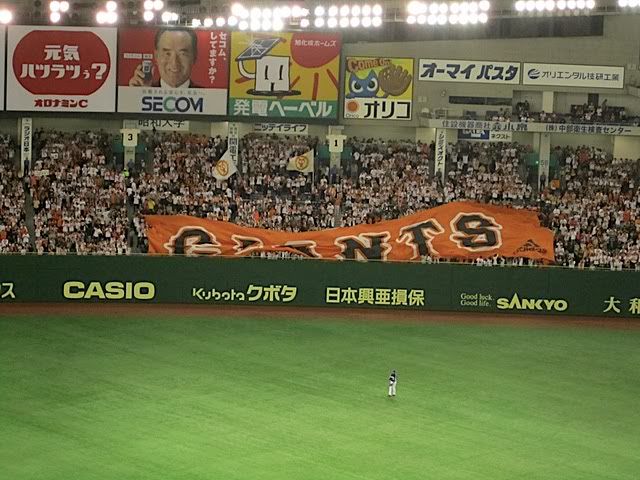
I’m back from Japan and have Basu-Baru pictures for your pleasure. Baseball in Japan has many of the trappings of the American version, but also includes cheerleaders and choreographed songs. Interestingly enough, the game I saw featured two Westerners at cleanup – Tony Blanco for the Chunichi Dragons and Alex Ramirez for the Yomiuri Giants. The pitchers had decent stuff, and the crowd was louder than many (most?) regular season MLB games, but overall the package was something like a AAAA game.

I digress. Time to take ownership of these outfielder rankings and change them up a bit. I will be doing them all season, as a sort of power ranking at the position. We’ll go with the FANS’ projected wOBAs (aka their upside projections) for another week.

The Top Three:
Ryan Braun, Milwaukee (.405 wOBA)
Matt Kemp, Los Angeles NL (.367 wOBA)
Justin Upton, Arizona (.388 wOBA)

Nothing much to say here except it looks like Upton’s ankle isn’t bothering him. These guys are studs and by the end of the year, could easily all be top-five fantasy players despite playing in the outfield.

There’s Nothing Wrong With…
Grady Sizemore, Cleveland (.343 wOBA)
Matt Holliday, St. Louis (.390 wOBA)
Carl Crawford, Tampa Bay (.367 wOBA)
Jacoby Ellsbury, Boston (.354 wOBA)
Curtis Granderson, New York AL (.340 wOBA)
Nelson Cruz, Texas (.368 wOBA)
Ichiro Suzuki, Seattle (.369 wOBA)
Shin-Soo Choo, Cleveland (.389 wOBA)

After the spirited Choo vs Granderson vs Sizemore comments conversation from the last time we updated these rankings, it’s only natural that we find a way to put them all in the same tier where they belong. Nelson Cruz is absolutely on fire, but his BABIP (.357) and K rate (24.1%) together suggest that the batting average should regress to his career norm. Granderson is still having trouble with lefties, but if he continues to bash righties to this extend, he’ll stay out of the next tier.

Not Quite Five-Category Performers
Josh Hamilton, Texas (.321 wOBA)
Jason Bay, New York NL (.397 wOBA)
Adam Lind, Toronto (.394 wOBA)
Nick Markakis, Baltimore (.349 wOBA)
Manny Ramirez, Los Angeles NL (.396 wOBA)

Manny is actually showing that he’s still got something left and with another tater or two could even join the next tier. That said, his missed games will keep the old(er) man back a little. Those same missed games should come into play with Hamilton eventually too. Lind’s power has taken a slight step back, but it’s early going and all it looks like he needs to do is loft the ball a little more (33.3% FB this year, 36.8% last year).

Missing Something?
Jayson Werth, Philadelphia (.382 wOBA)
B.J. Upton, Tampa Bay (.310 wOBA)
Andre Ethier, Los Angeles NL (.370 wOBA)

Werth reminded us that he has some injury issues by missing time with hip soreness, but has otherwise played well. The older Upton is actually playing about as well as can be expected, and in leagues that don’t use batting average, he may yet prove to be an elite option. Ethier will have his supporters, but his fly ball rate already fell, and his power pace should fall with it. The batting average should be strong this year, though, and he’s still a solid option.

Upside to Join the Top
Andrew McCutchen, Pittsburgh (.360 wOBA)
Carlos Quentin (.375 wOBA)
Michael Bourn (.326 wOBA)
Jason Kubel (.370 wOBA)

Outfielders are a tough position to handicap because of the sheer numbers, which also won’t allow me to go too deep. By highlighting some guys that could join the elite with the right years, we can delve a little deeper. So, while Shane Victorino is a fine option in the outfield, McCutchen is stealing bases at a pace (five so far) that would outpace the Flyin’ Hawaiian should it keep up. Bourn has shown the same plus plus speed. Should Quentin stay healthy, and Kubel prove that he can keep his slugging percentage over .500 year-in and year-out, they would join the power elite. So far, so good.


Chris Young the Outfielder

When we checked the center field position and created tiered rankings, there were a few players that were suggested as possible values at the position.

Carlos Gomez and Cameron Maybin could provide some nice speed – at the cost of risking your batting average. Since the rankings were for rotisserie baseball, that risk pushed those players off of the rankings.

But what if we were talking about head-to-head baseball, where punting a category is a strategy many deep leaguers employ? In such a format, you are competing in ten categories every week and can easily ‘punt’ a category if it provides an advantage elsewhere. Imagine the value you could get out of eschewing batting average – your lineup could employ Jimmy Rollins, Mark Reynolds, Adam Dunn, and Jayson Werth, all without the problems that lineup would normally entail.

With that strategy in mind, is Chris Young a viable option in 2010? If Bill James is to be believed, Youngs’ power and speed could return and answer that question affirmatively. The fans have yet to chime in (but should take this chance to give their input).

After famously being demoted to the minor leagues last year, Young returned to a post-All-Star-break line that could help batting-average-punters (.236/.343/.444) – at least in the power department. He didn’t steal a base. We can be forgiven for feeling confused.

Looking at his plate discipline stats may just muddy the waters. Every statistic is going in a different direction. His strikeout rate has gotten steadily worse (24.8% in 2007 to 30.7% last year), but he’s reaching less often (22.9% in 2007 to 18.0% last year). Perhaps it’s all about his contact rate, which is definitely getting worse (79.7% in 2006 to 73.9% last year), but there are plenty of players that succeed with a 75-ish% contact rate (Evan Longoria and Adrian Gonzalez most prominently), and with his still-strong walk rate (9.1% career, 12% in 2009), he has his good qualities.

There’s also something interesting going on with Young’s take rate. As RJ pointed out, Young takes a lot of pitches in the zone, and a good portion of those pitches could have been called balls last year. But again, Victor Martinez and Chris Coghlan both also took about 40% of the pitches they saw in the zone, and they had pretty good years last year.

It may just be that a player that both takes a lot of pitches in the zone and doesn’t make contact is going to have a hard time in major league baseball. Let’s set the bar at Young’s career levels of swinging in the zone (around 60%) and contact rate (around 76%). How many other players in the last two years have had good seasons with those rates?

Last year, the list was short: Mike Cameron, Jason Bay and Brandon Inge all had passable years sporting percentages close to Young’s numbers (but none took as many pitches in the zone, with Cameron swinging the least at 63.7%). In 2008, it was Jason Bay and Mike Cameron again (but Bay made contact on 77.1% of his pitches, and Cameron swung at more pitches than Young.)

It looks like we have a (rather obvious) comp in Mike Cameron then. Except that if you compare Cameron’s career numbers in the two categories (63.9% Z-swing%, 75.4% contact rate), you’ll notice he doesn’t take as many pitches in the zone. He also plays solid center field defense (+5.7 UZR/150 in CF, career).

And you have your two things to work on for Chris Young the Outfielder. In order to be Mike Cameron, he needs to swing at more pitches in the zone and play better defense. Then he’ll always have a place on the field. The good news is that Young swung at more pitches in the zone last year than he did the previous two years. The bad news is that his defense needs to take a serious step forward this year (-4.9 UZR/150 in CF, career). The good news means that he may be ownable in the right league next year. The bad news means that he won’t be ownable in any keeper leagues going forward if the defense doesn’t improve.


Check the Position: Right Field

Over the offseason we’ll take a look at each position on the diamond and see how the past season affected the positional rankings and where there might be some potential bounceback value picks going into next year’s drafts. (See shortstops, catchers, second basemen, first basemen, third basemen, and left fielders.)

These rankings are for 5×5 rotisserie fantasy baseball. Eligibility was determined by where the player had the most at-bats last year.

RightFielders

The tier-of-his-own player in right field is Justin Upton, and I doubt there will be too much grumbling about this ranking for a guy who hit .300 with 26 home runs and 20 stolen bases in his firs full year. Sure, we may talk a little about his high BABIP (.364), but for now let’s just look at the fan projections and sigh.

That should end the easy portion of our rankings today. Perhaps this is just a little self-pity in anticipation of the comments thread, but the next two tiers could be a single tier, or could be three tiers, and could probably be re-arranged ad infinitum. We’ll give Ichiro! Suzuki credit for his BABIP and (sexy) infield-hitting prowess which are perfect for the right fantasy team.

Now come the players that are impossible to rank. Where do you put a guy like Nelson Cruz, who will give you great power and speed, but will hurt your batting average? Could he be any more different from Shin-Soo Choo, who is is solid across the board but won’t win you a single category? Bobby Abreu is in the Choo-mold, but we’ll move him back a little for the waning power and, to be frank, his old age and body type. It hasn’t hurt him yet, but someday, well it just has to. Right?

I don’t think blame can be attributed for seeing a separation after Abreu. While Nick Markakis is a metronome, his steady ticking doesn’t provide much beyond a .300 average and 20 home runs. The steals in 2007 have proved to be an aberration, and while he may get a power spike some year, there’s no way to predict it. Andre Ethier should, with a better BABIP (.292 in 2009, .316 xBABIP, .322 career BABIP), have a better batting average next year, but is the power real? When Bill James shaves seven home runs off your total, you should take notice. He may not hit 40+% fly balls next year. Some will complain about Jayson Werth’s placement, because he certainly looks like a Nelson-Cruz-lite, and they might be right. But Werth has had issues with staying on the field, and with his batting average and strikeout issues, the tier seems right.

Jay Bruce may just zoom up the charts next year and make his ranking seem silly, but at least the fans are backing my sense that we should temper our enthusiasm on the young slugger just a tad. He does seem like a great upside play, better than the young but inconsistent Hunter Pence behind him, who has seemingly showed us his best already. Brad Hawpe has some strikeout issues, some defense issues, and never really showed the power we thought he might. Forgive me for not believing in the simultaneous spike in both flyball rate (39.6% in 2009, 35.7% career) and HR/FB (17.1% in 2009, 12.9% career) and agreeing with the projections that say Michael Cuddyer’s power may subside next year.

The last tier is not very exciting in my mind. Nick Swisher’s batting average ranges from awful to terrible, Jermaine Dye is getting older and posted a six-year low in line drive percentage (16.9%), Garrett Jones was a 28-year-old rookie who had done nothing before 2007 in the minor leagues, and Magglio Ordonez, well we all saw what happened there. In fact, I would rather wait until the end of the draft to pick someone off of the “just off” list, so the Deep League Value piece this Sunday will feature some gems.


Fun With Final Season Dollar Values

Two outfielders with similar names put up eerily similar fantasy numbers last year. Here are the respective numbers for Jason Bay and Jayson Werth:

JB:.267-36-119-103-13
JW: .268-36-99-98-20

The largest difference in any category is the 20 RBIs that separate them. As you might imagine, the two winded up with very similar dollar values. The RotoTimes Player Rater gave Bay’s season a $24.40 total while Werth’s received a $24.12 value.

But while those were very close, there were many, many more players who winded up with closer gaps in their dollar value. Many of these players played different positions and posted very different stats, but came out with similar values. For instance, check out these two lines:

A: .281-13-90-73-7
B: .243-31-90-84-2

Which one would you rather have?

Player A is James Loney, with an $8.53 value, while Player B is Dan Uggla, who checked in with an $8.52 total. Obviously, you would rather have Player B, once you know it was Uggla, a second baseman. The Player Rater does not take into account position scarcity. So, when making comparisons you either need to build in your own adjustments or focus on players at similar positions.

Let’s look at two players who have been compared recently by agent Scott Boras, in Mark Teixeira and Matt Holliday. Boras, the agent for both, is trying to get a contract for Holliday similar to the one he arranged for Teixeira last year. The argument has been met with a lukewarm response from the baseball community, but is one that was fairly apt for fantasy purposes last year. Here are their fantasy numbers:

MT:.292-32-122-103-2
MH:.313-24-109-94-14

The Player Rater gave Teixeira a $25.70 value and Holliday a $25.52 one.

Another interesting comparison between two players with very different skills but similar overall values last season is Ian Kinsler and Michael Bourn. Kinsler’s power and Bourn’s speed produced virtually identical fantasy seasons.

IK:.253-31-86-101-31
MB: .285-3-35-97-61

The Player Rater had the two separated by just one penny, with Kinsler posting the higher value at $22.81 last season.

Dollar values are not a precise measurement and different sites will have different values for players. These are best used as a rough estimate of value and as a reminder that owners (and players) can acquire value in a multitude of ways.


Stock Watch: 5/19

Stock Up

Jorge de la Rosa, Rockies

de la Rosa sure has played roster hot-potato for a lefty cooking in the low-90’s, having been a part of four trades while seeing time in the Arizona, Boston, Milwaukee, Kansas City and Colorado systems. The 28 year-old, as covered in great detail by Eno Sarris, has kicked off the 2009 season with a 2.99 FIP, 9.49 K/9 and 3.38 BB/9 in 42.2 innings. de la Rosa has been fortunate in the home run department (0.42 HR/9, 4.9 HR/FB%), but his XFIP (based on K’s, BB’s and a normalized HR rate) still checks in at a tidy 3.70. If de la Rosa can keep the walks at a moderate rate, he could be an asset in most any league.

Joe Mauer, Twins

I know- Mauer has long been a fantasy darling, as a line-drive hitting backstop with excellent control of the zone. But the 26 year-old’s power outburst to begin the ’09 season bears mentioning: he’s already popped 6 out of the park in 73 plate appearances (this after hitting a combined 16 dingers in over 1,100 PA’s during the 2007 and 2008 seasons). Don’t expect him to suddenly go all Mike Piazza on the league, but Mauer would only add to his immense value if he could loft 20 big flys in addition to his high-contact, patient act at the dish.

Ubaldo Jimenez, Rockies

Ubaldo has done a better job of limiting the base on balls in recent starts, with 22 K’s, 6 walks and 6 runs allowed in 27 frames during the month of May. Like de la Rosa, Jimenez has had some good luck on flyballs (0.20 HR/9, 2.4 HR/FB%), but his XFIP is a decent 4.43 despite a disastrous April (16 runs, 19/17 K/BB in 19 IP). The combination of whiffs (8.02 K/9) and worm-burners (50 GB%) makes the 25 year-old Dominican Republic native an intriguing trade target.

Jayson Werth, Phillies

The whole “is player X overrated/underrated” debate is obviously subjective, but Werth has to place among the more underappreciated talents in the game. How many people realize just how valuable this rangy, 6-2, 225 pounder has been for the Phillies since 2007? A 3.4 Win player in partial playing time in ’07, Werth posted a 5.3 WAR season for the Phillies in 2008 (tied with Jimmy Rollins for 2nd in a star-studded lineup), and he’s produced 1.4 wins already in 2009. With a .415 wOBA (.294/.396/.540) and 8 steals in 9 attempts, Werth is producing in every facet of the game. He’s even making a little more contact (23.8 K%, 29.9 career average), while raking against righties (.849 OPS) in addition to his usual lefty lashing (1.142 OPS).

Rick Porcello, Tigers

Porcello has gone from Seton Hall Prep to viable major league starter in less than two seasons, as the 20 year-old sinkerballer has allowed 2 runs in 18 innings during the month of May. Porcello isn’t blowing batters away (5.67 K/9), but he’s stingy with the free passes (2.95 BB/9) and generates grounders (53.6 GB%) with the sinker, a mid-70’s curve and a low-80’s changeup. Porcello is doing a better job of throwing his three quality offerings (particularly his curveball) from the same arm-slot. Check out his release point chart against the Yankees, in a 3.2 inning, 6 run drubbing on April 29th…

porcellorelease4-29

…and his release point in a 6-inning, 1 run gem against the A’s on May 16th…

porcellorelease5-16

Stock Down

Alexei Ramirez, White Sox

There has been a general malaise over the South Side bats in 2009 (the Pale Hose rank 26th in wOBA), and Ramirez is one of the main culprits. Ramirez has been slightly more “patient” in ’09 ( we’re speaking in incredibly relative terms here: 5.6 BB%, 37.2 Outside Swing Percentage in 2009 compared to 3.6 BB% and a 42.7 O-Swing% in ’08), but the “Cuban Missile” has failed to launch, with a sickly .243 wOBA. His BABIP sits at a very low .238, so some positive regression should be expected. Still, his .051 ISO is downright Bloomquistian. This is what you sign up for if you gamble on a batting average-dependent player: when those hits don’t fall in, that player’s value craters.

Todd Wellemeyer, Cardinals

Just when it looked like Wellemeyer might establish himself as a competent mid-rotation cog (4.51 FIP in 2008), he has gone and reminded everyone why he’s a former Cub, Marlin and Royal. His K rate has dipped from 6.29 per nine in ’08 to 5.28 in ’09, with his BB/9 inflating from 2.91 to 4.11. Wellemeyer’s go-to secondary offering last year was a mid-80’s slider (thrown 23.6% of the time), but his slider usage is down this season (12.9%), as is its velocity (83.1 MPH). In place of the hard breaker, the 30 year-old has mixed in a few high-80’s cutters and some high-70’s curves. The kitchen sink approach does not appear to be working.

Josh Fields, White Sox

The former first-rounder out of Oklahoma State has been a wreck at the plate this season, whiffing 32.8 percent of the time while making Scott Podsednik look like a power hitter (.096 ISO). That’s quite the fall for a guy who authored a .236 ISO during the 2007 season. At 26 years old and coming off a mundane season spent at AAA Charlotte in 2008 (.347 wOBA, .772 OPS), Fields isn’t such a highly-regarded youngster than he can continue to post oh-fer’s and stay in the lineup. He’s not on the Drew Henson path of doom quite yet, but he might want to take a few snaps in between BP sessions.

Armando Galarraga, Tigers

As a free-talent pickup from Texas, Galarraga was a pleasant surprise for the Tigers in 2008 while many other Detroit hurlers crashed and burned. A good deal of regression should have been expected this season (Galarraga’s 3.73 ERA far surpassed his 4.88 FIP), but we weren’t quite anticipating this kind of spontaneous combustion. While Verlander, Jackson and Porcello deal, 2008’s nominal ace has a 5.62 FIP and a walk rate closing in on five batters per nine innings. His last outing on May 17th was a 0.2 inning, 5-run disaster against the light-hitting A’s.

Kevin Kouzmanoff, Padres

The Crushin’ Russian has not lived up to his nickname so far in 2009. Kouzmanoff’s Isolated Power figure comes in at just .101, continuing a three-year downward trend: his ISO was .182 in 2007 (his first full season in the big leagues) and .173 in 2008. The 28 year-old’s wOBA’s have dipped from .339 in ’07, .316 in ’08 and just .284 in 2009. The Padres are giving some thought to putting Chase Headley back at the hot corner, to make room for mammoth 6-6, 275 pound prospect Kyle Blanks in left field (it’s a stretch, but he’s more athletic than you might think). Kouzmanoff will need to show something in the coming weeks if he hopes to avoid being usurped.


Is Werth Worth A Draft Pick?

In an age of ubiquitous media, it’s easy to have knee-jerk reactions. This is true in baseball circles as well, particularly when it comes to prospects. If a hot-shot minor leaguer reaches the big leagues and initially disappoints, there is a tendency to label the player a “bust” or write him off as overhyped. However, some guys just take a little longer to make good on those lofty expectations; not every youngster hits the ground running.

Jayson Werth is a perfect example of this phenomenon. The Baltimore Orioles nabbed the lanky right-handed hitter in the first round of the amateur draft all the way back in 1997. A catcher at the time, Werth showcased solid on-base skills, but he failed to put much of a charge into the baseball. Still, his combination of premium position and a refined batting eye earned him plenty of accolades. As this Baseball Prospectus article notes, Baseball America ranked Werth as the 52nd-best prospect in the minors prior to the 1999 season (Werth dealt with a hairline fracture in his wrist during the ’99 season, an unfortunate harbinger of things to come) and #48 before the 2000 campaign.

From those promising beginnings, Werth would go on to disappoint the O’s during the 2000 season, and was shipped to the Blue Jays for John Bale before 2001 kicked off. Werth split the ’01 and ’02 seasons between catcher, first base and the outfield, though his bat did improve without the strain of squatting behind the dish every day. He posted a .271/.383/.472 line between High-A and AA in 2001. “Jayson Werth, Prospect” was back at this point, as BA ranked him 70th overall following the year. Playing mostly outfield in 2002, he managed a .257/.355/.445 line at AAA.

Just when Werth looked to be back on track, he stumbled in a return engagement at Syracuse in 2003 (.237/.283/.441, 68 K in 236 AB). That, coupled with a few sour cups of coffee with the Jays, caused Toronto to cuts its losses with the 24 year-old. Werth was bartered to the Dodgers prior to the 2004 season in exchange for Jason Frasor.

The career roller coaster continued in ’04, this time hitting another high point. Werth managed a respectable .262/.338/.486 line, walking 9.4% percent of the time while showing range in the outfield. He did whiff 29.3% while showing a platoon split (.247/.318/.419 vs. RHP, .293/.381/.630 vs. LHP), but all in all it was a welcome bit of health and production for a guy with a bumpy road to the majors.

Stop me if you’ve heard this before, but Werth’s success did not carry over into 2005. He had the misfortune of catching an A.J. Burnett fastball in the wrist during spring training, and he just never got on track in between three stints on the DL. Werth posted a 12.5 BB%, but severe contact problems (33.8 K%) and minimal thump due to the banged-up wrist (.139 ISO) led to an anemic .234/.338/.374 showing. Offseason surgery revealed ligament damage in the wrist, but the procedure did not cure what ailed him. The 2006 season was lost while recovering, and the Dodgers non-tendered Werth prior to 2007.

Near anonymous a decade after being a highly-regarded high schooler, Werth inked an $850K deal with the Phillies before the ’07 season. Philly GM Pat Gillick, head honcho of the Orioles back when Werth was a first-round selection, took a low-risk flyer and was rewarded. In 304 PA, Werth compiled a tasty .385 wOBA and batted .298/.404/.459. The 6-5, 225 pounder drew plenty of free passes (14.7%), though he did swing and miss enough to call that near-.300 average into question (28.6 K%). Werth continued to incinerate southpaws (.375/.467/.591) while merely surviving versus same-side pitching (.257/.371/.389).

After Geoff Jenkins faltered in the early going, Werth became an everyday player for the world-champion Phillies in 2008. In a career-high 482 PA, he turned in a .382 wOBA and a .273/.363/.498 line. His control of the zone remained similar (12 BB%, 28.5 K%), but Werth also translated his athleticism to the base paths by swiping 20 bags in 21 attempts. Lefties continued to feel the pain (.303/.368/.652) while righties held him in check (.255/.360/.407). Werth’s broad base of skills (walks, pop, plus defense and base running prowess) allowed him to post 5.2 Value Wins. His open-market worth was a stunning $23.4 million- talk about a sweet return on investment.

The Phillies rewarded the arbitration-eligible right fielder during the offseason, inking him to a two-year, $10M contract. Even if Werth regresses somewhat, the deal looks like a bargain for the club.

Going forward, the 29 year-old projects to post another impressive campaign in 2009. His overall line might not look as pretty- as an everyday guy, he’ll see a higher percentage of plate appearances versus right-handed pitchers- but his on-base adeptness, decent power production and 20 SB potential make Werth worth a draft pick in all leagues.