Archive for Outfielders

Waiver Wire: May 6th

Three outfielders, one for standard leagues and two for the deepest of deep leagues…

Nick Swisher | Yankees | 53% owned

Best known as a three true outcomer, the former Ohio State Buckeye has been slightly more aggressive at the plate in 2010 than in the past (68.9 Z-Swing% in ’10 vs. sub-60% from ’08-’09), which has resulted in fewer strikeouts (18.9 K%), a slightly higher BABIP (.319), and thus a better AVG (.295). More contact for Swisher means more extra base hits (.253 ISO), and with the Yankees’ lineup, more extra base hits means more runs scored and more RBI for your fantasy team. As an added bonus, he also has both 1B and OF eligibility.

Brennan Boesch | Tigers | 1%

Called up once Carlos Guillen hit the disabled list, the lefty swinging Boesch has put up a .412 wOBA while facing nothing but pitchers of the opposite hand. His dominance of righties goes back to the last few years of his minor league career, so this is nothing new. You’re not going to get much help with the OBP category, but he’ll offer a nice amount of pop and good average if managed properly. Detroit faces lefthander David Huff tomorrow night, but after that you’re in the clear until at least the middle of next week.

Marcus Thames | Yankees | 1%

Signed during the offseason to be the team’s designated southpaw masher, Thames is going to see some more plate appearances this month because of Curtis Granderson’s injury. He’s sporting a small sample .503 wOBA, with basically all of the damage coming against lefties. Thames is obviously not going to maintain that pace all year, but he’s been a lefty killer his entire career (.367 wOBA vs. .326 vs. RHP), so 2010 is nothing different. With dates coming up against Jon Lester and Dontrelle Willis, Thames could pay dividends this weekend if you pick your spots with him.

Ownership rates based on Yahoo! leagues


Wood, Coghlan Flailing

What do Angels third baseman Brandon Wood and Marlins left fielder Chris Coghlan have in common? They share the sordid distinction of posting the worst weighted on base averages in their respective leagues (minimum 50 plate appearances). Wood, 25, trails all AL hitters with a .197 wOBA in 81 trips to the plate. The 24 year-old Coghlan, last year’s NL Rookie of the Year, brings up the rear in the senior circuit with a .206 wOBA in 96 PA. What’s going on here?

Wood scuffled in a small amount of playing time with the Angels from 2007-2009, batting .192/.222/.313. Pitchers carved him up, as Wood walked just three percent of the time and posted a sub-70 percent contact rate (80-81% MLB average). Still, it seemed premature to write off the Angels’ 2003 first-round pick as a bust. With Chone Figgins Seattle-bound, Wood had a good chance to take over third base. ZiPS, the FANS and CHONE all projected a mild performance for Wood in 2010:

ZiPS: .244/.300/.422, .316 wOBA
FANS: .254/.311/.445, .327 wOBA
CHONE: .246/.309/.453, .330 wOBA

At this point, L.A. and fantasy owners alike would be downright giddy if Wood could come close to those numbers. A .245 BABIP hasn’t helped, but he has been bad by any measure. He’s batting .179/.200/.231, and he’s hacking prodigiously. In posting a 2.5 percent walk rate and whiffing 30.8 percent, Wood has chased 41 percent of pitches thrown outside of the strike zone (27% MLB average). The righty batter is down in the count before you can say “Francoeur”: Wood’s 67.9 first pitch strike percentage is slightly more than 10 percentage points above the big league average. Swinging at junk so often, Wood hasn’t made much loud contact. His Isolated Power is .051.

Coghlan, meanwhile, looks at Wood’s ISO with envy. The lefty batter has yet to post an extra base hit this season. That’s right: you have the same ISO as last year’s Rookie of the Year, .000. While he wasn’t a power hitter in ’09, Coghlan posted a .321/.390/.460 triple-slash (.372 wOBA). The projection systems figured that he would regress somewhat this season (his batting average on balls in play was .365), but his bat looked comfortably above average:

ZiPS: .287/.358/.413, .345 wOBA
CHONE: .296/.371/.434, .357 wOBA
FANS: .300/.379/.422, .359 wOBA

Instead, Coghlan is slashing .182/.242/.182. While he isn’t struggling to control the zone as much as Wood, Coghlan’s plate discipline has also been poor.

During his award-winning season, Florida’s ’06 supplemental first-round pick swung at just 20.9 percent of pitches out of the zone, walking 9.4 percent. This season, his O-Swing is up to 34.8 percent and his walk rate is down to 7.3 percent. Coghlan’s K rate has climbed from 15.3% to 27.3%, and his first pitch strike percentage is 62.5% (57.3% in 2009). Considering Coghlan’s showing in 2009 and his history of controlling the zone in the minors (11.8 BB%, 13.1 K%), it’s surprising that he suddenly resembles a raw rookie.

Lunging at pitches that he normally takes, Coghlan has chopped the ball into the ground 52.4 percent this year, up from 47.6 percent in ’09. His BABIP is just .250, but Coghlan has popped the ball up 21.4 percent in 2010, compared to 7.1 percent the previous season (the MLB average is around 11 percent). Those infield flies are near-automatic outs.

Wood has lost just about all of his supporters in fantasy leagues (owned in four percent of Yahoo leagues), while Coghlan has retained some good will from his 2009 campaign (43 percent). For the rest of the season, ZiPS projects a .237/.291/.400 line from Wood (.305 wOBA) and a .275/.345/.391 (.332 wOBA) performance from Coghlan.

It’s hard to recommend Wood at this point, but Coghlan could be a decent buy-low option in deep mixed leagues and NL-only formats. Given his track record, it seems unlikely that he suddenly, permanently forgot how to tell a ball from a strike.


Waiver Wire: May 4th

I’ll do one shallow league guy just because he’s heating up and I’ve seen him on some wires, but then it’s back to the deep leagues of course. This triptych of ineptitude may leave you with a bad taste in your mouth, but there’s utility here despite their warts.

Nate McLouth | OF | Braves (50% owned)
It’s a mixed bag with McLouth, who was already behind the eight ball in leagues that count batting average. Since swing rates stabilize first, we’ll take a look there – and find the numbers going in different directions. Overall, he’s swinging a lot less this year (34.7%) than in his career overall (40.1%), but it’s hard to say that’s a negative right off the bat. Swinging less could, for example, lead to more selectivity and more walks. Accordingly, McLouth is reaching less (20.4%) than he has in his career (21.2%), and walking at a career high rate (14.3%). And that’s good. What’s bad is that his contact rate is down (81.3% this year, 85.4% career). In any case, more contextual clues lead to some hope. A week ago, McLouth had been dropped to 8th in the order and wasn’t playing against lefties. Though 478 at-bats against lefties is hardly an opus, his .702 OPS against lefties is close to a disasterpiece. Count it as hope that McLouth has been moved back to leadoff against righties, and you’ll get yourself a lifetime .818 OPS hitter against that hand. As long as you have daily lineups, and can wait for righties, he’s a good pickup.

Delmon Young | OF | Twins (15% owned)
Yes, I know. Hold your nose. Young is not the dynamic star that was once prognosticated for him. He’s very flawed. He doesn’t have much power. But this isn’t to say that he hasn’t improved. In fact, his swing profile includes some improvement in virtually every category. For such a wild swinger, swinging less has to be a positive – and Young is swinging less (54.7% this year, 61.2% career). He’s reaching at a career-low rate (36.8%), and this improvement is particularly informative because it’s part of a trend. He’s improved his reach rate in every season in the bigs. The best news is that his contact rate is up big (79.9% this year, 75.3% career) at the same time. He still swings at bad pitches too often, and his power is just barely above average, but there’s a good chance that he retains the gains he’s made in the early going. Though it’s not yet significant, it’s nice to note that he’s sporting a career high in flyball rate right now, and a .290/20/10 season is not out of reach. The hardest part will be following the lineups to make sure he’s playing.

Steve Pearce | 1B | Pittsburgh (0% owned)
Is another major league team about to give up on Jeff Clement? When is a good time to cut your losses and give up on a player? Did the Pirates already give up on Pearce before Clement? These are all good questions that won’t be answered here. Instead, we’ll just report that Pearce was recalled today and is on the major league roster. Though he’s shown a platoon split in the major leagues (.920 OPS versus lefties, .607 vs righties), those have come in a mere 378 plate appearances total. The same split is not as pronounced in the minors (.929 vs lefties, .871 vs righties) and virtually disappeared in his hot 2010 start (.353/.456/.612 overall). Maybe he’ll get some starts at first base against lefties, or maybe he’ll steal some time from the scuffling Lastings Milledge. It’s worth stowing a guy with a .889 career minor league OPS in about 2000 at-bats, especially when he’s just turned 27 and has a fire under his behind.

Ownership rates courtesy Yahoo Fantasy Sports.


Rankings Update: Outfielders

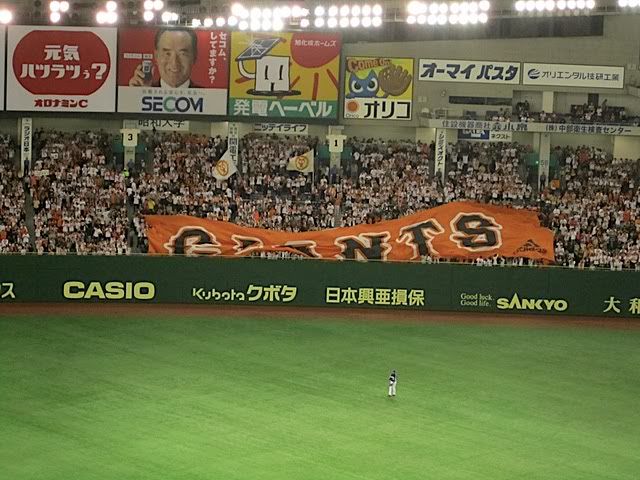
I’m back from Japan and have Basu-Baru pictures for your pleasure. Baseball in Japan has many of the trappings of the American version, but also includes cheerleaders and choreographed songs. Interestingly enough, the game I saw featured two Westerners at cleanup – Tony Blanco for the Chunichi Dragons and Alex Ramirez for the Yomiuri Giants. The pitchers had decent stuff, and the crowd was louder than many (most?) regular season MLB games, but overall the package was something like a AAAA game.

I digress. Time to take ownership of these outfielder rankings and change them up a bit. I will be doing them all season, as a sort of power ranking at the position. We’ll go with the FANS’ projected wOBAs (aka their upside projections) for another week.

The Top Three:
Ryan Braun, Milwaukee (.405 wOBA)
Matt Kemp, Los Angeles NL (.367 wOBA)
Justin Upton, Arizona (.388 wOBA)

Nothing much to say here except it looks like Upton’s ankle isn’t bothering him. These guys are studs and by the end of the year, could easily all be top-five fantasy players despite playing in the outfield.

There’s Nothing Wrong With…
Grady Sizemore, Cleveland (.343 wOBA)
Matt Holliday, St. Louis (.390 wOBA)
Carl Crawford, Tampa Bay (.367 wOBA)
Jacoby Ellsbury, Boston (.354 wOBA)
Curtis Granderson, New York AL (.340 wOBA)
Nelson Cruz, Texas (.368 wOBA)
Ichiro Suzuki, Seattle (.369 wOBA)
Shin-Soo Choo, Cleveland (.389 wOBA)

After the spirited Choo vs Granderson vs Sizemore comments conversation from the last time we updated these rankings, it’s only natural that we find a way to put them all in the same tier where they belong. Nelson Cruz is absolutely on fire, but his BABIP (.357) and K rate (24.1%) together suggest that the batting average should regress to his career norm. Granderson is still having trouble with lefties, but if he continues to bash righties to this extend, he’ll stay out of the next tier.

Not Quite Five-Category Performers
Josh Hamilton, Texas (.321 wOBA)
Jason Bay, New York NL (.397 wOBA)
Adam Lind, Toronto (.394 wOBA)
Nick Markakis, Baltimore (.349 wOBA)
Manny Ramirez, Los Angeles NL (.396 wOBA)

Manny is actually showing that he’s still got something left and with another tater or two could even join the next tier. That said, his missed games will keep the old(er) man back a little. Those same missed games should come into play with Hamilton eventually too. Lind’s power has taken a slight step back, but it’s early going and all it looks like he needs to do is loft the ball a little more (33.3% FB this year, 36.8% last year).

Missing Something?
Jayson Werth, Philadelphia (.382 wOBA)
B.J. Upton, Tampa Bay (.310 wOBA)
Andre Ethier, Los Angeles NL (.370 wOBA)

Werth reminded us that he has some injury issues by missing time with hip soreness, but has otherwise played well. The older Upton is actually playing about as well as can be expected, and in leagues that don’t use batting average, he may yet prove to be an elite option. Ethier will have his supporters, but his fly ball rate already fell, and his power pace should fall with it. The batting average should be strong this year, though, and he’s still a solid option.

Upside to Join the Top
Andrew McCutchen, Pittsburgh (.360 wOBA)
Carlos Quentin (.375 wOBA)
Michael Bourn (.326 wOBA)
Jason Kubel (.370 wOBA)

Outfielders are a tough position to handicap because of the sheer numbers, which also won’t allow me to go too deep. By highlighting some guys that could join the elite with the right years, we can delve a little deeper. So, while Shane Victorino is a fine option in the outfield, McCutchen is stealing bases at a pace (five so far) that would outpace the Flyin’ Hawaiian should it keep up. Bourn has shown the same plus plus speed. Should Quentin stay healthy, and Kubel prove that he can keep his slugging percentage over .500 year-in and year-out, they would join the power elite. So far, so good.


Waiver Wire: April 6th

This post comes to you all the way from Tokyo town. I just flew here today (yesterday? tomorrow?) and boy are my arms tired. (badum-ching!) As you can tell, it’s been a looong day. Let me quickly get to a couple waiver wire ideas before I pass out.

Shaun Marcum
Our shallow league special won’t be on the wire long, but if you missed out, don’t worry. There’s plenty of reasons to be suspicious of Mr. Marcum. First, even before he missed all of 2009 with elbow surgery, he hasn’t been the picture of health. His major league high is 159 major league innings in a season, and 168 total innings in a season. He doesn’t have a nice K/9 (7.13 career) or ground ball rate (40.3% career), and though his career ERA looks okay (3.95), his career FIP is much less interesting (4.81). That’s probably because he’s somehow managed to put together 400+ innings with a .273 BABIP. In his first start he had a sparkling .068 BABIP even. If it wasn’t such an obvious idea, actually, it seems that the best move here would be to sell high. Here’s a bet his ERA ends up in the low 4s where it belongs with his peripherals.

Dexter Fowler
It takes a little deeper bench in order to take advantage of the fact that Fowler is being summarily dropped in many leagues, but the reward is there for the patient manager. While Seth Smith is definitely a nice pickup in most leagues since he’s getting the lion’s share of at-bats by taking on righties, Fowler is not yet chopped liver. Obviously, the team is looking at Fowler’s nice .322/.374/.470 major league line against lefties (and his correspondingly putrid .228/.343/.353 line against righties) and making what they believe to be the best short-term move for the team. The problem is that this split has only come in 461 total major league at-bats (which is not a significant level for splits like these), and his minor league splits were non-existent (.843 OPS vs lefties, .859 OPS vs righties). Expect Fowler’s upside to will out and force some sort of move by management (Brad Hawpe, I’m looking at you), and in the meantime, just put him on your bench and slot him in against lefties. You’ll enjoy both short- and long-term return.

Scott Downs
The deep league special is a speculative play based on an incredibly tiny sample size seen in one light. Yes, Jason Frasor blew one save. And yes, it’s one inning. And yes, he probably won’t be removed from the closer’s role in Toronto today. On the other hand, Downs has been amazingly consistent for three years now (FIPs around 3.33 all three years), and managers love consistency. Compare Frasor’s range on his FIPs (2.99 to 4.55) and you’ll see that it’s not at all assured who’s going to have the better year in that pen this year. Throw in the fact that Frasor has been linked to the Twins in trade rumors, and Downs looks like a good bet if you’re a-speculatin’.


Updating the Outfielders

During the season, we will update these rankings based on new information which will hopefully help you determine good trade targets and stay on top of each position. This week, we’ll take a look at some springs so you can see who is on a roll going into the season.

The Top Targets:
Ryan Braun, Milwaukee (.405 wOBA)
Matt Kemp, Los Angeles NL (.367 wOBA)
Justin Upton, Arizona (.388 wOBA)
Grady Sizemore, Cleveland (.343 wOBA)
Matt Holliday, St. Louis (.390 wOBA)

There’s not enough news here to justify moving players around, but there are a couple things to mention. Justin Upton sprained his ankle last week and got dropped on some draft boards because of some early speculation that it might dampen his speed. Well, all he missed was one game and he’s currently hitting .366/.456/.714 and is a John Dewan candidate for a ‘breakout’ season because of that slugging percentage. If last year wasn’t his breakout season, you’re looking at a perennial top-five player in fantasy baseball. Upton’s also been the subject of some speculation and comparison over at TMI (insider), FWIW (LOL OMG).

It’s also worth mentioning that it’s ‘All Systems Go’ for Grady’s Ladies in the Cleveland bleachers this year. The good-looking coffee-cup-wearing outfielder they love so much is batting .378/.521/.595 with two stolen bases (against no caught stealings). A healthy year will remind people why Sizemore was a first round pick in the past, and one year he’ll have a lucky BABIP year and have a great batting average to boot.

The Next Best Thing:
Jason Bay, New York NL (.397 wOBA)
Jacoby Ellsbury, Boston (.354 wOBA)
Carl Crawford, Tampa Bay (.367 wOBA)
Jayson Werth, Philadelphia (.382 wOBA)
Ichiro Suzuki, Seattle (.369 wOBA)
Adam Lind, Toronto (.394 wOBA)
Nick Markakis, Baltimore (.349 wOBA)

Adam Lind’s skeptics might point to his poor spring (.214/.267/.429) as a sign that Lind won’t repeat his strong 2009, but it’s early going. He didn’t always put up .200+ ISOs in the minor leagues, and perhaps one could use that as evidence that his power is suspect. That camp can walk back his power projections, but I prefer to split the difference and like CHONE as the ‘floor’ projection (.293/.350/.502) despite the poor spring. Really, it’s only forty at-bats.

The Leftovers:
Josh Hamilton, Texas (.321 wOBA)
Curtis Granderson, New York AL (.340wOBA)
Nelson Cruz, Texas (.368 wOBA)
Manny Ramirez, Los Angeles NL (.396 wOBA)
B.J. Upton, Tampa Bay (.310 wOBA)
Andre Ethier, Los Angeles NL (.370 wOBA)
Shin-Soo Choo, Cleveland (.389 wOBA)

Because of his hot spring (.420/.455/.700), Josh Hamilton could be on the cusp of joining the group ahead of him. Maybe – if only he hadn’t suffered from two injuries in the spring. It is, of course, the injuries that keep people from drafting Hamilton. The good news is that these injuries probably could not have been avoided. Madison Bumgarner hit Hamilton in the hand, and he only missed a couple games with a hand contusion because it was only Madison Bumgarner (badum-ching!). Then Hamilton got a toothache. It seems ridiculous to type these words, but Hamilton’s got a litany of injuries that seem just as bizarre and it all adds up to something. Maybe. I’d focus on the nice spring numbers and draft him low for a bounce-back season.


Heyward Named Atlanta’s Starting RF

Protect your windshields, Braves fans: Jason Heyward’s potent lefty bat is coming to Turner Field. The Atlanta Braves officially announced that the best position prospect in the game will open the 2010 season as the club’s starting right fielder.

Just 20, Heyward has pummeled opposing pitchers since the Braves selected him with the 14th overall pick in the 2007 draft. His all-around talents have earned the admiration of all the prospect mavens: Baseball America and ESPN’s Keith Law named the Georgia prep product the best talent in the minors, while Baseball Prospectus’ Kevin Goldstein ranked him number two. John Sickels gave Heyward (who would be a junior had he attended UCLA) an A grade.

The 6-4, 220 pound man-child made his full-season debut in 2008, spending almost the entire year at Low-A Rome in the South Atlantic League (he got a late-season cameo in the High-A Carolina League with Myrtle Beach). Collectively, Heyward hit .316/.381/.473 in 533 plate appearances. He displayed some pop (.157 Isolated Power), while controlling the zone pretty well for such a young player (9.6 percent walk rate, 16.6 percent strikeout rate). Heyward was polished on the base paths as well, stealing 15 bags in 18 tries.

This past year, Heyward zoomed from Myrtle Beach to Double-A Mississippi of the Southern League, while getting a few trips to the plate in the International League for Triple-A Gwinnett. In 422 total PA, Heyward authored a .323/.408/.555 line, with a .232 ISO. Heyward walked as often as he whiffed, with 51 BBs and K’s apiece. While not a massive stolen base threat, he had 10 SB in 11 attempts.

Without question, Heyward is a premium keeper pick. But what can he contribute in 2010? CHONE projects Atlanta’s golden child to hit near a league-average clip, with a .258/.324/.416 triple-slash (98 wRC+). That jives with Heyward’s 2009 Major League Equivalent (MLE) line, which was .255/.321/.423 according to Minor League Splits. ZiPS is more optimistic that he can produce right away, forecasting .275/.341/.429 (110 wRC+). PECOTA likes Heyward even more, with a .280/.348/.477 projected line.

Heyward is a prodigious talent, a 20 year-old with the plate approach of a 30 year-old. Though it would be expecting too much for him to be a force at the plate right away, Heyward’s offensive floor for the upcoming season is probably that of an average MLB hitter. Personally, I wouldn’t be surprised if he easily surpasses that level, with a batting line somewhere between his ZIPS and PECOTA projections. The only real quibble regarding Heyward is durability: he missed time during the ’09 regular season with oblique, hip and heel injuries, and he was sent home early from the Arizona Fall League with a hamstring strain and a sore back.

At worst, Heyward figures to be average in 2010. At best, he could be a key contributor in all fantasy leagues. This may be the last time that you can get him without giving up a primo draft pick. Just don’t park too close to the ball park.

(As a side note, Melky Cabrera and Matt Diaz will split time in left field. While that arrangement should make for a productive real-world tandem, there’s little fantasy value to be had.)


Draft Order: The Outfielders

Today we’re taking a look at the Top 15 outfielders up for consideration on Fantasy Draft Day. We’ve already had posts for catchers, first basemen, second basemen, third basemen and shortstops.

The Top Targets:
Ryan Braun, Milwaukee (.405 wOBA)
Matt Kemp, Los Angeles NL (.367 wOBA)
Justin Upton, Arizona (.388 wOBA)
Grady Sizemore, Cleveland (.343 wOBA)
Matt Holliday, St. Louis (.390 wOBA)

Mr. Braun can do a little bit of everything for your fantasy squad. He can hit (.320 average, 203 hits in ’09), he can belt homers (32+ for three straight seasons) and he can run a little (20 steals in ’09). Thanks to some solid companionship in the lineup, he can also drive in and score 100+ runs a season. Add in the fact that’s he’s showing a better approach at the plate each season (walk-, K-rates and o-swing improving), and you have yourself a No. 1 stud outfielder.

The 25-year-old Kemp is zooming up quickly on Braun. He’s gotten better every year and he’s developed into a true 30-30 threat after slamming 26 homers and stealing 34+ bases for the second straight season. Kemp also had his first 100-RBI season in ’09 and he hits in a good, young lineup despite playing in a pitching-friendly park. He’s hit .290 or better in each of the last three seasons.

Upton is similar to Kemp, although not quite as proven, yet. Just 22, the converted infielder hit .300 with 26 homers and 20 steals in his first full MLB season in ’09. Upton is a little more of a free swinger than Kemp and the Diamondbacks’ best hitter doesn’t have quite as much protection in the lineup.

Sizemore had a down year in ’09, which is good news in one sense: You might get him at a slight discount in 2010. After hitting 22+ homers four four straight seasons, the outfielder slipped to 18 last year. He also failed to score 100 runs or steal 20+ bases after four straight seasons of doing just that. A 30-30 threat in his age-27 season, Sizemore won’t hit for a high average, but he should be around .270-.280 in ’10.

Holliday proved that there is life after Colorado for a slugger. He hit above .310 for the fifth straight season and even managed 24 homers despite playing part of the season in Oakland. Along with hitting for average and power, he’s a proven (and durable) slugger who can provide 100 RBI/runs, and steal 15-20 bases. Having Albert Pujols hit with him all season should definitely help the numbers.

The Next Best Thing:
Jason Bay, New York NL (.397 wOBA)
Jacoby Ellsbury, Boston (.354 wOBA)
Carl Crawford, Tampa Bay (.367 wOBA)
Jayson Werth, Philadelphia (.382 wOBA)
Ichiro Suzuki, Seattle (.369 wOBA)
Adam Lind, Toronto (.394 wOBA)
Nick Markakis, Baltimore (.349 wOBA)

You could include Bay in the Top Targets, but the Mets curse (and ballpark) worries me. The 31-year-old hitter should be good for power, RBI and runs. Bay should provide about 10 steals, but he’s not going to hit for a great average. Ellsbury won’t help you with power or RBI totals, but he’s going to steal a lot of bases and score a ton of runs while hitting for a good average. That pretty much sums up Crawford and Suzuki, too.

Werth is a 30-20 threat with great lineup protection, but he’s also an injury risk who does his fair share of swinging and missing. Lind’s breakout ’09 season was more believable than teammate Aaron Hill’s… and he’s one of the top up-and-comers in the American League. It’s just too bad he’s likely to spend much of the year at DH. We’re still waiting for Markakis’ breakout season and maybe 2010 will be the year. The 26-year-old outfielder could be good for a .300 average, 20 homers, 20 steals and 100 runs/RBI. Or, he could let us down again.

The Leftovers:
Josh Hamilton, Texas (.321 wOBA)
Curtis Granderson, New York AL (.340wOBA)
Nelson Cruz, Texas (.368 wOBA)
Manny Ramirez, Los Angeles NL (.396 wOBA)
B.J. Upton, Tampa Bay (.310 wOBA)
Andre Ethier, Los Angeles NL (.370 wOBA)
Shin-Soo Choo, Cleveland (.389 wOBA)

Hamilton has a huge ceiling but he also has a pretty high bust rate thanks to a lack of durability. Granderson could zoom up this list thanks to his presence in the Yankees’ potent lineup. He’s a sleeper 30-30 candidate. Cruz has some warts, but he also has 30-20 potential and hits in a good lineup and ballpark. Ramirez is getting older and less consistent but he’s in a contract year. Inconsistent + Frustrating = B.J. Upton. With that said, he’s a 20-40 threat. Ethier isn’t as explosive as his teammate Kemp and lacks stolen-base numbers, but he has power and run-producing skills. Choo is good for a .300 average, as well as 20 homers and steals. Perhaps 2010 will be the year that he scores 100 runs but he doesn’t hit in a great lineup.


Borbon Gets His Shot with Texas

Armed with a cadre of young, premium talent, the Texas Rangers have a good shot a contending in 2010 and figure to battle for AL West titles for years to come. CHONE projects Texas to tally 86 wins while taking baseball’s short-stack division. And there’s more help on the way. ESPN’s Keith Law placed the Rangers first in his 2010 MLB organizational rankings, as did Baseball America’s John Manuel on his own list.

While the club’s embarrassment of pitching riches dominates the conversation, Texas has a home-grown center fielder who figures to greatly aid those highly-touted arms. CHONE forecasts a 2.8 WAR season for Julio Borbon, with his superb range translating to well over a win saved defensively. But what about Borbon’s bat?

A University of Tennessee star, Borbon broke his ankle a week prior to the start of his junior season and missed the first two months of the college schedule. However, he recovered and impressed scouts with his fleet feet enough to be a supplemental first-round selection (35th overall) in the 2007 draft.

Texas inked the Scott Boras client for $1.3 million, and Borbon made his full-season debut in the High-A California League in 2008. In 314 plate appearances, Borbon batted .306/.346/.395, walking just 4.8 percent of the time but making plenty of contact (10.3 K%). He also stole 36 bases in 43 attempts (an 83.7 percent success rate) for the aptly-named Bakersfield Blaze.

Borbon earned a promotion to the Double-A Texas League during the summer, where he hit .337/.380/.459 in 280 PA. His walk and whiff rates remained similar (5 BB%, 12.5 K%), and he showed a little more pop (.122 Isolated Power, compared to a .089 ISO in High-A). However, he certainly benefitted from a .370 batting average on balls in play (BABIP), and his base thievery took a hit (17 steals in 28 attempts, a 60.7 percent success rate).

This past year, Borbon split his time between the Triple-A Pacific Coast League and the majors. With Oklahoma City, he posted a .307/.367/.386 triple-slash. He didn’t split the gaps often (.079 ISO), but Borbon improved somewhat in terms of working the count. He drew ball four 7.2 percent of the time, while striking out 9.8 percent. With 25 stolen bases in 32 tries (78.1 percent), he also put his speed to better use.

Borbon spent a few days in the big leagues in late June and early July, but he arrived in earnest in August. Overall, he had a .312/.376/.414 line in 179 PA, walking 8.4 percent and punching out 17.8 percent with a .102 ISO. His BABIP was .360. Most importantly for fantasy folks, Borbon nabbed 19 bases in 23 attempts, good for an 82.6 percent success rate.

Given the sample size, it’s best not to infer too much from Borbon’s first foray in the major leagues. But, his plate discipline stats indicate that he had some trouble telling balls from strikes. Borbon chased 27.4 percent of pitches thrown outside of the strike zone (25 percent MLB average), while letting ‘er rip on pitches within the zone just 55.5 percent (66 percent MLB average). Given his free-swinging ways in the minors, Borbon’s strike-zone judgment bears watching in 2010.

CHONE predicts that the 24 year-old will author a .297/.349/.400 line in 2010, with a 104 wRC+. Given a full year’s worth of playing time, Borbon should top 30 steals at a high-percentage clip. That makes him someone to target in mixed leagues. But as the old cliche goes, you can’t steal first. Borbon would be best served by showing a little more restraint at the plate.


The Young and Skinny Tony Gwynn

Every fantasy owner has their personal list of prospects that they follow throughout the season, waiting to pounce on them should they be called up. Sure, everyone had guys like Evan Longoria, Ryan Braun, and Buster Posey on their list, but there is always a few fringe prospects that could be of interest that no one else is thinking about. For me, one of those guys is Tony Gwynn, Jr. Following the 2006 season, in which he hit .300/.360/.396 with 30 steals in Triple-A, I was hooked. I liked him more for his name value than his production, but was interested in following his development nonetheless.

During 249 MLB games scattered across four seasons, Gwynn has been unimpressive. He has posted a career line of .261/.331/.326, good (bad?) enough for a wOBA of .298 and a wRC+ of 85. However, his career 9.2% walk rate is a plus, as is his 23% career line drive rate.

In 607 minor league games, Gwynn stole 151 bases in 205 tries (73.6% success rate). In 249 games in the majors, Gwynn has stolen 25 bases in 35 tries, coming in at a lower 71.4% success rate. A stolen base rate dropping once a player hits the big time is to be expected, due to veteran pitchers who can keep runners honest and catchers with better arms behind the plate. The big problem is that he is not being given the green light enough, and is on pace to attempt approximately half the steals he did in the minors over the same period of games.

Even though Gwynn has consistently hit below league average, his defense will keep him around in the big leagues. Both the FANS and CHONE have Gwynn at 5 runs below replacement level at the plate in 2010, yet both have him as a 2 WAR player. The CHONE projections have him with less than 500 plate appearances, so they are not inflated by unlikely playing time.

Talking to people that know the Padres far better than I do, it sounds like Gwynn will be given every opportunity to take the center field job. I’m still skeptical, but if he can get ample playing time, a .270 average with 15 steals is not out of the question, and will provide some value in NL-only and deep leagues.