Archive for Ottoneu

Ottoneu: Jake’s 2026 Keep or Cut Decisions at OF

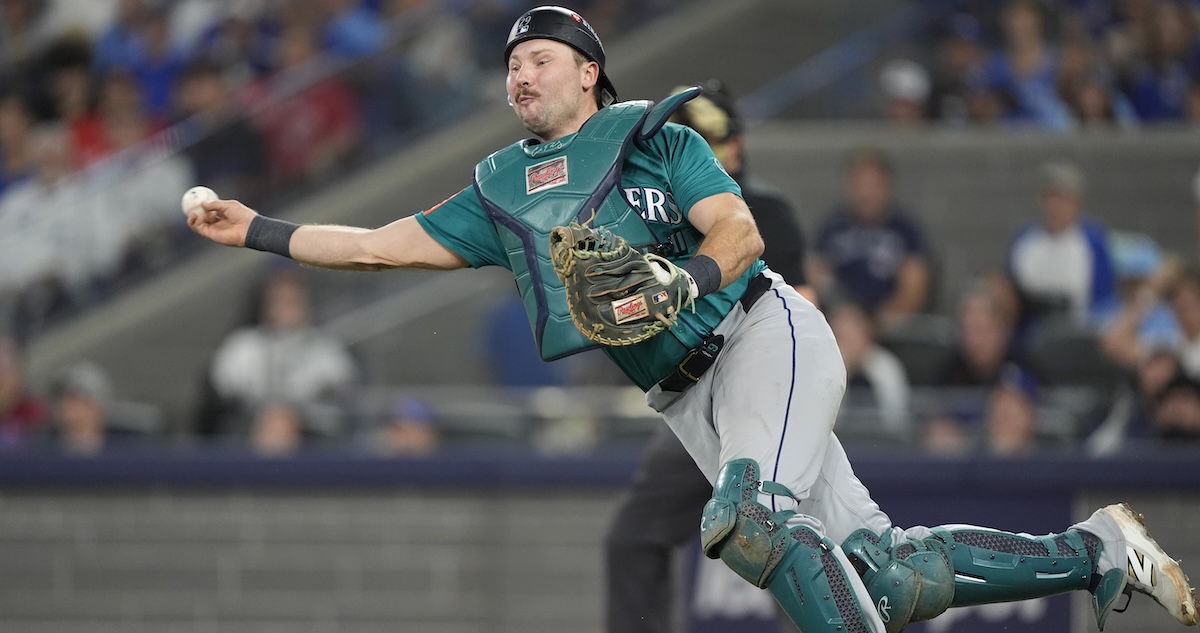
Credit: John E. Sokolowski-Imagn Images

The Ottoneu keeper deadline is quickly approaching. There’s less than a month left to make your roster decisions before the January 31 cut deadline. I’m going through a handful of difficult keep or cut decisions at every position group to give you a transparent look at my decision making process and hopefully help you with theses specific cases for these specific players. I started with the corner infielders and middle infielders before the holidays and will wrap up with pitchers later this week.

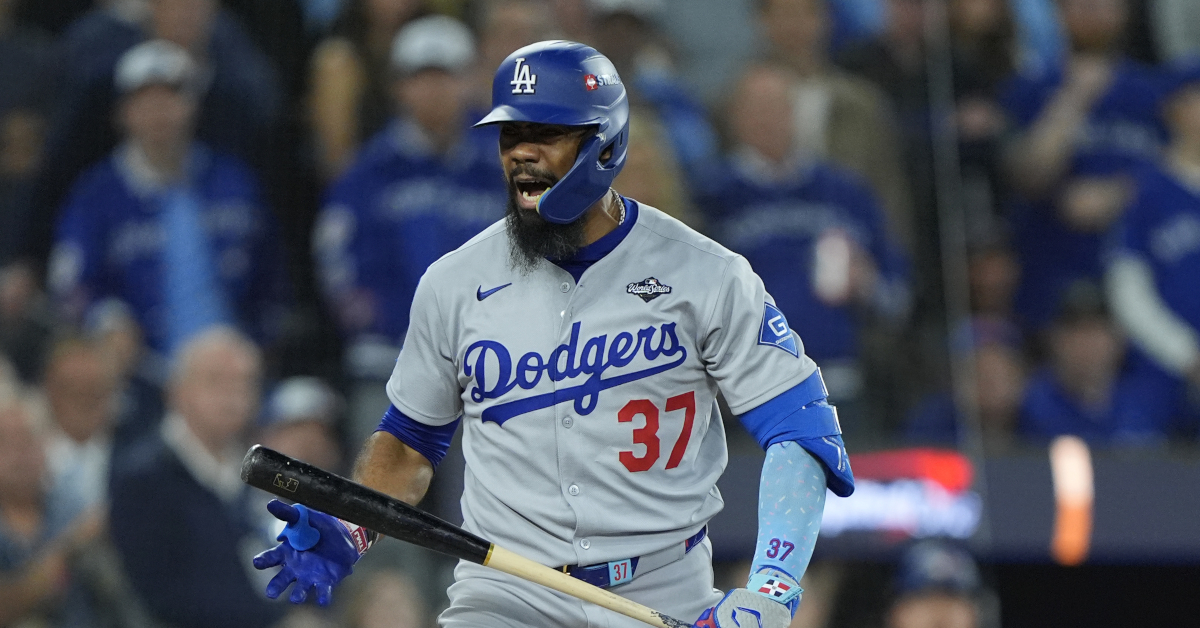
Teoscar Hernández, OF
Salary: $18, $19, $20
Average Salary: $21
2025 P/G: 4.55
Projected 2026 P/G: 5.04

A big bounce back season during his first year in Los Angeles had me hopeful that Teoscar Hernández’s down year in Seattle in 2023 was a one year blip. A year later, it kind of seems like the bounce back was the blip after Hernández posted a 102 wRC+ in ‘25, slightly worse than the 107 he posted with the Mariners a few years ago. Entering his age-33 season this year, which Hernández should we expect to see in 2026?

Let’s get the good news out of the way first: Hernández’s contact quality looked pretty good despite the underwhelming results. His hard hit rate was still well above average, and even though his barrel rate fell by more than three points, it was still barely outside the top quartile among qualified batters. That drop in barrel rate might have had an outsized effect on his bottom line results however. His expected wOBA on contact fell from .457 in 2024 to .403 in ‘25 despite no significant change to his batted ball mix. He wasn’t pounding the ball into the ground more often, he was simply less productive on the contact he was making. His average bat speed was down a little, but not dramatically which does provide some hope that he can rediscover his knack for barrelling up pitches.

The other concerning trend last year was a walk rate that fell to the lowest it’s been in his career. Hernández has never really been a patient hitter, but his walk rate usually fell right around league average when he was a middle-of-the-order run producer in Toronto. In 2025, it dropped to 4.8%. There were no dramatic changes to his underlying plate discipline metrics which makes his walk rate even more of a mystery. His swing rate in three-ball counts was 72.7%, much higher than his norm and the second highest three-ball swing rate in baseball. That tells me he was trying to swing his way out of his struggles rather than maintaining his measured aggression that served him so well in the past.

Steamer is essentially splitting the difference between Hernández’s down seasons in 2023 and ‘25 and the rest of his productive history. That’s probably a pretty reasonable expectation — he’s getting to the age where power output starts to slide and he doesn’t have the kind of approach that would allow him to thrive once his bat speed falls off a cliff. I think he’s probably got one or two more productive seasons left in his bat and there’s always the possibility he bounces all the way back to his ‘24 level.

Keep or cut?

I think I’m cutting all three of my shares of Hernández. His projection isn’t terrible but two out of the last three years have been extremely disappointing. I’m just not comfortable paying that much salary to see if he can figure things out in 2026 as he enters the decline phase of his career.

Kerry Carpenter, OF
Salary: $15
Average Salary: $10
2025 P/G: 4.44
Projected 2026 P/G: 5.37

How do you evaluate a part-time player who absolutely scorches the ball as the strong side of a platoon but useless when facing same-handed pitching. And what if that part-time player was coming off a down season where many of his offensive metrics took significant steps backwards. That’s the dilemma posed by Kerry Carpenter.

Because he’s the strong side of a platoon, Carpenter’s fantasy performance needs all sorts of context to fully understand. He’s primarily used against right-handed pitching and often pinch hits late in games if he isn’t starting. Those extra appearances off the bench artificially depress his overall points per game, though we can use points per game started, or more simply, points per plate appearance, to cut through some of that noise. Here’s a look at the various lenses we can use to clear up our evaluation of his production:

Kerry Carpenter, Ottoneu Fantasy Production
Year Overall P/G vR P/G Starting P/G Overall P/PA vR P/PA Starting P/PA
2023 5.18 4.61 5.41 1.33 1.39 1.33
2024 5.43 5.61 6.07 1.60 1.78 1.59
2025 4.44 4.07 5.08 1.24 1.31 1.27

When looking at points earned in games he started, Carpenter wasn’t too far off his production from his breakout two years ago and he looks a lot better from a points per plate appearance stand point as well.

The source of his struggles in 2025 seem to stem from a 54 point drop in BABIP and a 3.5 drop in walk rate. All of his underlying batted ball and plate discipline metrics look in line with his established norms and he even posted a career-best 22.8% strikeout rate last year.

Keep or cut?

I’m having a hard time justifying keeping a platoon outfielder for $15, even if he absolutely crushes right-handed pitching. The highs of 2024 are probably a high-water mark for him and Steamer isn’t predicting a big step forward for him in 2026. $10 is a more reasonable value for a really good part-time player like Carpenter, but a $15 salary gets squeezed off the roster.

Trent Grisham, OF
Salary: $7, $5, $4
Average Salary: $5
2025 P/G: 5.35
Projected 2026 P/G: 5.19

After settling in as a defense-first center fielder in San Diego, Trent Grisham enjoyed a huge breakout in New York in 2025. He’s shown he’s capable of producing at the plate in the distant past — he posted a 110 wRC+ across his first two seasons in San Diego in 2020 and ‘21 — but hasn’t hit very well until last year. All of a sudden, he started mashing the ball and wound up blasting a career-high 34 home runs in 2025.

Grisham has always had a patient approach at the plate and his batted ball quality significantly improved after joining the Yankees in 2024. The biggest difference was turning his sometimes overly patient approach into selective aggression on pitches in the zone early in the count. Ambushing pitchers when they tried to steal strikes worked wonders for Grisham and represents a real change in approach for him.

Surprisingly, Steamer believes in the changes Grisham made. It would have been easy to write off his breakout as a one-year blip, but the projections are calling for a solid follow-up season, though not necessarily up to the heights of his breakout.

Keep or cut?

I see the improvements in Grisham’s approach and batted ball quality and I’m willing to bet that they stick around in 2026. I’m keeping all three of my shares.
Ottoneu: Chad’s 2026 Keep or Cut Decisions at OF

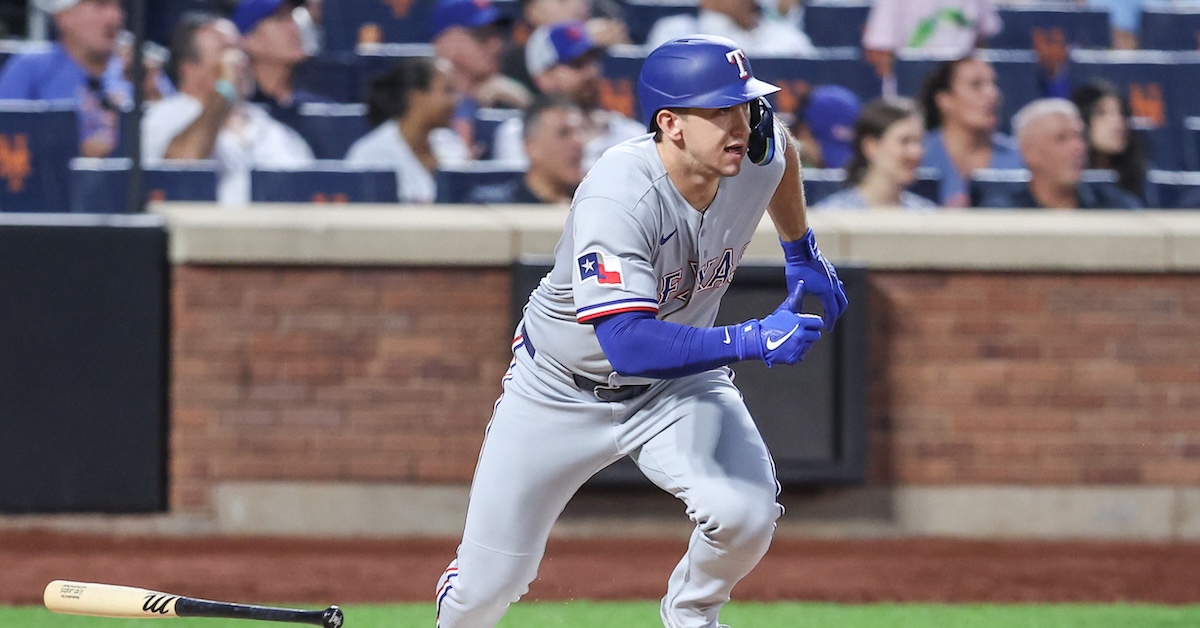
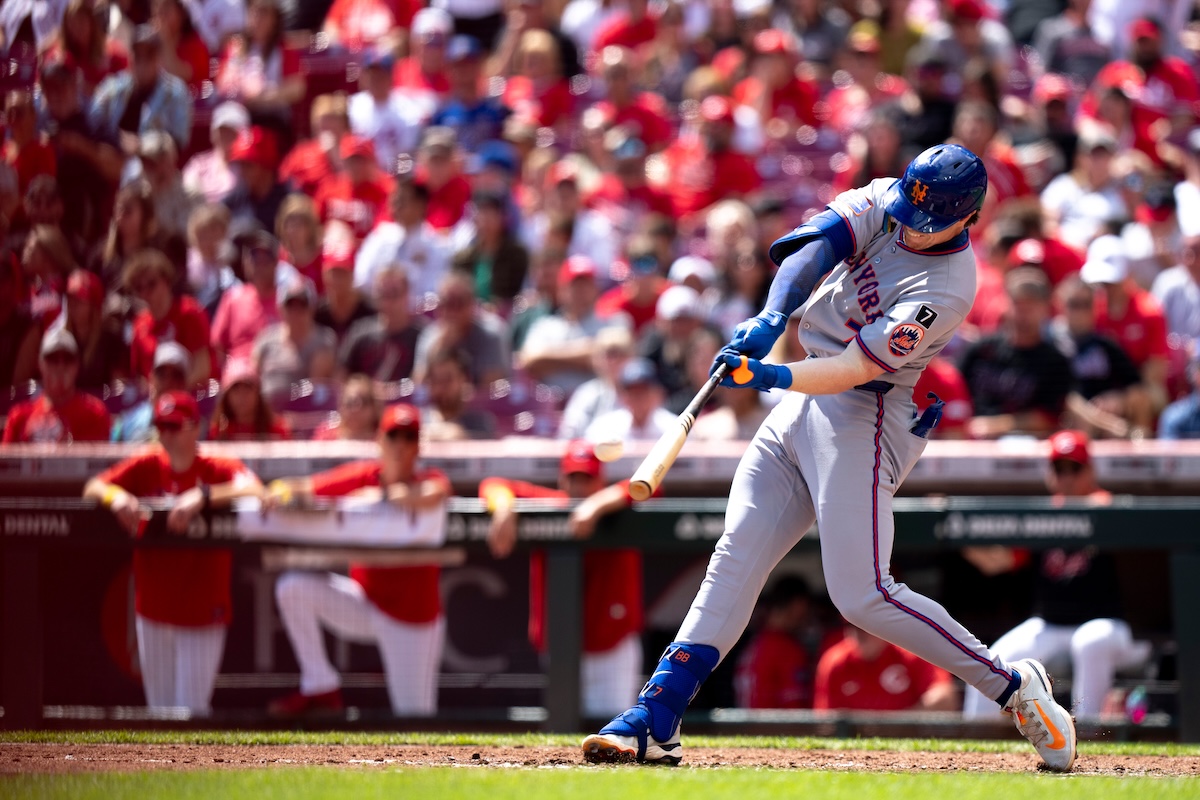
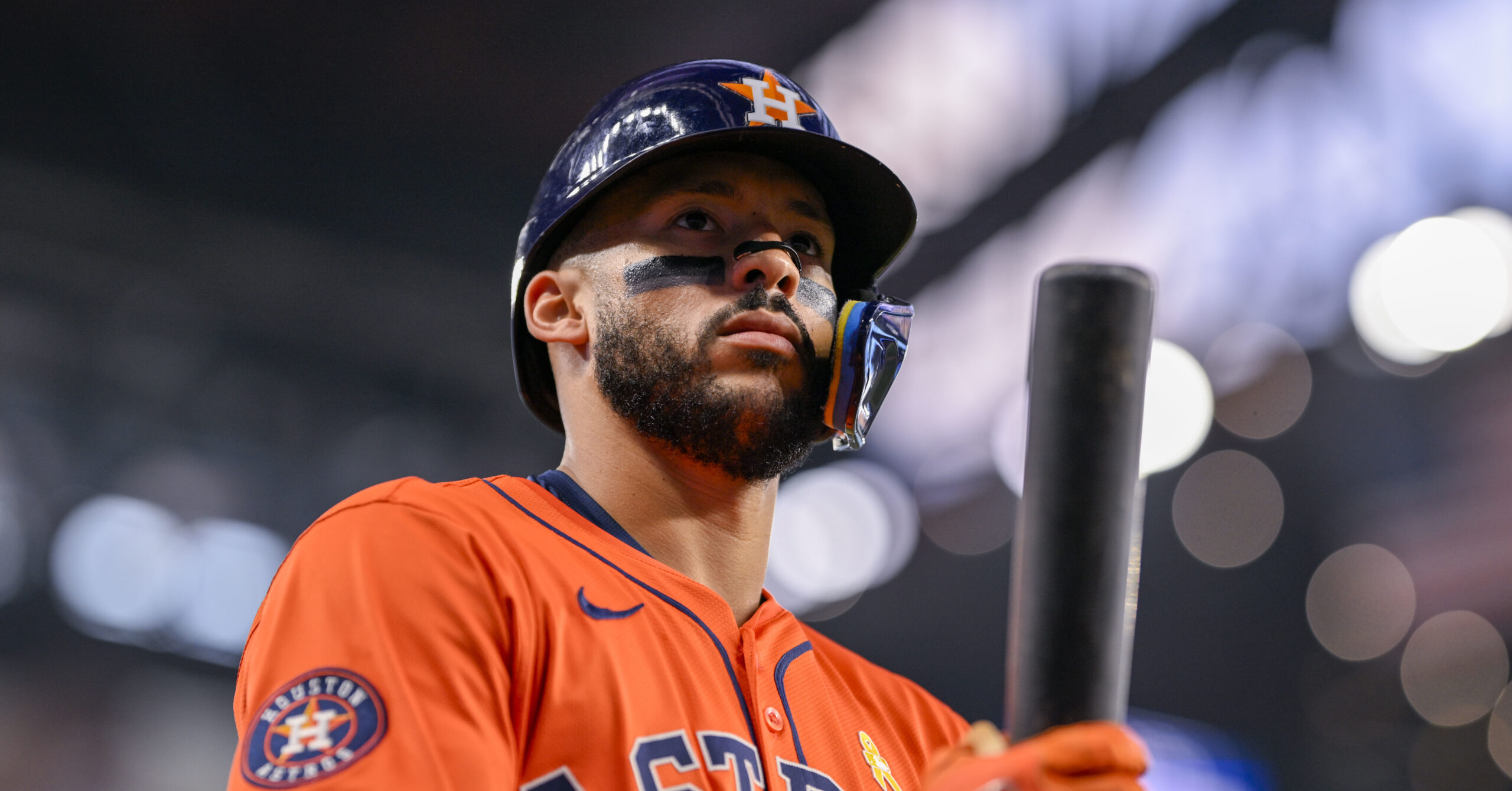
Wyatt Langford taking off from the box after putting the ball in play.
Credit: Wendell Cruz-Imagn Images

It feels like it has been forever since I last updated this series by reviewing my tough calls at MI and that is what the holidays do to us. A couple of weeks of family time and travel and suddenly it’s 2026, we’re just over a month out from pitchers and catchers reporting, and I am running out of time to make these decisions. Today, we turn our attention to the OF and debate whether to hold these OF bats or kick’em to the curb.

Read the rest of this entry »


Ottoneu: Chad’s 2026 Keep or Cut Decisions at MI

Credit: Albert Cesare/The Enquirer / USA TODAY NETWORK via Imagn Images

We’re now onto the fourth installment of our Keep or Cut decisions series. Jake has offered up his tough choices at CI/C and MI, I covered CI/C last week so now it is my turn to discuss MI. Usually, I make a point of looking at names Jake didn’t look at, but this week, I am going to start by (quickly) rehashing one of the players he covered with a slightly different take.

Read the rest of this entry »


Ottoneu: Jake’s 2026 Keep or Cut Decisions at MI

Credit: Jerome Miron-Imagn Images

The Ottoneu keeper deadline is quickly approaching. There’s about a month and a half left to make your roster decisions before the January 31 cut deadline. I’m going through a handful of difficult keep or cut decisions at every position group to give you a transparent look at my decision making process and hopefully help you with theses specific cases for these specific players. I started with the corner infielders last week and will have outfield and pitchers after the holidays.

Carlos Correa, SS/3B
Salary: $26, $15
Average Salary: $15
2025 P/G: 4.42
Projected 2026 P/G: 5.19

Carlos Correa’s capacity for greatness still resides somewhere within him. Just a year ago, he posted a 154 wRC+, though he was limited to just 86 games thanks to a significant foot injury. He played through that same issue this year and it’s likely that it seriously affected his ability to perform for most of the season. He limped to a .267/.319/.386 slash line (97 wRC+) through the first half of the season, though he improved on that after being traded back to the Astros at the trade deadline.

The most concerning yellow flag in Correa’s peripherals was a groundball rate that jumped 4.5 points from 2024. He was still hitting the ball with authority, but all that additional contact on the ground meant that his barrel rate fell to 6.8%, the second lowest mark of his career. His top level plate discipline metrics were a little out of whack too; his strikeout rate was mostly stable but his walk rate fell by more than three points. There was nothing really amiss in his underlying metrics; he was a little more aggressive at the plate because he saw more pitches in the zone than ever before but that doesn’t fully explain the drop in free passes.

The projections are a little more pessimistic than I’d expect based on his history, though his excellence in 2024 seems like the outlier when looking at his down seasons in ‘23 and ‘25. It all boils down to how his foot is fairing. If he’s truly healthy heading into next season, it’s reasonable to expect him to beat his projections. There’s also the matter of his position switch. Correa will retain shortstop eligibility next year, but he’ll probably lose it the year after unless something surprising happens in Houston.

Keep or cut?

I’m happy to keep Correa at $15 and I’d probably be comfortable up to $18 or $20 just based on his history of production. There’s a risk that he won’t be healthy, but he was valued around $25 during his abbreviated 2024 season. That’s the upside, even if he misses some time next year. But that same health risk means that I’m probably not keeping my $26 share.

Xander Bogaerts, SS
Salary: $9
Average Salary: $13
2025 P/G: 4.49
Projected 2026 P/G: 4.76

At this point in his career, Xander Bogaerts is a much more valuable real life shortstop than a fantasy one. There’s been a steady drop in offensive production over the last three years, though the good news is that his 2025 was an improvement on his dismal ‘24 season. Even though he’s likely well past the era of posting wRC+’s in the 130s, he’s only a couple of years removed from putting up a 119 wRC+ in 2023. While that first season in San Diego was a step back from his time in Boston, his fantasy value still sat around $20 for his efforts.

Despite the league average results on the field, there were some encouraging signs in Bogaerts’s underlying metrics. Never one to post outrageous batted ball peripherals, his hard hit rate was the highest it’s been since 2022 and his barrel rate, air contact rate, and pull rate the highest they’ve been since 2021. The main reason behind all those improvements? A 1.5 mph increase in his bat speed this year. Those gains in those specific metrics should have resulted in better outcomes but his actual wOBA trailed behind his expected wOBA by 12 points.

Steamer sees a bounce back season in Bogaerts’s future and I think I can see what the computer is picking up on. His down season in 2024 was marred by a serious shoulder injury and the improvements to his bat speed and batted ball peripherals tell me that his body has mostly returned to normal.

Keep or cut?

I’m going to keep at $9 and I think I’d be comfortable keeping up to $12 or $13. There’s some risk of age related decline, but he showed he was healthy last year. Don’t pay for his name recognition or the production you’d expect if he still played in Boston, but he still can be a useful middle infield option for your fantasy squad.

Jackson Holliday, 2B/SS
Salary: $9
Average Salary: $14
2025 P/G: 4.26
Projected 2026 P/G: 5.08

How do you properly assess a 21-year-old phenom who hasn’t lived up to the sky-high hype across his first two seasons in the majors? The scouting reports were so glowing, I imagine plenty of fantasy players paid a pretty penny for Jackson Holliday, hoping that they were getting a future star to anchor their lineups. Holliday could certainly still turn into that star, but he didn’t make the immediate impact many were expecting.

The good news is that Holliday is still exceedingly young and he improved by leaps and bounds during his second taste of the big leagues.His overall batting line was a hair below league average but he made some strides to elevate the ball more often and improved his contact rate by more than eight points. You can still dream on the ceiling because he still has so much more growing to do — both from a physical standpoint and just learning how major league pitchers will approach him — but he could be a year or two away from realizing that potential.

The projections see a small step forward from him in 2026 which is pretty reasonable given his pedigree and age. Still, those improvements only get him to the level of a replacement level middle infielder in fantasy baseball. Could he blow past those projections with a post-hype breakout? Absolutely! Do I want to bank on that happening next year? Eh…

Keep or cut?

I’m probably keeping at $9 though I think that’s probably the highest I’d be comfortable going at this point. Any higher and I’m buying his potential ceiling without any real indicators he’s about to breakout in a meaningful way. I also recognize that your place in your team’s competitive window will have a huge bearing on your willingness to keep Holliday. If you’re in win-now mode, keeping Holliday with a double-digit salary is a tougher pill to swallow than if you’re still rebuilding your roster and looking to compete in a year or two.

Bryson Stott, 2B/SS
Salary: $6, $4
Average Salary: $9
2025 P/G: 4.20
Projected 2026 P/G: 4.49

From July 23 through the end of the season, Bryson Stott posted a .307/.376/.508 slash line, good for a 143 wRC+ and 5.5 P/G. That hot streak corresponded with a pretty dramatic change to his swing mechanics. He was able to improve the quality of his contact while still maintaining the excellent plate discipline that buoyed his value as a batter throughout his career. With a solid approach now enhanced by more hard contact, Stott has all the underlying indicators of a potential breakout in 2026.

The projections aren’t yet picking up on those mechanical changes — to the silicon circuits, his hot streak to end the season was just that, no real signal to affect next year’s projection. But if his improved swing carries over to 2026, there’s real reason to believe he’ll be able to beat those projections easily. The risk is that he falls back to his previous career norms and remains a replacement level middle infielder for fantasy purposes.

Keep or cut?

I’m willing to pay $6 (and $4) to see if his swing changes carry over to next year. Those salaries are low enough that it’s easy to cut bait if he’s the same old Stott next year, but the potential for a huge breakout is real enough that it’s not a problem to carry him on my rosters to start the season. I’m not sure I’d go into double digits to keep him but I do think the ceiling is a lot higher than the projections think it is.


Ottoneu: Chad’s 2026 Keep or Cut Decisions at CI and C

Credit: Jerome Miron-Imagn Images

Jake Mailhot kicked off our series of articles reviewing our toughest keep or cut decisions on Monday, looking at some tough calls at C and CI. Today, I’ll follow his lead and go over my toughest calls at those spots, looking at one tough call each at 1B, 3B, and C. Read the rest of this entry »


Chad Young’s Tiered Rankings Preview

Last week, I asked you what you wanted to see from my rankings this winter, and the results were pretty interesting. I got a ton of comments, messages on Slack, etc. It was great to hear how much those value those rankings provide (except to the one dude who clearly hates rankings; sorry to you and the anti-rankings community for any harm I cause you with my rankings this off-season) and how much people appreciate the one-line comments on each player. But there were some other pieces of feedback worth noting, and those have all shaped my plan for rankings this year.

Read the rest of this entry »


Ottoneu: Jake’s 2026 Keep or Cut Decisions at CI and C

Credit: Eric Hartline-Imagn Images

The Ottoneu keeper deadline is quickly approaching. There’s about a month and a half left to make your roster decisions before the January 31 cut deadline. Over the next few weeks, I’ll be going through a handful of difficult keep or cut decisions at every position group. I’ll start with the four infield positions this week and move on to the outfield and pitchers next week.

Bryce Harper, 1B
Salary: $49, $42
Average Salary: $45
2025 P/G: 6.25
Projected 2026 P/G: 6.45

While Bryce Harper probably isn’t going to hit like he’s one of the top 5 batters in baseball again, he’s still extremely productive as he enters his age-33 season in 2026. A wrist injury in June cost him about a month of the ‘25 season and he’s averaged a little under 130 games played per season over the last five years. While he might not be an iron man, he’s been productive while he’s on the field, putting up a 146 wRC+ during that same five year period. His batted ball peripherals all looked in line with his career norms; his 47.5% hard hit rate and 12.3% barrel rate both look good and his .368 xwOBA was right in line with his actual results on the field.

While his strikeout and walk rates look good on the surface, there are a few yellow flags in his underlying plate discipline stats. His chase rate has significantly jumped over the last few years and it was up to 36.0% in 2025, the second highest mark of his career. He’s being forced to hunt for pitches out of the zone because pitchers simply refuse to give him anything to hit. Since winning his MVP award in 2021, he’s seen the fewest pitches in the strike zone of any batter in baseball by a pretty wide margin. This year, his zone rate was just 42.9%, the lowest in the majors and three points lower than the guy right ahead of him.

Steamer is predicting a bit of a bounce back season for Harper in 2026, though it’s mostly fueled by a jump in BABIP. He’s at the age where power starts waning a bit and the projections see him essentially holding his power numbers steady next year. I guess that’s what worries me. Harper has already slipped a bit from his peak and he’s not getting any younger (no matter how many weird blood procedures he wants to try). If you’re paying a premium in the hopes that he’ll get back to his MVP caliber seasons, you’re likely going to be disappointed.

Keep or cut?

I think Harper’s current average salary of $45 is reasonable for the projected production you’re hoping to get from him in 2026. Like with any aging slugger, there’s some risk involved in paying that much for the downslope of a career. I’m keeping at $42 and I’m shopping my $49 Harper, hoping to pass the buck for that decision to someone else.

Willson Contreras, 1B
Salary: $15, $14
Average Salary: $14
2025 P/G: 5.24
Projected 2026 P/G: 5.14

Now that Willson Contreras finally lost his catcher eligibility, he’s lost a ton of his fantasy value. A catcher who can put up 5.2 P/G is quite useful — just six other catchers surpassed that mark in 2025 — but a 5.2 P/G first baseman is quite another matter. Fifteen other first basemen surpassed that mark this year and eighteen are projected to be better than that in 2026. Instead of being a top tier option at catcher, Contreras is now a third or fourth tier option at first base.

To be fair, his batted ball peripherals all looked good during his first full season out from behind the plate. The biggest reason why his overall value took a hit in 2025 was because his walk rate dropped nearly five points, down to 7.8%. There was nothing amiss in his underlying plate discipline metrics; his chase rate, contact rate, and swing rates all looked normal. The biggest difference, then, was a higher rate of pitches seen in the zone — the highest zone rate of his career — and a corresponding increase in called strikes seen.

Steamer sees a bounce back in walk rate next year, but his BABIP takes a hit, leading to an overall projection a little worse than what he accomplished in 2025. I don’t have any qualms with the projection — it seems like it’s pretty reasonable — so my issue is with his positional eligibility. Right now, I’ve got him ranked in the same tier as Kyle Manzardo, Spencer Torkelson, and Christian Walker. Each of those players is useful in their own way, but I wouldn’t be comfortable with any of them as my primary first baseman in 2026.

Keep or cut?

I’m cutting both of my shares of Contreras. Paying up to $10 for him in next year’s auction is probably reasonable, but getting up to the mid-teens seems like an overpay.

Alec Bohm, 1B/3B
Salary: $11, $9
Average Salary: $11
2025 P/G: 4.66
Projected 2026 P/G: 4.90

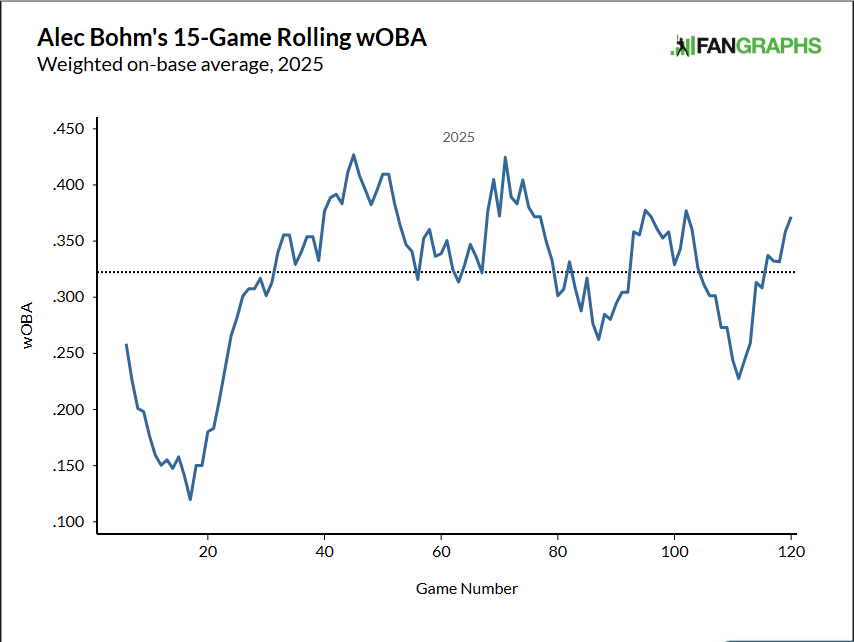
An abysmal first month of the season is bringing down Alec Bohm’s overall numbers from 2025. From May 1 through the end of the season, he posted a .308/.356/.453 slash line, good for a 124 wRC+ and 5.4 P/G.

That’s the kind of production we’ve been expecting to see from Bohm since his exciting debut back in 2020. The unfortunate thing about his excellent finish to the season is that it wasn’t really fueled by a change in any underlying batted ball metrics. He was the same hitter he’s always been, just really unlucky for the first month of the season and then a little luckier than normal over the next five months.

So which version of Bohm can we count on in 2026? Probably the same one we’ve come to know over the last few years — the same one who posted around 5.0 P/G in 2023 and ‘24. That’s a useful corner infielder, but not necessarily a high quality starting option. That’s what Steamer sees as the most likely outcome. If there’s one thing to latch onto as a source of hope, it’s that he ran the highest contact rate of his career this year. With his above average hard hit rate, putting the ball in play more often should lead to more positive results. Unfortunately, his ceiling is capped by how often he puts the ball on the ground and his correspondingly low barrel rate. Unless he can make a significant adjustment to start lofting the ball more often, his hot streak from the second half of this season will likely be the best version of Bohm we’ll see.

Keep or cut?

I’m really on the fence about Bohm. He fits better as a third baseman where the pool is a lot shallower than at first base but the roster where I have him rostered for $9 already has third base covered by José Ramírez. I’m not sure I want to keep him at $11 either, but that’s probably about what he’s going to be auctioned for if I end up cutting him. I think it’ll ultimately come down to my salary cap situation on both teams — if there’s room to roster a premium bench CI, then Bohm seems keepable. If not, he’ll end up a casualty of being good enough without a high potential ceiling to boost his value.

Adley Rutschman, C
Salary: $30
Average Salary: $21
2025 P/G: 3.79
Projected 2026 P/G: 5.03

I have no idea what to do with Adley Rutschman. To be fair, I don’t think the Orioles know what to do with him either. He had such a promising start to his career and then suddenly collapsed partway through the 2024 season. There was some hope that an offseason would help him get healthy for this year and he’d find a way to bounce back. That obviously didn’t happen. He suffered through two separate oblique strains, and even when he was healthy, he wasn’t producing at the plate.

The weird thing is that his underlying batted ball metrics aren’t out of whack, his plate discipline is still excellent, but he simply isn’t seeing the results that he enjoyed during his first two seasons in the big leagues. Some of that is a dramatic drop from his BABIP but it’s also a deterioration of his plate approach. His strikeout and walk rates aren’t affected, but his ability to hunt for pitches to do damage against has diminished over the last two years — his SEAGER dropped from 21.1 during his rookie campaign to 11.6 in 2025.

Steamer sees a pretty significant bounce back from Rutschman in 2026, but the projection has hedged against his ceiling based on his struggles these past two years. Like I mentioned with Contreras above, just seven catchers crossed the 5.0 P/G threshold this year. If Rutschman can get back to that level of production, he’ll be one of the best hitting catchers in baseball. There’s so much risk in paying for that projection knowing that he’s been a below average catcher for a season and a half now.

Keep or cut?

I’m obviously cutting at $30. That’s simply far too expensive for any catcher unless his name is Cal Raleigh. I’d be open to keeping Rutschman around $15, but even at that high a salary, you really need him to figure things out next year and hit his projection.


Ottoneu Rankings Season – What do you want to see?

With arbitration behind us, trade season upon us, and cut decisions looming, it is rankings season for your favorite team of Ottoneu writers. The last couple of seasons, you have gotten tiered rankings for Ottoneu FanGraphs points leagues both from Jake Mailhot and from me. We’ve focused on FanGraphs Points because it is the most popular Ottoneu format, and because the combination of our rankings and 5×5 rankings from other writers are enough to create a decent set of rankings for 4×4, 5×5 and SABR Points Ottoneu leagues. But you know what we haven’t done? Asked you what you want?

Read the rest of this entry »


Does Ottoneu Arbitration Correlate to League Standings?

Credit: Cary Edmondson-Imagn Images

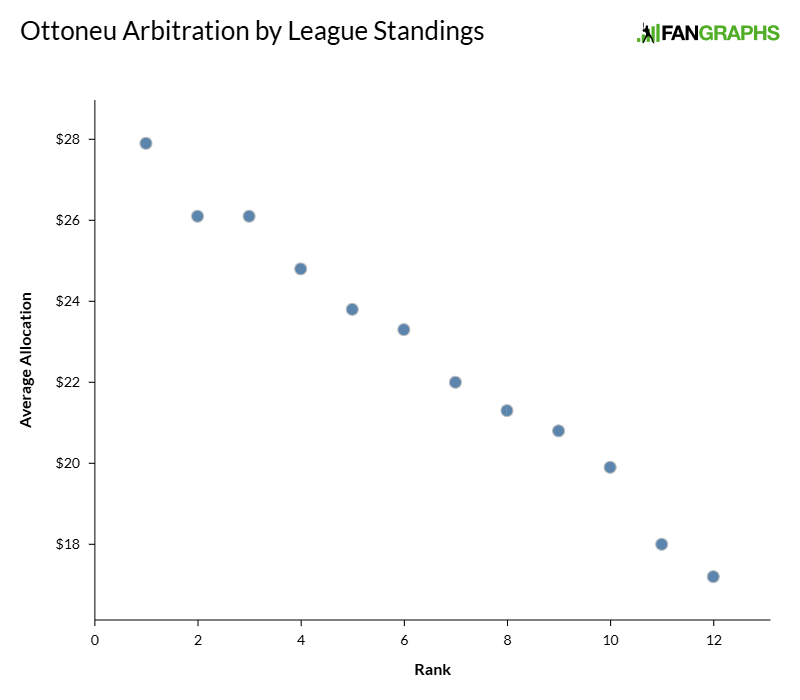
This one should be pretty quick. Chad has done all the heavy lifting analyzing how Ottoneu players handled the arbitration deadline last month; he presented a high-level recap and broke down arbitration by position. I was interested in taking a different approach: I wanted to confirm what my gut assumed to be true about which teams get allocated the most dollars during arbitration.

When I start the process of allocating dollars during the arbitration period, I usually begin by allocating a dollar to every team. You have to allocate at least a dollar to every team anyway, so I get that out of the way first. It’s also a good first step because I’ll often be torn between a number of players which tells me those roster deserve more dollars when I come back to allocate the rest of my funds. After that’s complete, I take a look at the final standings from the season and start allocating dollars to the top teams. Logically, the teams who finish higher in the standings should have rosters filled with players who have plenty of surplus value and need the help of the market to correct their salaries.

Do other Ottoneu players share this same inclination? The data says yes!

Ottoneu Arbitration by League Standings
Rank Average Allocation
1 $27.9
2 $26.1
3 $26.1
4 $24.8
5 $23.8
6 $23.3
7 $22.0
8 $21.3
9 $20.8
10 $19.9
11 $18.0
12 $17.2

The shape of that scatter plot shouldn’t be all that surprising. The best teams in every league get allocated nearly $28 on average (with a maximum of $33) while the worst teams in every league get allocated more than $10 less. There are some clear breaks between third and fourth place and sixth and seventh place, and the placement of those gaps makes sense too. The top three teams in every league are probably loaded with talented players with lower than market value salaries and the top half of every league should have competitive teams while the bottom half of every league is likely filled with teams who are building for the future.

Is there anything actionable you can do with this knowledge? Probably not. If you’re finishing in the top three of your league, you’re probably expecting to get hit with a bunch of arbitration dollars at the start of the offseason. It might be a handy guide for planning if you’re trying to work out what your offseason budget is going to look like during the summer — you could toss in an expected allocation amount into your projected budget based on where you think you’re going to finish.

What if we flip the question around and ask if league standings tell us how many dollars a team will allocate.

Ottoneu Arbitration by League Standings
Rank Average Allocated Dollars
1 $24.9
2 $24.0
3 $24.2
4 $23.8
5 $22.9
6 $23.3
7 $22.0
8 $22.9
9 $22.3
10 $21.3
11 $20.5
12 $19.0

Again, not many surprises. The best teams — probably the most engaged teams in your league — allocate the most dollars to other teams during arbitration. This data really isn’t actionable, it’s more a reflection of league engagement. The better your team performs, the more incentive you have to ensure your team retains every ounce of competitive advantage over your rivals. That means making sure every one of your arbitration dollars are allocated to their maximum impact.

So this might not have been the most exciting dive into arbitration, but it’s good to have my instincts confirmed by the data.


Ottoneu Arbitration by Position

Credit: John E. Sokolowski-Imagn Images

Last week, with Ottoneu Arbitration complete, we looked at where and how dollars were allocated, who was voted off, and more in an arbitration recap. Today, we’ll go deeper in another area, looking at arbitration by position.

Read the rest of this entry »