
The Trade Desk: Winning a Pitcher Deal
Trades are the lifeblood of fantasy baseball home leagues. The conversations around them help keep us connected and engaged, and make our league more fun. Striking deals isn’t always easy. There are often hurt feelings around lopsided proposals, league-mates who value players differently, and that one guy who wants to veto everything. We can improve our fantasy squads with the waiver wire, but our collective hit rates are low. Quite often, those pickups backfire in the form of a hitter’s cold streak or a pitcher’s blowup, which inevitably leads to dropping the player. The one facet we have control of in home leagues is trading.
Managers are often emotionally tied to certain players – specifically, missed draft targets or players from their favorite baseball team. Also, we’re not all great at zooming out for a long-term view and not being stuck in the moment. Good analysis can be washed away by recency bias and small sample sizes. No one can force us to make a deal, so it’s the one element of the game we have some control over and can use proper value assessment and negotiation techniques to our advantage.
This column will recommend hitters and pitchers to attempt to sell-high or buy-low, and touch on trade strategies. No two leagues or two managers are the same. You know your league-mates best: what kind of deal they’ll scoff at, which player type they’re willing to deal or acquire, and how good their player and market valuation skills are. I’ll do my best to dig deep and present realistic opportunities.
April is a good time to capitalize on the overreaction and panic of our league-mates.
Here is a trade scenario to consider that could perhaps spawn ideas about similar players:
Offer: Matthew Liberatore (SP, STL), Eduardo Rodriguez (SP, ARZ)
Target: Nathan Eovaldi (SP, TEX), Max Meyer (SP, MIA)
Now is a good time to explore offers for Liberatore and E-Rod. Both are lefties on below-average teams. Both are off to good starts. It is unlikely that either will have a higher market value this season than they do now.
Liberatore is a fine pitcher. He’s a former first-round draft pick of the Rays (2018) who spent time as both a reliever and starter until the Cardinals stretched him out last spring so that he could be part of their rotation. Liberatore had an excellent stretch over the first two months of the season. In his first 11 starts, Liberatore produced a 3.08 ERA, a 1.06 WHIP, and an impressive 3.5% walk rate, and his strikeout rate hovered at 21.4%. His walk rate normalized closer to league average (8%) over the final four months, but Liberatore had several blow-up starts and those last 18 starts didn’t go as well — a 5.05 ERA, 1.49 WHIP, as well as a K-rate dip to 17%.
Through his first two games this season, the ace of the Cards rotation has allowed two runs (both solo homers), with three walks and four punchouts in 11 innings. We shouldn’t fall victim to small sampleitis, but it’s worth noting that the damage could have been worse in those starts when we consider his strand rate (100%), BABIP (.216), and differential in ERA (1.64) and xFIP (5.28). The big question: does someone in our league like him and consider him “safe”? The one way to find out is by trade-fishing.
Eduardo Rodriguez has had two noteworthy seasons — with the Red Sox in 2019 (203.1 IP, 25% K, 3.81 ERA) and in 2023 with the Tigers (152.2 IP, 23% K, 3.30 ERA). The rest of his career has been mostly unremarkable and his WHIP (career 1.33) is usually detrimental to fantasy teams. In deeper leagues (15-teamers and above), where starting pitching options are thin, E-Rod might have slight appeal to someone in your league (perhaps a Red Sox fan) on name recognition alone. He looked great in his season debut where he threw five scoreless innings with five punchouts and two walks against a stacked Dodgers offense. Five days later, he followed up with seven strong innings with no runs allowed against the Braves. Most notable in those first two starts was his pitch mix. Typically a 44-47% four-seam guy, Rodriguez threw his fastball just 28% of the time in those first two starts, while significantly increasing his changeup usage (from 21% since 2024 to 35% in 2026). Rodriguez’s changeup was an effective pitch in his two best seasons, but it’s been an inconsistent offering of his over the course of his career. His sinkers and cutters pop from time to time, but overall, E-Rod’s pitch mix and effectiveness has been all over the map — simply too much tinkering.
Your league-mates are probably too smart to buy high on an inconsistent pitcher on a bad team just because he has a 0.00 ERA through two starts, but it sure is worth exploring. His next four starts are against the Mets (road), Orioles (home), White Sox (home), Brewers (road). Since the Diamondbacks play six, five and six games the next three weeks, there are no two-start weeks on the horizon for him unless there’s a rotation shift or some rainouts.
The biggest reasons to shop Liberatore and Rodriguez is because their ratios are currently far below where they’ll end up at and because we want as few of the below-average swing-and-miss arms on our roster as possible. Liberatore’s career swinging-strike rate is 9.2% (8.9% last season) and Rodriguez’s is 10.4% (under nine percent since 2024).
It’s unlikely that another manager will give up Nathan Eovaldi or Max Meyer in a 1-for-1 deal for Liberatore or Rodriguez, but it’s not a far-fetched starting point. Most of our friends can read through attempts of fantasy baseball trade subterfuge. We’re not going to start the conversation with “let me take Eovaldi off your hands and I’ll give you E-Rod, who hasn’t given up a run all season.” But we should take any opportunity to subtly point things out that accentuate the player you’re offering or criticizes the player you’re targeting. In fact, it doesn’t hurt do the opposite, perhaps with a little bit of BYAF (But You Are Free), a persuasion technique that reinforces a person’s autonomy:
“Eovaldi never plays a full season and is getting old, but I’m willing to take on the risk. It’s up to you, of course.”
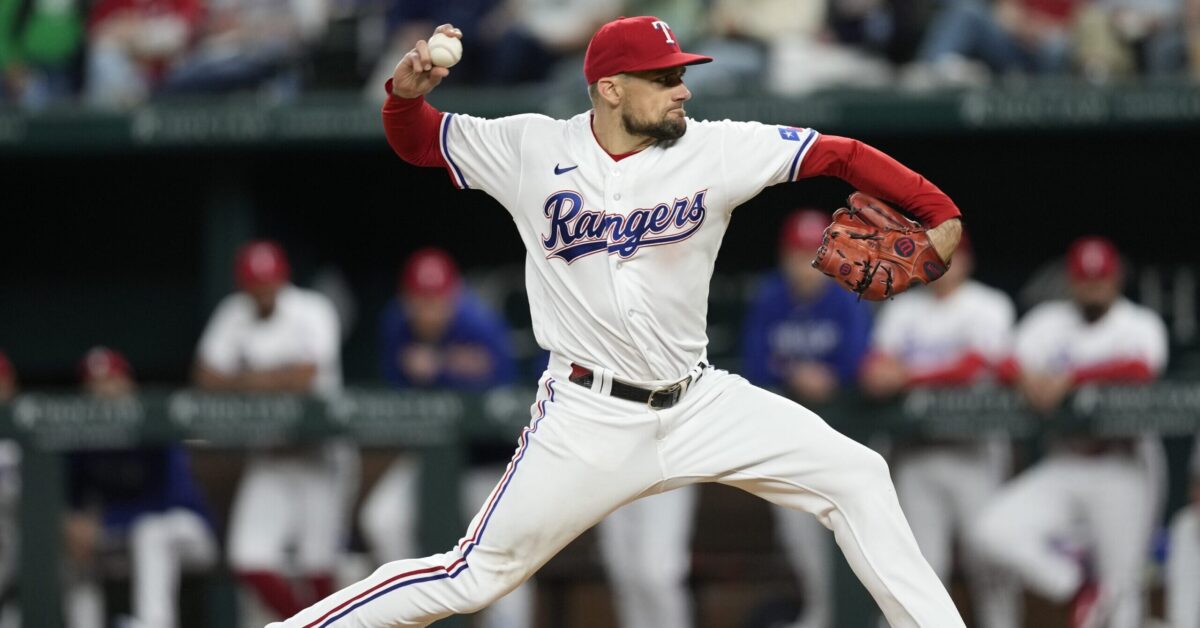
It’s undoubtedly been a rough start for Eovaldi. In his first outing, he gave up a two-run shot to Kyle Schwarber in the first inning and a three-run bomb to Alec Bohm in the fifth before getting pulled with two outs in the fifth. He struck out seven and didn’t walk a batter. His second start, against the Orioles, went poorly — 4 IP – 8 H – 6 ER – 3 BB – 5 K. There are no issues with his velocity — he’s still hitting 94-95 mph with his four-seamer. In fact, he threw it less than 14% of the time while raising his split-finger usage from 31% to 37%. His four-seamer is the pitch most of the damage has come on, and it’s likely he will continue relying primarily on his split-finger, curveball and cutter. He has a .481 BABIP and 54.1% strand rate in those two starts — definitely a touch unlucky.
Let’s not forget that the man maintained a 1.73 ERA (3.02 SIERA) and 0.85 WHIP over 22 starts last season. He hasn’t exactly been the bastion of health, but Ol’ Nate has averaged nearly 27 starts over his last five seasons. Moreover, he is typically an elite control guy, boasting a 6.5% career walk rate (since 2011!) and sported a 4.2% mark last season. A low-walk veteran with a 11+ ERA and 2+ WHIP is the exact type of pitcher we target in trades now.
The person with Max Meyer might currently be experiencing a case of “man, I fell for the hype; this guy stinks.” Meyer has allowed five runs and has walked five batters through his first two starts. On the flip side, he has 11 strikeouts (9.2 innings) with a 14.1% SwStr, his velocity is intact, and he continues to throw his patented slider at an average of one out of every three pitches. He calls a pitchers’ park home and is talented enough to beat out his ratio projections, which peg him in the 4.20-4.40 (ERA) and 1.30-1.35 (WHIP) range. Could you pull off Meyer for Liberatore or Rodriguez straight up? Probably not, but we don’t get what we want in life without asking.
The managers who win pitcher trades are the ones digging in the trenches. The ones who do a deep dive into peripherals, underlying metrics, velocity changes, pitch mix adjustments and play logs of past outings. Remember that a 1-for-1 offer out of the blue will usually give away your intent, so try to hide your true goal in a smaller, multi-player deal. It’s easier to trade with friends or league-mates you already have baseball or trade conversations with, and you can play a bit of the long-game by planting seeds in conversations that could help you get the deal you’d like to get done.
Vlad writes for RotoGraphs and is the head of fantasy baseball content at FTN Fantasy. He is a Tout Wars Expert League champ, member of the CDM Fantasy Sports Hall of Fame and has been nominated for FSWA writing awards six times. Vlad has been playing fantasy baseball since 1995, winning 42 NFBC leagues since 2012 and ranking in the top percentile in NFBC’s Online Championship contest (33% win rate, 52% cash rate; 64 leagues). Much to the chagrin of his colleagues and most baseball aficionados, Vlad is a lifelong Dodgers fan who claims his first gut call at age 9 was Kirk Gibson’s 1988 World Series home run. You can follow him on X and BlueSky @RotoGut.
I’m not so sure I’d want any of the guys discussed. But that’s just me.
I am sucker for taking the veteran who proves it every year, so I would be up for Eovaldi. ERod is an explosion waiting to happen.