Archive for bud norris

Bud Norris’ 2010 Season

The Houston Astros don’t have much to celebrate these days. The club owns a 16-30 record, with a -73 run differential. They’re old, expensive and franchise players like Roy Oswalt and Lance Berkman no longer figure to bring back top-shelf prospects in a trade. Years of player development neglect has left Houston with a dilapidated farm system boasting little outside of RHP Jordan Lyles, SS Jiovanni Mier and C Jason Castro. It could be years before the Astros emerge from the depths of the NL Central standings.

Right-handed starter Bud Norris was supposed to be one of the few Houston youngsters to make a positive impact on the big league club. A sixth round pick out of Cal Poly back in 2006, Norris notched 9.5 K/9 and 3.7 BB/9 in the minors, and he posted a 4.38 xFIP in 11 appearances (10 starts) with the Astros in 2009. Heading into 2010, I mentioned Norris (as well as Felipe Paulino) as a draft day sleeper:

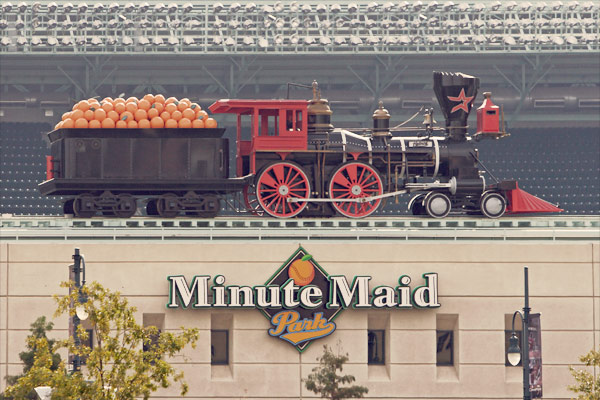
CHONE projects Norris to compile a 4.40 FIP in 2010, with 8.43 K/9, 4.14 BB/9 and 1.14 HR/9. He’ll miss bats, and he could be a nice addition to Houston’s staff if he can rein in the walks and not allow hitters to put that Minute Maid train in harm’s way.

At first glance, it looks like CHONE’s projection whiffed worse than Tommy Manzella at a slider. In 43.2 innings pitched, Norris has a 6.80 ERA. A closer inspection reveals reasons for optimism and continued frustration. The 25-year-old is far from a polished product, but his underlying skills suggest he’s still worth monitoring.

First, the good. Norris has whiffed 11.13 batters per nine innings this season, second-highest among starting pitchers with at least 40 innings pitched (Brandon Morrow is first). Bud’s garnering swinging strikes 10.9 percent of the time (8-8.5% MLB average), and his 73.8% contact rate is well below the 80-81% big league average.

But while Norris has often been dominant, his control remains scattershot. He has issued 5.36 BB/9, with just 43.8% of his pitches crossing the dish (48-51% MLB average in recent years). Bud’s getting behind hitters more than most, with a 56.6% rate of first pitch strikes. The big league average sits around 58%.

Even though Norris is being far too generous with the free passes, his xFIP is a useful 4.00. So, why is his ERA 2.8 runs higher?

For one, Bud has a .400 batting average on balls put in play. His line drive rate (25.6%) is very high, but it’s hard to draw any firm conclusions from that figure at this point. Even if you accept the premise that batters scorch the Norris offerings that they do make contact with, there’s no way that hits on balls in play continue to fall as if Bud were facing a team of Ty Cobbs. ZiPS projects a .334 BABIP for the rest of 2010. Norris has also stranded just 58.9% of base runners, well south of his 78 LOB% in 2009 and the typical 70-72% range for big league pitchers.

Right now, Norris is an aggravating blend of power and imprecision. He has also yet to prove that he can handle the workload of a major league starter — he missed time in 2008 with an elbow strain, was shut down a bit early last September with shoulder fatigue and he’ll apparently miss his scheduled start this Saturday due to biceps tendinitis.

With the injury concerns and inconsistency, Bud’s clearly not worth a roster spot right now. But don’t totally write him off. Beneath all the ugliness, there’s talent here.

Waiver Wire: Tuesday, April 20

We’ll do a tiered approach here. It’s what we do.

Ervin Santana | SP | Los Angeles (54% owned)
While the ownership numbers may be perplexing (he’s owned in all of my leagues), there’s reason for hope when it comes to the other Santana (soon to be the other other Santana). Most of the signs are looking good for Santana – his strikeout rate is up, his walk rate is down, and he’s even sporting a career-high ground ball rate. The only worrisome thing might be the reduced effectiveness of his slider as measured by his linear weights. It can’t be the half-MPH that he’s lost on the pitch, can it? In any case, he’s benefiting from a career-best 38.9% contact rate on pitches outside the zone, which doesn’t seem like it can continue when seen in the face of his career 58.4% rate. Perhaps people will start whiffing a little more on his pitches in the zone (98.8% !). It’s a strange mix right now, but since he’s healthy he should be on more rosters.

Casey Kotchman | 1B | Seattle (6% owned)
Paradoxically, it took a move to one of the toughest parks in the league for Kotchman to break out his career-best ISO (.310). Of course, that number only stabilizes around 450 plate appearances, so we shouldn’t read too much into it. Instead, let’s look at the numbers that stabilize the quickest: swing rates. Because they are based on pitch-by-pitch data, swing rates have a larger sample size in the early going. Kotchman is swinging at a career-low rate (35% this year, 45.4% career), and this has lead to the best K/BB ratio of his career (1.5). The strikeout percentage is below 10% and good for 25th-best in the league in the early going. That sort of ueber-patience seems to be serving him well. Don’t buy into the power, but the patience may end up leading to a good batting average and good run production, given the dearth of offense in Seattle.

Bud Norris | SP | Houston (5% owned)
(I know, the tiers are a little off.) Ever since Cistulli wrote this masterpiece about Norris’ nice outside-the-zone whiff rate, he has been an interesting character here in the green-and-eggshell. The secondary statistics for Norris are actually sort of frightening – he has an otherworldly strikeout rate (14.09 K/9), a disastrous walk rate (8.22 BB/9), and an insert-bad-adjective here groundball rate (23.8%). Group these rates with his zero HR/9 and you have an early-season special – an ERA (3.52) between his FIP (2.60) and his xFIP (4.03). That might be a strange feat – if it were to happen over a full season. I’d say some of those fly balls will begin to leave Minute Maid park shortly and that the xFIP is the number to follow, but that’s still a decent number that deserves attention. Maybe Norris will split the difference between his good start and bad start the next time he climbs the hill.

Ownership numbers courtesy Yahoo Fantasy Baseball.


Sleeper ‘Stros: Bud Norris and Felipe Paulino

The first three spots in the Houston Astros’ rotation are locked up. Ol’ reliable, Roy Oswalt, will be followed by Wandy Rodriguez and free agent pick-up Brett Myers.

Contenders for the back of the rotation include Brian Moehler, Wesley Wright, Bud Norris and Felipe Paulino. Both for the short and long term, the Astros (and fantasy owners) would be best off if Norris and Paulino snag those last two spots.

Norris, who turns 25 tomorrow, was Houston’s sixth-round pick in the 2006 draft. A short, stout righty (6-0, 225 pounds), Norris was tabbed as a future late-inning reliever because of his size and searing mid-90’s fastball. But while the Cal Poly product made his pro debut out of the ‘pen, he has been a starter ever since, as the Astros try to extract maximum value from one of the club’s few young building blocks.

In 340.2 minor league innings, Norris has struck out 9.5 batters per nine frames. His control hasn’t been particularly sharp, however, as he has issued 3.7 BB/9. This past year at Triple-A Round Rock, Norris notched 8.4 K/9, with four walks per nine innings and a 3.41 FIP.

Getting the big league call in late July, Norris slotted into Houston’s rotation (10 starts, one relief appearance). He tossed 55.2 innings, with 8.73 K/9, 4.04 BB/9, 1.46 HR/9 and a 4.38 xFIP.

Norris has a “hard, harder, hardest” repertoire, featuring a 94 MPH fastball, 87-88 MPH slider and an 86-87 MPH changeup. Opposing batters made contact 83.9 percent of the time against his stuff on pitches within the strike zone (87-88 percent MLB average), and 75 percent of the time overall (80-81 percent average).

Bud’s bugaboos are free passes and fly ball tendencies. He has never really been known for painting the black, and while his groundball rate in the minors was 47.4 percent, he burned worms at a 37.2 percent clip in the majors. It’s probably best not to read too much into that number, given the sample size. But it bears watching, given that Minute Maid Park has inflated home run production by eight percent compared to a neutral ball park over the last three seasons.

CHONE projects Norris to compile a 4.40 FIP in 2010, with 8.43 K/9, 4.14 BB/9 and 1.14 HR/9. He’ll miss bats, and he could be a nice addition to Houston’s staff if he can rein in the walks and not allow hitters to put that Minute Maid train in harm’s way.

Norris you probably buy. But Paulino, he of a career 6.40 ERA? Believe it or not, yeah. As Carson Cistulli pointed out earlier this off-season, there’s a big gap between Paulino’s results and the processes behind those results.

Inked out of Venezuela in 2001, Paulino is a 6-2, 260 pound leviathan who also comes equipped with radar gun readings that make scouts salivate. In addition to mid-90’s gas, he totes an upper-80’s slider, with an occasional mid-70’s curveball and mid-80’s changeup. He has punched out 8.4 batters per nine frames, with 4.4 BB/9 in 386.1 career minor league innings (71 starts, 32 relief appearances).

In the majors, Paulino has been pummeled. However, the 26 year-old’s peripherals paint the picture of a talented guy who’s been hosed by some terrible luck. In 116.2 innings (20 starts, eight ‘pen appearances), Paulino has 8.02 K/9, 3.39 BB/9 and a 4.23 xFIP. Yet, his ERA is nearly 2.4 runs higher, due mostly to a .353 BABIP and a 17.6 home run per fly ball rate. When a batter has put the ball in play against Paulino, hits have fallen as if Ichiro were perpetually at the plate. On fly balls, it’s as though Ryan Braun clones were lofting all of them. Those figures are bound to drop precipitously.

Like Norris, Paulino has been pretty hard to make contact against (85.1 Z-Contact, 74 Contact). And, like Norris, his biggest challenges will be honing his control and limiting those leisurely trots around the bases. CHONE envisions a 4.75 FIP for Paulino next year, with 7.81 K/9, 3.9 BB/9 and 1.35 HR/9.

The two have experienced some health problems. Norris was shut down a little early last year with right shoulder fatigue, and he missed some time in 2008 with a right elbow strain. Paulino missed nearly the entire 2008 season with a pinched nerve in his right shoulder, and served a DL stint for a right groin strain in 2009.

While neither hurler is a sure thing (is any pitcher?), Norris and Paulino have the punch out potential to be of use in NL-only leagues.


B.Myers Signs with Astros

The Houston Astros have reportedly signed free agent RHP Brett Myers to a one-year, $5 million deal with an option for the 2011 season.

Myers, 29, missed a large portion of the 2009 season following right hip surgery to repair a torn labrum in late May. He returned to the majors in early September as a reliever. However, a right shoulder strain shelved him for a few more weeks late in the year.

Philly’s first-round pick in the 1999 amateur draft, Myers was a mainstay in the starting rotation from mid-2002 through 2006. Despite turning in a 3.4 WAR season in 2005 and a 3.5 WAR campaign in 2006, the Phillies shifted Myers to the bullpen in 2007. He moved back to the starting five in 2008, and opened 2009 as a starter prior to the hip injury.

Myers has a wide gap between his career ERA (4.40) and his career Expected Fielding Independent ERA (3.90). Over the past three seasons, the dichotomy is even greater: a 4.56 ERA, and a 3.79 xFIP.

In the majors, Myers has struck out 7.5 batters per nine frames and walked 3.14 per nine innings. The wild divergence between his actual ERA and his xFIP can be explained by Brett’s homer-happy ways: he has surrendered 1.35 round-trippers per nine innings, despite generating more ground balls than the average pitcher (his GB% is 47.3). In general, home run per fly ball rates tend to stick around 10 to 12 percent. However, Myers’ HR/FB rate in nearly 1,200 innings is 15.5 percent.

Making 10 starts and eight relief appearances in 2009, Myers posted rates of 6.37 K/9 and 2.93 BB/9. He served up a jaw-dropping 18 dingers in just 70.2 innings pitched (2.29 HR/9). Again, his ERA (4.84) and xFIP (4.32) were far apart, as his HR/fly ball rate was stratospheric 23.4 percent.

In recent years, Myers has relied on his fastball less often. He chucked the pitch between 56 and 63 percent of the time between 2002 to 2005, but has since gone to his heater less than 50 percent. His fastball has been battered for a -0.77 run value per 100 pitches in the majors.

That fastball is pretty straight, tailing in on righty batters just four inches compared to a pitch thrown without spin (six inch MLB average for right-handed pitchers). As Trip Somers’ Pitch F/X Tool shows, that true fastball hasn’t garnered many swings and misses over the past two seasons. Myers’ whiff rate with his fastball since 2008 is four percent, while the MLB average is about six percent.

Myers’ bread and butter is his breaking stuff: an average mid-80’s slider (+0.03 runs/100) and a plus high-70’s curveball (+1.48) that drops off the table. A seldom-used changeup (-0.78) hasn’t been very effective.

Though we’re dealing with a small sample, Myers was more hittable in 2009 than in years past. His overall contact rate was 84.4 percent, compared to a career 80.3 percent average (the MLB average is 80-81 percent). His swinging strike rate was 6.5 percent, well below his career norm.

Moving from Citizens Bank Park to Minute Maid, Myers goes from a venue that increased home run production by 14 percent compared to a neutral park from 2007-2009 to one that inflated homers by eight percent over the past three seasons. Overall, CPB has boosted run scoring by three percent, while Minute Maid has decreased runs by four percent.

CHONE projects Myers to post a 4.79 ERA in 2010, with 7.57 K/9, 3.07 BB/9, and 1.5 HR/9 in 126 innings pitched. He’s worth a late-round flyer, but his uncertain health status and gopher-ball problems make Myers hard to recommend strongly.

Myers’ addition likely means that Bud Norris, Felipe Paulino and Brian Moehler will compete for two rotation spots.

Norris’ control has never been a strong suit, but his low-to-mid-90’s gas and hard slider have missed plenty of lumber. Twenty-five in March, Norris had a 4.38 xFIP, 8.73 K/9 and 4.04 BB/9 in 55.2 IP for the Astros last season.

Paulino’s ’09 results look horrifying (6.27 ERA), but as Carson Cistulli points out, Felipe’s peripherals were far more promising. He punched out 8.57 per nine innings and walked 3.41, also showcasing a mid-90’s fastball and a hard breaking ball. But a .368 BABIP and a 16.9 HR/FB% made him look like a punching bag. The 26 year-old’s xFIP in 97.2 frames was 4.10.

Moehler pitched better than his 5.47 ERA would indicate (4.67 xFIP), but fantasy types should be rooting for Norris and Paulino to win those last two spots.


Waiver Wire Watch for Week 25

It is never too late to improve your team! Here are five players available on the waiver wire under certain thresholds, according to the numbers at CBS Sports, who could be assets for your squad for the remainder of the season.

Under 40 Percent Owned

Miguel Olivo (30%) – With catchers, after you pass the first few tiers basically you want someone to help you in one category or another, most often HR or AVG. Olivo falls into the former, as he has 23 HR for the season. That makes him worth picking up right there. Add in the fact that he has also swiped a couple of bags in September and that makes him a worthwhile add down the stretch.

Under 30 Percent Owned

Bud Norris (26%) – After experiencing early success in his rookie season, Norris allowed 22 runs in 16.2 innings over four starts and saw his stock drop dramatically. But in his last three outings, Norris is 2-0 with 2.12 ERA with 21 Ks in 17 IP. A fastball/slider pitcher, Norris hit 98.4 in his last start and for the year has a 94.1 average fastball.

Under 20 Percent Owned

David Murphy (17%) – In his last 18 games, Murphy is batting .333/.395/.565 with 4 HR, 10 RBIs and 17 R. He is entrenched as an everyday player, an issue earlier in the season, and is the Rangers’ primary LF now, while also getting starts in RF and DH.

Under 10 Percent Owned

Ross Detwiler (2 %) – At first glance, an 0-6 record with a 5.80 makes one wonder why anyone saves a roster spot for Detwiler. But he has a 3.80 FIP and LH starters who can hit 94 do not grow on trees. In his last outing, Detwiler allowed 1 ER in 5 IP and posted 6 Ks. He is a high risk-high reward pitcher down the stretch.

Is This Guy Really on the Waiver Wire?

Paul Maholm (43%) – The average ERA in the National League for starting pitchers this year is 4.20 and the average WHIP is 1.378. Maholm checks in with 4.46 and 1.44 marks, respectively, making him slightly below average and worth a spot in most fantasy leagues. He has notched a Quality Start in four of his last six outings. He has neither the upside nor downside of Detwiler and is more likely to deliver a useful fantasy outing in his remaining starts.


Minor Impacts: July 23

Every Thursday throughout the season, Minor Impacts takes a look at some of the hottest minor league players that could have impacts at the Major League Level in the near future. Some of the players we’ve educated you on before their promotions include: Vince Mazzaro, Andrew McCutchen, Gordon Beckham, Robert Manuel, Marc Rzepczynski, Aaron Poreda, Jake Fox, Nolan Reimold, Daniel Bard, and Mat Latos.

Drew Stubbs: The Reds’ outfield is not instilling much fear in opponents as of late. Willy Taveras and Laynce Nix each have OBPs below .300. With Jay Bruce’s 18 homers on the DL, Nix leads the outfielders with eight dingers on the year. Thankfully, the organization keeps churning out outfield prospects. Stubbs is absolutely dripping with potential, athleticism and tools. Although he’ll likely always struggle to hit for a high average due to his contact issues (25.4 K%), the left-handed hitter could still manage to bat .250-.270. He has just two homers on the year, but Stubbs has the potential to hit 10-15 with his fair share of walks in the Majors when he matures as a hitter. Currently, he has 36 steals in 42 attempts and plays a plus centerfield.

Matt LaPorta: Chris Gimenez‘ versatility (He can catch) gives him a defensive edge over LaPorta, who is the much better offensive player and is currently wasting his time at triple-A. With 1B/DH Ryan Garko entering his expensive years in arbitration, he’ll likely be gone sooner rather than later, so Cleveland should just ship him out now to make room for LaPorta, who is a better hitter and comes much cheaper. LaPorta struggled in an early call-up to the club, but he received just 42 at-bats. For a club that’s going nowhere, it makes sense to give a 24-year-old – with the potential to hit 30 homers – a chance to play. He’s currently hitting .314/.390/537 with 11 homers in 255 triple-A at-bats.

Brandon Allen: Speaking of teams going nowhere, Arizona is in a similar situation, which is one of the reasons why the club jettisoned veteran pinch hitter and first baseman Tony Clark at the All-Star break. The club currently has Chad Tracy playing first base, but his offense is below-average for his position and he cannot stay healthy. Back-up first baseman Josh Whitesell is a career minor-leaguer who has constantly been overlooked, despite solid numbers. Whitesell will have to take advantage of his narrow window of opportunity, because Allen is waiting in the wings. Acquired earlier this season from the White Sox for reliever Tony Pena, Allen is a big-bodied slugger who has developed quickly over the past two seasons after originally being drafted out of high school in 2004. Last season, he hit 29 homers between high-A and double-A. This season, he’s got just 13 between double-A and triple-A, but he’s showing signs of becoming a better hitter due to a higher average (that’s not dependent on a high BABIP) and lower strikeout rates compared to his career norm. Since the trade to Arizona, he’s been on fire with a .364 average and five homers in 10 games.

Danny Valencia: To say Minnesota could use some stability at third base would be an understatement and Valencia just keeps getting better and better. With Joe Crede struggling with the bat as well as his health, and the likes of Nick Punto and Matt Tolbert offering little in the way of offense, the club needs to consider promoting Valencia as the team fights for a playoff spot. The 24-year-old third base prospect began the year in double-A before a promotion to triple-A where he’s currently hitting .362/.371/.616 with five homers in 24 games. Although his patience at the plate comes and goes (and when has Minnesota ever cared about OBP?), he won’t hurt the club in the strikeout category, he has average power, and he has the ability to hit .280-.290. Defensively, he’s solid with a plus arm.

Madison Bumgarner: Like quite a few other teams around Major League Baseball, the Giants club is fighting for a playoff spot and it appears that its best hope is the wild card. So the big question must be posed: Does it make sense to promote a 19-year-old pitching prospect if he’s dominating the competition in the minors and looks like a better option than one or two of the pitchers on your big-league rotation? It’s probably better to air on the side of caution, but this is the playoffs that we’re talking about… and Bumgarner currently has a career ERA of 1.50 in two minor league seasons. He’s also collectively allowed 176 hits in 228.1 innings with just 45 walks and 235 punch-outs. The left-handed pitcher is a rare find.

Bud Norris: The Astros club is also (surprisingly) in the playoff hunt but you have to be worried about how long the trio of Mike Hampton, Brian Moehler, and Russ Ortiz can hold it together. If at least one of the veteran arms falters, the organization needs to think about turning to top pitching prospect Norris. The 24-year-old right-hander has allowed just 98 hits in 114 innings of work this season with a walk rate of 3.95 BB/9 and a strikeout rate of 8.53 K/9. Even if they don’t need him now, the club might be better off by getting him some MLB experience – even if it’s in the bullpen – just in case the club needs an emergency starter late in the year or in the playoffs.