
Starting Pitcher Fastball Velocity Gainers & Decliners — Apr 6, 2026
Since the majority of stats remain in small sample size territory, especially for starting pitchers who may have only made one start so far, I like to dig into the underlying metrics that could ultimately drive a change in results. One of those drivers is pitcher fastball velocity. We know that velocity is highly correlated with strikeout rate and ERA, so all else being equal, higher fastball velocity should result in a higher strikeout rate and lower ERA. Of course, each individual pitcher start is a small sample, so you’re not always going to see the increased strikeout rate or lower ERA immediately, or vice versa. That’s why it’s prudent to track velocity changes early on to better predict where a pitcher’s strikeout rate and ERA may be headed.
So let’s now dive into the fastball velocity gainers and decliners so far. Keep in mind that most starters have only made one start and velocity does fluctuate from start to start. Don’t automatically get too excited if a pitcher’s velocity is up or panic about a decline, because we could see a reversion to their 2025 level in the very next start.
I’ll begin with the gainers on their most frequently thrown fastball (FA, SI, or FC).
| Name | Team | League | Pitch Type | 2025 Velocity | 2026 Velocity | Difference |
|---|---|---|---|---|---|---|
| Kodai Senga | NYM | NL | FA | 94.7 | 97.4 | 2.7 |
| Ryan Feltner | COL | NL | FA | 93.5 | 95.5 | 2.0 |
| Janson Junk | MIA | NL | FA | 93.6 | 95.4 | 1.8 |
| Ranger Suarez | BOS | AL | FC | 86.4 | 87.9 | 1.5 |
| Roki Sasaki | LAD | NL | FA | 96.1 | 97.6 | 1.5 |
| Shota Imanaga | CHC | NL | FA | 90.8 | 92.1 | 1.3 |
| Dustin May | STL | NL | FA | 95.4 | 96.5 | 1.1 |
| Taj Bradley | MIN | AL | FA | 96.2 | 97.3 | 1.0 |
| Dylan Cease | TOR | AL | FA | 97.1 | 98.1 | 1.0 |
| Kyle Freeland | COL | NL | FA | 91.6 | 92.6 | 1.0 |
| Jake Irvin | WSN | NL | FA | 92.4 | 93.3 | 1.0 |
For the full list of velocity gainers and decliners, plus a plethora of additional metrics for both pitchers and batters updated weekly, visit ProjectingX.com to learn more about and subscribe to ProjectingX IQ.
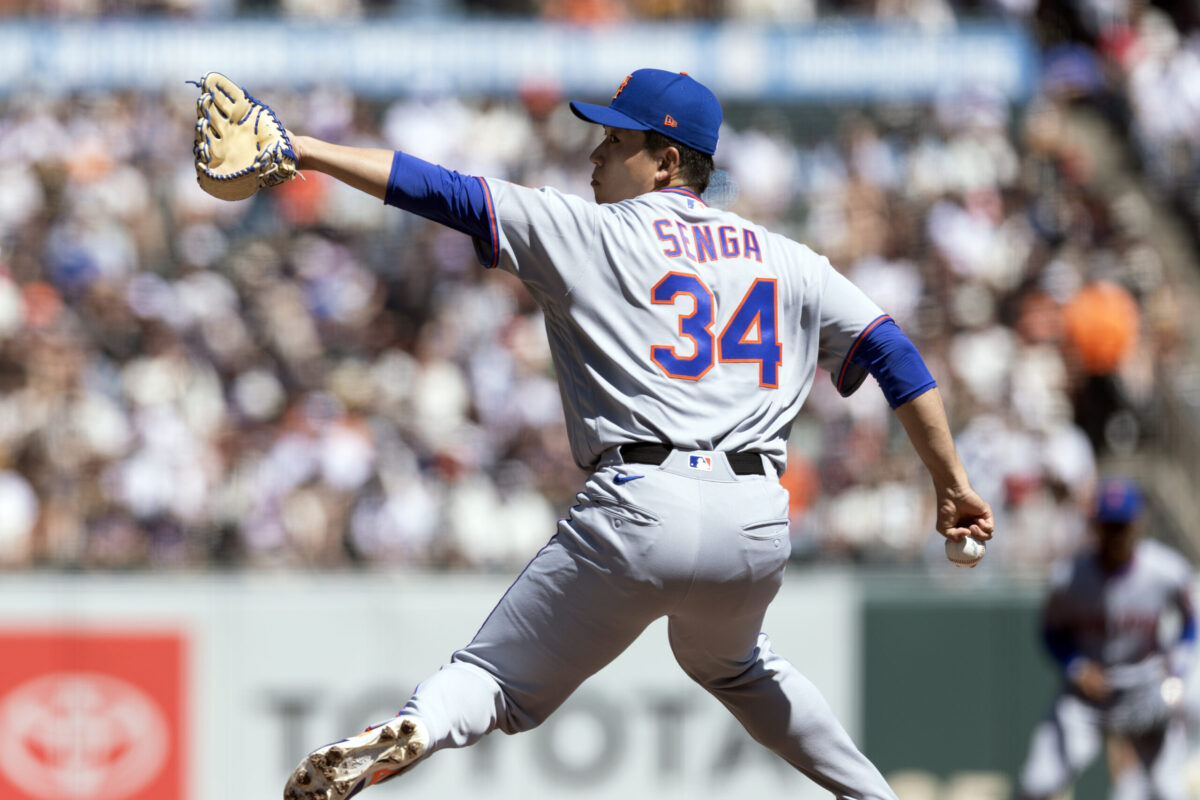
Kodai Senga’s velocity was up all spring training, which is why I boldly predicted that he would strike out 200 batters this year. Sometimes Spring velocity gains don’t stick when the season begins, but for at least his first start, Senga’s has. Actually, it more than stuck, as he only average 96.1 MPH with his fastball in Spring, but was all the way up to 97.4 MPH in his first start. In just that one start, he already exceeded his max velocity last year by 0.9 MPH and his 2024 max by 0.8 MPH! He did peak at 99.8 MPH back in 2023, so we’ll see if he can get anywhere close, but that doesn’t matter all that much. Of course, it’s not all about his strikeout rate, as he has struggled with his control throughout his career. A double digit walk rate should be acceptable if he’s striking out 30% of opposing batters, though that’s still not great news for his WHIP.
Just one start of three innings got Ryan Feltner on the gainers list. Obviously, as a Rockies pitcher who has never even posted a 20% strikeout rate, he could be ignored.
With an nearly an extra two miles per hour of added juice on his four-seamer, Janson Junk is certainly not throwing junk. He essentially came out of nowhere to show pinpoint control last year and be serviceable in NL-Only leagues and a streaming option in shallower mixed formats. Any extra zip could get his strikeout rate up to league average, perhaps, which combined with his sterling control, could make him more than just a streamer.
In 2025, the sinker was Ranger Suarez’s preferred fastball offering. His usage on the pitch barely changed during his first start, but he significantly upped the usage of his cutter, which is why that’s the pitch that ended up on this chart. Both his sinker and four-seamer did gain a marginal amount of velocity, but the cutter is up more meaningfully. I’m not sure how significant this is for his strikeout rate, but it clearly hasn’t benefited it yet when also accounting for his weak showing yesterday. The pessimist inside me thinks that when I finally own him, and in multiple leagues, this is the year he severely disappoints. Perhaps he’s just getting his command in order after his WBC play.
Well lookey here, it’s Roki Sasaki! Despite the strong velocity last year, his four-seamer was bad according to Stuff+. Unfortunately, even with the added oomph, his four-seamer barely gained any Stuff+ points and still remains well below average. I see another poor line yesterday as I type this, as control continues to be an issue. That’s a major problem when your strikeout rate is below average and Stuff+ rates all three of your pitches below average. You would have to imagine the team figures out how to get better results out of this repertoire, but the metrics under the hood just don’t suggest a turnaround anytime soon.
Shota Imanaga was another spring training velocity gainer that led to a bold prediction of mine. His first start was slightly below that spring average, but still up 1.3 MPH from last year and 0.4 MPH from his 2024 rookie campaign. His strikeout rate was way down last year, so a velocity rebound might be just what the doctor ordered to see a return to a mid-20% mark. Combine that with elite control and you end up with an upper echelon starter and ample profit compared to his draft price.
At the risk of sounding like a broken record, Dustin May was yet another spring velocity gainer who made his way into my bold predictions. Sadly, this one ain’t going very well so far. In fact, I apologize to all those whose ratios have been ruined because of my bullishness here. All his fastball velocities are up, though still sit well below his peak marks from 2020-2023. But even with the additional gas, his Stuff+ hasn’t budged at all and he’s recorded an embarrassingly low 5.7% SwStk%. He’s not even the groundball pitcher he used to be (he’s actually been an extreme fly ball guy so far, which is pretty crazy). I don’t know what has to happen here to bring back the kind of stuff that excited everyone when he first debuted, but it would be nice to see it while he’s actually healthy.
It’s been two starts for Taj Bradley and his velocity was rather stable, so that’s a good sign that this spike is going to last. After being ranked the second best Rays prospect and 36th overall years ago, he’s been a major bust, as his strikeout rate has collapsed, and ERA sat over 5.00 twice in three seasons. Stuff really hasn’t been the issue though, it’s been location. So far, the added velocity has led to a Stuff+ surge, but his Location+ remains just as poor as always. Of course, better stuff is going to give him a larger margin for error since it should lead to a strikeout rate rebound. I’m sure he’s going to be very hard to trust, especially in daily leagues when you’re constantly making the decision whether to start or bench him. I’d rather own him in a weekly and deeper league where I could just let him start all year and cross my fingers that breakout numbers will be there by the end.
Uhhhh, I don’t think Dylan Cease needs any more velocity! It’s all about his control and location. Obviously, higher velocity is still good…as long as he’s able to throw strikes.
Wow, the 33-year-old Kyle Freeland’s velocity is sitting at the highest of his career! Weird that he’s the second Rockies pitcher on here.
Jake Irvin posted just a 15.8% strikeout rate last year and with a 5.70 ERA, was nowhere near any fantasy owners’ radars this season. Unfortunately, this is more about a partial rebound after last year’s 1.5 MPH slide than any new heights. In fact, he debuted in 2023 with a 94.5 MPH fastball, but that went into freefall. That said, even though his velocity is still well below his 2023 and 2024 marks, his Stuff+ jumped above 100 for the first time, with every single one of his pitches representing career bests. I doubt that’s sustainable, but now I’m curious if he actually made any mechanical changes.
I’m typically far less concerned about velocity declines this early than I am excited about velocity gains. That’s because some pitchers are still working their way up and in just one or two starts could easily be back to normal. However, it’s still worth reviewing them because the magnitude of decline obviously still matters.
| Name | Team | League | Pitch Type | 2025 Velocity | 2026 Velocity | Difference |
|---|---|---|---|---|---|---|
| Michael McGreevy | STL | NL | FA | 93.0 | 90.8 | -2.2 |
| Slade Cecconi | CLE | AL | FA | 94.3 | 92.3 | -2.0 |
| Aaron Civale | ATH | AL | FC | 89.2 | 87.3 | -2.0 |
| Reid Detmers | LAA | AL | FA | 95.8 | 94.0 | -1.8 |
| Joe Boyle | TBR | AL | FA | 98.5 | 96.7 | -1.8 |
| Steven Matz | TBR | AL | SI | 94.5 | 92.8 | -1.7 |
| Emmet Sheehan | LAD | NL | FA | 95.6 | 93.9 | -1.7 |
| Shohei Ohtani | LAD | NL | FA | 98.4 | 96.8 | -1.6 |
| Reynaldo López | ATL | NL | FA | 95.6 | 94.1 | -1.5 |
I’m sure that Michael McGreevy has been picked up in lots of leagues by owners thinking their adding a potential breakout starter based solely on his 2.53 ERA. But with a microscopic 5.3% SwStr% thanks to career worst velocity, he’s not fooling anyone. Word is that he plans to work on his hip movement during his bullpen sessions to hopefully regain some lost velocity, so we’ll see if that makes a difference. I wouldn’t touch him regardless of league format right now.
Slade Cecconi’s velocity was up in spring training, so as an owner in AL Tout Wars, I was shocked and disappointed that he was well down during his first start. It scared me into benching him during yesterday’s gem. The good news is that his velocity did rebound. The bad news is that it was a partial rebound, as it was still down from last year. I’m far less concerned now, but still wondering where his spring velocity went.
Aaron Civale’s cutter is sitting at its second lowest career velocity, while his sinker is at its lowest. Not great for a guy with below average velocity to begin with. I doubt he was in high demand in drafts this year given his homer friendly new park, but this makes him even less appealing. He should remain in the AL-Only free agent pool. Give me a middle reliever instead.
Well, duh Reid Detmers after he pitched out of the bullpen last year. His velocity is right in line with past years as a starter, while he has cut down on his curveball usage in favor of his changeup. This is the highest Stuff+ he’s had as a starter, highest Location+ ever, and highest Pitching+ as a starter as well. He’s in a bad situation with the Angels and it’s anyone’s guess if this is finally the breakout. We could wish though.
Wait, wait, wait, is that a 6.5% walk rate for Joe Boyle?! And it comes with a career best strikeout rate and SwStr%?! The hope here is that he would offset any degradation in stuff with improved control and command. Welllll, his botCmd is up, though still below average, while his Location+ is also up, barely, and still well below average. Overall, his stuff hasn’t actually improved, and his Pitching+ is as weak as last year. He might not have a rotation spot for that much longer anyway, but I am so darn curious what he would do over a full season in the rotation.
Steven Matz is another former bullpenner who rejoined the rotation this year. However, his sinker velocity is the lowest of his career. He’s in a good situation (well, maybe except for wins) to eke our some deep league value, but I don’t think I’d expect a 20%+ strikeout rate to hold unless his velocity improves.
I’ve seen a lot of concern about Emmet Sheehan’s velocity on X. For a young, breakout potential guy, I definitely get the concern. To be honest, I’m surprised his Stuff+ didn’t grade out higher than 101 last year when he recorded an elite 15.6% SwStr%. This year, that Stuff+ is all the way down to 88, which is just shocking. You always question the health of young pitchers, but I don’t think there’s been any whispers at all about an injury. Perhaps he’ll suddenly be back to normal in a start or two. Perhaps it’s just a mechanical tweak away from normality. But I can’t imagine him staying at this level and not hearing an explanation, whether it is injury or something that needed adjustment.
Well this is a pretty big drop in stuff for Shohei Ohtani, whose Stuff+ was at 115 last year and just 101 so far this year. I might actually prefer him to throw less hard so he doesn’t end up on the IL for a long stretch that also prevents him from batting.
Well, at least Reynaldo López is way up from his 91.3 MPH spring training mark, but this is still down meaningfully. Interestingly, even in his elite 2024, his Stuff+ was just below average at 98, and even his Pitching+ was that same mark. So I think we could have expected significant regression even without the velocity concerns. Now his Stuff+ was down to just 85 after two starts. I would run far away here.
Mike Podhorzer is the founder of ProjectingX IQ, an advanced fantasy baseball analytics platform that transforms projection data and in-season performance signals into actionable intelligence. He is the 2015 Fantasy Sports Writers Association Baseball Writer of the Year and three-time Tout Wars champion. He is the author of the eBook Projecting X 2.0: How to Forecast Baseball Player Performance, which teaches you how to project players yourself. Follow Mike on X@MikePodhorzer and contact him via email.
I know Sale doesn’t make this list but his starts have been 95.9 and then 92.5 to start the year. He did have one start in April last year at 92.7 so it’s probably nothing, but not great to see him sitting 92.5 last start. . . .
Surprising after he was way up in his first start. Definitely something to watch given his age and injury history.
I heard that Sale was pitching thru an illness, hopefully that explains the velo drop.
Had not seen that. Good to know
Sale and Cecconi were both ill for their starts where ther velo was down. Seems significant with this small of a sample size.