
Small Sample Sizes in Bat Tracking
In the first few days of the season, I have heard (and made!) a number of references to swing speed changes. As fantasy players, we are always looking for that leg up, the first piece of actionable data that we can act on to make a move that no one else is ready to make. Bat speed certainly seems like early useful data. If a guy has gained or lost bat speed, that might not show up in the results yet, and even if it does, we know better than to overreact to a guy hitting one more or one less homer than we might have expected.
But bat speed is subject to small samples sizes, as well. I looked into two specific examples of names that came up this weekend and – in both cases – found reasons to pause before acting.
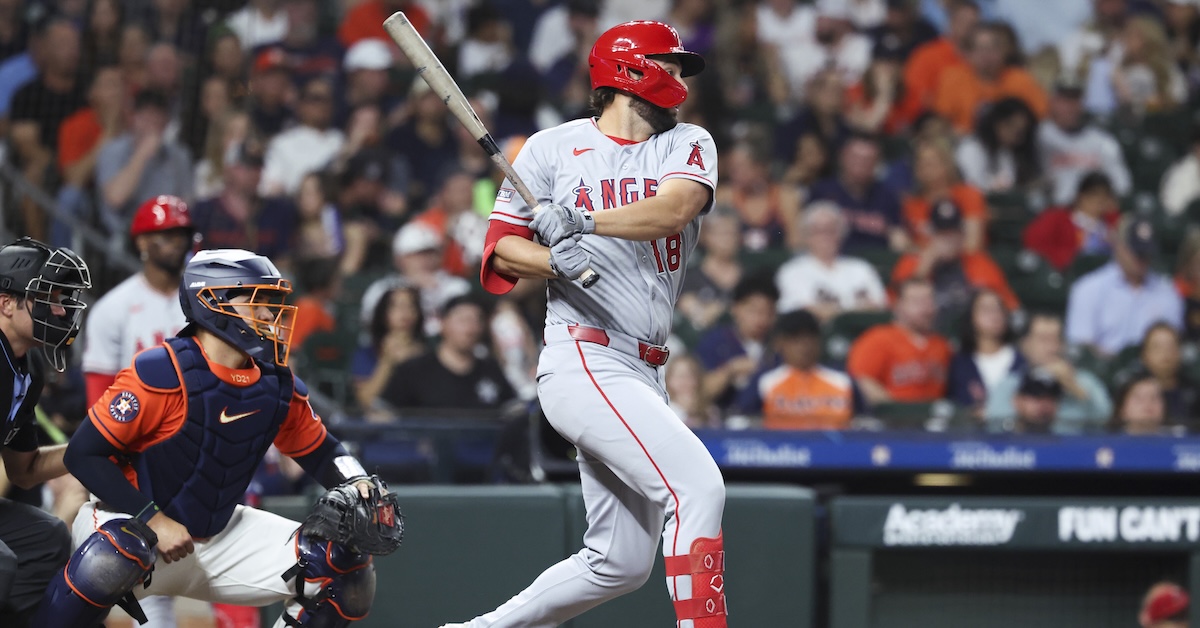
Nolan Schanuel hit two homers opening weekend, which shouldn’t be news for a first baseman, but isn’t your typical slugging first basemen. We think of hulking home run machines at first, mashing 25+ homers a season. Schanuel came into the year with 26 HR in 1,303 career PA. So going deep twice in a his first 20 PA is worth noting.
And it isn’t the only noteworthy thing about Schanuel’s season. Never a free swinger, he has barely taken the bat off his shoulder this year, offering at just 31.5% of pitches. In the zone, out of the zone, whatever, Schanuel has been patient.
He is making harder contact, too. His hard hit rate is up to 41.7% (it was 27% for his career coming into the year) and his barrel rate is up to 8.3% (it was 3.8%). Small sample sizes abound, but that’s fun to see.
Which brings us to bat speed. Schanuel has always been a soft swinging, high contact type of bat. Think Luis Arraez or Steven Kwan rather than Pete Alonso or even Freddie Freeman. He increased his bat speed last year to 67.5 mph and his fast swing rate to 6.1%, which is a little like going out of the fire and into the frying pan. Things are better, but they’re still not good.
And so Schanuel made a concerted effort to boost his swing speed this offseason. And it seems to be working! His swing speed is up to 69.6 mph! Another 2.1 mph jump! Of course, 69.6 still isn’t good. If last year was out of the fire and into the frying pan, he’s still in the frying pan, but the heat has been turned down from high to medium.
But digging even a little bit deeper, I come away a little less convinced that Schanuel has made huge strides here. First of all, I happened to mention Schanuel when recording the Keep or Kut podcast Sunday and called out that he was up 3.5. mph in swing speed – up to 71 mph. If one game was enough to drop him from 71 to 69.6, another day or two could easily have him right back where he was last year.
In addition, his fast rate (swings over 75 mph) is actually down, at 4.5% (vs. 6.1% last year). That’s still an improvement over 2023 and 2024, but it’s not some super positive sign.
Then you can take a look at his swing speed distribution.
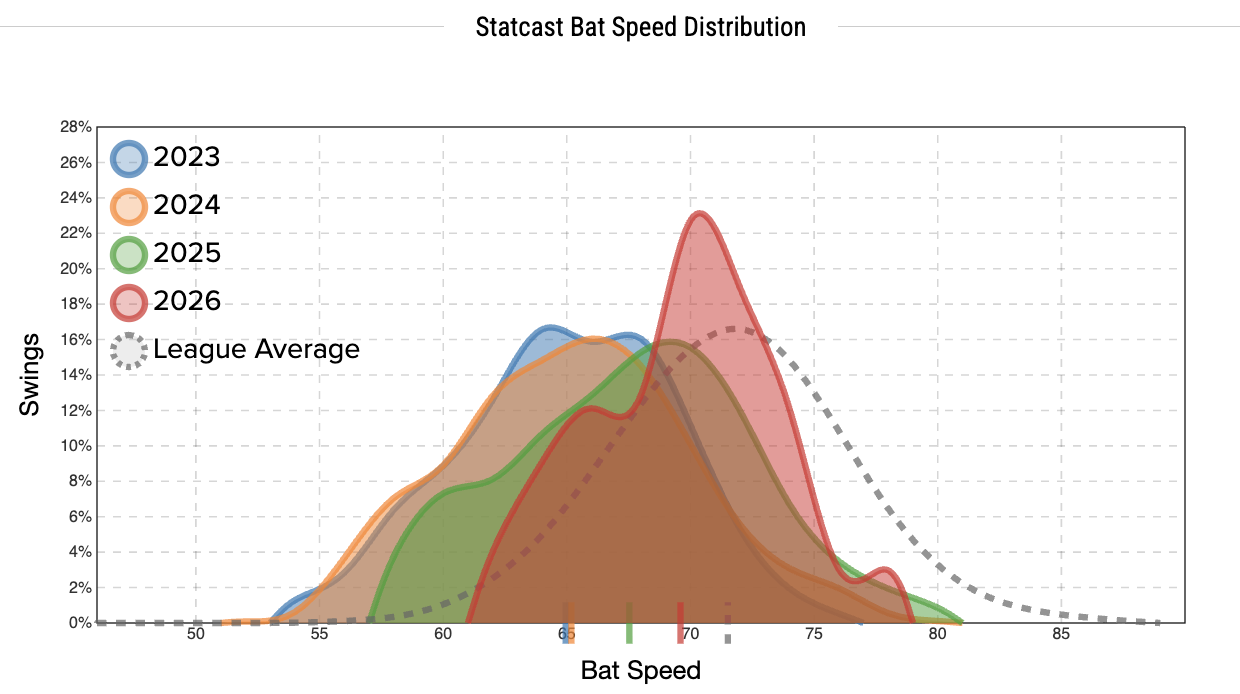
The thing that jumps out to me is that his swing speed hasn’t shifted right (faster) so much as it has become more concentrated. The high end of his 2026 swings hasn’t reached the high end of this 2025, but he has cut out his lowest-speed swings. That actually continues a multi-year trend. The furthest left point (slowest swings) each year are less slow than the year before.
What Schanuel seems to be doing, especially when coupled with the plate discipline data above, is being more selective and aiming to simply not swing when he otherwise would take a defensive swing. That might also be small sample noise, but it seems to track with what he has done the last couple of years.
Keeping in mind that the vertical axis on this graph is a percent, it looks to me like he is swinging a little bit harder, but not as much as we might hope. And that perhaps is related to his 103.6 max EV this year. Schanuel has hit 29 balls harder than that in his career; 21 of them last season. That doesn’t make 103.6 mph max EV a bad sign, but there isn’t much to suggest he has reached some new level of power. At least not yet.
Even from a swing speed perspective, Schanuel’s fastest swing in 2026 (77.1 mph on Friday), is just the 25th fastest of his career. That’s the only swing in the top 90 fastest of his career. Statcast has him with 2,207 swings in his career, so two of the top 90 this early isn’t nothing, but like the max EV, there really isn’t anything to suggest he is actually swinging harder. The increase in average swing speed coupled with this data remains consistent with a guy taking fewer slow swings, rather than more fast ones.
That can be a good thing – reducing soft contact, especially for a guy who has great bat control and can take more pitches while still limiting strike outs, can let lead to better results. Even if his best contact is no better than it was, if it represents a higher share of his balls in play, that is probably good.
On top of that, Schanuel is showing some other changes and improvements. His swing tilt is down and his attack direction has gone from pretty neutral (2° oppo in 2023, 1° oppo in 2024, 1° pull in 2025) to a bit more pull happy (7° pull this year), which might let him get into more power. His ideal attack angle is also up from 48.4%, 46.4%, and 46.1% the last three years to 59.1% this year. Again, all the small sample caveats apply, but he is pulling the ball more and lifting the ball more. His pull-air percentage is up to 25%. That’s a good way to let your power over-perform your swing speed. I don’t think we are seeing massive bat speed gains, but there are some legitimately positive signs to justify speculating on him where you have roster space.
On the other end of the spectrum, Mookie Betts was widely viewed as a bounce back candidate, and his early season wOBA (.344) is up from last year (.318) despite a .111 BABIP. His walk rate is down, but so his his K-rate, as (unlike Schanuel) Betts has gotten more aggressive both in and out of the zone in the early going. But his exit velocity and hard-hit rates are down. His barrel rate is technically up, but that’s one barrel in 10 batted ball events.
So with that inconsistent early data, it makes sense to check out his swing speed and…well this doesn’t look great. His average bad speed is down to 67.3 mph, after sitting 69 mph the last two years and 71.4 in 2023. His fast swing rate is down, as well. But before making any judgements, it’s worth looking at the same chart we looked at for Schanuel.
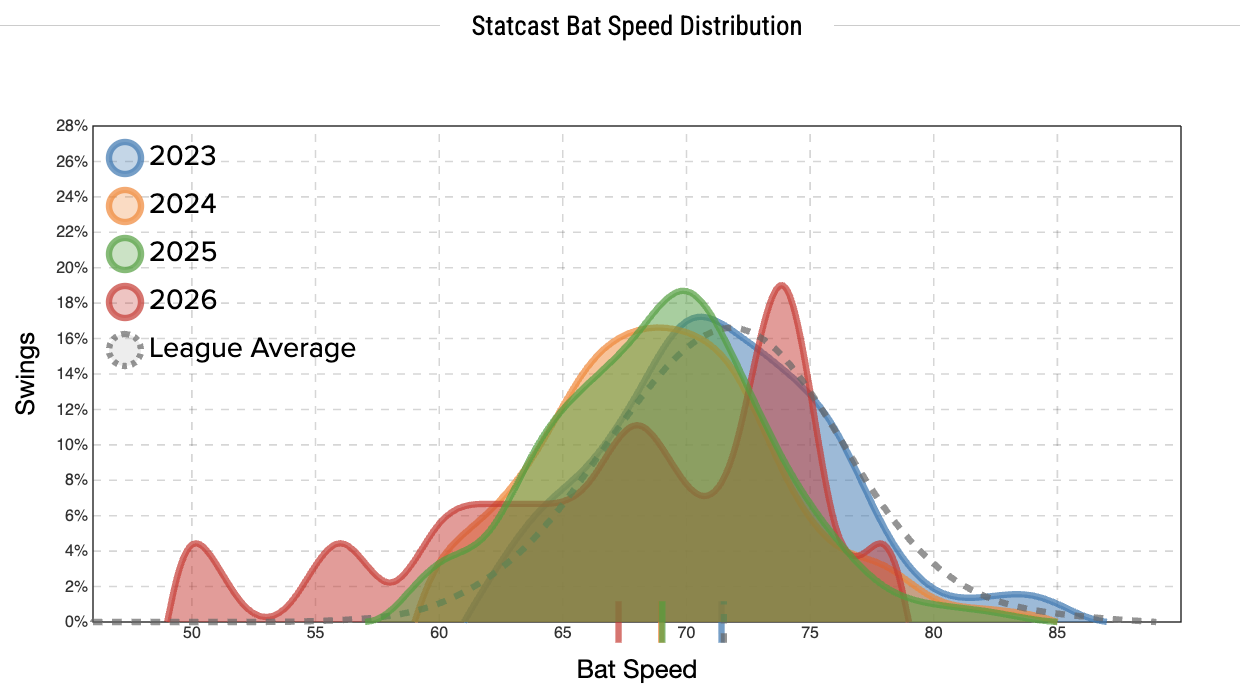
Again, I think the chart is telling, but in a different way. The big concern with the chart might be that even in 2024 and 2025, Betts was getting some swings in at 80+ mph. That hasn’t happened yet this year. But the highest point in the graph – where his swings are happening most often – is, if anything, faster than it was the last couple of years. His average is being dragged down less by a lack of high-speed swings and more because the long tail on the left end of this chart is very, very long.
To me, this doesn’t look like a guy who has lost his bat speed. It looks like a guy who has had some awkward and/or uncomfortable plate appearances in the early going. If he keeps taking 50 mph swings, that will be reason for concern. But if you look at the same chart with raw swing total on the vertical axis, you can quickly see that the sample this year is so small that those seemingly-large hills at arond 50 mph at 56 mph are basically nothing.
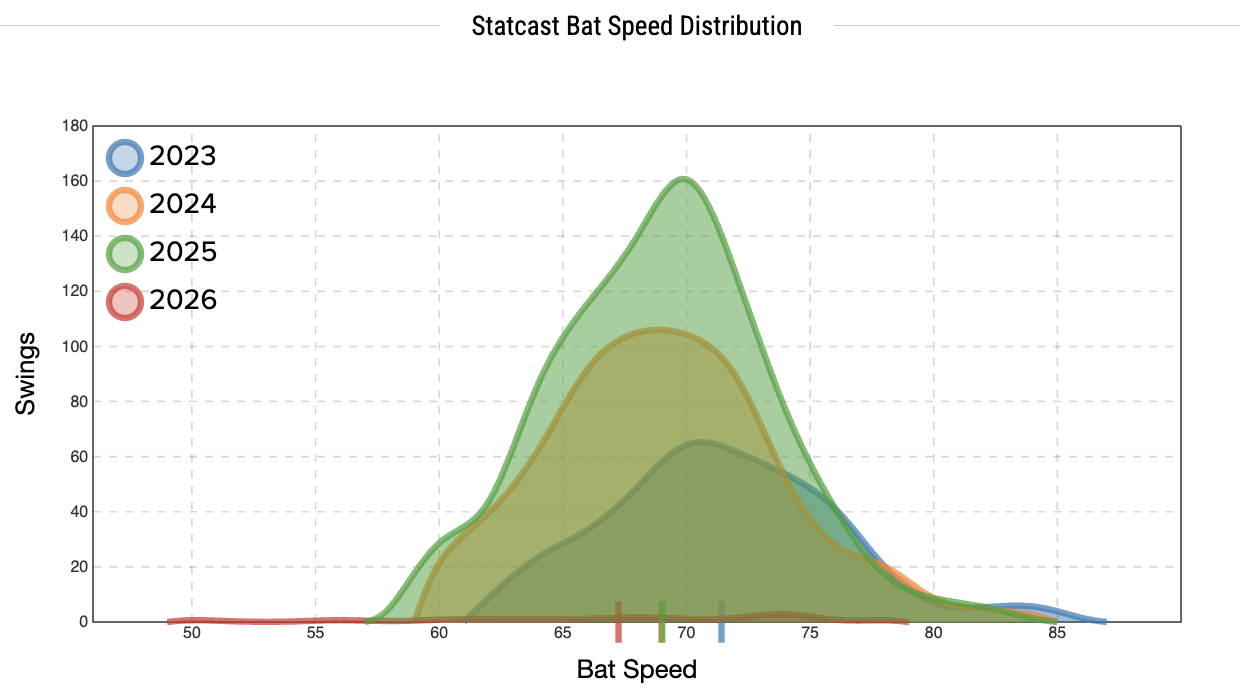
In fact, if you pull up all of his swings dating back to 2023, you will find out that his slowest swings are check swings at 18.6, 20.5, 20.9, etc. mph. His slowest swing this year is 29.2 mph, which is the 16th slowest swing he has had in the bat tracking era (since 2023), out of 2,890 tracked swings. He has had two of his 100 slowest swings this year. But what you are really seeing is just a couple more non-competetive swings than normal, and that is skewing his average.
Statcast has tracked swing speed on 17 swings from Mookie Betts this year, getting to that 67.3 mph average swing speed. Betts’s fastest swing this year is 78.4 mph. Last year, he had 18 swings faster than that, including 10 over 80 mph. If his next three swings happen to be 75, 77.5, and 80 mph, his season average will go back up to 68.8 mph and his fast swing rate will jump from 6.7% to 16.7%. Is that likely to happen? No. But it is not remotely out of the question. Last September, he had a run of swings that were 80.4, 79.4, 78.8, 72.6, 71.4, and 70.1 mph in a single game.
One more view of this is comparing this sample of 15 competitive swings to 15 swing samples from 2025.
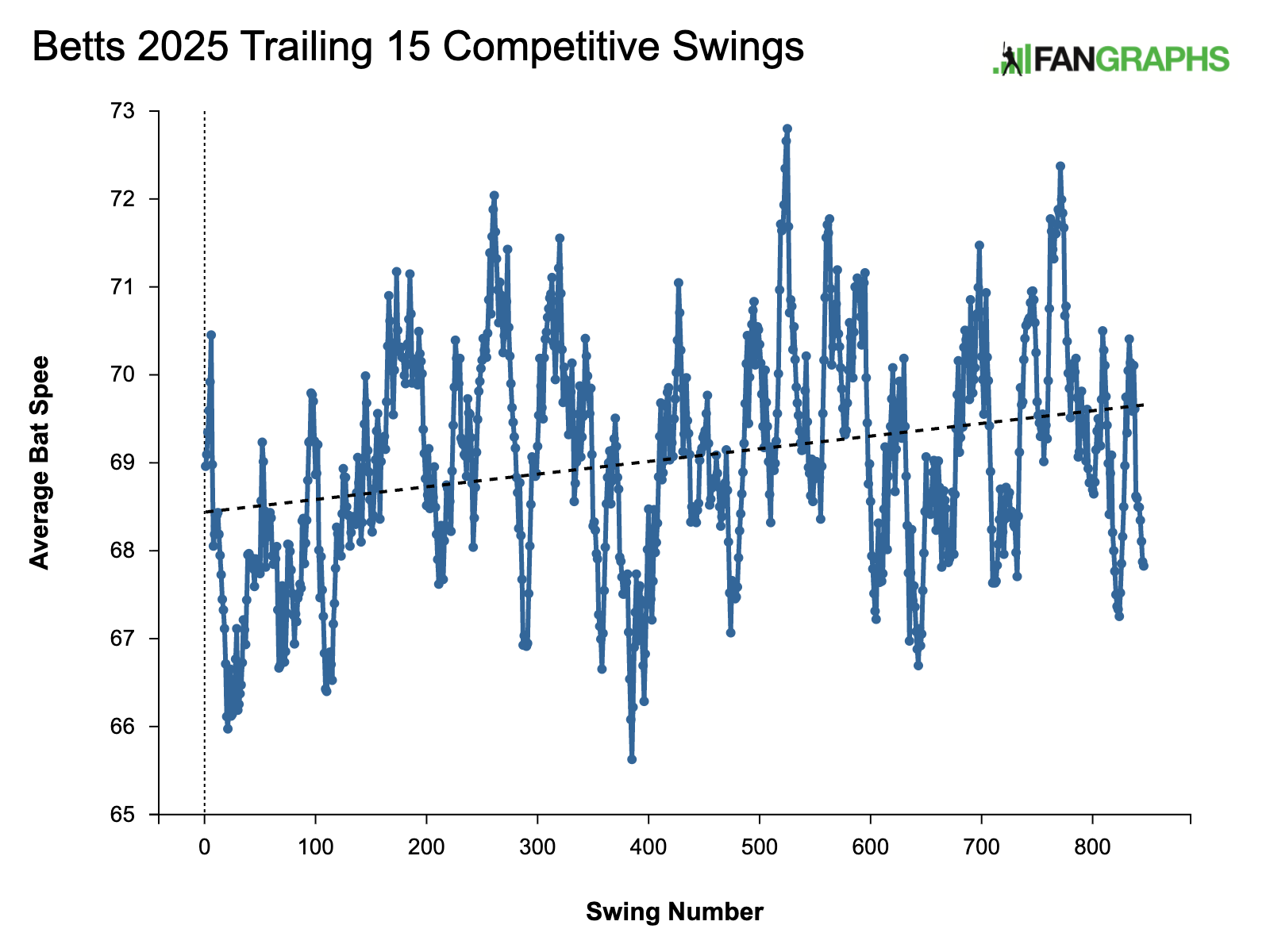
Over the 2025 season, Betts increased his swing speed, as viewed by 15 swing samples. That 67.3 mph average swing speed so far this year doesn’t look all that low, either. Betts dipped well below 67 mph over 15 swings multiple times last year.
I haven’t seen anyone say they are worried about Mookie Betts. I have heard some worry that maybe he won’t rebound the way many of us hoped or expected, with bat tracking data cited. But I don’t see any red flags in his bat speed data. In fact, if you go back to the first Betts chart, seeing the high point on the chart to the right of the peak of the 2025 curve looks somewhat promising.
A long-time fantasy baseball veteran and one of the creators of ottoneu, Chad Young's writes for RotoGraphs, and can be heard on the Keep or Kut Podcast. You can follow him on Bluesky @chadyoung.bsky.social.
I’m definitely worried about Betts, and I’ve long been on the record that I expect him to age poorly. I expect we’ll be seeing 90 wRC+ performances from him in another year or three (which is still a 3 WAR player irl but pretty poor for our fantasy purposes).
Much of my past concerns relate to his build–historically, undersized players have aged poorly relative to what I’ll call “normal build” MLBers. That trend holds true at all talent levels. However, my initial comments came prior to most of the statcast revolution, and I do think things have changed in terms of players having more actionable data and biofeedback. In the past, undersized players followed the same aging playbook as everybody else (more or less). Maybe a Kenny Lofton would reach out to a Betts type with a piece of questionable advice. These days, Betts doesn’t have to stumble along the wrong path. He can hop in a dev lab and quickly figure out how to maximize his current talents even as they decline.